


A foreign graduate planning to apply to a university in Turkey usually needs to address several tasks: choose a university and program, prove language proficiency, prepare the school-leaving certificate and transcript, and, before final registration, obtain an apostille, translation, and recognition of secondary education (lise denkliği) if necessary.
The main foreign educational document for this procedure is the certificate of completed secondary education (lise diploması). If the document was issued in a country where the 1961 Hague Convention applies in relations with Turkey, it is usually provided with an apostille. If an apostille is not applicable, another form of official authentication is used. After that, a translation into Turkish may be required, and for final registration — a Lise Diploma Denklik Belgesi.
In brief: what does a foreigner need to apply to a university in Turkey?
- Admission: foreign applicants apply directly to the selected universities under the rules of uluslararası öğrenci kabulü.
- Main documents: school-leaving certificate, transcript, passport, and an examination result or diploma accepted by the university.
- Apostille: for the lise denkliği procedure, MEB requires a properly authenticated document confirming completion of school.
- Translation: foreign documents may require a sworn translation and, depending on the procedure, a notarized translation.
- Denklik: recognition of secondary education is processed through the e-Denklik system of the Turkish Ministry of National Education.
- Next step: before legalizing the entire set of documents, the requirements of the specific university and the country where the school-leaving certificate was issued should be checked.
Key terms
Lise diploması — a document confirming completion of secondary school.
Lise denkliği — recognition of foreign secondary education in Turkey.
Lise Diploma Denklik Belgesi — a document confirming the result of the denklik procedure.
e-Denklik — the electronic system for submitting a denklik application.
Apostil — an apostille under the 1961 Hague Convention.
Yeminli tercüme — a sworn translation.
Kesin kayıt — final registration at a university after obtaining the right to enroll.
How can a foreigner apply to a university in Turkey?
Admission requirements for foreign students vary from university to university. There is no single centralized application system for all Turkish universities. The applicant selects universities and applies according to the rules of each one.
Depending on the program, results from TR-YÖS, SAT, ACT, International Baccalaureate (IB), Abitur, Matura, Baccalauréat, and other national or international examinations and diplomas may be accepted.
It is important to distinguish between two processes. First, the university evaluates the applicant and makes an academic admission decision. Separately, foreign educational documents are prepared for official use in Turkey. It is at the second stage that issues of apostille, translation, and lise denkliği arise.
What documents does a foreign student need to apply to a university in Turkey?
The exact set depends on the university and program, but a foreign applicant usually needs a school-leaving certificate, official transcript, passport, photograph, and an examination result or diploma accepted by the university.
If school has not yet been completed, instead of the final certificate the university may temporarily accept a certificate of expected graduation or a temporary school completion document (geçici mezuniyet belgesi).
For certain programs, a language certificate, motivation letter, portfolio, or other documents may additionally be required. Therefore, the entire school archive should not be apostilled in advance: the specific requirements of the selected universities should first be checked.
In what language can foreigners study at universities in Turkey?
The language of instruction (eğitim dili) depends on the university and program. Instruction may be conducted entirely in Turkish, entirely in English, or simultaneously in several languages.
For example, French plays an important role in many programs at Galatasaray Üniversitesi. If the student proves the required level of language proficiency, they may begin the main academic program. If the level is insufficient, the university may assign them to preparatory education (hazırlık sınıfı).
For a Turkish-language program, proof of Turkish proficiency (Türkçe yeterlilik belgesi) may be required; for an English-language or French-language program, a language examination result or certificate accepted by the specific university may be required.
The absence of a language certificate does not always mean refusal of admission. At some universities, the student first completes a language preparatory year. Therefore, the language of instruction should be checked before ordering a translation of the school-leaving certificate and transcript.
Is an apostille required on a school-leaving certificate for admission to a university in Turkey?
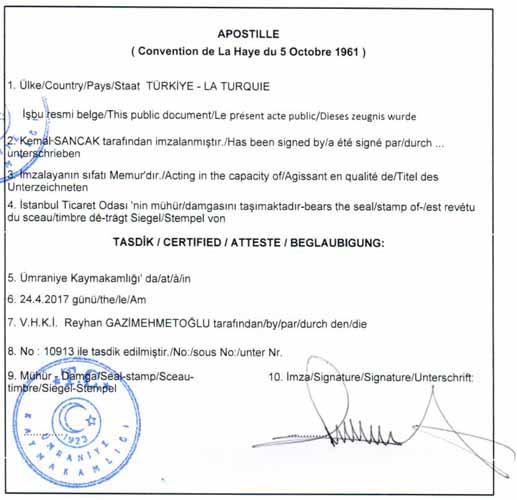
For a graduate of a foreign school, the main document is the school-leaving certificate (lise diploması). To obtain lise denkliği, the Turkish Ministry of National Education (Millî Eğitim Bakanlığı — MEB) requires a school completion document with an apostille. If an apostille is not applicable to the relevant document or country, MEB provides for authentication through the competent ministry of education, ministry of foreign affairs, or embassy or consulate.
An apostille does not confirm the level of education or grades. It certifies the authenticity of the signature, seal, and authority of the person who signed the official document. Academic recognition of school education is carried out separately within the lise denkliği procedure.
For which countries is an apostille required on a school-leaving certificate for Turkey?
An apostille is used for documents from states between which the 1961 Hague Convention is in force. According to the Hague Conference on Private International Law (HCCH), as of June 30, 2026, the Convention has 130 Contracting Parties.
They include, among others, Russia, Kazakhstan, Belarus, Ukraine, Azerbaijan, Germany, France, the United Kingdom, the United States, Canada, and China. For documents from these countries, subject to the conditions of the Convention, an apostille is used rather than consular legalization.
It is important to take into account not only a state's participation in the Convention but also the date on which it enters into force for the specific country. For example, the Convention enters into force for Thailand on February 28, 2027, and for Vietnam on September 11, 2026. Therefore, the country's status should be checked as of the date the documents are processed.
An apostille is issued in the country of origin of the document. A Russian school-leaving certificate cannot be apostilled in Turkey, just as a Turkish authority cannot place an apostille on a Kazakh, Ukrainian, or German school document.
For lise denkliği, the apostille is primarily required on the document confirming completion of secondary school. The international status of the document does not in itself exempt it from this requirement: MEB separately states that documents such as the IB Diploma, Matura, Baccalauréat, and similar documents of completed secondary education must also be properly authenticated.
For which countries is consular legalization required instead of an apostille?
If the country of origin of the document is not covered by an apostille system in force between that country and Turkey, another procedure for official authentication is required.
As of the date this article was updated, August 2026, the list of Contracting Parties to the Apostille Convention does not include, for example, the United Arab Emirates, Egypt, Qatar, and Kuwait. For documents from such states, the legalization chain prescribed for Turkey must be checked.
Depending on the country, the school-leaving certificate may first be authenticated by the competent education authority, then by the ministry of foreign affairs of the country of origin and the Turkish diplomatic mission.
Typical scheme: education authority → Ministry of Foreign Affairs → Embassy or Consulate of Turkey
This scheme is indicative. The specific sequence depends on the country and the authority that issued the document, so the requirements for the specific school-leaving certificate must be checked before starting the procedure.
When do school documents not require an apostille or consular legalization?
One should not assume that any bilateral agreement between Turkey and another country automatically eliminates the apostille requirement for a school-leaving certificate. International agreements may apply only to certain categories of documents or specific procedures.
A good example is Azerbaijan. Turkey and Azerbaijan have an agreement on legal and commercial judicial assistance that provides for exemption of a number of documents from additional authentication when used before judicial authorities. However, this does not mean that an Azerbaijani school-leaving certificate is exempt from apostille for lise denkliği: the MEB education representation in Baku directly states that graduates must obtain an apostille on the diploma in advance.
There are also genuine exceptions directly provided for by MEB rules. In particular, the denklik procedure does not apply to documents of students from schools opened abroad by the Republic of Turkey, Türkiye Maarif Vakfı schools, as well as public and private schools subordinate to the Ministry of National Education of the Turkish Republic of Northern Cyprus (KKTC). Certain international schools also do not undergo denklik if the entire relevant level of education was completed according to the Turkish program and curriculum.
In addition, an apostille may not yet be required at the initial online university application stage. Many universities first review electronic copies, while the apostilled original and Lise Diploma Denklik Belgesi become necessary later, during kesin kayıt.
Is an apostille required on a transcript for a Turkish university?
A transcript (transkript) shows the subjects studied and grades received and is one of the main documents of a foreign applicant. However, the requirements for it do not fully coincide with the requirements for the school-leaving certificate.
MEB directly links the mandatory apostille primarily to the document confirming completion of school. At the same time, an official transcript, school report cards (karne), and other documents confirming education may be required for lise denkliği.
In addition, the university has the right to establish its own requirements for the transcript. Therefore, the question of an “apostille on a transcript for a Turkish university” cannot be resolved in the same way for all universities: the requirements of the specific university should first be checked, and only then should it be determined whether a separate apostille is required.
Can an apostille be placed on a copy of a school-leaving certificate?
In some countries, an apostille may be issued not directly on the original but on an officially certified copy. However, an ordinary photocopy is insufficient for lise denkliği.
MEB states that if the apostille is placed on a photocopy of the diploma, the copy must have certification of its conformity with the original. In Turkish practice, the expression «Aslı Gibidir» is used for such a certification, among others.
Therefore, before processing, it is necessary to determine whether the original document, an officially certified copy (onaylı suret), or a notarized copy (noter onaylı suret) will be used. An unsuitable type of certification may make it necessary to have the document processed again.
How should a foreign school-leaving certificate be translated for admission to a university in Turkey?
An apostille confirms the official nature of a foreign document but does not replace a translation. If the language of the school-leaving certificate or transcript is not accepted by the university or denklik center, a sworn translation (yeminli tercüme) will be required.
In practice, it is usually more convenient to obtain the apostille or complete consular legalization first and then translate the fully processed document. In this case, the school-leaving certificate itself, the apostille text, and other authentication markings are translated at the same time.
Original → apostille or legalization → translation → notarization if necessary → use in Turkey
For the denklik procedure, MEB may request a notarized translation (noter onaylı tercüme) if the denklik center is unable to work with the language of the original. If the translation was made abroad, MEB states that it must be authenticated by a Turkish consulate in accordance with the applicable rules.
When translating, it is especially important to check the spelling of the first and last name, the name of the school, subjects, grading system, document number, and graduation date. If the name in the passport differs from the name on the school-leaving certificate following marriage or an official name change, an additional document linking the old and new personal details may be required.
How can a foreigner obtain a Lise Diploma Denklik Belgesi in Turkey?
Lise Diploma Denklik Belgesi confirms the equivalence of foreign secondary education with the Turkish system. The procedure is carried out by the Turkish Ministry of National Education (MEB), and the preliminary application is submitted through e-Denklik.
A graduate usually needs a properly authenticated school-leaving certificate, transcript or other school documents, identification document and, if necessary, proof of actual study abroad. Electronic copies are uploaded to the system, but the originals are then presented to the denklik center.
It is important to understand that a university admission letter (kabul mektubu) does not replace denklik. The university makes the academic decision, while MEB separately confirms the level of foreign school education.
How can someone apply to a university in Turkey if the school-leaving certificate has not yet been issued?
A final-year student (lise son sınıf öğrencisi) may apply to some universities before final graduation. At the first stage, an official school certificate stating the expected graduation date may be accepted instead of the school-leaving certificate.
After graduation, the final educational document must be obtained and prepared for official use in Turkey.
Application → completion of school → obtaining the school-leaving certificate → apostille or legalization → translation → lise denkliği → kesin kayıt
What additional documents does a student under 18 need in Turkey?
For a foreign student who is a minor, a birth certificate (doğum belgesi), parental consent (muvafakatname), or guardianship documents may additionally be required. If one of the parents has died, a death certificate may be needed in the relevant procedure.
If such documents were issued abroad, the issue of apostille or legalization is considered separately for each document. They are particularly important during final registration and the subsequent processing of a student residence permit (öğrenci ikamet izni).
How should school-leaving certificates from Russia, Kazakhstan, Azerbaijan, and Ukraine be prepared for study in Turkey?
All four countries participate in the apostille system, but their internal processing procedures differ. Therefore, the place where the school-leaving certificate was issued has practical significance even where MEB's final requirement is the same.
Russia is a party to the Apostille Convention. Apostilles on Russian educational documents are issued by the competent executive authorities of the constituent entities of the Russian Federation; the specific authority depends on the region.
An application may be submitted not only by the document holder but also by an authorized representative with the power of attorney prescribed for the procedure. A Russian consulate in Turkey does not replace the Russian apostille authority: if the original is located in Turkey, in practice it may need to be sent to Russia or processed through a representative.
Kazakhstan also applies the Apostille Convention. Apostilles on documents issued by secondary education organizations are processed through Kazakhstan's state system and the territorial departments of the Committee for Quality Assurance in Education.
The application can be started through the e-government portal or submitted through the State Corporation “Government for Citizens.” When submitted in person, an authorized representative may apply under a power of attorney; the original document is provided for apostille.
Yes. Azerbaijan participates in the Apostille Convention, and the MEB education representation in Baku directly states that graduates applying for lise denkliği must obtain an apostille on the diploma in advance.
Azerbaijan has a state apostille and legalization system; in the prescribed cases, documents may be submitted by the holder, a close relative, or a representative under a power of attorney. Before submission, the competent authority for the specific type of educational document should be clarified.
The existence of a bilateral agreement between Turkey and Azerbaijan on legal assistance should not be interpreted as a general exemption of school-leaving certificates from apostille for MEB.
Ukraine is a party to the Apostille Convention. Apostilles on Ukrainian educational documents are issued by the Ministry of Education and Science of Ukraine. Document preparation is carried out through the authorized Information and Image Center.
Ukrainian authorities provide for both in-person and remote submission. Documents may also be submitted by the holder's representative; according to information from the Ministry of Education and Science of Ukraine, a notarized power of attorney is not required for submission by a representative, although the holder's consent statement for the processing of personal data is used.
Can the admission process in Turkey be started without a completed apostille?
Yes, in a number of cases the initial university application can be submitted before all legalization procedures are completed. Many universities initially review scans of the school-leaving certificate, transcript, passport, and examination results uploaded to the system.
However, this does not mean that an apostille will no longer be needed. After obtaining the right to enroll, the student must meet the final registration requirements, and at this stage the original school-leaving certificate, translation, and Lise Diploma Denklik Belgesi may be required.
Therefore, the optimal sequence is as follows: first select the universities and check their requirements, then determine the correct procedure for processing the school-leaving certificate, and only after that order the apostille, legalization, and translation.
How should foreign documents be prepared if the student is already in Turkey?
The mere fact that the document holder is in Turkey does not make it possible to place a Turkish apostille on a foreign school-leaving certificate. An apostille is issued by the competent authority of the document's country of origin.
Therefore, if the original is already in Turkey, it may be necessary to send the document internationally to the country of issue or arrange processing through a representative. In some countries, it is possible to start the procedure electronically or submit the document through an authorized person.
Sometimes, before apostilling, it is first necessary to obtain a duplicate school-leaving certificate or transcript, authenticate the signature of an official, or contact an archive if the school has been closed or reorganized.
What is consular legalization?
In our video we are explaining what consular legalization is, why it is needed, when it is applied, and how it differs from the apostille procedure.
Schmidt & Schmidt offers legalization in more than 80 countries all over the world.
What is an apostille?
What is an apostille? Why do I need an apostille? How do I get an apostille? - Our video will explain everything you need to know about the apostille.
If you have a document that needs to be certified with an apostille for use abroad, Schmidt and Schmidt will assist you! We provide apostille services in more than 100 countries worldwide.
How does Schmidt & Schmidt help prepare documents for admission to a university in Turkey?
Schmidt & Schmidt helps foreign students prepare school documents for official use in Turkey. First of all, we check the country and authority that issued the school-leaving certificate, the type of document, the availability of a transcript, and the requirements of the selected university.
Depending on the situation, we can arrange an apostille or consular legalization in the country of origin, obtain a duplicate school-leaving certificate or transcript, arrange a sworn translation and notarization, as well as international delivery of documents to Turkey.
If the passport and school document show different surnames or the student is under 18, we also check which additional documents — for example, a marriage certificate, birth certificate, or parental consent — should be prepared together with the main set.
Next step
For a preliminary check, it is sufficient to send:
- a scan or photograph of the school-leaving certificate;
- a scan of the transcript or grade supplement;
- the country and educational institution that issued the documents;
- the name of the selected university or at least the intended study program in Turkey;
- information about where the original documents are currently located.
If the student is under 18 or the surname on the school-leaving certificate does not match the passport, this should also be stated when making the inquiry. After checking, it is possible to determine which documents actually require an apostille, legalization, or translation without processing unnecessary documents.
Studied in Turkey and moving abroad?
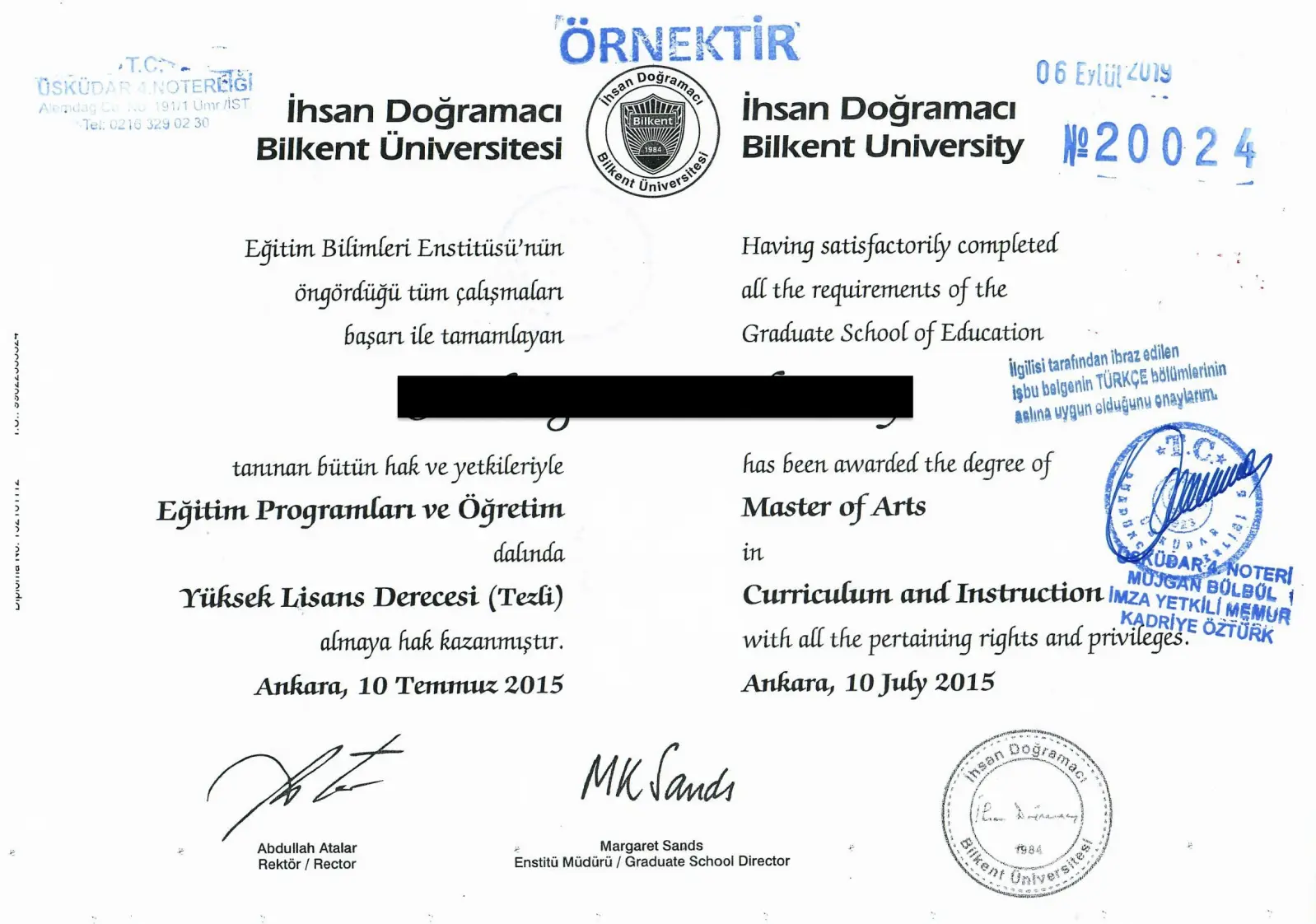
In this guide, we covered the legalization of foreign school-leaving certificates for study in Turkey. If you graduated from a Turkish school or university and plan to continue your studies, work, or obtain a residence permit in another country, the document requirements will be different.
Learn how to properly obtain an apostille from the Governor's Office (Valilik), complete consular legalization of a Turkish diploma, and arrange a translation in our dedicated article: Legalization and apostille of Turkish educational documents.
Official sources on admission, apostille, and lise denkliği in Turkey
When preparing documents, it is recommended to check the current requirements in official sources, since the list of countries participating in the Apostille Convention, the procedures of individual states, and university admission rules may change.
- MEB e-Denklik — official school education recognition system
- MEB — official answers to questions about denklik, apostille, and translations
- HCCH — current list of parties to the Apostille Convention
- Study in Türkiye — official information portal on higher education in Turkey
- MEB Eğitim Müşavirliği in Baku — denklik requirements for documents from Azerbaijan
- Government of Kazakhstan — apostilling educational documents
- Ministry of Education and Science of Ukraine — apostille on educational documents
Frequently asked questions about foreign admission to universities in Turkey
For lise denkliği, MEB requires a properly authenticated document confirming completion of secondary school. If the Apostille Convention applies to the country and document, such authentication is usually an apostille.
Not always. MEB links the mandatory apostille primarily to the document confirming completion of school. At the same time, the specific university may establish additional requirements for the transcript.
No. An apostille on a foreign school document is issued by the competent authority of its country of origin. If the student is already in Turkey, it may be necessary to send the original or arrange processing through a representative.
In most cases, it is more convenient to obtain the apostille or complete legalization first and then translate the document together with the apostille and other authentication markings.
No. An apostille authenticates an official foreign document. Lise Diploma Denklik Belgesi confirms the equivalence of foreign school education with the Turkish system.
Documents are first uploaded to e-Denklik, but MEB provides for presentation of the originals to the denklik center. Therefore, a PDF file alone is usually insufficient to complete the procedure.
No. The initial university application and final registration are different stages. The requirements of the universities and MEB should first be checked, and then only those documents that genuinely require an apostille should be apostilled.


