


Educational documents issued in Turkey — diplomas, transcripts, and certificates — often require an apostille for use abroad. This is especially relevant when applying to foreign universities (master’s, PhD programs), as well as for employment or recognition of qualifications.
An apostille may also be required for work in regulated professions such as medicine, education, construction, and other fields where official confirmation of qualifications is necessary.
It is important to note that an apostille only confirms the authenticity of the signature, seal, and the status of the issuing official. It does not confirm the content of the document or the level of qualification. For this purpose, a qualification recognition procedure (nostrification or diploma equivalency) is used.
What is an apostille?
Legalization of a document is a procedure by which a document obtains legal validity for use in another country.
Apostille is a simplified form of legalization used between countries that are parties to the 1961 Hague Convention (Apostille Convention).
In Turkey, the procedure is regulated by national legislation based on this convention.
An apostille is a special stamp placed on official documents to confirm the authenticity of the signature, seal, and authority of the issuing official.
The authenticity of the document’s content is not confirmed by an apostille.
Foreign documents certified with an apostille
Foreign documents certified with an apostille are recognized in all countries that are parties to the Hague Convention (subject to national procedures for document use in each country).
An apostille can only be issued in the country where the document was issued. In Turkey, the authorities authorized to issue apostilles are provincial governorates (Valilik) and district administrations (Kaymakamlık), as well as, depending on the type of document, judicial authorities and the notary system.
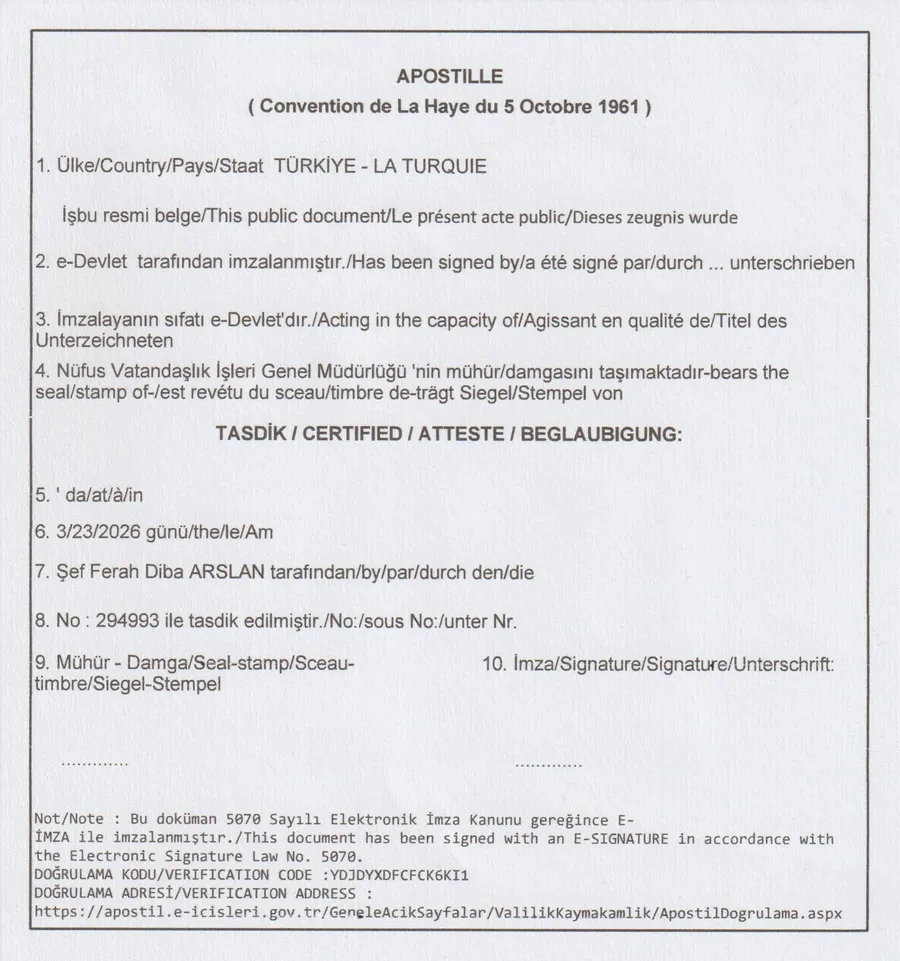
Depending on the document category, the distribution of authority is as follows: administrative documents (for example, certificates, civil registry documents, and in most cases university documents) are apostilled through provincial governorates (Valilik) and district administrations (Kaymakamlık); judicial documents are processed through authorized judicial bodies (courts); and notarial documents are processed through the notary system, after which the apostille is placed on the notary’s signature. The Ministry of Justice of Turkey does not issue apostilles directly but supervises and coordinates the apostille system through judicial bodies.
The authenticity of an apostille can be verified through Turkey’s electronic government systems (e-Devlet / UYAP), depending on the document type and issuing authority.
When an apostille is not required
For employment in most commercial organizations, apostille on educational documents is not required if the profession does not require special licensing.
An apostille is also not required when using documents in countries with which Turkey has agreements on mutual recognition of certain documents or simplified legalization (for example, the Republic of Azerbaijan or the Turkish Republic of Northern Cyprus; depending on the document type and agreement).
Procedure for apostilling diplomas in Turkey
Educational documents from state and recognized educational institutions are subject to apostille certification in Turkey. However, the apostille itself confirms the signature and authority of the official, not the accreditation of the institution.
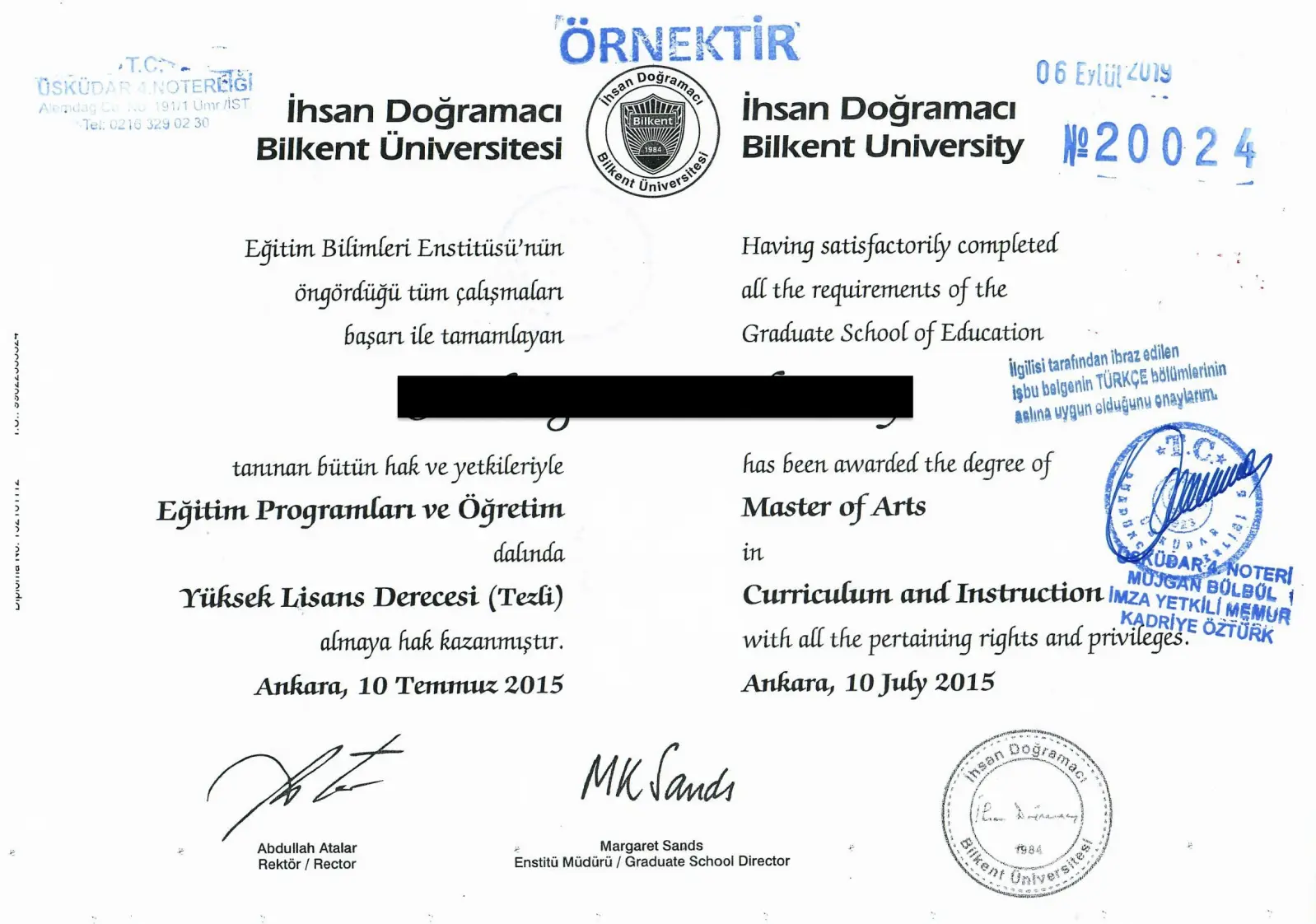
A list of universities can be found on the website of the Council of Higher Education of Turkey (YÖK — Higher Education Council). YÖK is not an apostille authority and does not participate in the apostille process — its role is limited to regulation, recognition, and accreditation of higher education institutions and academic programs.
It does not matter in which country the studies were completed or where the diploma was physically issued. If the diploma was issued by an authorized educational institution and properly prepared, it can be apostilled in the country of issuance.
The apostille procedure for diplomas in Turkey may vary depending on the type of document. As mentioned earlier, the apostille certifies the signature and seal of the authorized person.
Turkish diplomas usually already contain the rector’s signature and the university’s official seal. During legalization, the diploma may first go through notarization (noter), if the apostille is applied to a notarized copy.
After that, the document is submitted to the authorized government body (Valilik or Kaymakamlık), or judicial authorities, depending on the certifying body, where the apostille is affixed confirming the authenticity of the signature and seal of the relevant official.
Required documents for legalization
First and foremost, the original diploma is required. In addition, printed copies of diploma supplements (Diploma Eki / Transcript) are needed. In some universities, these are issued only electronically, so they must be printed.
In certain cases, a written consent from the student may also be required for diploma verification, if this is required by the internal procedures of a specific university or organization.
Methods of apostille certification
A diploma can be apostilled in several ways:
- The diploma and its supplement are bound together into a single package, with an additional certification sheet attached. The disadvantage of this method is that physical binding marks may appear on the document.
- The diploma and supplement are certified separately, in which case the apostille and certification are placed on the respective documents.
- The diploma may be certified as a notarized copy made from the original (noter). In this case, questions may arise in the destination country.
- Only the diploma can be apostilled without the supplement, but this may not be sufficient for nostrification or admission to a foreign university.
What can go wrong during apostille processing
The following situations may occur during processing:
- The seal and signature on the diploma are poorly legible — a duplicate document may be required.
- The university has changed its name and is not listed in the YÖK registry — proof of succession may be required.
- The university is under investigation or its license has been suspended — apostille may be temporarily unavailable.
- The signatory is not listed among authorized persons — confirmation of authority may be required.
In such cases, a diploma reissue request or additional data verification may be required.
Consular legalization
If your diploma will be used in a country that is not a party to the Hague Convention, such as the UAE or Egypt, the document is subject to consular legalization. This is a more complex process than apostille: the document is first certified by the Turkish Ministry of Foreign Affairs, and then by the consulate of the destination country.
- First stage — local certification in Turkey. Depending on the regulation, the document is certified by the Provincial Governorate (Valilik) or District Administration (Kaymakamlık) in the region where the issuing university is located. This confirms the authenticity of university officials’ signatures and usually takes from a few days to a couple of weeks.
- Second stage — submission to the Turkish Ministry of Foreign Affairs (Dışişleri Bakanlığı) in Ankara for pre-legalization. At this stage, the central authority confirms the authenticity of local administration stamps. Processing time may range from several weeks to a month.
- Third stage — final certification at the Embassy or Consulate of the destination country (UAE or Egypt) in Turkey (Ankara or Istanbul). The embassy places its stamp confirming the signature of the Turkish MFA officer. This takes approximately 3–15 working days depending on workload.
A diploma legalized with a single MFA stamp cannot be used for multiple countries.
What is consular legalization?
In our video we are explaining what consular legalization is and where to apply for it.
Schmidt & Schmidt will assist you in all issues concerning the legalization.
Schmidt & Schmidt offers legalization in more than 80 countries all over the world.
Document shipping and certified translation
Since apostille is issued only in the country of document origin, international shipping of documents may sometimes be required.
After legalization, the document is translated into the language of the destination country.
It is recommended to translate the final version of the document with the apostille in the destination country and certify the translation according to local requirements.
The translation must go through a verification process, during which the graduate checks the correct spelling of names, subjects, and other details.
What happens next
After obtaining an apostille and notarized translation, the documents become valid for use abroad.
With this set, you can:
- apply to foreign universities
- confirm qualifications
- apply to government authorities in another country
When people usually contact us
We assist with document processing in the following cases:
- admission to master’s or PhD programs abroad
- recognition of professional qualifications
- employment in regulated fields
- obtaining professional licenses
- submission of documents to foreign government authorities
- preparation of relocation documents
What is an apostille?
What is an apostille? Why do I need an apostille? How do I get an apostille? - Our video will explain everything you need to know about the apostille. If you have a document that needs to be certified with an apostille for use abroad, Schmidt and Schmidt will assist you! We provide apostille services in more than 100 countries worldwide.
How we can help
We will review your documents and recommend the optimal procedure — apostille or consular legalization — depending on the requirements of the destination country.
Our specialists support the process at all stages: from communication with universities and government authorities to preparation of notarized copies, translations, and document delivery.
We help with:
- obtaining apostille
- arranging consular legalization
- preparing translations and notarized copies
- interacting with universities and government authorities
- handling complex and non-standard cases
- organizing international document delivery
Our team provides support in Russian, English, German, Turkish, and Chinese.
FAQ: Legalization and Apostille for Turkish Educational Documents
You must provide the original physical diploma and your printed transcript (Diploma Eki). While it is possible to apostille a notarized copy in Turkey, many foreign institutions will reject it. We strongly recommend working with the original documents to ensure international acceptance. You will need to ship these to our office via a secure courier.
If your documents are in order, the Apostille process through the Valilik or Kaymakamlık typically takes 1 to 3 working days. However, you should factor in additional time if your diploma requires notarized copies, sworn translations, or international shipping.
An Apostille is a faster, single-stamp process used for countries within the Hague Convention (like Germany, Spain, or the UK). Consular Legalization is a longer, 3-stage process required for non-Hague countries (such as the UAE, Egypt, or Qatar), requiring stamps from local authorities, the Turkish Ministry of Foreign Affairs, and the destination country's embassy.
No, but physical binding marks can occur depending on the method used. If a diploma and transcript are bound together with an additional certification sheet, a hole punch or rivet may be used. If you want to keep your original diploma pristine, we can discuss certifying the diploma and transcript separately, depending on what your target university allows.
Yes. You do not need to be physically present in Turkey. You can send your original documents directly to our Turkish office via a trackable courier, and our specialists will handle the notarization, apostille, or consular legalization process on your behalf.
No. An apostille only proves that your diploma is a legally genuine document and that the signatures and seals on it are authentic. It does not evaluate your academic level or automatically grant you the right to practice a regulated profession (such as medicine, law, or engineering) in your destination country. For professional licensing, you will still need to complete a separate diploma equivalency or recognition procedure (nostrification) with the local authorities after the apostille is affixed.


