Summary: EAC Marking
- What is the EAC marking? A conformity mark of the Eurasian Economic Union (EAEU) confirming that a product meets all requirements of the relevant technical regulations. EAC stands for Eurasian Conformity.
- When is it required? For all products placed on the EAEU market (Russia, Belarus, Kazakhstan, Armenia, and Kyrgyzstan) for the first time that fall under at least one Technical Regulation.
- Forms of Conformity Assessment: Depending on the product category, either an EAC Certification, an EAC Declaration, or State Registration is required.
- Applicant Requirements: Only a company established within the EAEU is authorized to apply for certification or registration. Foreign manufacturers must appoint an Authorized Representative within the Union.
- Marking Requirements: The EAC mark must be affixed to every product unit, label, or package. It must be monochromatic or have a clear color contrast, with a minimum size of 5 mm.
- Next Steps: Submit your product details and HS code to receive an individual consultation on the correct conformity assessment procedure.

What do the letters EAC stand for?
EAC stands for Eurasian Conformity. EAC is a certification mark which indicates that the products conform to all Technical Regulations of the Eurasian Economic Union. All products that have passed relevant conformity assessment must be marked with the EAC symbol. Thus, the EAC mark is an important prerequisite for bringing a product to market in the EAEU. The Eurasian Economic Union ahs five members: Armenia, Belarus, Kazakhstan, Kyrgyzstan, and Russia.
What conformity assessment procedures exist in the Customs Union?
The Technical Regulations foresee three types of proof of conformity:
Which products require EAC marking?
EAC conformity assessment covers an impressively broad spectrum of product groups — from heavy industrial machinery to everyday consumer goods. Whether a product requires an EAC Certificate or an EAC Declaration is not a matter of chance; it is strictly anchored in Customs Union Decision No. 620 as well as the respective Technical Regulations (TR CU).
Goods without a valid certificate of conformity can neither be cleared through customs nor distributed. For manufacturers, the golden rule remains: Clarity before shipping. Products that do not fall under EAEU-wide regulations are often still subject to national procedures (such as fire safety or metrology), making precise classification in advance indispensable.


















Why should the exporter has his product certified?
It is prohibited to sell products without the EAC Declaration or EAC Certificate, if these products are listed in the technical regulations. Products sold without proper labeling may be subject to fines, withdrawal from the market, or confiscation.What are the requirements for EAC marking?
- Only products which proved their conformity with the relevant Technical Regulations of the EAEU can be marked with the EAC symbol.
- The EAC mark can be attached only after the EAC Declaration or EAC Certificate have been successfully registered.
- The EAC marking must be attached to every product, label, insert, sticker, or package.
- In addition to the EAC marking, no other mark or seal which could contradict the "EAC" mark is permitted.
- The EAC mark consists of a combination of three stylized letters—“E,” “A,” and “C”—and is of equal height and width. The mark must be affixed to a contrasting background.
- The dimensions of the EAC mark must ensure good legibility to the naked eye against the background and must not be less than 5 mm.
- It may be affixed in any manner that ensures its legibility throughout the product’s entire service life.
- The EAC mark must be either monochromatic or have a clear color contrast with the surface.
- It is prohibited to use the EAC mark in a way that could mislead consumers regarding the meaning of the EAC mark. Misuse of the EAC mark may result in criminal penalties.
There are some additional EAC Markings which must be attached to the explosion proof equipment and medical products:
EX Marking |
EAC-MED Marking |
|---|---|
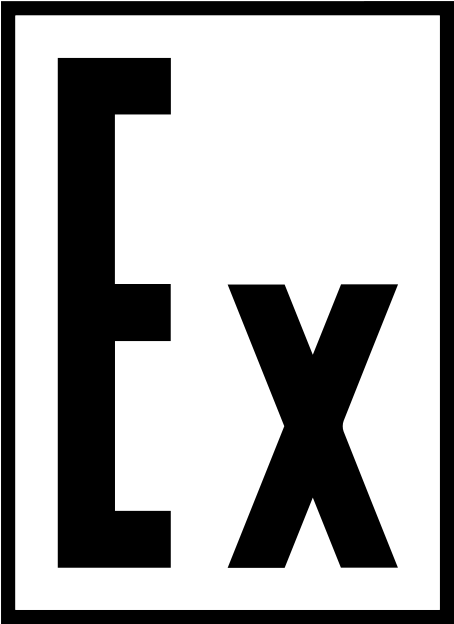
Products that comply with the requirements of TR CU 012/2011 “On safety of equipment for operation in explosive atmospheres” must be marked accordingly. This marking confirms that the product is suitable for use in hazardous (explosive) environments and meets the applicable safety requirements. |

Medical devices must bear the EAC-MED marking as a mandatory indication of conformity. This marking confirms compliance with the applicable medical regulations and allows the product to be legally marketed and used across all EAEU member states. |
Can the CE Marking replace the EAC Marking?
No. CE or other national certification are not accepted in the EAEU. The product must undergo the EAC conformity assessment. The CE and EAC markings pursue the same goal: they indicate that a product meets essential safety and health requirements. Nevertheless, they refer to different markets, legal frameworks, and procedures. For manufacturers operating both in the EU and the EAEU, it is important to distinguish between the two systems.
Scope and purpose
- CE marking: A prerequisite for placing products on the market within the European Economic Area (EU and EFTA). It indicates compliance with relevant EU directives.
- EAC marking: The conformity mark of the EAEU, required for Russia, Belarus, Kazakhstan, Armenia, and Kyrgyzstan. It confirms compliance with the applicable Technical Regulations (TR CU / TR EAEU).
Legal basis and Conformity Assessment
CE marking: Based on EU regulations and directives. The manufacturer determines applicable directives, carries out the assessment, and prepares the EU Declaration of Conformity.
EAC marking: Based on the unified Technical Regulations of the EAEU. Depending on the product, assessment is carried out in the form of an EAC certificate or an EAC declaration, registered in the unified EAEU database.
Key differences
| Criterion | CE marking | EAC marking |
|---|---|---|
| Market area | European Economic Area (EU/EFTA) | Eurasian Economic Union (RU, BY, KZ, AM, KG) |
| Legal basis | EU directives and regulations | Technical regulations TR CU / TR EAEU |
| Conformity assessment | Internal production control; notified bodies where required; EU Declaration | EAC certificate or declaration; testing in accredited labs and audits |
| Conformity mark | CE mark on product/packaging | EAC mark on product/packaging |
| Validity | Often linked to product modifications | Generally valid for up to 5 years |
Practical implications for exporters
In practice, CE marking does not replace EAC marking — and vice versa. Companies wishing to market products in both regions must undergo separate conformity assessments. We support you in determining which directives and regulations apply to your specific portfolio.
Detailed background information is available in our article on the difference between CE and EAC marking.
Legal Framework for EAC Marking: TR CU and TR EAEU Regulations

The creation of a Customs Union and later the Eurasian Economic Union (EAEU) between Russia, Belarus, Kazakhstan, Armenia, and Kyrgyzstan led not only to the abolition of customs borders and other obstacles between states but also to a subsequent coordination of Technical Regulations. National standards such as GOST-R and TR in Russia, STB in Belarus, or Kazakh GOST-K have been replaced by binding technical rules applicable to all members of the EAEU. Another important aspect of the new standards is their coordination with European standards.
As it stands, 52 Technical Regulations have been passed. Products for which no Technical Regulation has yet been developed still undergo conformity assessment following the national norms and standards of the member states. For example, certification in the areas of fire protection and metrology is still subject to national regulations.
Products that are not subject to mandatory conformity assessment may be certified with a voluntary GOST certificate.
The EAC markings were introduced through the board decision of the EAEU Commission No. 711 on July 15, 2011.
How Can We Help?
Navigating the regulatory landscape of the Eurasian Economic Union can be challenging. Our team provides comprehensive support for companies seeking market entry, assisting with EAC certification, declaration, and state registration.
Our experts prepare and review technical documentation, ensuring it meets all legal requirements and is accurately translated into the required languages. This attention to detail is essential for smooth market entry and legal compliance across all member states.
With extensive experience across various industries—including machinery, electronics, and consumer goods—we provide targeted guidance to facilitate your certification process.
How to apply for Certification?
To help you enter the Eurasian Economic Union (EAEU) market quickly and in full legal compliance, we support you throughout the entire EAC certification process – from the initial request to the delivery of the original documents.