Summary: The Ignition Hazard Assessment for Ex Equipment under TR CU 012/2011
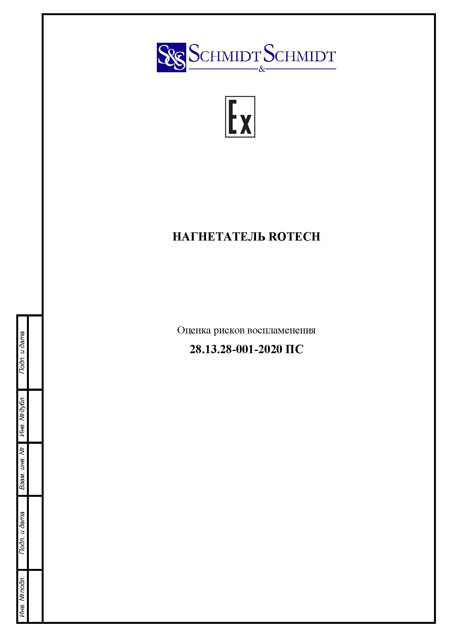
- Mandatory Proof for Non-Electrical & Mechanical Ex Equipment: For compulsory EAC Ex Certification under TR CU 012/2011 (an EAC Declaration is legally excluded for Ex equipment), a formal Ignition Hazard Assessment (Russian: Otsenka opasnosti vosplameneniya) must be submitted.
- Key Difference from Western Practice (EU ATEX vs. TR CU 012/2011): Although TR CU 012/2011 is modeled on European ATEX Directive 2014/34/EU, EU-Type Examination Certificates and English- or German-language ATEX dossiers under EN ISO 80079-36 do not replace Russian-language EAEU verification records.
- Current Normative Basis (Type of Protection Ex h): Compilation follows harmonized standards GOST 31441.1-2011 (EN 15198) and GOST ISO 80079-36 / 80079-37 (constructional safety "c", control of ignition sources "b", liquid immersion "k") as well as GOST 31438.1-2011 and GOST 31438.2-2011 (EN 1127).
- Four-Step Methodology: Systematic analysis of all 13 potential ignition sources, evaluation of their probability of occurrence during normal operation and malfunctions, definition of design-based protective measures, and binding assignment of the Ex equipment category.
- Sanctions-Compliant Ex Certification in Euros: Schmidt & Schmidt converts your existing EU ATEX files into GOST-compliant Ex dossiers and coordinates accredited Ex testing as well as ISO/IEC 80079-34 audits with full legal certainty via Germany and Kazakhstan.
Significance of the Ignition Hazard Assessment under TR CU 012/2011
Exporting electrical and non-electrical equipment intended for use in potentially explosive atmospheres to the Eurasian Economic Union (EAEU) (Russia, Belarus, Kazakhstan, Armenia, and Kyrgyzstan) requires mandatory EAC Ex Certification under Technical Regulation TR CU 012/2011 "On Safety of Equipment for Operation in Explosive Atmospheres".
A core mandatory document in the certification dossier—particularly for mechanical, pneumatic, or hydraulic Ex equipment and assemblies (such as pumps, fans, compressors, gearboxes, couplings, brakes, agitators, and industrial valves)—is the Ignition Hazard Assessment. It provides engineering proof that the equipment does not generate effective ignition sources during normal operation, expected malfunctions, or rare malfunctions.
Why EU ATEX Files Alone Are Not Enough: Within the European single market, manufacturers of non-electrical Category 2 equipment (Zone 1/21) often merely lodge their technical documentation with a Notified Body. Under EAEU law, however, the accredited Ex certification body examines the Ignition Hazard Assessment in full technical detail—requiring a complete, standard-compliant Russian-language version referencing Eurasian GOST standards.
Key Differences for International Manufacturers: EU ATEX (2014/34/EU) vs. TR CU 012/2011
For machinery, pump, gearbox, and valve manufacturers from Europe, North America, and other international markets, decisive procedural and documentary differences apply compared to European ATEX practice:
| Criterion | EU Practice (ATEX Directive 2014/34/EU) | EAEU Practice (TR CU 012/2011 / EAC Ex) |
|---|---|---|
| Approval Type | Internal production control (Cat. 3), dossier lodging with Notified Body (Cat. 2 non-electrical), or EU-Type Examination (Cat. 1 / Cat. 2 electrical). | Exclusively mandatory EAC Ex Certification (Schemes 1C for serial production, 3C for batch, 4C for single unit). EAC Declaration is not permitted. |
| Ignition Hazard Assessment | Compiled per EN ISO 80079-36 / EN 15198 in English or German; usually kept at the plant or lodged with the Notified Body. | Mandatory part of the filing dossier in Russian per GOST 31441.1 / GOST ISO 80079-36; actively audited by the Ex expert. |
| Ex Marking | CE mark + hexagonal Ex symbol + equipment group/category (e.g., II 2G Ex h IIB T4 Gb). |
EAC mark + dedicated Ex mark + Eurasian Ex coding (e.g., 1Ex h IIB T4 Gb X). |
| Quality Assurance (QAN) | Production quality recognition under ISO/IEC 80079-34 for Category 1 and 2 (electrical). | Mandatory manufacturing audit (ISO/IEC 80079-34) for serial certification (Scheme 1C) conducted by the EAEU certification body. |
| Companion Documents | EU Declaration of Conformity and ATEX operating manual. | Technical Passport (Ex Passport), Operation Manual, Safety Justification, and Ignition Hazard Assessment. |
Normative Basis and the 4-Step Assessment Procedure
The Ignition Hazard Assessment is carried out in accordance with harmonized standards GOST 31441.1-2011 (EN 15198:2007), GOST ISO 80079-36, and GOST ISO 80079-37 (type of protection "Ex h" – constructional safety "c", control of ignition sources "b", liquid immersion "k") as well as GOST 31438.1-2011 and GOST 31438.2-2011 (EN 1127-1 / EN 1127-2) across four consecutive work stages:
1. Analysis of Potential Ignition Hazards (13 Ignition Sources)
Systematic examination of all assemblies and materials for the 13 ignition sources defined in GOST 31438.1:
- Hot surfaces (temperature classes T1–T6 or maximum surface temperature in °C);
- Mechanically generated sparks (friction, impact, abrasion, material pairings);
- Static electricity, stray electric currents, and cathodic corrosion protection;
- Adiabatic compression, shock waves, and flowing gases;
- Exothermic chemical reactions (including self-ignition of dusts), open flames, hot gases, as well as electromagnetic/ionizing radiation and ultrasonics.
2. Evaluation, Protective Measures & Categorization
- Evaluation of Ignition Hazards: Assessing the probability and frequency with which a potential ignition hazard becomes an effective ignition source during normal operation, expected malfunctions, or rare malfunctions.
- Determination of Protective Measures: Specifying design-based and protective measures (e.g., protection concepts Ex h, Ex d, Ex e, Ex i, Ex p) and required control/limiting devices, complete with verification records.
- Final Evaluation & EPL Assignment: Cross-checking residual hazards against protective measures, defining special conditions of use ("X" marking), and bindingly assigning the Equipment Protection Level (EPL Ga/Gb/Gc or Da/Db/Dc).
Your Added Value with Schmidt & Schmidt: Sanctions-Compliant Ex Documentation from a Single Source
Converting European ATEX approval files into legally valid TR CU 012/2011 documentation requires deep explosion-protection engineering expertise and exact knowledge of current Eurasian testing practices—while strictly complying with international export control and sanctions regimes (Regulation (EU) No 833/2014 and Swiss SECO rules).
Our Complete Ex Documentation Package for Manufacturers under TR CU 012/2011:
- Conversion of Existing EU ATEX Assessments: We transform your existing risk matrices and ignition hazard assessments under EN ISO 80079-36 / EN 15198 into a standard-compliant Russian Ignition Hazard Assessment per GOST 31441.1 / GOST ISO 80079-36.
- End-to-End Ex System Documentation: In addition, we compile the Technical Passport (Ex Passport) featuring accurate EAEU Ex marking, the Operation Manual with dedicated safety rules for Ex zones, the Safety Justification, and specialized translations of technical drawings.
- 100% Sanctions-Compliant Execution & Billing in Euros: All projects, Ex laboratory tests, and ISO/IEC 80079-34 audits are coordinated with full legal certainty in Euros via our German headquarters in Passau and our accredited partners in Kazakhstan (Sanctions Compliance), with timely delivery of all originals.
6 Steps to a GOST-Compliant Ignition Hazard Assessment & EAC Ex Approval
We support your explosion-protection officers and design engineers from initial ATEX file review to the registered EAC Ex certificate: