Summary: EAC Declaration
- What is an EAC Declaration? An official document where the manufacturer or applicant declares that the products meet the minimum safety requirements of the EAEU Technical Regulations.
- When is it required? For products listed in the unified EAEU list (Decision No. 620) before they are placed on the market or imported.
- Applicant Requirements: An EAC Declaration can only be applied for by a company established in the EAEU. Foreign manufacturers must appoint an Authorized Representative within the Union.
- Registration Process: Since 2021, the applicant must register the declaration directly in the official EAEU register using an electronic digital signature (EDS).
- Certificate vs. Declaration: A declaration is drafted on a plain A4 sheet (no official security blank), and the legal responsibility for compliance lies primarily with the applicant, not the certification body.
- Processing Time: Typically 1 to 2 weeks, depending on the availability of required test reports and technical documentation.
- Costs: The costs vary depending on the scope of testing, the applicable technical regulations (TR ZU) and the product characteristics. A declaration for a machine costs from €1,800. A declaration for EMC costs from €1,500.
- Validity: Generally valid for 1 to 5 years for serial production, or limited to a specific batch.
- Next Steps: Submit your product details and HS code to receive an individual consultation on the correct declaration scheme.
What is an EAC Declaration and when is it required?
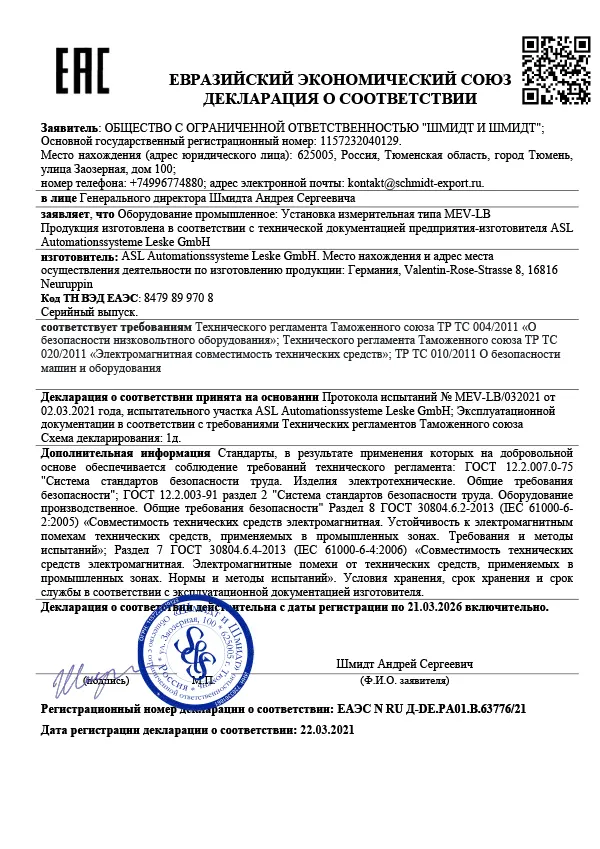
The EAC Declaration of Conformity of the Eurasian Economic Union (EAEU) is official evidence that products meet the minimum safety requirements of the Technical Regulations (TR CU / TR EAEU). This ensures that products are safe for consumers and the environment within the unified customs territory.
In which countries is the EAC Declaration valid?
The Eurasian Economic Union is a major trade agreement between Armenia, Belarus, Kazakhstan, Kyrgyzstan, and Russia. Within this territory, a common customs tariff, uniform trade rules, and harmonized technical regulations apply.
Products covered by an EAC Declaration may be moved and sold freely throughout the entire customs territory of the EAEU without the need for additional national conformity assessments such as GOST-R, TR, or GOST-K.
Which products require an EAC Declaration?
An EAC Declaration or an EAC Certificate is mandatory for all products included in the "Unified List of Products Subject to Mandatory Conformity Assessment" according to Decision No. 620 of the Customs Union Commission.
Products not included in this list may still be subject to national regulations in individual member states. Therefore, it is essential for manufacturers and exporters to determine in advance whether their goods require an EAC Declaration to prevent delays and legal risks in market access.
What is the procedure of EAC conformity assessment?

The procedure of conformity assessment is often a highly complex and time-consuming process that raises many questions for manufacturers and importers. This article aims to help find answers to these questions. All information provided in this article, based on the Law № 184 of the Russian Federation "On Technical Regulation" of december 27, 2002 and on the GOST standard 31893-2012 Conformity assessment. Standard system in conformity assessment”.
An EAC Declaration is made by the manufacturer, importer or authorized representative and entered into the uniform register on request of the applicant to the accredited certifying body.
Depending on the purpose of the EAC Declaration, different schemes can be applied: for serial production or for single-supply.
These and other definitions related to EAC Conformity Assessment are available in GOST 31894-2012 Terms and definitions in the field of conformity assessment (confirmation).
According to the certification process, the EAC Declarations are valid for up to 5 years.
An EAC Declaration may only be applied for by a company established in the territory of the EAEU. Therefore an authorized representative within the EAEU is required. If you need an authorized representative, we will be pleased to offer you a suitable company that takes over this function.
As a proof of conformity with the requirements of the EAEU when registering an EAC Declaration , audit reports as well as test reports from a notified body may be required.
Step-by-Step Guide: How to obtain an EAC Declaration
The process of registering an EAC Declaration is a strictly regulated procedure. To ensure full compliance with the Technical Regulations of the EAEU, the applicant must follow these 7 essential steps:
- Step 1: Classification & Standards – Identification of the product’s customs tariff number (HS Code) and selection of the applicable Technical Regulations (TR CU / TR EAEU).
- Step 2: Selection of the Declaration Scheme – Determination of the appropriate conformity assessment scheme (e.g., 1D, 3D, or 6D) based on the production type (batch vs. serial).
- Step 3: Laboratory Testing – Conducting product tests. Depending on the scheme, tests are performed either by the manufacturer or in an accredited testing laboratory.
- Step 4: Technical Documentation – Preparation of the required documentation (Technical Passport, Safety Justification, Manuals) based on successful test results.
- Step 5: Drafting & Issuance – Drafting the EAC Declaration of Conformity in the prescribed format by the authorized applicant.
- Step 6: Registration in the Unified Register – Entry of the declaration and supporting evidence into the official Unified Register of the EAEU to grant legal validity.
- Step 7: EAC Marking & Market Access – Affixing the EAC conformity mark to the product and packaging to allow free circulation within the EAEU.
Note: Since 2021, the registration of EAC Declarations in Russia must be performed by the applicant directly using a digital signature (EDS).
Step 1: Classification of the product and selection of the relevant standards
The Applicant Rule: The registration of an EAC Declaration may only be carried out by a company established within the territory of the Eurasian Economic Union (EAEU). A foreign manufacturer is not authorized to apply independently.
If you require an authorized representative, we would be pleased to provide a suitable EAEU-based company to perform this legal function for your business.
The responsibility for the correct classification of the products, the selection of the conformity assessment scheme, and the technical documentation lies entirely with the applicant (manufacturer, importer, or authorized representative). This step identifies which Technical Regulations (TR CU / TR EAEU) apply to the product based on its HS Code and technical characteristics.
Key Definitions for Classification:
Serial Production: Intended for regular, ongoing deliveries over a fixed period (typically 1 to 5 years). This mode often requires a quality management system (QMS) audit or enhanced manufacturing control by the manufacturer.
Batch / Charge: A defined quantity of manufactured units with the same name and designation, intended for a specific sale or contract. The declaration is valid only for this specific shipment.
Product Unit: A single item or a specific, limited quantity of the product intended for a single delivery.
These and other fundamental legal definitions related to EAEU conformity assessment are established in the standard GOST 31894-2012 — Terms and definitions in the field of conformity assessment.
Step 2: Selection of the Declaration Scheme
So far, 52 technical regulations have been adopted in the Eurasian Economic Union, which must be used for EAC Declaration. Several sets of rules are currently being developed or are already being discussed at the Union level.
The technical regulations TR CU and TR EAEU are basically the counterpart of European CE directives, or more precisely EU regulations. TR CU is abbreviation of Customs Union Technical Regulations and TR EAEU is an abbreviation of Eurasian Economic Union Technical Regulations, similar to the designation of CE directives e.g. Directives 2006/42/EC and 2011/65/EU. More on this topic you can find in our articles: "Which one is correct: TR CU certificate or EAC certificate?" and "Differences between EAC Certificate and EAC Declaration".
The technical regulations set minimum requirements for the safety of the respective products. The conformity of the products with the regulations is declared by EAC Declaration by the manufacturer or its representative. After successful conformity assessment, the products are marked with the EAC conformity mark. The EAC marking declares that the product complies with the applicable safety requirements of the technical regulations. Only then the product can be placed on the EAEU market for free circulation.
Which module should be applied for a product?
Modules are called schemes in technical regulations. All technical regulations contain detailed descriptions of the EAC Declaration, the so-called schemes. The selection of the scheme depends on the characteristics of the product, the production process and the delivery. The schemes of conformity assessment can be considered the counterpart of the conformity assessment modules according to the EU directive 768/2008/EG in the Eurasian Economic Union. Possible schemes of the EAC Declaration are explained below:
| Scheme | Product examination | Manufacturing audit | Manufacturing control | Scope of application | Certificate of conformity |
|---|---|---|---|---|---|
| 1D | Examination of the product sample by the manufacturer | - | Manufacturing control by the manufacturer | For series production; applicant: domestic/foreign manufacturer, if there is an authorized representative of the EAEU | EAC Declaration for serial production |
| 2D | Examination of the contract-bound delivery in batches or single-unit production by the applicant | - | - | For contract-bound delivery in batches or single-unit production; applicant: domestic/foreign manufacturer, seller (supplier), if there is an authorized representative of the EAEU | EAC Declaration for contract-bound delivery in batches or single-unit production |
| 3D | Examination of the product sample in an accredited testing laboratory | - | Manufacturing control by the manufacturer | For serial production; applicant: domestic/foreign manufacturer, if there is an authorized representative of the EAEU | EAC Declaration for serial production |
| 4D | Examination of the contract-bound delivery in batches or single-unit production by the applicant in an accredited testing laboratory | - | - | For contract-bound delivery in batches or single-unit production; applicant: domestic/foreign manufacturer, if there is an authorized representative of the EAEU | EAC Declaration for contract-bound delivery in batches or single-unit production |
| 5D | Examination of the product sample | - | Manufacturing control by the manufacturer | For series production; applicant: domestic/foreign manufacturer, if there is an authorized representative of the EAEU | EAC Declaration for products which are used in production facilities with higher risk exposure or for innovative products for whom no guidelines exist |
| 6D | Examination of the product sample in an accredited testing laboratory | Certification of the quality system | Manufacturing control by the manufacturer | As in 5D | EAC Declaration for series production |
Step 3: Laboratory Testing

The testing of product samples is often a mandatory step in the EAC Declaration process. A representative sample of the product is tested for conformity with the requirements of the technical regulations of the EAEU. It is also examined whether the product is suitable for the intended use.
In the case of an EAC Declaration, the applicant is required to send product samples to a laboratory for testing. To ensure that these samples are officially accepted for conformity assessment, certain technical requirements and shipping guidelines must be strictly followed. It is generally easiest to send the samples as a postal item; however, specific customs and documentation requirements must be met. Detailed tips to help manufacturers correctly select and ship samples can be found in our sample selection and shipment guide.
The sample tests may be conducted on the manufacturer’s site and with the manufacturer’s testing equipment. If the EAC Declaration is carried out according to scheme 1D or 2D, product tests may be carried out in the manufacturer's own production laboratory. However, the technical regulations must be taken into account.
The tests are carried out in accordance with the standards specified in the Annex to the Technical Regulations (GOST standards) according to a special programme and methodology established on the basis of the generally accepted method of certification testing and depending on the type of product. The programme and methodology can be developed both by the manufacturer and by the experts of the certification body.
The results of the examinations are entered in the test report.
Step 4: Technical Documentation
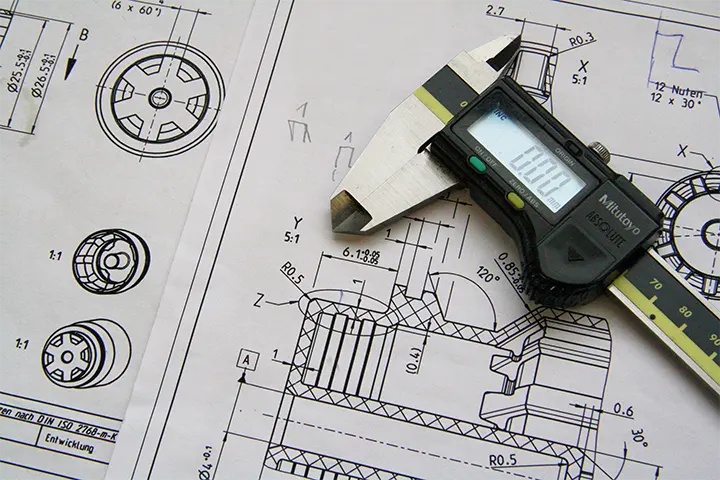
If the result is positive, the following information and documents must be prepared and collected:
- denomination of the product
- detailed product description
- customs tariff number
- technical passport
- instruction manual
- technical drawing
- technical data sheet
- test report
- registration number of the customs declaration for the import of product samples
- GLN - Global Location Number
- GTIN-Code - Global Trade Item Number
- already existing certificates: ISO, DIN, CE, CB
In any case, a detailed list of the documents which can be found in the respective technical regulation shall be indicated.
Step 5: Drafting & Issuance
After the successful completion of all testing and audit procedures, the applicant drafts the EAC Declaration of conformity.
Unlike the EAC certificate, there is no specific official form or security blank required for an EAC Declaration. The applicant provides the required information about the product on a standard sheet of paper (A4 format), which is then signed and stamped by the authorized representative or the manufacturer's EAEU-based office. The document must strictly follow the prescribed layout established by the EAEU Commission to ensure legal validity during customs clearance.
Step 6: Registration in the Unified Register
The EAC Declaration is then entered by the applicant in the unified register, where it is assigned a registration number.
The period of validity of the EAC Declaration depends on many parameters (for example the applied technical standards, the selected scheme and the type of production (serial production, single production etc.), which are directly specified in the respective technical regulation.
Step 7: EAC Marking and Market Access

After the successful registration of the EAC Declaration in the unified register, the products must be marked with the EAC conformity mark of the EAEU. This mark serves as visual proof that the product complies with all applicable legal requirements and safety standards of the Eurasian Economic Union.
The specific requirements for the design, dimensions, and affixing of the EAC marking are established in the Decision of the Customs Union Commission No. 711 of July 15, 2011.
Key Rules for Marking:
- The EAC mark must be affixed to every unit of the product, its packaging, or the accompanying documentation before the goods cross the EAEU border.
- The marking must be visible, legible, and indelible throughout the entire life cycle of the product.
- Placing products on the market without the appropriate EAC marking is strictly forbidden and can lead to heavy fines, product confiscation, or a ban on sales.
Beyond legal compliance, the EAC marking significantly increases the trust of potential customers and distributors, facilitating smooth circulation and increasing demand for the product across the EAEU member states.
What is an EAC certificate?
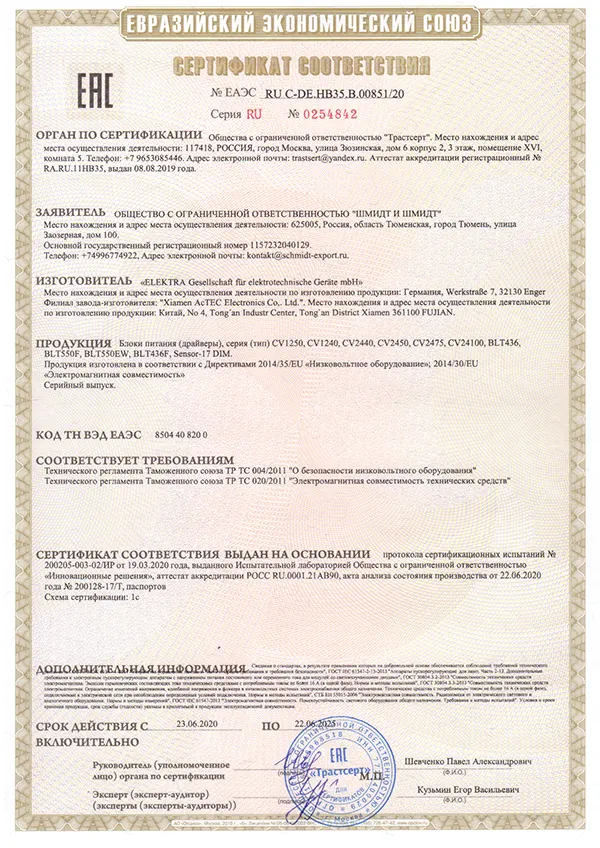
In addition to the EAC Declaration, the EAC Certification also exists as another form of official proof that the products comply with the technical regulations of the participating countries.
The EAC certificate and the EAC Declaration have the same validity. The products listed in the board decision of the EAEU No. 620 from 07.04.2011 require an EAC certification or an EAC Declaration.
What are the differences between an EAC Certificate and an EAC Declaration?
| Criteria | EAC Certificate | EAC Declaration |
|---|---|---|
| Applicant | manufacturer, importer, authorized representative | manufacturer, importer, authorized representative |
| Classification of products | made by the certifying body | made by the applicant |
| Proof of conformity | based on the test report of the accredited test laboratory | based on applicant's own evidence or the test report of the accredited test laboratory |
| Quality assurance | comprehensive production audit through the certifying body or external ISO 9001 certification | quality assurance is done by the applicant |
| Issuing of the document | certification body on an official form | applicant on a plain sheet of paper |
| Registration | certification body | applicant or certification body |
| Validity | 1 to 5 years | 1 to 5 years |
| Responsibility | lies with the certification body | lies with the applicant |
| Surveillance | certification body | - |
Optional certification
If your products are not subject to compliance with EAC standards and you need a confirmation of the safety and high quality of your products, we can offer you a GOST Certification for the Russian and Kazakh market.
When is an Authorized Representative required for an EAC Declaration?

Foreign manufacturers that do not have a registered legal entity in one of the Member States of the Eurasian Economic Union (EAEU) are not entitled to independently apply for an EAC Declaration or register it in the unified state register. Without a business partner established within the EAEU, obtaining a valid EAC Declaration and accessing the market is legally impossible.
In this case, the foreign manufacturer must appoint an authorized representative established in an EAEU Member State. This representative acts as the official applicant and takes full legal responsibility for the conformity of the products with the technical regulations. The authorized representative handles the entire registration process, coordinates with testing laboratories, and ensures that the product meets the safety requirements of the EAEU.
Under current EAEU legislation, specifically regarding the electronic registration of declarations, only an operator based within the territory of the Union can perform the necessary filings. For companies from Europe, the USA, or Asia, appointing a reliable authorized representative is a mandatory prerequisite for successful export and customs clearance.
Schmidt & Schmidt assists international manufacturers in designating a professional authorized representative within the EAEU. Through our legally compliant solution via Kazakhstan — a key Member State of the EAEU — we ensure the seamless issuance and registration of EAC Declarations. With our local offices in the region, we guarantee that the entire conformity assessment process not only complies with the technical regulations of the Union but is also conducted in strict accordance with current European and American sanctions regulations. Our service provides our clients with reliable, lawful, and sustainable access to the EAEU market.
How do EU and US sanctions affect the EAC Declaration?

In addition to the technical regulations of the Eurasian Economic Union (EAEU), European and international companies must strictly comply with applicable EU and US sanctions when registering an EAC Declaration. These restrictive measures often target the export of specific dual-use goods, luxury items, and industrial equipment, as well as transactions with listed individuals and entities. Failure to comply can lead to severe civil and criminal liability, including heavy fines and debarment from international trade.
The situation is especially critical for exports to Russia and Belarus. Due to the complex geopolitical landscape, numerous embargoes have been implemented that directly impact the conformity assessment process. For example, a declaration might be technically correct, but if the testing laboratory, the certification body, or the local business partner is included on a sanctions list, the entire document becomes legally unusable for Western companies. Therefore, a thorough screening of all involved parties against current EU and US sanctions lists is mandatory before starting the declaration process.
Another significant risk is the "blocking" of shipments at the border due to sanctions violations, even if a valid EAC Declaration is present. A conformity assessment does not provide a "safe harbor" from export control regulations. This makes close coordination between compliance departments, export officers, and your authorized representative essential to secure supply chains and avoid legal conflicts.
For manufacturers aiming to export products to Kazakhstan, Russia, or other EAEU Member States, sanctions compliance must be treated with the same priority as technical safety. This involves reviewing the end-use of the products and ensuring that the designated authorized representative operates in a legally stable jurisdiction.
Schmidt & Schmidt provides a legally compliant solution via Kazakhstan. As a Member State of the EAEU, Kazakhstan is fully authorized to register EAC Declarations. Through our local offices in Almaty and Astana, we ensure that the entire declaration process is carried out in strict compliance with European and US sanctions, enabling our clients to maintain lawful access to the EAEU market while mitigating risks.
Detailed information on these regulatory developments can be found in our specialized article: EAC Certification Amid EU and US Sanctions against Russia and Belarus.
How long is an EAC Declaration valid?
The validity period of an EAC Declaration depends on the respective technical regulation (TR CU/EAEU), the chosen declaration scheme, and the type of delivery (serial production vs. batch).
Typically, the validity is determined as follows:
- For serial production, the declaration is usually issued for a period of 1 to 5 years. This allows for continuous deliveries during the specified timeframe.
- Some specific technical regulations stipulate shorter maximum periods. For instance, TR CU 030/2012 On the Safety of Lubricants, Oils, and Special Fluids limits the validity to 3 years.
- For single shipments (contract-based), the declaration is valid only for the specific batch or units defined in the supply contract and does not have a fixed expiration date beyond the sale of those units.
After the expiration of the validity period, a new conformity assessment must be carried out to ensure the products still comply with the current safety standards of the EAEU.
Suspension or revocation of the issued EAC Declaration
The validity of the issued EAC Declaration may be suspended temporarily or permanently in the following cases:
- The authorized representative and the applicant have mutually agreed to revoke the validity of the EAC Declaration
- The product does not comply with the requirements of the technical regulations due to new modifications
- The authority that carries out the state control over the declared products was informed about quality deficiency
The decision on suspending or revoking the conformity certificate is made by the certification body. The applicant will be informed of the decision in writing within five working days.
How much does an EAC Declaration cost?
The costs of an EAC Declaration depend on several variables. A fixed price cannot be provided upfront, as every product must be evaluated individually. The primary pricing criteria include:
- Applicable Regulations: The specific Technical Regulations (TR CU / TR EAEU) that apply to your product.
- Product Type & Complexity: Design, number of components, and the variety of models or modifications.
- Scope of Testing: Required laboratory tests, safety assessments, and EMC (Electromagnetic Compatibility) reports.
- Completeness of Documentation: Quality and availability of technical files, drawings, and existing test reports.
- Product Samples: The selection and shipment of representative samples for testing is a critical part of cost planning.
To determine the exact costs, a technical evaluation of your product is necessary. For this, we typically require a detailed product description and the HS Code. Based on this information, we will provide you with a tailor-made quotation.
Detailed information can be found on our specialized page: Costs of EAC Certification and EAC Declaration.
The rights of the applicant
The applicant has the right to:
- select the forms and schemes of attestation of conformity for the goods specified in the technical regulations,
- to address itself to that certification body whose scope of accreditation applies to the declared goods,
- use the EAC conformity mark,
- to lodge complaints with the authorised body about unlawful acts by the certification bodies and centres (laboratories),
- as well as to apply to the court for the protection of their rights and legal interests.
Liability for Non-Compliance with Requirements
The sale of products without valid EAC conformity certificates or with falsified or unreliable documents entails severe penalties under Chapter 14 of the Law on Administrative Offenses. These may include fines of up to tens of thousands of euros, suspension of business activities, confiscation of products, and—in cases involving threats to life, health, or the environment—even criminal prosecution.
An overview of possible penalties for violations of EAC certification regulations can be found in our expert article. Therefore, it is of utmost importance to take the EAC conformity assessment seriously.
Which legal framework applies to EAC Declaration?
The legal basis involves the following agreements:
What are TR CU and TR EAEU, and what role do they play?
To date, 52 technical regulations have been adopted within the Eurasian Economic Union, which serve as the legal basis for the EAC Declaration. Several additional regulations are currently under development or being discussed at the Union level.
In essence, TR CU and TR EAEU technical regulations are the counterparts to European CE directives and EU regulations. TR CU stands for Technical Regulations of the Customs Union, while TR EAEU stands for Technical Regulations of the Eurasian Economic Union—similar to the distinction between CE directives such as 2006/42/EC and 2011/65/EU. You can find more detailed information in our expert articles: "Which one is correct: TR CU certificate or EAC certificate?" and "Difference between CE and EAC marking".
The technical regulations establish the minimum safety requirements for the respective product groups. The conformity of the products with these regulations is confirmed by the manufacturer or their authorized representative via the EAC Declaration. Following a successful conformity assessment, the products are marked with the EAC conformity mark. This EAC marking declares that the product meets the applicable safety requirements of the technical regulations. Only then may the product be placed on the EAEU market for free circulation.