What is a technical passport?
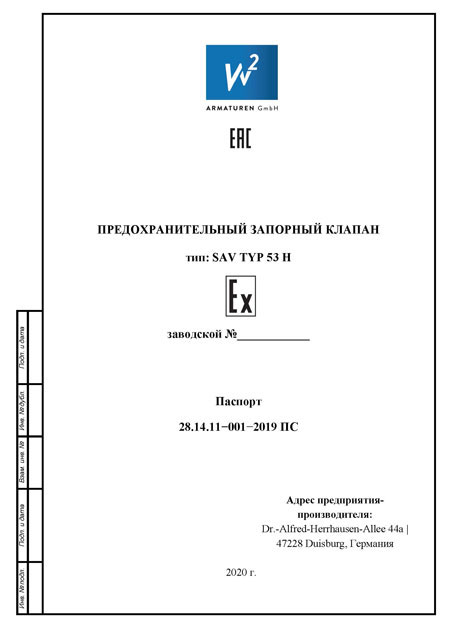 A technical passport is a document that summarizes the key technical specifications and the entire product lifecycle (commissioning, maintenance, repairs, disposal) of a product. All changes made to the machine are entered in the passport: modernization, conversion, installation of spare parts, repair, and welding work.
The technical passport is an important document for the end user of the product, and it must be submitted to the accredited certification body as part of the certification process.
In which countries a technical passport is requiredt?
The technical passport is an important document in the Eurasian Economic Union:
- Kazakhstan,
- Belarus
- Armenia
- Kyrgyzstan
- Russia
However, the certificate issued in accordance with GOST standards is also required in other CIS countries:
- Uzbekistan
- Azerbaijan
- Turkmenistan
- Tajikistan
What information does a technical passport provide?
The technical passport contains the key technical data of a machine, installation, or device:
- Product information and technical specifications such as product name, manufacturer, date of manufacture, serial number, and intended use
- Components and their characteristics
- Service life, operating life, storage life, and manufacturer’s warranty
- Instructions for use and storage, including special safety measures and specific operating conditions
- Packaging, preservation, and recycling
- All modifications made to the machine: modernization, reconstruction, installation of spare parts, repairs, welding work
- Information on existing EAC approvals
Why is a technical passport required?
There are two main reasons why a technical passport is a mandatory document.
On the one hand, the technical passport for machines, installations, or pressure equipment is a prerequisite for EAC certification and EAC declaration. It is a key document, especially when equipment or machinery is used in high-risk industrial facilities. In such cases, technical passports are subject to state supervision.
Secondly, the technical passport is a key document that not only allows the operator to record the entire lifecycle of the machine, but also consolidates all relevant information on maintenance, inspections, repairs, and modifications in one place. It serves as proof of compliance with safety and quality requirements, facilitates the planning of preventive maintenance measures, and is an important tool for traceability and liability management. Through systematic documentation in the passport, the operator can minimize risks, improve the efficiency of the machine, and quickly demonstrate compliance with legal requirements in the event of audits or official inspections. Therefore, the technical passport must be carefully maintained and regularly updated throughout the entire service life of the product.
According to which standards is the technical passport prepared?
- GOST 2.601-2019 “Unified system for design and operational documentation”
- GOST 2.610-2019 “Unified system for design documentation”
These are the main standards. In addition, other GOST standards may also apply depending on the product and the requirements of the relevant technical regulations, for example:
- GOST 34347-2017 “Steel welded vessels and apparatus. General technical requirements” – standards for pressure equipment
- GOST 34612-2019 “Pipeline valves. Technical passport. Rules for development and preparation”
- GOST 33259-2015 “Flanges for valves, fittings and pipelines for nominal pressure up to PN 250”
Scope of application of the technical passport
The technical passport is prepared in accordance with the requirements of the relevant technical regulations for a specific product. For machinery and equipment falling within the scope of technical regulations, a technical passport must be issued:
- TR CU 004/2011 On the safety of low-voltage equipment
- TR CU 010/2011 On the safety of machinery and equipment
- TR CU 011/2011 On the safety of elevators
- TR CU 012/2011 On the safety of equipment intended for use in explosive atmospheres
- TR CU 016/2011 On the safety of gas-fueled equipment
Content of a technical passport
The technical passport consists of a cover sheet and generally of the following sections:
- Basic information about the product and the technical data
- Completion
- Lifetime and storage duration, manufacturer's warranty
- Preservation
- Notes on packaging
- Instructions for acceptance
- Notes on the loan of equipment during the use
- Instructions for repair
- Instructions for operation and storage (if necessary)
- Disposal information
- Other information
- Price information
The technical passport must be stored carefully throughout the life of the product.
Key Facts About the Technical Passport
- The technical passport is created separately for each installation or machine and for each individual serial number.
- The technical passport is prepared in Russian. However, it is also possible to issue a bilingual passport. In most cases, the languages are Russian and English.
- The technical passport is prepared by the machine manufacturer. An authorized representative can also create the passport. Specialized service providers, such as Schmidt & Schmidt, also offer passport preparation, including in multiple languages.
- The technical passport is a mandatory document required to obtain an EAC declaration or an EAC certificate.
- The technical passport is recognized in the following countries: Armenia, Azerbaijan, Belarus, Kazakhstan, Kyrgyzstan, Russia, Tajikistan, Turkmenistan, Uzbekistan.
Our services
Our experienced experts develop high-quality technical documentation for the conformity assessment: EAC Certificate, EAC Declaration, state registration, fire safety certification, etc. If necessary, we can translate your documents into Russian.
Costs for the preparation of the technical passport
The cost for preparation of the technical passport depends on various factors. We always find an individual concept and offer a variety of payment options to meet the needs of our customers.