
Schmidt & Schmidt offers sworn and notarized document translation services in Turkey.
For the official use of foreign documents in Turkey, simply translating the text into Turkish is not sufficient. Depending on the country of origin of the document, the receiving institution, and the purpose of its use, an apostille or consular legalization, translation by a sworn translator, notarization, or a combination of several procedures may be required.
The institution of sworn translators in Turkey
The work of sworn translators in Turkey is directly connected with the notarial system. The main rules are established by Turkish Notary Law No. 1512 — Noterlik Kanunu — and the Noterlik Kanunu Yönetmeliği.
Article 103 of the Notary Law regulates the certification of a translation by a notary, while Article 96 of the Regulation on the Implementation of the Notary Law establishes the procedure for engaging a translator and having the translator take an oath before a notary.
In accordance with Article 96 of the Noterlik Kanunu Yönetmeliği, the notary must make sure that the translator has command of the relevant language. Diplomas, certificates, other documents, or other methods of verifying qualifications may be used for this purpose.
After that, the translator takes an oath before the notary, and the corresponding record is kept at the notary's office.
Thus, the Turkish concept of yeminli tercüman — “sworn translator” — is closely connected with the notary before whom the translator took the oath.
What kind of translation do you actually need?
Before starting work, it is important to determine not only the translation language, but also where, for which procedure, and by which institution the document will be used.
For example, the following options are possible:
| Situation | What may be required |
|---|---|
| The document was issued abroad and will be used in Turkey | An apostille or consular legalization may be required, after which the document is translated into Turkish and, if necessary, notarized. |
| A Turkish document will be used abroad | Translation, notarization, and subsequent apostille or consular legalization may be required. |
| Only an informational translation is required | Notarization and an apostille may not be required. |
| The document is intended for a court, migration authority, bank, university, or another official institution | The requirements should be checked before the translation begins. |
Therefore, we recommend informing us not only what needs to be translated, but also where the document will be submitted and for what purpose.
When is notarization of a translation not required?
Not every translation in Turkey needs to be notarized.
If the translation is used exclusively for information purposes, internal company work, preliminary review of a document, preparation of a transaction, or another action where the receiving party does not require an officially certified translation, an ordinary or sworn translation without notarization may be sufficient.
In addition, individual government authorities, banks, universities, consulates, and commercial organizations may establish their own requirements regarding the form of translation.
Therefore, the question should not be formulated as “is a notary required for this type of document in general,” but rather as “what form of translation does the specific institution require for the specific procedure”.
Schmidt & Schmidt helps determine the required level of certification before translation begins, so that the client does not pay for notarization, an apostille, or other procedures if they are not actually needed.
Sworn translation procedure in Turkey
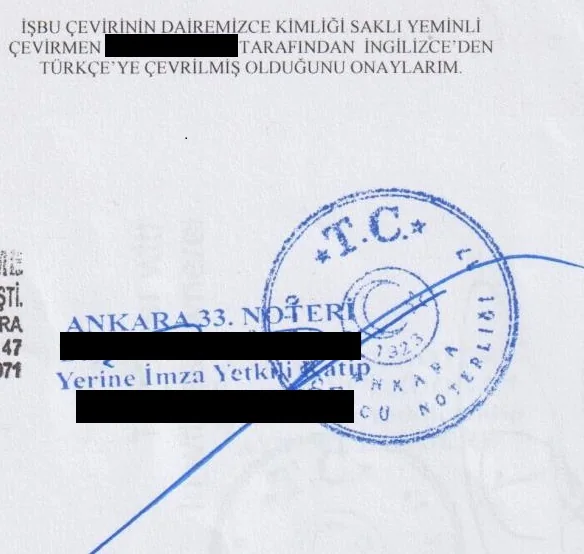
A sworn translator performs the translation and certifies it with their signature.
However, a sworn translation and a notarized translation are not the same thing.
Article 103 of Turkish Notary Law No. 1512 provides for certification of a translation by a notary. When a sworn translator is used, the certification clause includes the relevant information about the translator, after which the notary affixes the date, signature, and seal.
It is the notarial act that turns the translation into a notarized document.
Can a translation be certified by any notary?
Not always. In the Turkish system, the translator's oath is connected with the notary's office where the corresponding record is kept.
Article 96 of the Noterlik Kanunu Yönetmeliği provides that a notary cannot assign a translation to a person whose oath record is not held at that notary's office.
Therefore, a translator working with one notary does not automatically become a sworn translator for all notaries in Turkey.
This does not mean that the client is always required to personally apply to one specific notary's office. The legislation provides for interaction between notaries in cases where the required translation-related notarial act cannot be performed at the place of application.
Therefore, in practice it is important to determine in advance which translator and which notary will participate in the certification, especially if the document needs to be completed urgently or in a rare language.
Translation from the original and translation from a copy: aslından and fotokopisinden
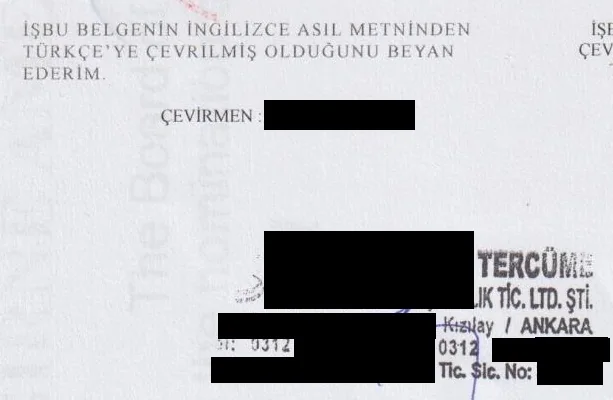
In Turkey, it is important to take into account the exact document from which the translation is made.
In notarial and translation practice, the following designations may be used, among others:
| Wording | What it means |
|---|---|
| aslından tercüme / aslından tercümedir | The translation was made from the presented original. |
| fotokopisinden tercüme / fotokopisinden tercümedir | The translation was made from a photocopy. |
Notarization of a translation made from an ordinary photocopy does not in itself mean that the notary confirmed that the copy corresponds to the original.
If the receiving authority requires a translation from the original or from a notarized copy, a translation from an ordinary photocopy may not be suitable.
Therefore, before the procedure begins, it should be determined what exactly is required:
- translation from the original;
- translation from a notarized copy;
- translation from an ordinary copy;
- notarized translation;
- notarial copy with translation;
- apostille on the source document;
- apostille on the notarized translation.
Does the document need to be translated in full? Kısmi tercüme — partial translation
It is not always necessary to translate a document in full. Depending on the purpose for which the document will be used and the requirements of the receiving institution, it may be sufficient to translate individual pages, sections, or information.
Such a translation is called kısmi tercüme — partial translation.
The concepts of kısmi tercüme and aslından / fotokopisinden describe different characteristics of a translation. Kısmi tercüme means that only part of the document is translated, while aslından or fotokopisinden indicates whether the translation was made from the original or from a copy.
Therefore, a partial translation can also be made from the original and bear the corresponding aslından notation. The fact that only part of the document is translated does not in itself mean that the translation was made from a copy.
| Option | What it means |
|---|---|
| aslından tam tercüme | Full translation of the document from the presented original. |
| aslından kısmi tercüme | Translation of only the necessary part of the document from the presented original. |
| fotokopisinden tam tercüme | Full translation of the document from a photocopy. |
| fotokopisinden kısmi tercüme | Translation of only the necessary part of the document from a photocopy. |
For example, a client may present the original of a multi-page corporate document, but for a specific procedure only a translation of the page containing information about the director, a particular contractual provision, a registry entry, or other specific information is required.
In that case, the translation may remain a translation from the original — aslından, even though the entire document is not translated.
With a partial translation, it must be clear exactly which part of the source document was translated. Such a translation must not create the impression that the entire document was translated if it covers only individual pages, clauses, or information.
The possibility of using kısmi tercüme must be determined taking into account the requirements of the receiving institution. If a full translation is required for a specific procedure, a partial translation will not be sufficient.
Before starting work, Schmidt & Schmidt can determine whether the entire document really needs to be translated. If only a specific part is sufficient, this makes it possible to reduce the scope of work, time, and translation cost without the need to use a copy instead of the original.
Apostille and notarized translation in Turkey
If a foreign official document is to be used in Turkey, it is first necessary to determine whether it requires legalization.
For documents from states party to the 1961 Hague Convention, an apostille is used in the relevant cases. Documents from other states may require consular legalization or another procedure provided for by international agreements.
If the apostille forms part of the foreign document, the entire set, including the text of the apostille, is generally translated.
Why the translator's signature alone is not sufficient for an apostille on the translation
If an apostille is required specifically on the translation, the signature of the sworn translator alone is generally insufficient.
An apostille confirms:
- the authenticity of the signature;
- the capacity in which the person signing the document acted;
- where appropriate, the authenticity of the seal or stamp.
An apostille does not confirm the accuracy of the document's content or the quality of the translation.
A sworn translator does not become a public official merely because they took an oath before a notary. Therefore, the translation is usually notarized first, after which the notarial document can be apostilled.
Typical procedure:
- translation by a sworn translator;
- notarization of the translation;
- apostille by the competent Turkish authority.
At the same time, it is necessary to distinguish between an apostille on the source document and an apostille on the notarized translation. Depending on the requirements of the receiving authority, one of these actions or both may be required.
Our main advantage — translation taking into account the purpose of the document
The same word may have several formally correct translations, but not every one of them is suitable for a specific legal or administrative procedure.
Schmidt & Schmidt first determines where the document will be submitted and what function it must perform, and then draws the translator's attention to critically important terminology.
For example:
| Term | Risk of inaccurate translation | What must be taken into account |
|---|---|---|
| licence | It may turn into undefined “rights.” | It must remain a licence or permit if that is what the source document means. |
| exclusive | The meaning of exclusivity may be lost. | The legal meaning of exclusivity must be preserved. |
| shall | An obligation may be rendered as a neutral or future action. | The appropriate degree of obligation must be conveyed. |
| may | A right or possibility may mistakenly be turned into an obligation. | The appropriate nature of the authority or possibility must be preserved. |
| authorised representative | The scope of the representative's authority may be rendered incorrectly. | The translation must reflect the actual nature of the authority granted. |
| province, region, state, district, municipality, city | The administrative classifications of different countries may not correspond. | The term must be selected taking into account the administrative system of the destination country. |
For example, an administrative unit called a province in the country of origin may fall under the category of city in the classification of the receiving institution. In such a case, it is necessary to select a term understandable to the receiving authority without distorting the content of the original.
If there is no exact equivalent, the original concept may be retained in brackets or supplemented with an explanatory wording.
Why can a literal translation change the meaning of a document?
Consider a simple example:
Original wording: Exclusive Distribution Licence.
If the word exclusive is omitted and licence is rendered only as general “rights,” the translation may create a completely different impression of the nature of the relationship between the parties.
The correct wording depends on the entire document: it may concern an exclusive licence, an exclusive right of distribution, or another legal construct.
The translator's task is not to mechanically replace each word with the nearest dictionary equivalent, but to accurately convey the legal meaning that is actually present in the original.
Our task is not to change the document to achieve a desired result, but to prevent a formally permissible but unfortunate translation of one word from changing its legal meaning.
This is particularly important for contracts, licences, powers of attorney, corporate documents, court materials, commercial registers, documents concerning authority, diplomas, and migration documents.
Names, company names, dates, and transliteration
In an official translation, it is important to render correctly not only the content of the document, but also identifying information.
Particular attention is required for:
- first and last name;
- name of the legal entity;
- name of the government authority;
- address;
- document number;
- dates;
- administrative-territorial units;
- names of educational institutions and positions.
The same name may have several variants of Latin transliteration. For example, a name written as Aleksandr in one document may appear as Alexander in another.
For an official procedure, such a difference may matter even if it is obvious that the documents refer to the same person.
Therefore, when translating personal documents, we try to verify the spelling of the first and last name primarily against the passport or another document that will be used to identify the person in the destination country.
A similar problem arises with company names. A registered corporate name should not always be translated literally. In some cases, the official company name should be preserved, while a translation of the legal form or an explanation should be provided separately.
Dates, document numbers, amounts, and other identifiers also must not be arbitrarily “corrected” or adapted by the translator. If the source document contains an unusual system of dating or notation, this must be taken into account in such a way that the translation remains understandable while also corresponding to the original.
What should be done if an error is discovered after notarization?
If an error is discovered before notarization, it can usually be corrected in the translation before the procedure is completed.
The situation is more complicated if the translation has already been notarized.
You cannot simply change the text in an electronic copy of an already executed notarial document and continue using it as the original.
Depending on the nature of the error, the stage of the procedure, and the notary's requirements, it may be necessary to prepare a corrected translation, carry out notarization again, or perform another action provided for by the notarial procedure.
If the incorrect translation has already been apostilled or the document has been legalized for use abroad, after correction it may also be necessary to repeat the subsequent stages.
Therefore, when an error is discovered, Schmidt & Schmidt first determines at what stage the document is and which actions actually need to be repeated.
Translation of websites and the e-Tespit system
It is necessary to distinguish between translation of the text of a web page and proof that specific information was actually located at a particular internet address at a particular point in time.
A translator can translate a printout or file provided to them. However, the translation and its notarization do not in themselves confirm that the text was actually located on the specified website on a particular date.
For the official recording of internet content in Turkey, there is a special notarial procedure called e-Tespit, which operates through the information system of Türkiye Noterler Birliği.
The legal basis for electronic recording is Article 198/A of Notary Law No. 1512 and the Noterlik İşlemlerinin Elektronik Ortamda Yapılması Hakkında Yönetmelik.
If an internet page is to be used, for example, in court or another official procedure, the sequence may be as follows:
- recording the internet content through e-Tespit;
- execution of a notarial document;
- if necessary — translation of the recorded content;
- if used abroad — determining whether an apostille or other legalization is required.
Schmidt & Schmidt can help determine whether a simple translation of a web page is sufficient or whether the internet content must first be officially recorded.
The following may be subject to official translation:
| Category | Documents |
|---|---|
| Civil status records | Birth, death, marriage, and divorce certificates; documents issued by civil status registration authorities. |
| Education and qualifications | Diplomas, school-leaving certificates, and qualification documents. |
| Judicial and law enforcement documents | Court documents; criminal record certificates; documents issued by law enforcement authorities. |
| Personal documents | Identity documents; medical documents; consents for a child to travel abroad. |
| Notarial documents | Notarial acts; powers of attorney. |
| Corporate documents | Constitutive and corporate documents; extracts from commercial registers and company registers. |
| Real estate | Extracts from foreign real estate registers. |
| Licensing and technical documents | Licences and permits; documents confirming compliance with requirements and standards. |
Cost of sworn translation in Turkey
The cost depends on the volume of the document, language pair, complexity of the content and layout, the need for notarization, and additional procedures.
The price is determined individually after reviewing the document.
At the same time, it is not always necessary to pay for translation of an entire multi-page document. If the receiving authority only needs a specific part and kısmi tercüme is permitted, the cost can be calculated only for the required volume.
Notarization, apostille, consular legalization, e-Tespit, and courier delivery, if required, are calculated separately.
Timeframes for sworn translation in Turkey
The timeframe depends on the volume and complexity of the document, the language, the availability of the relevant sworn translator, and the need for notarization.
If an apostille, legalization, or other official processing is additionally required, the overall timeframe also depends on the work of the relevant authorities.
Courier delivery of completed documents from Turkey is charged separately.
How to order a translation?
For a preliminary review, send us a scan of the document and provide the following information:
- the country where the document was issued;
- where it will be used;
- the institution to which it will be submitted;
- the procedure for which it is required;
- the language into which the translation is required;
- whether the original document is available.
If the document is large, also indicate exactly what information needs to be presented to the receiving institution. We will be able to check whether a full translation is required or whether kısmi tercüme may be sufficient.
Based on this information, we will be able to determine whether translation from the original or from a copy, a full or partial translation, notarization, apostille, consular legalization, or another form of processing is required.
Official sources
When preparing documents, it is recommended to check the current requirements using official sources:
- Turkish Ministry of Justice — Noterlik Kanunu — the official legislation section of the Turkish Ministry of Justice containing Notary Law No. 1512.
- Turkish Ministry of Justice — Noterlik Kanunu Yönetmeliği — the official section of regulations governing notarial activities.
- Türkiye Noterler Birliği / e-Devlet — e-Tespit — the official electronic service for recording internet content.
- HCCH — Convention of 5 October 1961 on Apostille — the official text of the Hague Convention abolishing the requirement of legalization for foreign public documents.
Frequently asked questions about sworn translation in Turkey
A sworn translator — yeminli tercüman — is a translator who has taken an oath before a notary and whose details are held by the relevant notary's office. A sworn translation and a notarized translation are separate concepts.
It depends on where the document is submitted. For many official procedures, a notarized translation is specifically required. If the document is needed only for information purposes or the receiving party accepts a sworn translation without notarization, additional notarization may not be required.
Yes, a translation can be made from a copy, but the notation indicating which document it was translated from must be taken into account. A translation from a photocopy does not automatically mean that the notary confirmed that the copy corresponds to the original.
Not always. If the receiving authority only needs specific pages, information, or provisions, kısmi tercüme — partial translation — may be permitted. At the same time, a partial translation can be made either from the original — aslından — or from a copy — fotokopisinden. The possibility of using a partial translation must be determined in advance taking into account the requirements of the receiving institution.
It depends on the document, its country of origin, and the requirements of the receiving authority. If an apostille is required on the source document, the apostille is generally obtained first, and then the entire document is translated together with the apostille.
As a rule, the translation must first be notarized before it can be apostilled. An apostille certifies the official signature, the authority of the person who signed, and the seal or stamp, but does not confirm the accuracy of the translation itself.
Notarial certification should not be regarded as an independent expert review of every legal term. This is precisely why, for legally significant documents, it is important to determine the purpose of the translation in advance and check critically important terminology.
It is possible to translate a printout or file of a web page, but such a translation does not in itself prove that the information was actually located on the specified website at a particular point in time. The e-Tespit system may be used for the official recording of internet content in Turkey.
There is no universal rule under which a Turkish notarized translation is automatically accepted in all countries. The requirements are determined by the destination country and institution. An apostille or consular legalization of the notarial document may be required, and in some cases the receiving authority requires a translation made or certified directly in the destination country.
It depends on the document, the country where it was processed, and the requirements of the Turkish institution. Foreign notarization may require an apostille or consular legalization. In addition, the specific Turkish institution may require a translation into Turkish prepared in the form prescribed for that procedure. Therefore, a foreign notarized translation should not be considered automatically sufficient for every procedure in Turkey.
You cannot simply change the electronic copy of an already executed notarial document. Depending on the nature of the error, a corrected translation and new notarization may be required. If the document has already been apostilled or legalized, the subsequent stages may also need to be repeated.
Usually, a scan of the document is sufficient for a preliminary calculation. It is also necessary to provide the translation language, the country and institution where the document will be used, and indicate whether notarization, an apostille, or other legalization is required. For multi-page documents, it is also advisable to indicate whether the entire document or only specific information needs to be translated.