
Diplomas, certificates and other educational documents issued in Ukraine after 2022 do not have official legal validity abroad. In practice, this means that, unless such a document is legalised, it cannot be used to apply for a master's or doctoral programme at a foreign university or to obtain employment at a state institution.
Two separate procedures apply to Ukrainian diplomas, school-leaving certificates and other educational documents, and it is important not to confuse them. Recognition (nostrification) confirms that the level of education obtained is equivalent to the state's standard. Legalisation (apostille) confirms the authenticity of the document itself — that the signatures and seals on it are genuine.
How the rules on diploma recognition have changed
As of 19 May 2024, the 1993 Minsk Convention on Legal Assistance ceased to apply to Ukraine. From that point onwards, Ukrainian documents formally require an apostille to be used in these contries (under the 1961 Hague Convention, which remains applicable between the two countries). In practice, obtaining a Ukrainian apostille under the current circumstances is extremely difficult.
Why and when is an apostille required?
If you intend to use a Ukrainian diploma in a country that is a signatory to the 1961 Hague Convention, you can legalise it for university admission through a simplified procedure known as apostillisation.
An apostille is a special stamp that confirms the authenticity of an official document. It can be affixed to documents issued by government authorities, local self-government bodies, educational institutions and organisations to which the state has granted special powers.
Commercial documents cannot be apostillised. Therefore, if you have received a certificate for completing an educational course offered by a private company that does not hold an educational licence, it cannot be apostillised. Only documents issued by accredited educational institutions holding an official state licence can be legalised through apostillisation.
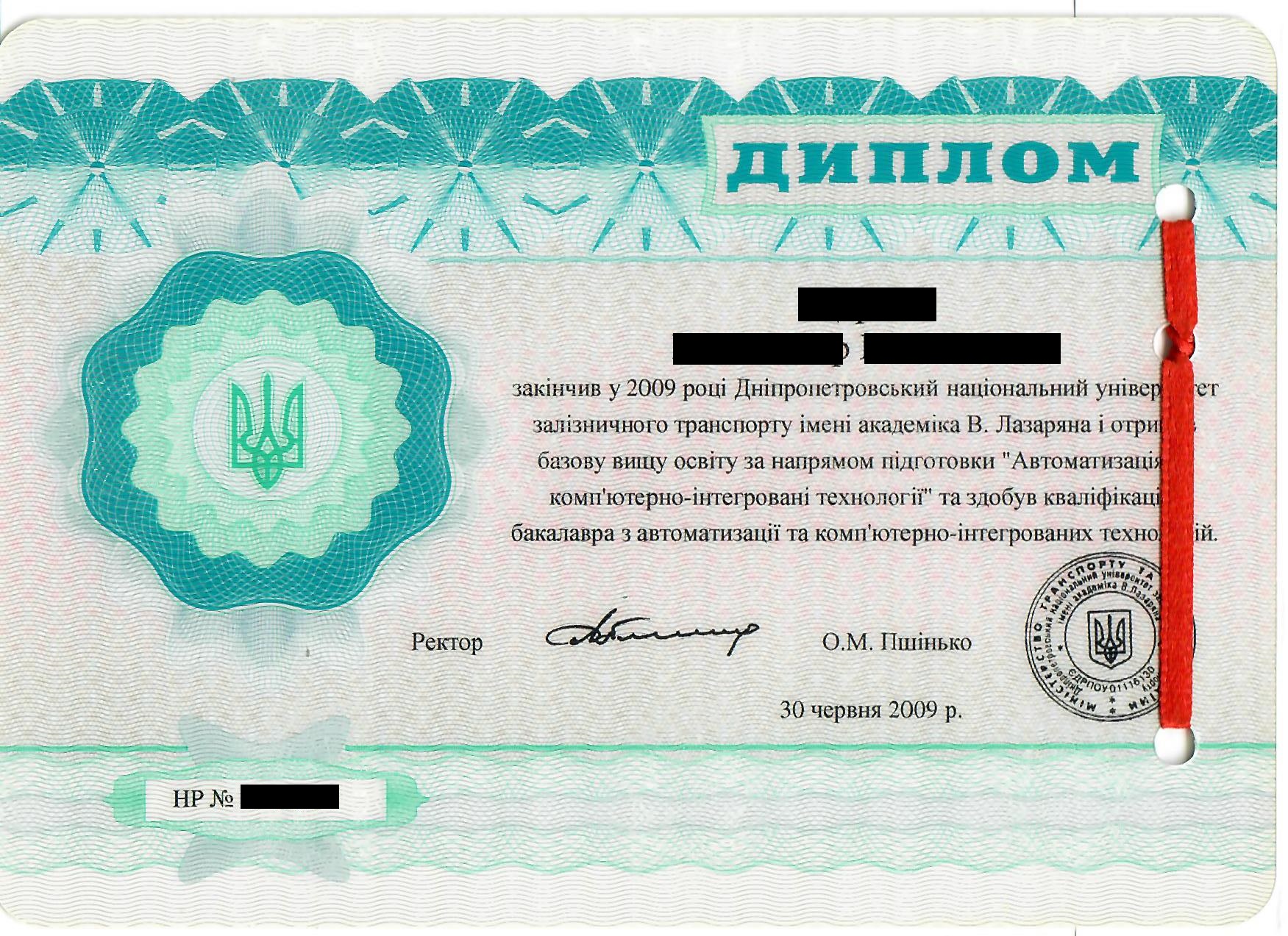
It should be noted, however, that apostillisation confirms that the document was issued and that the signature of the authorised official is authentic. It does not automatically grant the right to work in regulated professional fields (such as medicine, law, etc.), nor does it replace the recognition of higher education — nostrification. Nostrification is required for admission to universities or employment in a profession corresponding to the qualification obtained.
An apostille can only be affixed in the country where the document was issued. It is not possible to obtain one through diplomatic or consular missions.
When is an apostille not required?
Most commercial organisations will not require employees applying for positions that do not involve special access to have their diplomas or other educational documents legalised by means of apostillisation. In addition, a diploma does not need to be apostillised if a special mutual recognition arrangement covering diplomas and academic degrees is in force between Ukraine and another country. Such arrangements may affect eligibility for university admission or employment in one's professional field.
For example, Ukraine was a party to the 1993 Minsk Convention, which meant that diplomas generally did not require an apostille for use in most CIS countries. A notarised translation of the diploma from Ukrainian into the official language of the country where it was to be used was sufficient.
Ukraine decided to withdraw from the Convention at the end of 2022; however, it formally ceased to apply to Ukraine on 19 May 2024. Since that date, Ukrainian diplomas have generally required an apostille for use in most CIS countries, with the exception of Moldova, Uzbekistan and Georgia, with which Ukraine has separate bilateral agreements.
Procedure for apostillising diplomas in Ukraine
Apostilles are affixed at regional offices of the Ukrainian Ministry of Education or at the Ministry of Education and Science in Kyiv itself. The Ministry of Education sends a written request to the university that issued the diploma and, once confirmation has been received, affixes the apostille.
The Ministry of Education and Science of Ukraine does not affix apostilles to educational documents directly. Applications are processed by the state-owned enterprise "Information and Image Centre" (ENIC Ukraine). Documents can be submitted in two ways: through a courier service or at the Centre's office, either in person or through a representative. In both cases, you must first register an electronic account on the Centre's website and create an application. Instructions are available on the portal.
Key application requirements:
- the applicant must be an adult holding a passport; the applicant does not have to be the owner of the documents;
- a single application must be created for all documents, in the name of the applicant rather than the document holder (if they are different people);
- the application must be completed in Ukrainian only;
- scanned copies must be in colour, legible and show all relevant details; they must be submitted in .jpg or .jpeg format and must not exceed 1 MB.
The operator processes the application within 1–3 working days. Applications completed incorrectly will not be accepted for processing. Once the application has been checked, the applicant receives a notification with further instructions. If everything is in order, the documents can then be sent: the original document, the original application and the original payment receipt. For in-person submission at the office, it is sufficient to create an application and book an appointment in advance; a notarised authorisation for a representative is not required.
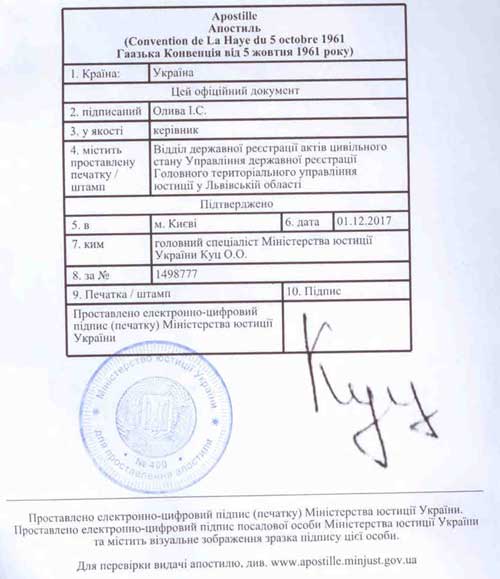
The authenticity of an apostille that has already been affixed can be verified through the Centre's online service (available in Ukrainian and English): https://enic.in.ua/index.php/ua/aporegua. The database contains apostilles issued by the Ministry of Education and Science of Ukraine since 18 January 2013. To verify an apostille, enter its number (field 8), the application number (the additional number above the barcode, in the format AZ-12345-67) and the date of the apostille (field 6).
The apostillisation procedure at the Ukrainian Ministry of Education generally takes around 5–10 working days. No power of attorney is required.
Documents Required for Legalisation:
- Original diploma;
- Original diploma supplement, if available.
Format of Ukrainian educational documents
Since 1997, diplomas in Ukraine have been issued in the form of plastic cards, with the diploma supplement issued separately on paper. In this case, the apostille is affixed to a separate sheet, which is attached to the diploma. Both the diploma and its supplement issued before the late 1990s are paper documents, and an apostille is affixed to each separately. This means that two apostilles are required, and the documents are not bound together. The older format has also been retained for specialist retraining diplomas.
Types of educational documents issued in Ukraine
School education
- Certificate of Primary Education (свідоцтво про здобуття початкової освіти);
- Certificate of Basic Secondary Education (свідоцтво про здобуття базової середньої освіти);
- Certificate of Complete General Secondary Education (свідоцтво про здобуття повної загальної середньої освіти) — formerly known as the school-leaving certificate.
Higher education
- Junior Bachelor's Degree Diploma (диплом молодшого бакалавра);
- Bachelor's Degree Diploma (диплом бакалавра);
- Master's Degree Diploma (диплом магістра);
- Doctor of Philosophy / Doctor of Arts Diploma (диплом доктора філософії / доктора мистецтва);
- Doctor of Sciences Diploma (диплом доктора наук).
The following qualifications were previously awarded but are no longer issued: Specialist Diploma, Junior Specialist Diploma and Candidate of Sciences Diploma.
In addition, Ukraine issues specialist retraining diplomas, as well as various educational certificates and statements.
The format of the apostille used in Ukraine is standardised and does not depend on the region in which it is affixed.
Sending documents from Ukraine
Since apostilles in Ukraine are affixed to original educational documents, the document must first be sent to a third country and then onwards to Ukraine. Direct delivery is not available. The cost of such courier delivery is calculated according to the rates charged by courier services.
However, given the current political situation, we do not recommend sending original diplomas or certificates issued by Ukrainian universities to Ukraine. There is a considerable risk that the document will not reach its destination.
In such cases, together with our colleagues in Kyiv, we obtain a duplicate diploma from the university or school, have it apostillised in Kyiv, and transport it first to Germany, from where it is then sent to the client.
Due to the restrictions in place, delivery takes 3–4 weeks.
Consular legalisation in Ukraine
If a diploma is to be used in a country that is not a party to the Hague Convention, such as the UAE or Egypt, it must undergo consular legalisation. This procedure is more complex than apostillisation. The consular legalisation of diplomas and certificates in Ukraine involves several stages:
- Obtaining a notarised copy of the diploma in Ukraine.
- Obtaining a notarised translation of the copy into the language of the destination country.
- Certification by the Ministry of Justice of Ukraine.
- Certification by the Consular Department of the Ministry of Foreign Affairs of Ukraine.
- Certification by the embassy of the destination country.
The first three stages of legalisation can be completed either at the regional level or in Kyiv. The fourth stage can only be completed in Kyiv.
At present, however, the final stage — certification by the embassy — cannot be completed in Ukraine. Due to the political situation, almost all embassies in the country are closed. It is therefore necessary to contact the embassy of the destination country in either Warsaw or Berlin. The UAE is an exception to this rule. After certification by the Ukrainian Ministry of Foreign Affairs, the documents must be submitted directly to the UAE Ministry of Foreign Affairs in Dubai, where the final legalisation stamp will be affixed.
What is an apostille?
What is an apostille? Why do I need an apostille? How do I get an apostille? - Our video will explain everything you need to know about the apostille. If you have a document that needs to be certified with an apostille for use abroad, Schmidt and Schmidt will assist you! We provide apostille services in more than 100 countries worldwide.
Translation of educational documents
To use an educational document abroad, it must be accompanied by an official notarised translation prepared in accordance with national law after legalisation. If the translation is prepared by a notary's office in Ukraine, it will not be accepted by official authorities in other countries.
The translation must undergo a verification process. This involves sending the completed translation to the graduate for review to ensure that their first and last names, the subjects studied and the titles of academic papers have been translated correctly, as inaccuracies may arise during translation.
The notarised translation may be bound to the notarised copy bearing the apostille.
What is consular legalization?
In our video we are explaining what consular legalization is and where to apply for it.
Schmidt & Schmidt will assist you in all issues concerning the legalization.
Schmidt & Schmidt offers legalization in more than 80 countries all over the world.
What happens next?
Once you have received your legalised diploma, together with a copy bearing an attached notarised translation, the documents can be considered officially valid for use in Russia. You can submit this set of documents to Russian universities when applying for a master's or doctoral programme, or to the Federal State Budgetary Institution "GlavExpertCentre" for the recognition of your qualification.
How can we help?
If you are located outside Ukraine, we would be pleased to assist you with the apostillisation and legalisation of your documents for use abroad.
You can always contact Schmidt & Schmidt. We have extensive experience in legalising a wide range of documents and provide all the services required in this area, including obtaining notarised copies, translation, preparing the necessary powers of attorney, legalising documents with government authorities and foreign consulates, and delivering completed documents to most countries worldwide.
You can find out more about the legalisation and apostillisation procedures on our website.