


Police Clearance Certificate is an official document issued by the internal affairs authorities confirming that a person currently has no criminal record and is not wanted in connection with a criminal case. Alternatively, any previous criminal records have already been expunged.
Police Clearance Certificate may often be required in the following situations:
- Obtaining a visa;
- Applying for a temporary residence permit;
- Applying for a residence permit;
- Obtaining citizenship;
- Employment;
- Admission to an educational institution;
- Background checks for adoption and guardianship;
- Providing evidence in court;
- Entering into marriage.
What is a Police Clearance Certificate in Poland?
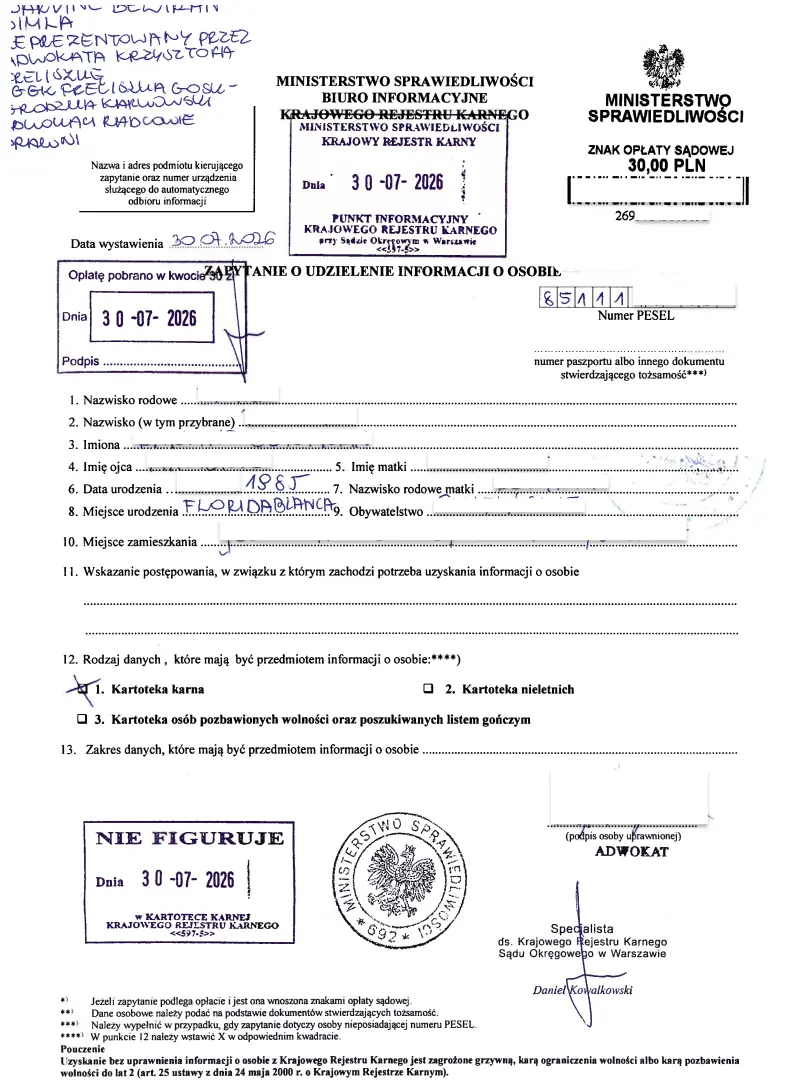
In everyday speech, a document confirming the absence of a criminal record in Poland is generally referred to simply as a “Police Clearance Certificate” (zaświadczenie o niekaralności). However, this is not its official name. The document itself has no title, and in official acts it is referred to as “information about an individual from the National Criminal Register” (informacja o osobie z Krajowego Rejestru Karnego — KRK). The register itself is administered by the Polish Ministry of Justice.
The issuance of Police Clearance Certificates in Poland is regulated by the Act of 24 May 2000 on the National Criminal Register, the Regulation of the Minister of Justice of 7 July 2015 on providing information about individuals and legal entities based on data collected in the National Criminal Register, and other legal and regulatory acts.
A Police Clearance Certificate is a paper or electronic document generated on the basis of data from the National Criminal Register. The document is issued in Polish.
The National Criminal Register collects data on persons:
- Who have been convicted by a final court judgment of criminal offences or fiscal offences;
- Against whom criminal proceedings in cases concerning criminal or fiscal offences have been conditionally discontinued;
- Against whom criminal proceedings in cases concerning criminal or fiscal offences have been finally discontinued on the basis of an amnesty;
- Who are Polish citizens and have been convicted by courts of other countries;
- In respect of whom security measures have been imposed in accordance with the law in cases concerning criminal or fiscal offences;
- Minors in respect of whom educational, therapeutic or corrective measures have been imposed pursuant to the Act of 9 June 2022 on the Support and Rehabilitation of Minors;
- Who have been finally found guilty of minor offences and sentenced to imprisonment;
- Who are wanted under an arrest warrant;
- Who are temporarily detained;
- Who are serving sentences of life imprisonment, imprisonment for up to 25 years, imprisonment, military detention, detention or substitute imprisonment;
- Minors placed in juvenile shelters.
In paper form, the Police Clearance Certificate is a completed standard request submitted by the applicant to the KRK, bearing a special stamp confirming the presence or absence of a criminal record. In electronic form, the Police Clearance Certificate is an XML document intended to be read by a computer. The electronic document is certified with the digital signature of an official and has no legal validity in printed form.
Only a paper Police Clearance Certificate bearing the signature of an official is suitable for apostille and subsequent use abroad.
How to obtain a Police Clearance Certificate in Poland
There are three ways to obtain a Police Clearance Certificate in Poland:
- Apply in person at one of the information points of the National Criminal Register (they are usually located at district or regional courts);
- By post;
- Electronically via the National Criminal Register’s e-KRK portal.
Police Clearance Certificate in person
To obtain a Police Clearance Certificate, you need to visit one of the National Criminal Register’s information points in person and complete the relevant application form with your personal details (the form can be obtained on site or printed out in advance from the Internet). You must bring your passport, a power of attorney (if the request is being made on behalf of a third party), and money to pay the fee. After checking the databases, a register employee will place a special stamp on the form confirming the presence or absence of a criminal record and issue the document to the applicant.
Police Clearance Certificate by post
To submit a request for a Police Clearance Certificate by post, you need to pay the fee (it is important that the payment date matches the date stated in the application), print and complete the application form from the Internet, and then send it to the National Criminal Register (together with the receipt, stamp and proof of payment). The response will look the same as in the case of an in-person application — a form completed by the applicant bearing a special stamp.
Police Clearance Certificate electronically
To obtain a Police Clearance Certificate electronically, you need to create a profile on the ePUAP portal, register, select “Applications and Requests”, complete the application, sign it digitally, pay the fee and submit it. The response will be sent to your email address as an XML file. However, it is unlikely to be accepted for use abroad (except in countries that do not require Poland to provide additional legalization of documents).
Police Clearance Certificate by power of attorney
A Police Clearance Certificate can also be obtained by power of attorney. When submitting the request, the applicant’s representative must present a document confirming their identity, a document authorizing them to represent the applicant (power of attorney), as well as a copy of the power of attorney and a copy of the represented person’s identity document.
Processing time for a Police Clearance Certificate in Poland
The general processing time is from one to three months, depending on the city, the specifics of the request, and the need for legalization and the delivery address.
Apostille for a Polish Police Clearance Certificate
Poland acceded to the Hague Convention Abolishing the Requirement of Legalization for Foreign Public Documents in 2004, and the Convention entered into force in the country in 2005.
Apostilles on Polish Police Clearance Certificates are issued by the Ministry of Foreign Affairs. Before obtaining an apostille, you must submit an application in advance through the e-Konsulat system. To apply for an apostille, you must have the complete set of documents, the application, a printed confirmation of the appointment, and the payment receipt.
Please note that an apostille cannot be affixed in Poland to a printout of an electronic Police Clearance Certificate or to a copy of a paper certificate. Only the original paper Police Clearance Certificate is eligible for an apostille.
What is an apostille?
What is an apostille? Why do I need an apostille? How do I get an apostille? - Our video will explain everything you need to know about the apostille. If you have a document that needs to be certified with an apostille for use abroad, Schmidt and Schmidt will assist you! We provide apostille services in more than 100 countries worldwide.
Consular legalization of a Polish Police Clearance Certificate
If the country where the Polish Police Clearance Certificate is to be used is not a party to the 1961 Hague Convention, for example the UAE, a more expensive and complex consular legalization procedure will be required for the document to be accepted.
Consular legalization is a multi-step procedure for certifying the authenticity of a document, used for countries that are not parties to the 1961 Hague Convention.
To have a Polish Police Clearance Certificate legalized through the consular legalization procedure, you need to follow these steps:
- Obtain the Police Clearance Certificate;
- Have the certificate legalized by the Ministry of Foreign Affairs;
- Have the document translated by a sworn translator;
- Have the document legalized at the consulate or consular section of the embassy of the destination country.
Due to the number of steps involved, the procedure is lengthy and quite costly. Some countries do not have consulates in Poland, in which case the final stage of legalization may need to be completed in another country where the relevant consulate is located.
What is consular legalization?
In our video we are explaining what consular legalization is and where to apply for it.
Schmidt & Schmidt will assist you in all issues concerning the legalization.
Schmidt & Schmidt offers legalization in more than 80 countries all over the world.
Official translation of a Polish Police Clearance Certificate
A Polish Police Clearance Certificate is issued in Polish. To use it abroad, an official translation must be prepared in accordance with the legislation of the country where the document will be submitted — by a sworn, certified, notarial or court translator in the country of destination.
A translation of the certificate made in Poland (except when the consular legalization procedure is applied) will most likely not be accepted abroad.
Document delivery
After obtaining and apostilling or legalizing a Police Clearance Certificate, it is often necessary to send the document to another country. In such cases, not only speed but also the security of delivery is important, especially when dealing with original official documents.
Schmidt & Schmidt organizes international document delivery worldwide. We use reliable logistics solutions and modern tracking systems, allowing you to monitor the shipment at every stage and ensure its timely delivery to the recipient.
Our specialists ensure careful and confidential handling of documents and help resolve any issues that may arise during international delivery, including carrier requirements and customs clearance procedures.
We can arrange delivery of Police Clearance Certificates, legalized documents, translations and other official documents to most countries worldwide, both for private clients and for law firms and organizations.
How can we help?
We will be happy to assist you in obtaining a Police Clearance Certificate in Poland, including its procurement and legalization for use abroad, as well as translation and delivery anywhere in the world.
You can always contact Schmidt & Schmidt. We have extensive experience in the procurement and legalization of various documents and provide all the necessary services in this area, including obtaining notarized copies, translation, preparation of the required powers of attorney, legalization of documents with government authorities and consulates of foreign countries, as well as delivery of completed documents to most countries worldwide.
You can find more information about the legalization procedure on our website.


