
Divorce often creates an international document problem long after the divorce proceedings themselves are over. A person who divorced in Turkey may later need to prove the divorce abroad in order to remarry, obtain citizenship or a residence permit, change a surname, settle an inheritance, deal with child custody, or complete another official procedure. The opposite situation is equally common: a person divorces abroad, but the divorce must still be documented, authenticated, translated, or registered in Turkey.
According to the Turkish Statistical Institute (TÜİK), 193,793 couples divorced in Turkey in 2025. In international cases, the practical difficulty is often not the divorce itself, but the documents that come afterwards. Which document actually proves a Turkish divorce? Does the judgment have to contain a Certificate of Finality (kesinleşme şerhi)? Where is the apostille obtained? What happens if the destination country does not accept apostilles? Is a formal court recognition procedure (tanıma ve tenfiz) required? And what should be done if the original divorce judgment was lost many years ago?
Below we explain how Turkish divorce documents are obtained and prepared for use abroad, and how foreign divorce decisions can be prepared for official use in Turkey. We also highlight essential legal requirements, common administrative pitfalls, and practical steps to avoid unnecessary delays.
In brief: divorce documents in Turkey
- Main document: a Turkish divorce is normally proved by the court's Divorce Judgment (boşanma kararı).
- Finality matters: the divorce takes legal effect when the judgment becomes final. For international use, the judgment may therefore need a certificate of finality or another confirmation of finality.
- Apostille: Turkish divorce judgments are judicial documents. If the Hague Apostille Convention applies, they can be apostilled through the competent judicial authority.
- Non-Hague countries: where an apostille cannot be used, consular legalization or another procedure may apply. In some court proceedings, documents may also be requested directly through international judicial-assistance channels.
- Lost judgment: in many cases, an old divorce judgment can be located and a new certified copy obtained from the competent court or judicial archive.
- Foreign divorce: a divorce granted abroad may need authentication, Turkish translation, and registration in the Turkish civil registry.
- No Turkish lawsuit in every case: certain foreign divorce decisions can be registered administratively in Turkey without separate recognition proceedings if the statutory requirements are satisfied.
- Next step: send us a scan of the document you already have and tell us where the divorce took place and in which country the document will be used. We can determine what needs to be obtained, apostilled, legalized, or translated.
Key terms
Divorce Judgment (boşanma kararı) is the court judgment by which a marriage is dissolved in Turkey. For international procedures, this is usually the most important document.
Certificate of Finality (kesinleşme şerhi) confirms that a court judgment has become final. This is important because the date on which a divorce judgment becomes final is legally different from the date on which the court originally pronounced its decision.
Recognition (tanıma) means recognition in Turkey of the legal effect of a foreign judgment, while Enforcement (tenfiz) concerns enforcement of provisions of a foreign judgment that require execution in Turkey.
Population Registry Extract (nüfus kayıt örneği) is an official Turkish population-registry extract, also commonly described in English as a civil registry extract. Depending on the purpose of the foreign procedure, it may also be used to demonstrate a person's civil status.
Divorce in Turkey: divorce by mutual agreement and contested divorce
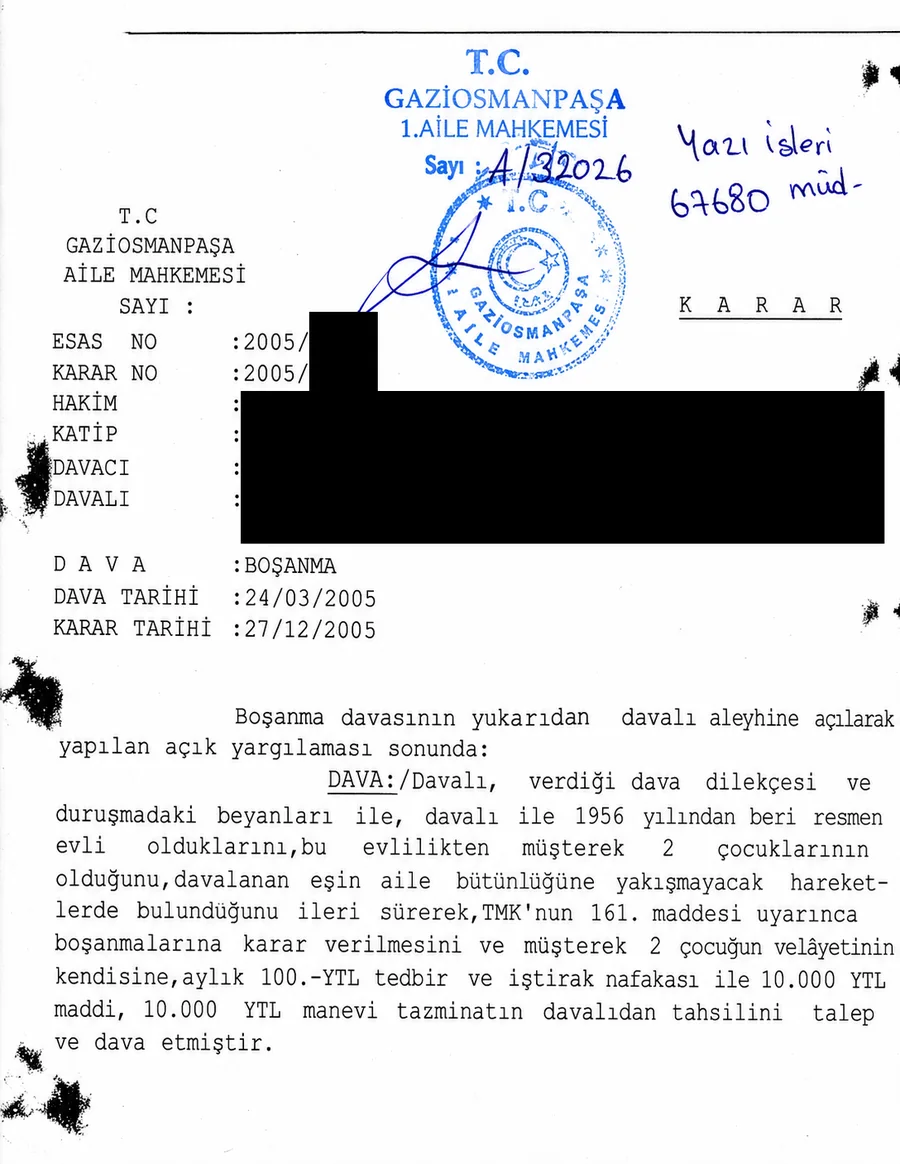
Turkish divorce proceedings are generally divided into Divorce by Mutual Agreement (anlaşmalı boşanma) and Contested Divorce (çekişmeli boşanma).
In a divorce by mutual agreement, the spouses agree that the marriage should end and reach agreement on the consequences of the divorce. Under Turkish law, this form of divorce is available when the marriage has lasted for at least one year and the other statutory conditions are fulfilled. The spouses normally agree on matters such as maintenance, compensation, custody, and arrangements concerning children, and the court examines their agreement before granting the divorce.
A contested divorce is different because the spouses disagree either about the divorce itself or about one or more of its consequences. Such proceedings can therefore take considerably longer and may involve evidence concerning the circumstances of the marriage, children, financial claims, maintenance, compensation, or other issues.
For somebody who later needs to use the divorce abroad, however, the distinction between divorce by mutual agreement and contested divorce becomes less important. In both cases, the practical question eventually becomes the same: which official document proves that the marriage has legally ended and that the decision has become final?
What document proves a divorce in Turkey?
The principal document is normally the final divorce judgment issued by the Turkish court. Foreign authorities use many different expressions for this document. A request may refer to a “Turkish divorce judgment,” “divorce decree,” “final divorce decision,” “certified divorce judgment,” or simply a “divorce certificate from Turkey.”
The wording used by the foreign authority is not always decisive. What matters is what the authority actually expects the document to prove. A civil registry that merely needs confirmation that a person is currently divorced may accept different evidence from a court that needs to examine the terms of the original judgment.
For example, a person who divorced in Turkey and wants to remarry abroad may be asked to provide the complete divorce judgment. Another authority may additionally request proof showing exactly when the judgment became final. In some administrative procedures, a Turkish population registry extract showing the person's current status may be sufficient instead.
This is why it is useful to check the requirements of the receiving authority before ordering a new document, apostille, or translation. Obtaining and legalizing the wrong document can result in unnecessary cost and delay.
Why is the Certificate of Finality (kesinleşme şerhi) so important?
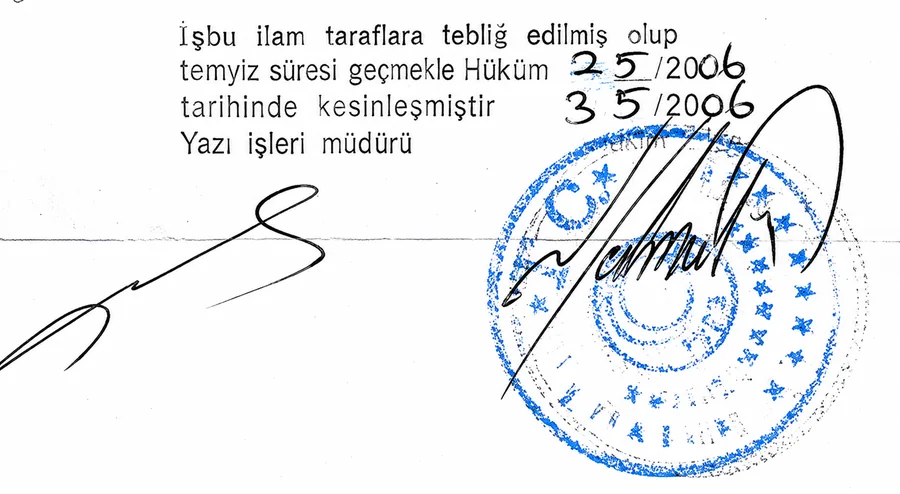
A divorce judgment and a final divorce judgment are not necessarily the same thing. A Turkish court can issue its decision, but the judgment may still be subject to the procedural steps that must be completed before it becomes final.
The certificate of finality confirms that the judgment has reached finality. For international use, this can be just as important as the divorce decision itself because a foreign authority often wants to know not only that a Turkish court ordered the divorce, but also that the marriage was definitively dissolved.
This distinction is particularly important with old documents. A client may have a photocopy of a reasoned judgment from many years ago and understandably assume that this is the complete divorce document. However, if the copy does not show that the judgment became final, a foreign authority may reject it or request additional evidence.
Practical recommendation: before obtaining an apostille or arranging an expensive translation, the judgment should first be checked to determine whether it contains adequate proof of finality.
Can a Turkish divorce judgment be apostilled?
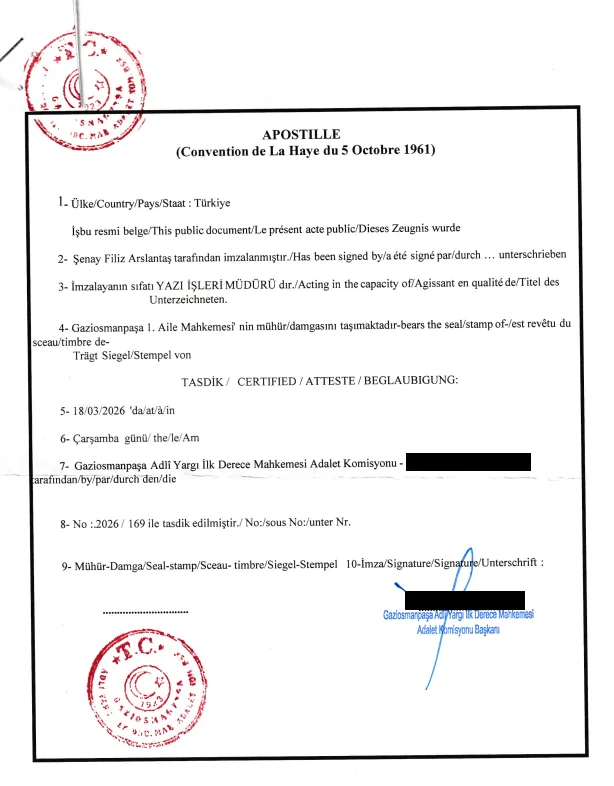
Yes. A Turkish divorce judgment is a judicial document. When it is intended for use in a country where the Hague Apostille Convention applies in relation to Turkey, the document can normally be authenticated with an apostille.
In Turkey, judicial documents are not apostilled in the same way as ordinary administrative documents. Apostilles for judicial documents are issued by the competent Presidencies of the Judicial Commissions in places where high criminal courts are established.
The first stage is therefore to establish exactly which court document is required. If the client already has an appropriate certified and final judgment, the document can be prepared for apostille. If only an old photocopy or incomplete version is available, it may first be necessary to obtain a new certified copy or the missing certificate of finality.
Typical procedure: obtaining the required final divorce judgment → judicial apostille → translation where required → use of the document abroad
An apostille does not certify that the contents of the divorce judgment are correct and does not reconsider the divorce. Its purpose is to authenticate the official origin of the public document so that it can be presented in another country participating in the Apostille system.
Can a divorce judgment receive an electronic apostille?
Turkey also operates an e-Apostille system, and court decisions are among the documents for which an electronic apostille can currently be issued.
This can be convenient for clients who are abroad because the apostilled electronic document can be obtained and verified digitally. Nevertheless, legal validity and practical acceptance are not always exactly the same thing. A foreign authority may have its own procedural requirements and may still request a paper certified document for a particular application.
For this reason, before choosing an electronic form solely because it is faster or more convenient, it is advisable to check whether the authority receiving the divorce document accepts an e-Apostille and electronic court decision.
Is a Population Registry Extract (nüfus kayıt örneği) enough to prove a divorce?
Sometimes it is, but not always.
After a Turkish divorce has been registered in the population system, a population registry extract can contain relevant civil-status information. If a foreign authority simply needs evidence of the person's present marital status, such an extract may be suitable.
A population registry extract is nevertheless not a substitute for the complete divorce judgment in every procedure. If the receiving authority needs to examine the court's decision, determine the precise date of finality, verify custody arrangements, or understand another provision of the judgment, it may insist on the court decision itself.
Turkish population registry extracts can also be apostilled, including through the e-Apostille system. The choice between a population registry extract and a complete divorce judgment should therefore be based on the purpose for which the document will be used rather than on which document is easier to obtain.
The apostille itself does not normally determine how recent the underlying document must be. The receiving authority may require a recently issued population registry extract, civil registry extract, or certificate of marital status. In some international civil-status procedures, documents issued more than three or six months before submission may no longer be accepted, so the receiving authority's freshness requirements should be checked before the document is ordered and apostilled.
Is Formül B a divorce certificate?
No, not in the ordinary sense. Multilingual Marriage Extract (Formül B) is a multilingual extract relating to a marriage registration. It is useful in many international civil-status procedures, but it should not automatically be treated as a replacement for a final divorce judgment.
If a foreign authority asks for proof that a previous marriage has ended, it may require the final Turkish divorce judgment or another official record showing the divorce. If it merely wants information about the marriage itself, the multilingual marriage extract may serve a different purpose.
It is therefore important to distinguish between proving that a marriage existed and proving that it was legally dissolved.
What happens when the destination country does not accept an apostille?
The Hague Apostille Convention considerably simplifies the international use of public documents, but it does not apply to every country or every international situation. If a Turkish divorce judgment is intended for a country where the Apostille system cannot be used, a different authentication procedure must be determined.
Consular legalization of a Turkish divorce judgment
One possibility is consular legalization. For Turkish court decisions intended for use in a non-Apostille country or for submission to certain foreign embassies, the procedure differs from the judicial apostille route.
According to the procedure applied by the Turkish Ministry of Foreign Affairs, a notarized copy of a court decision may first be prepared. The notarial certification is then authenticated by the competent Governorate (Valilik) or District Governorate (Kaymakamlık) before the document can proceed to the Ministry of Foreign Affairs. Depending on the destination country, legalization by its embassy or consulate may then also be required.
A possible legalization chain: Turkish court decision → notarized copy → Governorate or District Governorate certification → Turkish Ministry of Foreign Affairs → embassy or consulate of the destination country
This sequence should never be applied mechanically to every non-Hague country. Embassies can impose different requirements concerning originals, copies, translations, prior certifications, appointments, and fees. The correct route should therefore be checked according to the country in which the divorce document will actually be used.
International agreements may simplify the procedure
It is also incorrect to assume that every document must either receive an apostille or go through full consular legalization. Turkey is party to bilateral and multilateral agreements concerning legal cooperation and the use of official documents. Depending on the country, document, and purpose of use, such an agreement may simplify authentication or remove an otherwise applicable legalization requirement.
This is why the correct first question is not simply “Is this country a member of the Apostille Convention?” The more useful question is: what authentication regime applies to this particular Turkish document for this particular authority?
Can a foreign court request the document directly from Turkey?
There is another situation that is quite different from apostille and consular legalization. If a Turkish divorce judgment is required as evidence in proceedings before a foreign court, that court may in some circumstances request information or certified documents from the Turkish judicial authorities through international judicial assistance.
International judicial assistance allows judicial authorities in different countries to cooperate in matters such as obtaining evidence, information, originals, and certified copies of records. The exact route depends on the applicable convention, bilateral agreement, central-authority procedure, or other rules governing cooperation between Turkey and the requesting country.
This is not a procedure that a private client can simply choose instead of obtaining an apostille. The request is initiated through the competent judicial authorities. However, where the foreign court itself is willing or required to obtain the Turkish document through official channels, the client may not need to prepare the document in the same way as a private document submitted directly to an administrative authority.
Important: apostille, consular legalization, exemption under an international agreement, and international judicial assistance are separate procedures. The correct one depends on where the document will be used and who is requesting it.
How should a Turkish divorce judgment be translated?
Divorce judgments can be considerably longer than ordinary civil-status certificates. A Turkish judgment may include the history of the proceedings, the parties' statements, reasoning of the court, custody arrangements, maintenance, compensation, and the operative part of the decision.
The receiving authority should therefore be asked whether it requires the complete judgment or only a particular certified part. Some authorities require a full translation, while others are principally interested in the operative part and the confirmation that the divorce became final.
Where an apostille or legalization is necessary, it is generally practical to complete the authentication procedure first and then translate the complete document together with the apostille, certificate of finality, and other official stamps. This prevents a situation in which the original judgment is translated first and the client later discovers that the additional authentication pages must also be translated.
Names require particular attention. A person may have married under one surname, divorced under another, and now hold a passport under a third form of the name. Transliteration can create additional differences when Turkish documents are compared with records issued in Russian, Arabic, Ukrainian, Chinese, Kazakh, or another language. If the connection between the names is not obvious, additional civil-status or name-change documents may be required.
What if the Turkish divorce judgment has been lost?
Losing the original divorce judgment is a common problem, particularly when the divorce took place many years ago and the person has since moved abroad.
In many cases, it is possible to obtain a new certified copy. The first step is to identify the court file. A case number makes the search much easier, but it is not always indispensable. The approximate year of the divorce, the names of the former spouses, and the court or city where the proceedings took place can help identify the relevant file.
For older divorces, the file may already have been transferred to a judicial archive. This can make the retrieval procedure less immediate, but it does not mean that the document no longer exists.
Once the correct file has been identified, it can be determined which version of the judgment is available, whether a separate certificate of finality is needed, and whether the person requesting the document can obtain it directly or must act through an authorized representative.
If the document is intended for use abroad, the service does not have to end with obtaining the court copy. The certified judgment can subsequently be prepared with the apostille, consular legalization, or other authentication required for the destination country, followed by translation and international delivery.
A complete case may therefore involve: locating the court file → obtaining the certified judgment → confirming finality → international authentication → translation → delivery abroad
Can a Turkish divorce judgment be obtained without travelling to Turkey?
Often, yes. Many people who need Turkish divorce documents no longer live in Turkey and do not want to travel merely to obtain a court record.
Whether a document can be obtained through a representative depends on the nature of the document, access to the court file, and the authority of the person making the request. In some situations a power of attorney may be required.
If that power of attorney is issued abroad, it may itself need to be notarized and apostilled or legalized before it can be used in Turkey. A Turkish translation may also be required. The exact wording of the power of attorney should therefore be checked before it is signed abroad.
For Turkish citizens living abroad, it may be simpler to have the power of attorney drawn up directly at a Turkish consulate (Türk Konsolosluğu). A Turkish consular power of attorney is prepared in Turkish for use in Turkey and does not require a separate apostille before it can be used before Turkish authorities.
This is particularly important where obtaining the divorce judgment is only the first part of a larger procedure. A properly prepared authorization can make it possible to coordinate retrieval of the document, certification, apostille or legalization, translation, and courier delivery without requiring the client to return to Turkey.
Why are Turkish divorce documents needed abroad?
The most obvious reason is remarriage. A person who divorced in Turkey and subsequently wants to marry in another country may need to prove that the previous marriage has legally ended. Depending on the country, this can involve the divorce judgment, certificate of finality, a population registry extract, a certificate of current marital status, or a combination of these documents.
Divorce documents are also frequently requested in immigration and citizenship procedures. An immigration authority may need a complete history of the applicant's marriages and divorces, particularly where family status affects residence rights, family reunification, citizenship, or the identity of children.
A divorce can also explain a surname change. If a person's current passport does not match a birth certificate, previous marriage certificate, diploma, or other official record, the divorce judgment and related civil-status documents can help establish the documentary chain between the former and current names.
Inheritance is another common reason. A court, notary, or probate authority abroad may need to determine whether a person was still legally married to the deceased at the date of death. In that situation, the date on which the divorce became final can be especially important.
The same divorce file may also contain decisions relating to custody, contact with children, or maintenance. These documents can have their own international uses and may need to be separately obtained and authenticated.
Custody and child-related decisions after divorce
A Turkish divorce judgment may contain a decision on Custody (velayet), or custody may later be dealt with in a separate judicial decision. A parent who lives abroad may need this document for school enrollment, immigration, a residence application, medical matters, passport procedures, or another case in which parental responsibility must be demonstrated.
A custody decision is also a judicial document. If it is to be used abroad, the same fundamental questions arise: is the available copy suitable for official use, has the decision become final where finality is required, does the destination country use apostille or another authentication procedure, and what form of translation will be accepted?
It is important, however, to distinguish authentication of the document from recognition of the legal effect of the decision. An apostille confirms the official origin of the document; it does not by itself guarantee that another country will recognize or enforce the custody arrangement.
Maintenance and alimony decisions
The same distinction applies to maintenance/alimony (nafaka). A Turkish court decision concerning maintenance can be obtained, authenticated, and translated for use abroad, but the international enforcement of the financial obligation is a separate legal issue.
Depending on the foreign procedure, the authority may request the relevant judgment together with proof that it is final or enforceable. Additional documents may also be needed under the rules governing international recovery of maintenance.
Schmidt & Schmidt can assist with the documentary side of the procedure — obtaining the court document, authentication, translation, and delivery — while questions concerning recognition or enforcement of the claim itself must be considered under the applicable law and international agreements.
Foreign divorce judgments for use in Turkey
The reverse situation is just as important. A Turkish citizen may divorce in Germany, Russia, the United States, the United Kingdom, or another country, while the Turkish civil registry continues to show the person as married until the foreign divorce is properly processed in Turkey.
Before anything is submitted to the Turkish authorities, the foreign divorce document should be examined carefully. It is necessary to establish what type of document was issued, whether the decision has become final, and whether finality is evident from the judgment itself. If it is not, a separate certificate of finality or another confirmation may need to be obtained from the foreign court or authority.
The document must then be prepared for use in Turkey. If the Hague Apostille Convention applies, the apostille is issued in the country where the foreign document originated. A foreign divorce judgment cannot be brought to Turkey and receive a Turkish apostille. If the Apostille Convention does not apply, consular legalization or another authentication procedure may be required.
After the foreign document has been properly authenticated, it normally needs to be translated into Turkish in the form accepted by the Turkish authority. Only then can the question of registration or recognition in Turkey be dealt with efficiently.
Can a foreign divorce be registered in Turkey without filing court proceedings for recognition?
Yes. A Turkish court case is not necessary in every case.
Article 27/A of the Civil Registration Services Law provides an administrative mechanism through which certain foreign judicial or administrative decisions concerning divorce, annulment, nullity of marriage, or determination of whether a marriage exists can be registered directly in the Turkish civil registry.
The foreign decision must have been issued by a competent judicial or administrative authority under the law of the country where it was made, must have become final, and must not clearly contradict Turkish public order. The documentation must also satisfy the applicable authentication and translation requirements.
The parties can apply personally or through their attorneys. Importantly, the current law also provides that if one of the parties is deceased or is a foreign citizen, the other party who is a Turkish citizen, or that person's attorney, may apply alone, provided the other statutory requirements are fulfilled.
This is particularly relevant to international marriages. For example, a Turkish citizen who divorced a foreign spouse abroad should not automatically assume that the former spouse must come to Turkey and participate in court proceedings for recognition (tanıma). Depending on the circumstances and the documents available, administrative registration may be possible.
Applications abroad are handled through the competent Turkish foreign representations, while applications in Turkey are dealt with through the civil-registration authorities designated for this procedure.
What documents are needed for registration of a foreign divorce?
The precise file depends on the country and the form of the foreign decision, but the central documents are the foreign divorce decision itself and reliable proof that it has become final.
If finality is not shown on the judgment, a separate official certificate of finality may be necessary. That additional document may itself have to be apostilled or legalized and translated into Turkish.
Identity documents are also required, and where a foreign passport is used, a Turkish translation may be necessary. If the application is submitted through a representative, the authorization must comply with the requirements applicable to this procedure, including the rules concerning a special power of attorney.
The most efficient approach is therefore to examine the foreign judgment before ordering translations or authentication. If the document is incomplete, the missing certificate should generally be obtained in the country of origin first rather than discovering the problem after the rest of the file has already been prepared.
Registration of divorce is not the same as recognition and enforcement of everything in the judgment
This distinction causes considerable confusion in international divorce cases.
Administrative registration of the foreign divorce deals primarily with the fact that the marriage has ended and with updating the person's civil status in Turkey. A foreign divorce judgment may, however, contain much more than the dissolution of the marriage.
It may determine custody, child or spousal maintenance, visitation, property rights, financial compensation, or other obligations. Updating the Turkish civil registry to show that the parties are divorced does not automatically make all of these additional provisions enforceable in Turkey.
If one of those provisions must be legally recognized or enforced in Turkey, separate proceedings for recognition (tanıma) or enforcement (tenfiz) may be necessary under Turkish private international law. In such a case, the foreign judgment, certificate of finality, authentication, translation, proof of service, powers of attorney, and other supporting documents may become part of a court file.
Schmidt & Schmidt can assist with obtaining and preparing the required official documents. Where legal representation or a court application is required, the judicial part of the procedure must be handled by an appropriately authorized lawyer.
What if registration of the foreign divorce is refused?
Refusal of administrative registration does not necessarily mean that the foreign divorce has no legal effect in Turkey.
If the requirements for direct civil-registry registration are not satisfied, it may still be possible to apply to the competent Turkish court for recognition (tanıma) or, where enforcement is required, enforcement (tenfiz).
At that point the quality of the document file becomes especially important. The foreign judgment must be available in the correct official form, its finality must be demonstrated, and the authentication and translation must satisfy Turkish requirements. Depending on the case, evidence concerning service of proceedings or other procedural matters may also be required.
For this reason, even where a lawyer will ultimately handle the recognition case, obtaining and preparing the correct documents is a separate practical task that can often be organized in advance.
How does Schmidt & Schmidt help with divorce documents?
Schmidt & Schmidt specializes in obtaining official documents and preparing them for international use. In divorce-related matters, we can work in both directions: obtaining and authenticating Turkish documents for use abroad, and obtaining or preparing foreign divorce documents for use in Turkey.
A typical case may begin with nothing more than an old scan of a Turkish divorce judgment. We can determine whether the document is sufficient, whether the certificate of finality is missing, whether a new certified copy should be obtained, and which authentication procedure applies in the destination country.
Where the divorce took place abroad, we can help organize the document chain in the country of origin before the documents arrive in Turkey. This can include obtaining a new divorce certificate or judgment, obtaining evidence of finality, arranging an apostille or consular legalization, international courier delivery, translation, and notarization where required.
Depending on the case, our services can include:
- obtaining certified Turkish divorce judgments and related court documents;
- locating older court files and documents in judicial archives;
- checking or obtaining a certificate of finality;
- obtaining apostilles for Turkish judicial or administrative documents;
- arranging consular legalization where the Apostille Convention does not apply;
- checking whether another international authentication regime applies;
- obtaining foreign divorce documents and certificates of finality;
- arranging apostille or legalization abroad;
- preparing custody, maintenance, civil-status, and name-related documents for international use;
- translation and notarization;
- international courier delivery.
If you already have a divorce judgment, obtaining a new copy is not automatically necessary. The existing document should first be checked. In many cases, determining what is already usable can save both time and unnecessary legalization costs.
Next step
Send us a scan of the documents you already have and tell us:
- where the divorce took place;
- approximately when the divorce took place;
- in which country the document will be used;
- whether you already have the complete divorce judgment;
- whether the document contains a certificate of finality;
- whether you need document procurement, apostille, legalization, translation, or the complete service.
We will check the documents and determine the appropriate procedure before the authentication or translation work begins.
What is consular legalization?
In our video we are explaining what consular legalization is, why it is needed, when it is applied, and how it differs from the apostille procedure.
Schmidt & Schmidt offers legalization in more than 80 countries all over the world.
What is an apostille?
What is an apostille? Why do I need an apostille? How do I get an apostille? - Our video will explain everything you need to know about the apostille.
If you have a document that needs to be certified with an apostille for use abroad, Schmidt and Schmidt will assist you! We provide apostille services in more than 100 countries worldwide.
Frequently asked questions about divorce documents and apostille in Turkey
The principal document is normally the Divorce Judgment (boşanma kararı) issued by the competent Turkish court. For international use, the document may also need to show that the judgment has become final.
A certificate of finality is an official annotation or certification confirming that the court judgment has become final. It is particularly important where a foreign authority needs proof that the divorce has definitively taken effect.
Yes. A Turkish divorce judgment is a judicial document and can be apostilled for use in countries where the Hague Apostille Convention applies.
In many cases, yes. A certified copy can be obtained from the relevant court or judicial archive. The information needed to locate the file depends on the age of the case and the records that are still available.
Yes. Court decisions are among the documents currently available through the Turkish e-Apostille system. The receiving foreign authority should nevertheless be checked to make sure it accepts the electronic format for the intended procedure.
It depends on the receiving authority. A population registry extract may be sufficient where only current marital status must be proved, but an authority that needs the actual judicial decision or its terms may require the complete divorce judgment.
Consular legalization or another authentication procedure may be required. The exact chain depends on the destination country and should be checked before the document is prepared.
In some judicial proceedings, a foreign court can request information or certified documents through international judicial-assistance channels. This is initiated through the competent authorities and is different from a private person obtaining and legalizing the document.
Yes, if the statutory conditions are met. Certain final foreign judicial or administrative divorce decisions can be registered directly in the Turkish civil registry under Article 27/A of the Civil Registration Services Law.
No. Under the current Article 27/A, where one of the parties is deceased or is a foreign citizen, the other party who is a Turkish citizen, or that person's attorney, may apply alone if the other statutory conditions are satisfied.
No. If an apostille is required on a foreign divorce document, it must be issued by the competent authority of the country where that document originated. Turkish authorities apostille Turkish public documents.
No. Registration primarily concerns the termination of the marriage and the person's civil status. Custody, maintenance, property, compensation, or other provisions may require separate recognition or enforcement proceedings.
In many cases, yes. Depending on the document and destination country, Schmidt & Schmidt can coordinate document procurement, proof of finality, apostille or consular legalization, translation, and international delivery.