
Apostille and consular legalization in Turkey are often presented as a simple sequence of stamps. In practice, the stamp itself is usually the easy part. The real problems in 2026 are appointments, queues, physical attendance, offices located in different parts of Ankara, busy notaries, rapidly increasing translation and certification costs, and the possibility that one small defect forces the document to repeat several stages of the process.
For somebody living in Ankara, a rejected document may cost several hours. For somebody travelling from Istanbul, Izmir or abroad, the same problem can mean a failed trip, another hotel night, another international courier shipment or another week of delay. This guide focuses on the practical difficulties that clients actually encounter when legalizing documents in Turkey.
In brief: what are the main apostille and consular legalization problems in Turkey in 2026?
- MFA authentication: the relevant procedure requires physical handling in Ankara, and applicants should not expect to complete it by email or by simply mailing documents to the Ministry.
- Waiting times: based on our 2026 experience, an MFA visit can involve around three hours of waiting, while a physical apostille procedure may take around 1.5 hours.
- Appointments and payment: missing an MFA appointment can mean losing the opportunity to submit the documents, while card payments are not accepted in our current experience and applicants need Turkish-lira cash.
- Several physical stages: YÖK, TOBB, Kaymakamlık, notaries and the MFA may all be involved in the same legalization project.
- Costs: simple sworn translation can start from around 700 TRY per page, a basic “Aslı Gibidir” notarial certification from around 900 TRY per page, and notarization of a sworn translation from around 1,500 TRY per page.
Why is MFA authentication in Ankara difficult in practice?
For many documents requiring consular legalization, authentication by the Turkish Ministry of Foreign Affairs is one of the central stages. The relevant authentication procedure requires physical handling in Ankara. It cannot simply be completed by emailing a scan, and clients should not treat the Ministry as a postal legalization service where an original document can simply be mailed in and returned after authentication.
Someone therefore has to physically deal with the document in Ankara. Even if only one document is involved, somebody must bring the original to the relevant MFA authentication unit, wait for processing, make the required payment, collect the document and, where necessary, continue to the embassy or consulate of the destination country.
This immediately creates additional cost for clients outside Ankara. What looks like a relatively inexpensive government certification may in reality involve travel, accommodation, local transportation, lost working time and, if the first attempt fails, a second trip. More general questions about the difference between apostille and consular legalization are covered in our apostille and consular legalization FAQ.
The practical problem is not only obtaining the MFA authentication. It is having somebody physically in Ankara who can return and solve the problem if the document is not accepted the first time.
Does an MFA appointment mean the document will be processed immediately?
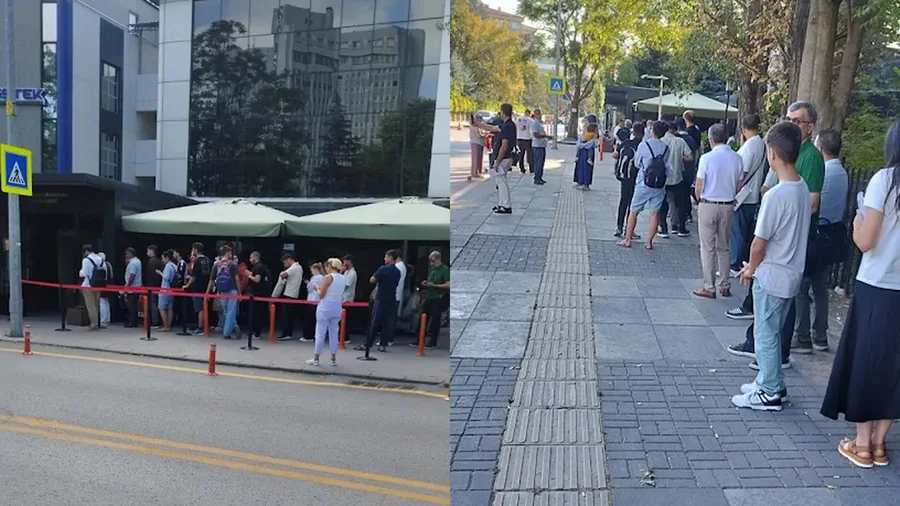
No. An appointment should not be confused with immediate service. Based on our practical experience in Ankara in 2026, applicants should be prepared for an average total waiting time of approximately three hours. Some visits are faster, while on busy days the process can take considerably longer.
At the same time, applicants themselves cannot safely arrive late. In our experience, arriving even approximately one hour after the allocated appointment time can result in the documents not being accepted and a new appointment being required. This creates a frustrating situation: the authority may keep the applicant waiting for several hours, but the applicant cannot assume that a substantial delay on their own side will be tolerated.
Trying to arrive without an appointment is also not a reliable alternative. A person may wait for hours and still leave without completing the procedure. For somebody who has travelled to Ankara from another city, this can turn a legalization attempt into an entirely wasted day.
Are card payments accepted at the MFA authentication unit?
In our experience with the Ankara authentication procedure in 2026, card payments are not accepted and applicants need cash in Turkish lira. This is a small practical detail that can cause a surprisingly serious delay because many applicants only discover it after they have already entered the procedure and waited in the queue.
Applicants without sufficient cash are normally forced to leave and find an ATM. The nearest practical option is usually a Kuveyt Türk ATM. Leaving the authentication unit, reaching the ATM, withdrawing the money and returning can easily take 15 minutes or more.
After several hours of waiting, a 15-minute trip to an ATM can be enough to affect another appointment, embassy submission or the possibility of completing the legalization that day.
The problem becomes more significant for bulk files because the amount of cash required increases with the number of documents. For this reason, we calculate the expected charges in advance and make sure that sufficient Turkish-lira cash is available before attending the procedure.
Why are bulk legalization projects more difficult?
Processing one document and processing 20 or 30 documents are completely different operations. During periods of heavy workload, we have encountered situations where MFA personnel declined to register more than approximately five documents per applicant at one time.
This should not be understood as a statutory five-document limit. It is a practical workload restriction that may be applied when the queue is particularly heavy. For somebody legalizing one birth certificate it is irrelevant, but for companies processing corporate certificates, powers of attorney, KYC documentation, international tender documents or files for several subsidiaries, it becomes a serious planning issue.
Professional agencies also receive no automatic preferential treatment. Representatives handling substantial quantities of documents may face additional scrutiny and can be instructed to reduce the submission, leave the queue or return under different arrangements.
The advantage of using a local legalization agency is not privileged access to government offices. It is the ability to deal with failed submissions, restrictions and repeat visits without requiring the client to travel to Ankara.
How long does an apostille take in Turkey?
Physical apostille procedures are generally easier than full MFA authentication, but they are not necessarily instantaneous. Based on our practical experience in Ankara in 2026, approximately 1.5 hours is a realistic average waiting time for a physical apostille procedure. Sometimes the document is processed faster; on busy days the relevant Kaymakamlık may take considerably longer.
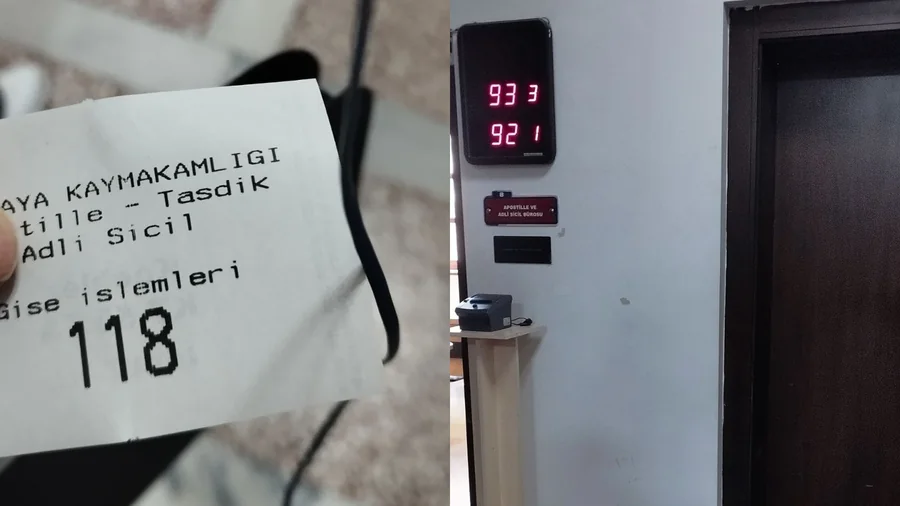
The important issue is the cumulative effect of several queues. A legalization project can involve a notary, apostille authority, MFA and embassy on the same day. If the notary takes an additional hour and the apostille requires another 90 minutes, an MFA or embassy appointment later in the day can easily be missed.
This is why a legalization procedure cannot always be planned as a sequence of short ten-minute visits. Each stage can affect every stage that follows it.
Why can the official MFA or YÖK address lead you to the wrong office in Ankara?
One of the most avoidable problems is travelling to the correct institution but the wrong building. Large Turkish institutions frequently operate from several headquarters, annexes and specialized units. The address that appears first in an internet search may therefore be the institution's main administrative address rather than the office responsible for the specific international certification procedure.
The Ministry of Foreign Affairs is a good example. The relevant document authentication procedure is handled at a specific authentication unit rather than simply at whichever MFA address appears first online. Going to the wrong building can cost hours before the actual legalization procedure has even started.
A similar problem exists with the Yükseköğretim Kurulu — YÖK. For documents intended for international use, the relevant certification operation may not be handled in what a client understands to be the main YÖK building. A person can therefore travel to Ankara, reach YÖK and still discover that the department needed for the document is somewhere else.
How does YÖK certification affect apostille and legalization of Turkish diplomas?
Turkish university diplomas and other higher-education documents may require an additional YÖK certification or verification stage before the international legalization procedure can continue. Depending on the document and intended use, the practical chain may therefore become:
University → YÖK → translation/notary → apostille or MFA → embassy
Every arrow represents another physical movement of the original document. If YÖK identifies a problem, the remaining stages normally stop until that issue has been resolved. Additional university certification, supporting documentation or another correction may be required before the document can proceed.
For a client outside Ankara, this can create another journey or another courier cycle. When the file is managed locally, the YÖK stage can instead be coordinated with the remaining legalization procedures without repeatedly sending the original documents between cities.
How are Turkish corporate documents apostilled and legalized?
Corporate legalization projects can involve even more authorities. Depending on the type of document and intended use, a file may have to pass through the Trade Registry, Chamber of Commerce, TOBB, a notary, Kaymakamlık, MFA and finally the embassy or consulate of the destination country.
These authorities are not located behind one counter. An international KYC project involving ten corporate documents may therefore require numerous separate physical visits before the file is complete. This is one reason why corporate legalization can take substantially longer than the number of documents alone would suggest.
The main challenge is usually not obtaining one particular certification. It is coordinating several different authorities in the correct order and avoiding a situation where an error discovered at a later stage forces the documents to repeat earlier stages. For information about obtaining Turkish corporate and other official records, see our page on document procurement in Turkey.
Can any Kaymakamlık issue an apostille in Turkey?
Physical apostille procedures often require a visit to the competent Kaymakamlık or another competent apostille authority. However, clients should not assume that every document can automatically be apostilled at every Kaymakamlık. Competence, jurisdiction and the ability to verify the relevant signature can still matter.
Once the correct authority has been identified, timing becomes another practical issue. A document may have just come from a notary or another certification authority and still need to reach the apostille office before the next stage can begin. A delay of one hour earlier in the process can therefore determine whether the apostille is completed the same day.
How do Turkish notaries affect apostille and legalization times?
Notary procedures are often treated as a routine stage, but Turkish notaries can be extremely busy. At the same time they may be processing powers of attorney, real-estate matters, vehicle transactions, corporate procedures, sworn translations, certified copies and lengthy foreign documents.
Presenting a 20-page translated file does not mean that the notary can immediately process it. If the notary finishes later than expected, the applicant may miss the Kaymakamlık. If the apostille takes longer than expected, the MFA appointment may then be lost. If the MFA stage runs late, the foreign embassy may already be closed.
In multi-stage legalization, a delay at the first office can determine whether the final office can still be reached that day.
How much does sworn translation cost in Turkey in 2026?
Translation has become a substantial component of legalization costs. Based on the market in which we currently operate, approximately 700 TRY per page should now be considered a realistic starting point even for a relatively simple sworn translation from English.
This starting level assumes a common language, straightforward terminology, a clear document and uncomplicated formatting. Less common languages, difficult layouts, handwriting, technical terminology or urgent work can cost considerably more.
The difference is relatively small for a one-page certificate but becomes significant for a 20- or 30-page corporate or academic file. For this reason, clients should determine which pages genuinely require translation before ordering the translation of an entire file.
How much does notarization cost in Turkey in 2026?
Notarial certification can now be even more expensive than translation. In our practical 2026 cases, a straightforward “Aslı Gibidir” certification can start at approximately 900 TRY per page, while notarization of a sworn translation can start at approximately 1,500 TRY per page.
These are practical starting figures rather than universal fixed tariffs. The exact amount depends on the document, transaction type, number of pages, characters, copies and the applicable notarial calculation. Nevertheless, they demonstrate why unnecessary certification has become an expensive mistake.
If 20 pages are translated and notarized and the receiving authority later confirms that it only required an apostilled original, the unnecessary cost can already reach tens of thousands of Turkish lira. We have discussed related problems in more detail in our article on the most common mistakes when translating documents for use abroad.
Typical mistakes and how to avoid them
The same problems appear repeatedly in international document legalization. Some cost only an hour; others can require the entire document package to be prepared again.
| Typical mistake | What happens | How to avoid it |
|---|---|---|
| Going to the wrong office | The institution may be correct, but the department handling international certification is in another building. Several hours can be lost before the real procedure even begins. | Confirm the exact unit and physical address before travelling, not only the institution's main address. |
| Arriving without an MFA appointment | The applicant may wait for hours without the documents being accepted. | Treat the appointment as an essential part of the procedure rather than relying on a walk-in attempt. |
| Arriving late for the appointment | Even after travelling to Ankara, the applicant may be refused and have to obtain another appointment. | Allow substantial time for Ankara traffic, previous authorities and security procedures. |
| Arriving at the MFA without cash | The applicant has to leave the procedure, find an ATM and return, potentially losing another appointment or the opportunity to finish that day. | Calculate the expected MFA charge in advance and bring sufficient Turkish-lira cash. |
| Translating or notarizing too much | Unnecessary translation and notary costs can reach thousands or tens of thousands of lira for large files. | Confirm exactly which documents and pages the receiving authority requires before ordering translation or notarization. |
| Sending only the front side of a document for review | A stamp, signature, annotation or previous certification on the reverse side may be discovered only after the original reaches the authority. | Send scans of all pages and both sides before the procedure begins. |
| Assuming a large file will be processed in one turn | During busy periods, practical limits may be imposed on the number of documents handled per applicant. | Plan bulk corporate and KYC projects as operations requiring capacity and potentially several submissions. |
| Planning several authorities with no time buffer | A delay at the notary or apostille office can cause the applicant to miss the MFA or embassy appointment. | Build realistic waiting time into the schedule and avoid treating each authority as a ten-minute visit. |
| Confusing apostille and consular legalization | The wrong authentication chain is started, potentially creating unnecessary translations, notarizations and repeat visits. | Determine the destination country and the receiving authority's requirements before starting. See our apostille and legalization FAQ for the basic distinction. |
The most expensive mistake is usually starting too early
Translation, notarization and authentication should not be ordered simply because they may be needed. First determine exactly what the receiving authority requires. With 2026 translation and notary prices, avoiding one unnecessary certification can save more money than trying to find the cheapest provider later.
How can you obtain a Turkish apostille while living abroad?
Being outside Turkey does not change where a Turkish apostille is issued. A Turkish public document must be apostilled through the competent authority in Turkey; an authority in Germany, the United Kingdom, Canada or another destination country cannot issue a Turkish apostille simply because the document holder is living there.
This creates a common problem: the owner is abroad, while the document and the authority that must process it are in Turkey. Depending on the type of document, several solutions may be possible.
Option 1: send the original document to Turkey
If the original Turkish document is already abroad and the original itself has to be apostilled, it can be sent back to Turkey by international courier. A local representative can then handle the required procedure and return the completed document abroad.
Before sending an irreplaceable original, however, it is worth checking whether the competent authority can instead issue a new certificate or whether a certified copy is acceptable for the intended use.
Option 2: use a representative in Turkey
Many procedures can be handled through a representative, although the exact authorization required depends on the document and authority. For some procedures a specific power of attorney may be required, while others can be handled with less extensive authorization.
This option is particularly useful where several stages are required, because the representative can deal not only with the apostille but also with document procurement, YÖK, TOBB, translation, notarial certification, MFA authentication or embassy legalization where necessary.
Option 3: obtain a new document in Turkey instead of sending the old original back
For certain civil-status, corporate or other official records, obtaining a fresh document in Turkey may be more practical than shipping an existing original internationally. This also reduces the risk that an older certificate is rejected because the receiving authority requires a recently issued document.
Schmidt & Schmidt can also assist with obtaining documents in Turkey before the apostille or legalization stage begins.
Option 4: check whether an electronic solution exists for your document
Turkey provides electronic procedures for certain categories of official documents. However, electronic availability should not be assumed for every diploma, corporate document, power of attorney or other certificate. The exact document type and the requirements of the receiving authority should be checked first.
If you are abroad, do not send the original document to Turkey before confirming which version of the document actually needs the apostille. In some cases obtaining a new document locally is faster and safer than shipping the existing original twice.
Why are Turkish apostille and legalization applications rejected?
Many legalization problems cannot be identified completely from a scan. A document may appear perfectly acceptable electronically and still be rejected when the original is examined. Typical problems include a missing reverse side, an unclear stamp, incorrect notarial wording, an incomplete translation, a signature that cannot be verified, another authority that should have been visited first or an embassy-specific requirement that changes the necessary certification chain.
Once one of these problems is identified, the document may have to move backwards through the procedure. This is why the ability to correct a defect locally can be as important as the initial submission.
A rejected document does not always have to mean a lost day
For a client travelling to Ankara, a rejection at 10:30 in the morning can mean a failed trip. When the file is being handled locally, a correctable translation, copy or certification problem may instead be fixed and, where the authority's procedure permits it, another attempt can be made later in the same working day.
This ability to react locally is particularly important because some defects only become apparent after the original document has been examined by the authority.
Why does Schmidt & Schmidt's location in Ankara matter?
Schmidt & Schmidt's Ankara office is positioned close to the authorities most frequently involved in international document legalization. We are approximately:
- 15 minutes on foot from the MFA authentication unit;
- 10 minutes by car from YÖK;
- 10 minutes by car from TOBB;
- 15 minutes by car from two different Kaymakamlık offices.
Our regular sworn translators also work closely with the notaries used for our documents. This location does not give us privileged treatment at government offices. Its value is much more practical: when something goes wrong, we are already nearby.
If a document is rejected in the morning, we may be able to return, correct the problem and make another attempt in the afternoon. If YÖK requests an additional step, the document does not automatically have to be sent back to another city. If a notarial certification has to be corrected, we do not necessarily lose another working day.
For a client travelling to Ankara, a rejected document can mean a failed trip. For us, it may mean losing part of the morning.
How do we reduce delays with translation and notarization?
Translation and notarization are particularly sensitive to timing. We work with regular sworn translators who give our documents priority, and our translators operate in close coordination with the notaries processing these translations.
This allows us to shorten a workflow that might otherwise look like:
Translator → courier → notary → courier → legalization agency → government authority
Instead, the document can move directly from translation to notarial processing and then to the relevant government authority. For urgent cases, saving one or two hours at this stage can determine whether the next legalization stage can still be reached on the same working day.
For more information about certified translations, see our sworn translation service.
What should you check before apostille or legalization in Turkey?
Before original documents are sent to Ankara, it is advisable to check the complete file rather than only the page that appears to require the apostille or legalization. Both sides of documents can contain stamps, signatures, annotations or earlier certifications that change the procedure.
Next step
For a preliminary review, we normally need:
- clear scans or photographs of all pages;
- scans of both sides of every document;
- information about where the originals are currently located;
- the country where the documents will be used;
- the name of the receiving authority or institution;
- any written legalization, translation or certification requirements received from that authority.
This allows us to identify the likely procedure and potential problems before unnecessary translations, notarial certifications, courier shipments or government visits are arranged.
The main difficulty is execution, not the apostille itself
The main challenge of apostille and consular legalization in Turkey in 2026 is getting the document through the complete physical chain. Government offices are in different locations, important procedures are concentrated in Ankara, appointments can be strict, queues can last for hours, card payment may not be available, notaries can be overloaded, and translation and certification costs have increased sharply.
One missing page or incorrect certification can send the document backwards through the process. For this reason, local execution and the ability to react quickly when a problem appears can be more important than the first submission itself.
Official sources on apostille, MFA authentication, and document legalization in Turkey
When preparing documents for international use, it is recommended to check the current requirements in official sources. Apostille Convention coverage, competent authorities, MFA procedures, e-Apostille availability, notary tariffs, and corporate-document procedures may change over time. Practical waiting times and local processing conditions described in this article are based on our 2026 experience, while the links below provide the underlying official rules and systems.
- Turkish Ministry of Foreign Affairs — official Ankara authentication appointment system, current fee, address, and working hours
- Turkish Ministry of Foreign Affairs — official questions and answers on document authentication, personal attendance, postal applications, appointments, and fees
- Turkish Ministry of Foreign Affairs — official requirements to check before submitting documents for authentication
- Turkey e-Apostille — official electronic apostille system
- Turkey e-Apostille — official information on eligible document types, fees, validity, and processing
- HCCH — current list of parties to the Apostille Convention and dates of entry into force
- HCCH — competent authorities authorized to issue apostilles in Turkey
- YÖK — official website of the Turkish Council of Higher Education
- Türkiye Ticaret Sicili Gazetesi / TOBB — official system for Turkish Trade Registry Gazette records and certified copies
- Turkish Ministry of Justice — official announcements on the 2026 notary fee tariff and subsequent amendments
Frequently asked questions about apostille and consular legalization in Turkey in 2026
The relevant MFA authentication procedure requires physical handling in Ankara. If you do not want to travel personally, a representative or service provider must handle the physical document there under the applicable procedure.
Based on our practical experience in Ankara in 2026, approximately three hours is a realistic average total waiting time. The actual time depends on the day and workload.
In our 2026 experience, card payments are not accepted for the authentication procedure and applicants should arrive with sufficient Turkish-lira cash.
It should not be assumed that a large number of documents will always be accepted in one turn. During periods of heavy workload, we have encountered practical restrictions on the number of documents registered per applicant.
In our practical Ankara experience in 2026, approximately 1.5 hours is a realistic average waiting time, although the actual time depends on the authority and workload.
Yes, but the Turkish apostille itself must still be issued through the competent procedure in Turkey. Depending on the document, the original can be sent to Turkey, a representative can handle the procedure, a new document can be obtained in Turkey, or an electronic solution may be available.
A preliminary review can identify likely translation, notarization, apostille, YÖK, TOBB, MFA or embassy requirements before unnecessary costs are incurred. Scans should include all pages and both sides of every document.