Schmidt & Schmidt arranges Chinese translations of foreign documents for employment, study, family matters and business in China. We help prepare translations bearing a local translation company's stamps and the necessary supporting materials.
China's system differs from the sworn translation system used in a number of European countries. Foreign documents submitted to Chinese institutions are usually translated by translation companies. The company prepares the translation, applies its stamps and supplies a copy of its business licence.
If you also need to prepare Chinese documents for use abroad, we can help arrange an apostille in China . To check a Chinese counterparty or obtain its registration details, you can order a Chinese commercial register extract .
On this page
How does document translation work in China?

For a foreign document that needs to be submitted in China, the usual approach is to commission a local translation company. The company takes responsibility for the translated text and prepares it for official submission.
Chinese notarial offices more commonly handle the reverse situation: preparing Chinese documents for use abroad. In that case, a foreign-language translation forms part of the notarial package.
A foreign diploma for a Chinese employer and a Chinese diploma for an overseas university therefore follow different routes. The first usually involves a translation bearing a translation company's stamps. The second involves preparing a Chinese notarial document with a translation.
Do you need to contact a Chinese notary?
If you need a Chinese translation of a foreign certificate, diploma or criminal record certificate, a notarial office is usually not the first point of contact. Start by checking the recipient's requirements and choosing a suitable translation company.
Do not assume that a Chinese notary will translate any foreign document and certify the translation using a procedure familiar from another country. If the institution specifically requests a notarial document, clarify which notarial act is required and where it should be performed.
This page covers mainland China. Procedures for Hong Kong and Macao need to be checked separately.
What does the completed package include?
When you order through us a translation of a foreign document for use in China, the usual package includes the translation, a copy of the translation company's business licence and the required stamps. Before work begins, we agree what your submission needs.
The three parts of your translation package
1 Chinese translation
The translation covers the document and any additional pages required: attachments, reverse sides, certification wording and the apostille, if it forms part of the requested package.
It is important to agree the scope in advance. For example, translating a diploma without its transcript may be insufficient if the university or employer requests details of subjects and grades.
2 A copy of the company's business licence
营业执照 (yíngyè zhízhào) is the company's business registration document. A scan or printed copy accompanies the translation and identifies the organisation that carried out the work.
The business licence belongs to the company, not to an individual translator. It should not be confused with a sworn translator's credentials or confirmation that a particular translation is accurate.
3 Translation stamp and company seal
The package uses a dedicated translation stamp — 翻译专用章 (fānyì zhuānyòng zhāng) and the official company seal — 公章 (gōngzhāng). A statement confirming completeness and accuracy is added where necessary.
Stamp placement, page presentation and additional attachments are agreed with the recipient's requirements in mind. The number of stamps alone does not determine whether a translation is suitable for a particular procedure.
What should you check before ordering?
The main reference point is the institution that will review your documents. Ideally, obtain its requirements in writing: an official checklist, an email or a link to the relevant instructions.
Before commissioning the translation, check:
- Who must carry out the work. Will the recipient accept a translation from a suitable company, or must you use a specified organisation?
- How the result must be presented. Which stamps, statements and company registration materials are required?
- Which pages need translating. Must the translation include attachments, the apostille, reverse sides and notarial certification wording?
- How the package must be submitted. Are electronic files sufficient, or are paper copies, originals or particular types of copies required?
- Whether the source document is suitable. Does it need an apostille? Are there limits on its age? Does it contain all the information required for the application?
Answering these questions helps avoid completing a translation only to discover that the institution requires another version of the document or a different certification format.
Why can requirements differ?
Different authorities and procedures may have their own rules. A successful submission in another city does not necessarily establish what your application requires.
For example, a published Shanghai guide for highly qualified foreign professionals who entered China on an R visa provides for translations bearing the employer's seal. Nanjing's work permit guidance refers to a translation company's stamp. These provisions apply to the procedures described in the respective sources. [1], [2]
Rather than relying solely on another applicant's experience, check the current instructions for your own application.
When is an apostille or consular legalization needed?
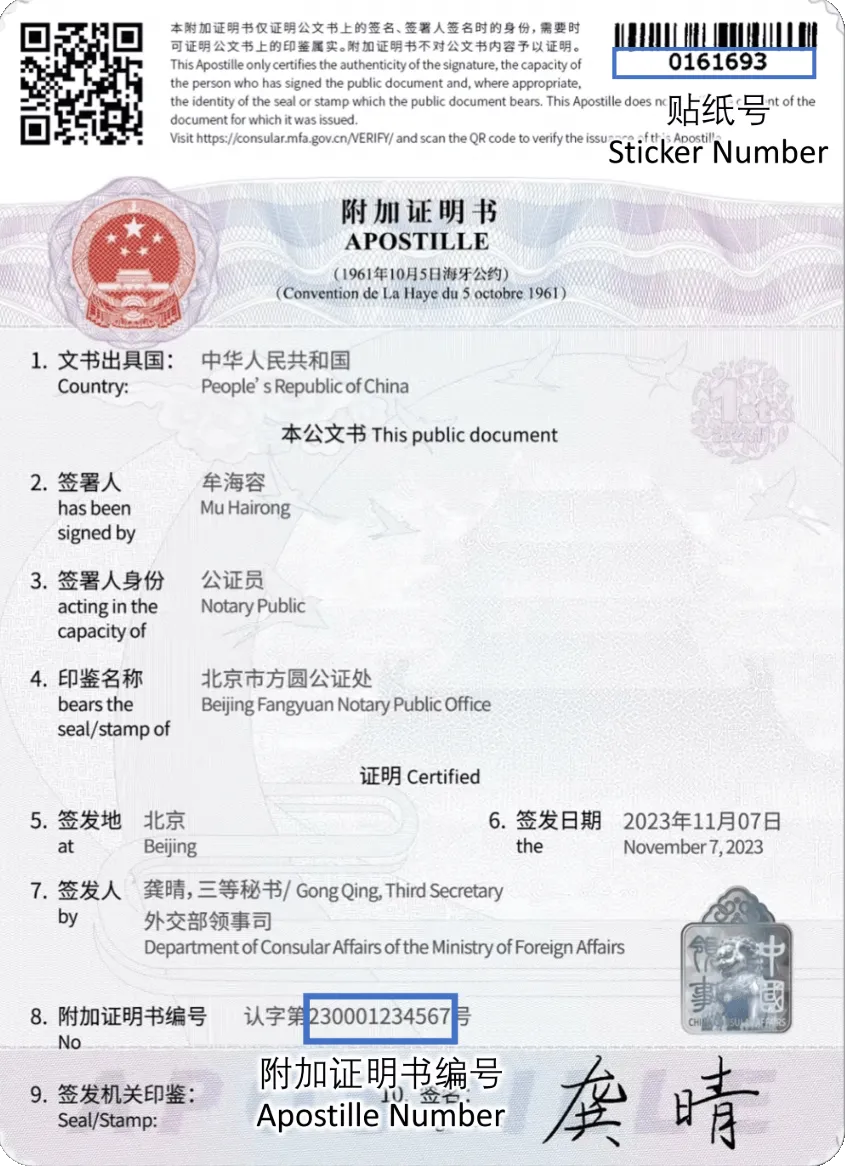
A sample Chinese apostille. Foreign documents are apostilled in their country of origin.
Translation and document authentication serve different purposes. A translation makes the content understandable in another language. An apostille certifies the signature, the capacity in which the signatory acted and, where appropriate, the seal or stamp on the document. It does not certify the document's contents. [3]
If a foreign document needs an apostille, it must be obtained through the competent authority in the document's country of origin. Having the document translated in China does not replace that step.
Is consular legalization always required?
No. The Hague Convention Abolishing the Requirement of Legalisation for Foreign Public Documents has applied to mainland China since 7 November 2023.
Where the Convention applies between China and the document's country of origin, an apostille replaces consular legalization for documents within its scope. If an exemption or a simpler procedure exists, that option should be checked first. [3], [4]
Where the Convention does not apply between the countries and no exemption exists, consular legalization may be necessary. It is therefore incorrect to assume that every foreign document for China must pass through a Chinese consulate.
Which comes first: the apostille or the translation?
If the recipient needs a Chinese translation of the complete authenticated package, it is usually more practical to obtain the apostille first and then translate the document together with it. This avoids translating additional pages separately.
However, some preliminary procedures require a translation earlier. If notarisation or legalization is also involved, agree the sequence in advance.
Does the apostille need translating?
If the institution requires a translation of the complete package, include the apostille. Its standard multilingual fields do not automatically remove the requirement for a Chinese translation.
Further information: apostille and legalization in China .
Which documents do we translate?
We arrange translations of personal, educational and corporate documents. Common requests include:
- Birth, marriage, divorce and death certificates.
- Documents confirming marital status, family relationships and name changes.
- Diplomas, school certificates, diploma supplements and academic transcripts.
- Criminal record certificates.
- Evidence of employment history and professional qualifications.
- Passports and other identity documents.
- Powers of attorney, declarations and consent documents.
- Court judgments and other procedural documents.
- Medical documents.
- Articles of association, corporate resolutions, contracts and company powers of attorney.
- Commercial register extracts and financial statements .
- Land and property register extracts .
- Certificates and product conformity documents.
If your document is not listed, send it for a preliminary assessment. A scan allows us to assess its length, language and presentation requirements.
How can you avoid translation errors?
Stamps do not rule out mistakes. Names, dates, numbers and company names deserve particular attention: inaccuracies in these details can raise questions at submission.
Translating Chinese documents for use abroad
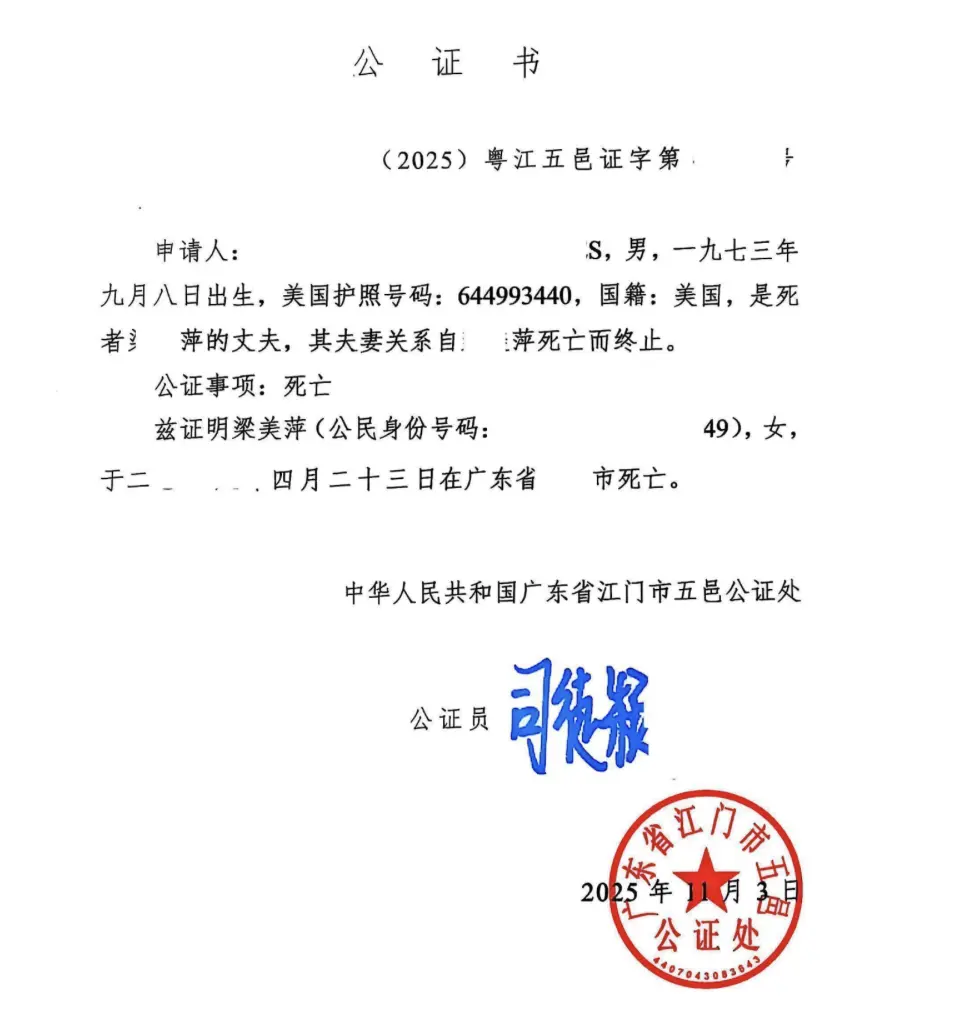
A sample Chinese notarial certificate. This differs from a translation bearing a translation company's stamps.
A different procedure applies when a document issued in China is needed abroad. For common personal documents, this often involves obtaining a notarial certificate — 公证书 (gōngzhèngshū) with a foreign-language translation.
Before the certificate is prepared, tell the notary the destination country, purpose of submission, required language and recipient's requirements. This helps determine the certificate's content and form.
It is important to establish what needs to be certified: education, birth, absence of a criminal record, a copy's conformity with the original, a signature or another matter. These notarial acts are not interchangeable. [5]
What do “single” and “double” notarisation mean?
In practice, you may encounter the terms “single” and “double” notarisation. The relevant question is whether an additional certification is needed confirming that the translation corresponds to the Chinese text.
The presence of a foreign-language text in the package does not always mean that this correspondence has been separately certified. If the destination country requires it, raise the issue before the certificate is issued.
China's standard for translating notarial certificates into English separately describes the package for cases where conformity between the translation and source text needs to be certified. [6]
Could another translation be required in the destination country?
Yes. A foreign institution may require a local sworn translator or another translator it recognises to translate the Chinese certificate, attachments and apostille.
A Chinese notarial translation should therefore not be treated as a universal solution for every country. Check whether additional work will be needed before ordering.
Further information: preparing Chinese documents, apostille and consular legalization .
How do you order a translation?
Start by sending readable scans and a brief description of your request. We need to know which document needs translating, where it will be submitted and when it must be ready.
- Document review. We check completeness, text volume and scan quality.
- Agreeing the presentation. We clarify the required stamps, attachments and delivery format. If the requirements are incomplete, we identify questions to ask the recipient.
- Confirming the terms. We agree the price, timeframe and delivery method. If originals or additional procedures are needed, we tell you in advance.
- Translation and review. We arrange the work using the names, company names and terminology you have supplied.
- Delivery of the package. We provide the agreed electronic files, paper copies or both.
What determines the price?
The price depends on the language, text volume, terminology, scan quality and presentation requirements. A page of a civil status certificate and a page of financial statements can involve different amounts of work. We therefore calculate the price after reviewing the documents.
Additional procedures and delivery are quoted separately where needed. The total price is agreed before work begins.
How long does translation take?
The timeframe is confirmed after the materials have been assessed. It depends on the volume, language and required presentation. If you already have a submission appointment, mention the date in your first enquiry.
For a paper package, allow time for preparation and delivery as well as translation. Where required, we arrange courier delivery to the agreed address.
Frequently asked questions
Only if the recipient allows it. A self-prepared translation does not replace a company translation where the company's stamps and registration materials are required. Some procedures allow employer-certified translations, but this must be checked separately.
This must be agreed with the translation company. It may require a review, corrections or a new translation. Do not assume that a company will stamp a translation without checking its contents.
Usually, a scan is sufficient for a preliminary assessment. Whether the entire order can be completed without the original depends on the required presentation and certification. Separately, check whether the institution will require the original at submission.
The receiving institution decides. A foreign sworn or notarised translation is not automatically suitable for every procedure in China. If you already have a translation, show it to the recipient first: you may not need to order another one.
There is no single validity period for all translations. The translation must correspond to the document being submitted, and the document itself must meet the recipient's requirements.
Translating an old certificate again does not update its issue date. If a document has been replaced or corrected, check whether a new translation is required.
The scope usually follows the submission requirements. Do not omit reverse sides, attachments or certification wording on your own initiative. If only an extract is needed, agree this with the recipient first.
The problem may lie with the source document: an unsuitable version, an outdated issue date, missing information or the absence of required authentication. A translation does not resolve these deficiencies.
Official sources
- Hongkou District Enterprise Services Platform, Shanghai. Guide to Foreign Nationals Working in Shanghai, Series 03: Work Permits for Highly Qualified Professionals Entering on an R Visa. 17 March 2026. Official publication in Chinese . Accessed 19 October 2026.
- Nanjing Municipal Science and Technology Bureau. Frequently Asked Questions on Foreigners' Work Permits, 2025 edition. 19 March 2025. Official guidance in Chinese . Accessed 19 October 2026.
- Hague Conference on Private International Law. Convention of 5 October 1961 Abolishing the Requirement of Legalisation for Foreign Public Documents. Articles 1–5. Convention text ; contracting parties, dates and notifications . Accessed 19 October 2026.
- Office of the Chargé d'Affaires of the People's Republic of China in Lithuania. Notice on the Discontinuation of Consular Legalization Following China's Accession to the Apostille Convention. 6 November 2023. Official notice in Chinese . Accessed 19 October 2026.
- People's Republic of China. Notarisation Law. Publication by the Ministry of Justice. Official text in Chinese . Accessed 19 October 2026.
- Ministry of Justice of the People's Republic of China. Standard SF/T 0052—2021: Requirements for Translating Notarial Certificates into English. Official publication in Chinese, PDF . Accessed 19 October 2026.
The package contents and ordering process describe our service arrangements. Examples of official requirements apply to the procedures identified in the cited sources. Check the receiving institution's current rules before commissioning the documents.