We provide extracts from the Commercial Register of Luxembourg with translation and apostille.
When Register Extracts Are Needed
An extract from the Commercial Register of Luxembourg (Auszug RCS) is an official document containing publicly available information about Luxembourg enterprises and individuals whose activities are subject to certification, require a special permit, or must be entered into the register by law.
In addition, the Commercial Register of Luxembourg contains financial statement data of enterprises.
An extract from the Commercial Register of Luxembourg can be used for:
- Banking operations: opening accounts, obtaining loans, and passing compliance checks.
- Transactions and contracts: verifying the authority of the signatory, the legal standing of a counterparty, and preparing foreign trade agreements.
- Notarial actions: executing real estate transactions, amendments to the articles of association, or registration of companies with foreign participation.
- Tenders and licensing: confirming registration to participate in procurement and obtain permits.
- Court proceedings: filing statements of claim and confirming the status of a defendant or plaintiff.
- Investment audit: verifying ownership history (Due Diligence) and obtaining information on counterparties in Luxembourg when conducting foreign trade transactions.
Information from the Commercial Register of Luxembourg is provided as an electronic PDF document with translation. If necessary, it can be sent by post in notarized or apostilled form.
What Is the Commercial Register of Luxembourg
The Commercial Register of Luxembourg, Registre de Commerce et des Sociétés (RCS), is a public state information resource that keeps records of all economically active legal entities and individuals in accordance with the Law of December 19, 2002.
The Commercial Register of Luxembourg is maintained under the jurisdiction of the Ministry of Justice of the Grand Duchy. The register is managed under the supervision of the Ministry of Justice of Luxembourg by a specialized organization, Luxembourg Business Registers (LBR). Direct entry of records into the commercial register is carried out by the respective chambers of commerce and skilled trades.
The Commercial Register of the Grand Duchy of Luxembourg has existed since 1909. In 2003, its administration was transferred to the Ministry of Justice and since then has been maintained exclusively in electronic form. Records made prior to that time were kept in written form and are currently being digitized. It is planned that all records of the Commercial Register of Luxembourg dating back to 1909 will be available electronically. The register contains information on more than 150,000 active companies and organizations. Documents from the register are issued primarily in French or German, although the information system itself operates in several languages, including French, German, and English.
In accordance with European Union directives, the Commercial Register of Luxembourg is maintained exclusively in electronic form. Both data submission to the register and obtaining an extract take place electronically via the unified electronic document management system LBR. To obtain an extract, the name of the organization and/or its registration number (RCS number) is required.
All documents from the register of Luxembourg are issued in the official administrative languages (predominantly French or German). If necessary, they can be translated into another language.
Luxembourg enforces a prohibition on duplicate company names at the national level, as a result of which searching by exact name in the Commercial Register (RCS) yields a single specific company. To check local branches (succursales) or uniquely identify a legal entity, the city of registration, the RCS registration number (for example, in the format BXXXXXX), or the national identification/tax number is used.
Specifics of Obtaining a Paper Extract:
If you need an official paper document with a stamp (for example, for an apostille or a physical archive), an electronic extract will not suffice, and the procedure becomes noticeably more complex compared to the digital version.
Obtaining officially certified paper extracts from the register (Extrait certifié) requires submitting a special request through the administration of Luxembourg Business Registers (LBR). Unlike electronic copies, a paper document is manually certified by an authorized officer of the authority, affixed with the organization's seal, and sent to the applicant by postal services.
This process takes from several days to a couple of weeks and always incurs a fee: the state duty is paid separately according to the issued invoice. This format is required primarily for international document circulation when further certification of the extract at the Ministry of Foreign Affairs of Luxembourg is needed for affixing an apostille or consular legalization.

Current extract (Auszug RCS) – an official document containing up-to-date information as of the time of the request. This is the most requested document, provided in French or German.
A current extract from the Commercial Register of Luxembourg contains:
- name
- legal form
- registered address
- lines of business
- authorized share capital
- details of directors and authorized signatories
* some of the listed data may be unavailable for a specific organization or provided for an additional fee.
Order processing time: from 30 minutes.

Annual financial statement data – based on these data, a complete picture of the company's financial position can be formed. The document is provided in French.
Annual financial statement data from the Commercial Register of Luxembourg contain:
- name
- company balance sheet
- profit and loss statement
- auditors' report
- directors' report
* some of the listed data may be unavailable for a specific organization or provided for an additional fee.
Order processing time: from 30 minutes.

Certificate of liquidation Löschungszertifikat – a document confirming the fact of a company's liquidation. Can be obtained in French or German.
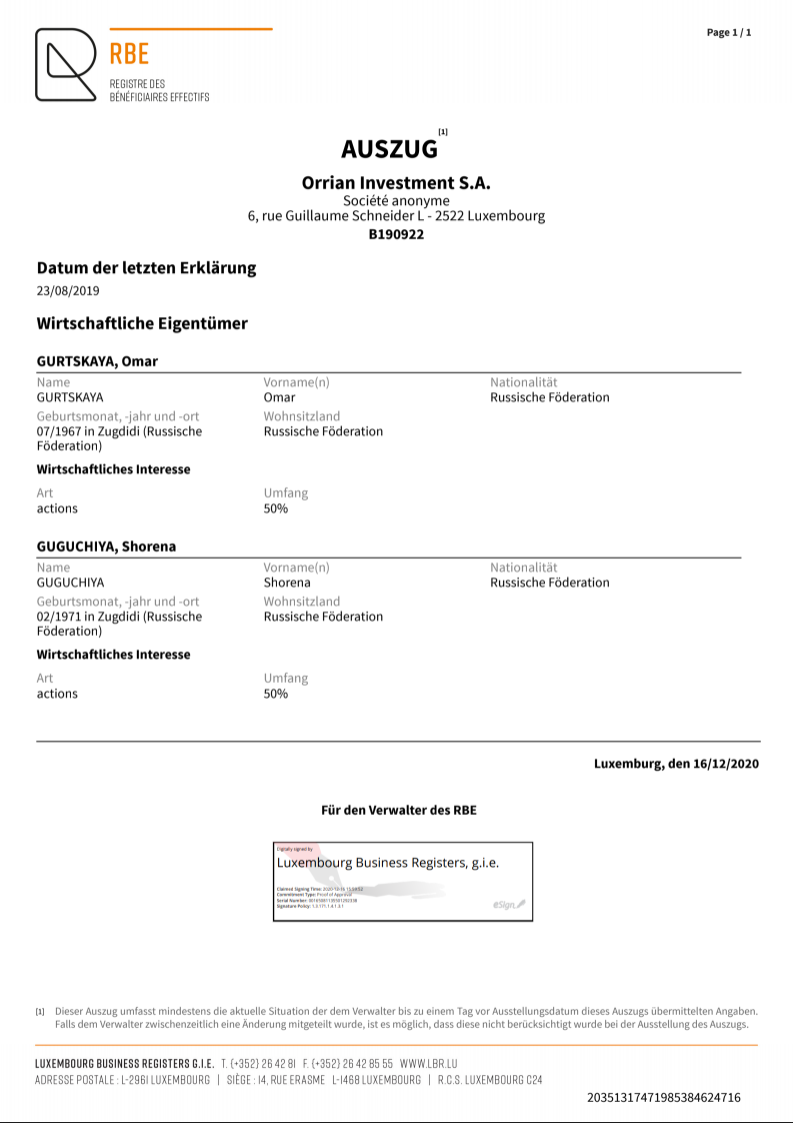
- full company name
- registration number
- registered address
- list of beneficial owners
- shareholding sizes of beneficial owners
The extract is provided in German and French.
Order processing time: from 30 minutes.

Other documents – copies of other documents filed with the register of Luxembourg.
The following extracts can also be obtained from the register of Luxembourg:
- Certificate of non-registration of a company in the register
- Articles of association of the company
- Application for registration
Searching for and obtaining an extract is possible using the following criteria:
- full name of the organization
- partial name and registered address
- enterprise identification number
The following main legal forms of enterprises exist in Luxembourg:
With legal entity status:
Société anonyme (S.A.) — public limited company.
Société par actions simplifiée (S.A.S.) — simplified joint-stock company.
Société à Responsabilité limitée (S.à r.l.) — private limited liability company.
Société en Nom collectif (SNC) — general partnership.
Société en Commandite Simple (SCS) — simple limited partnership.
Société en Commandite par Actions (SCA) — partnership limited by shares.
Société coopérative (SC) — cooperative society (cooperative).
Without legal entity status:
Société en Commandite Spéciale (SCSp) — special limited partnership.
Extracts from the commercial register are provided by us in strict compliance with the legislation of the Grand Duchy of Luxembourg and in full adherence to European personal data protection requirements (GDPR).
Requests are processed within one business day. Courier delivery of an apostilled extract is paid separately according to courier service rates.
You can order preliminary information on the availability of company records in the Commercial Register of Luxembourg free of charge on our website.
Register of Beneficial Owners of Luxembourg
Luxembourg operates a separate Register of Beneficial Owners — Registre des Bénéficiaires Effectifs (RBE).
Following the adoption of the Fourth EU Anti-Money Laundering Directive (4AMLD) in 2017, Luxembourg law requires all companies to identify their ultimate beneficial owners and submit the information to the Business Register (Luxembourg Business Register, LBR), which then regularly publishes it in the Register of Beneficial Owners of companies.
The Luxembourg Law "On the Register of Beneficial Owners" (Registre des Bénéficiaires Effectifs (RBE)) covers a wide range of enterprise structures, forms, and types.
Both companies and partnerships fall under this legislation, regardless of whether they are regulated or not. These include enterprise forms such as: SA, SCA, Sàrl, SCS, SCSp, SE, SNC, GIE, SAS, SC.
The legislation also extends to investment funds. These include structures such as: UCITS, Part II Fund, SIF, SICAR, RAIF, and other types of AIF. Luxembourg common funds (FCP) are also covered by the law, although they were initially excluded, as are foreign branches of commercial corporations and public organizations.
The following information is submitted to the register:
- First and last name
- Date of birth
- Identification number
- Nationality
- Country of residence
- Basis of ownership
A beneficial owner means an individual who directly or indirectly owns or controls a legal entity. This is determined by the following criteria:
- More than 25% of the company's share capital;
- More than 25% of the voting rights in the company;
- Exercising direct or indirect control over the management of the company by other means.
Special Cases and Reporting Procedures
- Exemptions: Only listed companies (whose shares are traded on a regulated market) are exempt from the obligation of detailed disclosure — it is sufficient for them to indicate the name of the stock exchange.
- Chain of ownership: Companies that have indirect beneficial owners are required to provide information on all legal entities through which control over the Luxembourg structure is exercised.
- Absence of beneficial owners: If a company has no direct or indirect owners meeting the criteria, it must declare the members of its senior management (dirigeants principaux).
- Update deadlines: amendments to the register need to be filed only if changes have occurred with respect to already identified beneficial owners or their details. Luxembourg law allows one month to update the information.
⚠️ Important Clarification on Data Access
Following the landmark ruling of the Court of Justice of the European Union (CJEU) of November 22, 2022, Luxembourg was one of the first countries to completely close free public access to the RBE for the general public.
Now, external applicants (including journalists) must provide documentary proof and detailed justification of a "legitimate interest" (intérêt légitime) to obtain data. Each such request is reviewed individually by the managing organization LBR and may be rejected.
Full and unhindered access to the information is retained only by competent state authorities (courts, police, tax authorities), as well as notaries, lawyers, auditors, and banks within the framework of compliance and KYC procedures.
Apostille Certification of Extracts from Luxembourg
Luxembourg acceded to the Hague Convention Abolishing the Requirement of Legalisation for Foreign Public Documents on April 4, 1979, and the Convention entered into force on June 3, 1979.
Thus, documents issued in Luxembourg are subject to legalization under a simplified procedure — apostille certification; after certified translation, such documents acquire full legal force.
Important: Documents obtained electronically from the register of Luxembourg can be certified with an electronic apostille (e-Apostille) directly through the Ministry of Foreign Affairs of Luxembourg. However, if the document is intended for use in countries where government agencies or banks require strictly paper originals (for example, for courts), the electronic format will not suffice. In such cases, it is necessary to order an official paper extract bearing the "wet" seal of the authority in advance for subsequent affixing of the standard "Apostille" stamp.
The authority empowered to certify Luxembourg documents with an apostille is the Ministry of Foreign Affairs of Luxembourg (Ministère des Affaires étrangères).
As a rule, certifying an extract with an apostille takes about two weeks.
In addition, you can order a notarized translation of documents from French/German into English from us.
Liquidation of Companies in Luxembourg: Status in the Registers
Upon termination of a company's activities, its data are not deleted, but transferred to an archived status in the Commercial Register (RCS) and the Register of Beneficial Owners (RBE).
It is impossible to obtain a standard extract for a liquidated company — it will not be issued. Instead of an extract, you will only receive a Certificate of Liquidation (Certificat de radiation). At the same time, all company data remain accessible in the document archive.
Company statuses in the RCS
- "En liquidation" (In liquidation): management passes to the appointed liquidator, and the company exists solely to settle accounts with creditors.
- "Radiée" (Struck off / Liquidated): settlements are completed, the final balance sheet is approved, and the company has officially ceased to exist.
Data retention (5-year rule)
After a company is struck off (radiation), information on its beneficial owners in the RBE database, as well as originals of corporate documents (held by a notary or in an archive), must be retained for 5 years. The physical storage address of the documents is recorded in the register.
Duties of the liquidator
- Publish liquidation resolutions in the official gazette RESA.
- Provide tax clearance certificates confirming no debts from the tax administration (ACD), customs (AED), and social security (CCSS).
- Update data in the RBE within the standard one-month period if beneficial owners change during the liquidation process.
Radiation d'office (Compulsory strike-off): The LBR Registrar has the right to administratively close "abandoned" companies (without an office, financial statements, or data in the RBE). At the same time, information on related persons is still placed into the mandatory 5-year archive.
Difference Between Electronic and Apostilled Extracts
| Characteristic | Electronic extract | Paper extract with apostille |
|---|---|---|
| Format | PDF file with verification code | Paper original with LBR seal and Apostille stamp |
| Processing time | From 30 minutes | 1–2 weeks (ordering paper copy + legalization at the MFA) |
| Legal force | Informational certificate | Official document for government agencies and courts |
| Legalization | Not possible in electronic form | Affixed (Apostille of the MFA of Luxembourg) |
| Application | Counterparty verification, prompt analysis, contract preparation | Courts, opening bank accounts, international notarial transactions |
| Cost | from 20 € | from 250 € |
Annual Financial Statements of Enterprises in Luxembourg
Under the Luxembourg Law on Commercial Companies of August 10, 1915 (Loi concernant les sociétés commerciales) and the Law on the Register of Commerce and Companies and the Accounting and Annual Accounts of Undertakings of December 19, 2002 (Loi RCS), commercial limited liability companies — public limited companies (SA), private limited liability companies (SARL and simplified SARL-S), partnerships limited by shares (SCA), European companies (SE), as well as partnerships (SNC, SCS) whose partners are limited liability companies or whose annual turnover exceeds EUR 100,000 — are required to annually approve and file annual financial statements. Documents are submitted electronically (via the eCDF platform in a structured format with subsequent registration) to the Luxembourg Business Register (Registre de Commerce et des Sociétés — RCS). The general meeting of members must approve the financial statements within 6 months after the end of the financial year, after which 1 month is given for filing with the RCS (meaning the final deadline is 7 months from the year-end closing date).
Financial statements filed with the RCS are public. Financial statements can be found in the register by company name and its registration number (RCS number), and copies of registered annual reports can be obtained electronically (in French, German, or English).
Public companies whose securities are admitted to stock exchange trading, as well as banks, insurance companies, and financial institutions, are required to apply International Financial Reporting Standards (IFRS). Other businesses use Luxembourg accounting standards (LUX GAAP) or may voluntarily adopt IFRS.
Enterprise Categories, Reporting Scope, and Mandatory Audit
The scope of information disclosed in the public register is determined by the size of the enterprise (if at least two of the three criteria are not exceeded for two consecutive years):
- Small enterprises: balance sheet total up to EUR 5.5 million, net turnover up to EUR 11 million, average number of employees up to 50 (file an abridged balance sheet, abridged profit and loss statement, and abridged notes; exempt from preparing a management report and mandatory external audit);
- Medium-sized enterprises: balance sheet total from EUR 5.5 to 25 million, turnover from EUR 11 to 50 million, staff from 50 to 250 employees (file a full balance sheet, abridged profit and loss statement, notes, and management report on operations);
- Large and public companies: enterprises exceeding the thresholds for medium-sized companies file a full set of financial statements — detailed balance sheet, detailed profit and loss statement, comprehensive notes, and management report;
- Mandatory audit: conducted by an approved statutory auditor (réviseur d'entreprises agréé) for medium-sized, large, and public companies, as well as regulated financial institutions.
Notarized Translation of Documents from Luxembourg
Extracts and other official documents from the Luxembourg commercial register can be translated into another language by a sworn translator directly in Luxembourg, or the translation can be completed in the destination country and notarized. Schmidt & Schmidt provides professional document translation services with subsequent official certification. The cost of work is calculated individually based on the volume of the specific document.
Document Delivery
After obtaining an extract and having it apostilled, it is often necessary to promptly send the document to another country. In such cases, not only speed but also delivery security is important.
Schmidt & Schmidt arranges international courier delivery of documents worldwide. We use reliable logistics solutions and modern tracking systems, allowing you to monitor the movement of your shipment at every stage of the journey and ensuring its timely hand-to-hand delivery to the recipient.
Validity Period of an Extract from the Commercial Register of Luxembourg
The validity period of the document is not limited by law, but directly depends on the requirements of the receiving party (bank, judicial authorities, or notary).
Two types of documents are used for different purposes:
- Electronic extract (for informational purposes): Valid strictly at the time of download. Ideal for quick counterparty checks, financial statement analysis, or preparing current contracts. It has the status of an informational document and cannot be used for legally significant actions. As a rule, it is recommended to use extracts no older than 1 week.
- Paper extract with apostille (for legal purposes): Required for courts, opening bank accounts, or registering corporate transactions. For such documents, the 30-day period is usually calculated from the date the apostille is affixed by the Ministry of Foreign Affairs. The extract itself must be obtained within a reasonable time (as a rule — up to 30 days prior to legalization).