
Police Clearance Certificate is an official document issued by the internal affairs authorities confirming that a person currently has no criminal record, is not wanted for criminal offenses, or that any previous convictions have already been expunged. It is one of the most commonly required documents for international mobility.
A Police Clearance Certificate is often required in the following situations:
- Obtaining a visa;
- Applying for a temporary residence permit;
- Applying for a residence permit;
- Obtaining citizenship;
- Employment;
- Admission to an educational institution;
- Background checks for adoption or guardianship;
- Providing evidence in court;
- Marriage registration.
What is a Police Clearance Certificate in Russia?
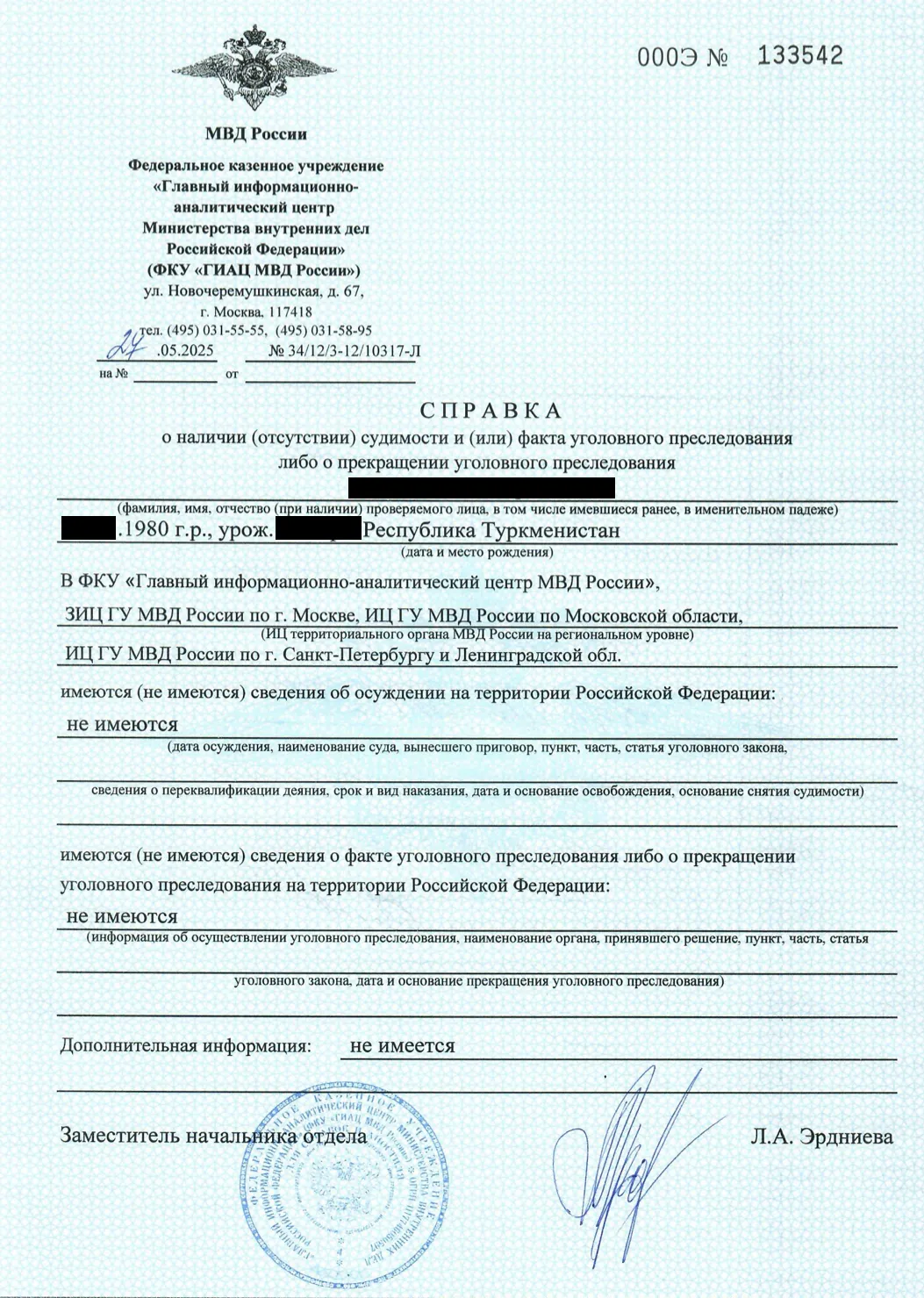
The official name of the document in Russia is Certificate of the Presence (or Absence) of a Criminal Record and/or Criminal Prosecution, or of Termination of Criminal Prosecution.
The issuance of the certificate is governed by the official regulations of the Ministry of Internal Affairs of Russia for providing state services on criminal record certificates, approved by Order No. 660 on September 27, 2019.
The Police Clearance Certificate can be issued in paper or electronic form and contains information from the databases of the Ministry of Internal Affairs. The service is managed by the Ministry itself, specifically by the Main Information and Analytical Center (GIAC MIA) and its Information Center.
The certificate is issued in Russian and is available to Russian citizens, foreigners, and stateless persons aged 14 and older.
At the applicant’s request, three main types of Police Clearance Certificates can be issued in Russia:
- Electronic;
- Paper;
- Paper with an apostille.
In addition, there is a form called “Certificate of Presence/Absence of a Criminal Record,” which can be issued by Russian consular offices abroad.
How to obtain a Police Clearance Certificate in Russia
Police Clearance Certificates in Russia can be requested in the following ways:
- Through the Gosuslugi (State Services) portal;
- Through a Multifunctional Center (MFC) for the provision of state and municipal services;
- At the Information Center of the Ministry of Internal Affairs (MIA).
Paper certificates can only be collected in person at an MFC or the MIA Information Center. They are valid for three months. If not collected within this period, the certificate must be requested again.
Electronic Police Clearance Certificate
An electronic Police Clearance Certificate in .pdf format, together with the MIA officer’s digital signature in .sig format, is delivered to the applicant’s personal account on the Gosuslugi portal. The certificate can be sent by email or copied to a USB drive. It can be printed at an MFC — a self-printed certificate is not legally valid.
Paper Police Clearance Certificate
To obtain a paper certificate, you must appear in person at the MIA Information Center or an MFC with an identity document. Online submission via Gosuslugi only allows you to submit the application.
Police Clearance Certificate by power of attorney
A Police Clearance Certificate can be obtained on behalf of another person — a minor, an incapacitated individual, or via power of attorney. It cannot be requested for a deceased person.
To prepare a power of attorney, you must visit a notary with your passport and the passport details of the person being represented. The notary will verify the applicant’s legal capacity.
When submitting an application via power of attorney, you must provide a notarized copy of the person’s passport and the notarized power of attorney. To collect a paper certificate under a power of attorney, you must bring your passport, the notarized power of attorney, and a copy of the represented person’s passport.
When requesting a Police Clearance Certificate for a child aged 14–18, the parent must provide (or upload) a copy of the child’s passport, a copy of the birth certificate, and (if the applicant and the child have different surnames) a copy of the marriage certificate or another document explaining the difference.
If the certificate is requested for an incapacitated person, in addition to the passport, a guardianship appointment document must be provided.
The authorized officer issues the paper certificate on a special form. Paper certificates and their stubs are printed using official printing methods, bound in booklets, and include a two-sided background security grid, a watermark with the emblem of the Russian Ministry of Internal Affairs, and microtext reading “MIA Russia.”
The size of the full sheet (certificate and stub) is 30 × 29.7 cm (length/width). The stub is separated from the certificate by a perforated line running the full length of the sheet, located 9 cm from the left edge of the certificate.
The certificate number consists of a series (the code of the GIAC MIA Russia or the regional MIA authority plus a letter) and a unique number. The series and number are printed on the sheet in two places (on the stub and on the certificate itself) using official printing methods.
The letter in the series is assigned periodically, and duplication of the series and number on different sheets is not allowed. All certificates have consecutive numbering.
The textual information in a Police Clearance Certificate is filled in by the Main Information and Analytical Center (GIAC MIA Russia) and the Information Center using computer systems.
To request a Police Clearance Certificate via the Gosuslugi portal, you need to:- Log in to your Gosuslugi account;
- Select the relevant service;
- Choose the type of certificate;
- Specify the person for whom the certificate is issued and complete the form;
- Verify the entered information;
- Upload the required photos or scanned documents;
- Submit the application.
At Russian consular offices abroad, the application process for a Police Clearance Certificate may vary: it can be done in person (including via power of attorney) or by mail. Specific procedures should be confirmed with the consulate in each case.
To obtain a Police Clearance Certificate through a Russian consulate or consular section abroad, you must pay the consular fee and provide the following documents:
- Application form;
- Original international or internal passport with copies of all filled pages;
- Power of attorney or birth certificate of a minor, if applicable.
When receiving a Police Clearance Certificate, personal details must be carefully checked. Any error or typo will make the document invalid.
Processing time for a Police Clearance Certificate in Russia
According to the official regulations, the standard processing time is 30 calendar days. However, when applying through an MFC, an additional two days may be required for data exchange. If a paper certificate with an apostille is requested, the processing time increases to 35 days. If the certificate is not issued within the standard timeframe, you should contact the MIA Information Center or the MFC in person.
It is not possible to request expedited processing or specify exact dates. Electronic certificates submitted via the Gosuslugi portal are usually processed slightly faster.
How to verify the authenticity of a Police Clearance Certificate
The digital signature of an electronic certificate can be verified using the special service on the Gosuslugi portal. You will need to upload the electronic document and the signature file, then click the “Verify” button.
Apostille on a Police Clearance Certificate in Russia
As the legal successor of the USSR, Russia is a participant in the 1961 Hague Convention Abolishing the Requirement of Legalization for Foreign Public Documents (“Apostille Convention”).
An apostille is an internationally standardized way of certifying the authenticity of a document for use in countries that recognize this form of legalization. It usually appears as a special stamp or certificate.
The Ministry of Internal Affairs of Russia is authorized to affix an apostille to paper documents it issues. To have a Police Clearance Certificate apostilled, there are two options:
- Request the certificate with an apostille from the outset;
- Have an already issued certificate apostilled at the MIA Information Center.
An apostille cannot be affixed to a certificate issued by Russian consular offices, because the apostille procedure does not apply to consular documents. As a result, many official authorities abroad may refuse to accept such certificates. Before obtaining a consular-issued certificate, it is important to confirm whether the receiving organization will accept it.
What is an apostille?
What is an apostille? Why do I need an apostille? How do I get an apostille? - Our video will explain everything you need to know about the apostille. If you have a document that needs to be certified with an apostille for use abroad, Schmidt and Schmidt will assist you! We provide apostille services in more than 100 countries worldwide.
Consular legalization of a Police Clearance Certificate from Russia
If the country where the Russian Police Clearance Certificate will be used is not a participant in the 1961 Hague Convention, for example the UAE, a more complex and costly consular legalization process is required.
Consular legalization is a multi-step procedure to verify the authenticity of a document for countries that are not part of the 1961 Hague Convention.
To legally use a Russian Police Clearance Certificate abroad through consular legalization, the following steps must be followed:
- Obtain the certificate;
- Make a notarized copy of the certificate;
- Certify the document at the Ministry of Justice of Russia;
- Legalize the document at the Consular Department of the Ministry of Foreign Affairs of Russia, or at a regional office of the Russian MFA;
- Have the document translated by a notary;
- Legalize the document at the consulate or consular section of the embassy of the destination country.
Because of the many steps involved, this procedure is lengthy and relatively expensive. Some countries do not have consulates in Russia, so the final stage of legalization may need to be completed in another country where a consulate is located.
What is consular legalization?
In our video we are explaining what consular legalization is and where to apply for it.
Schmidt & Schmidt will assist you in all issues concerning the legalization.
Schmidt & Schmidt offers legalization in more than 80 countries all over the world.
Official translation of Police Clearance Certificate in Russia
A Russian Police Clearance Certificate is issued in Russian. To use it abroad, an official translation must be made in accordance with the laws of the destination country — by a sworn, certified, notarial, or court-appointed translator in that country.
Translations made within Russia (except through consular legalization) are unlikely to be accepted abroad.
Document delivery
After obtaining a Police Clearance Certificate, its apostille, or legalization, there is often a need to send the document to another country. In such cases, both speed and security of delivery are important, especially for original official documents.
Schmidt & Schmidt arranges international delivery of documents worldwide. We use reliable logistics solutions and modern tracking systems, allowing us to monitor the shipment at every stage and ensure timely delivery to the recipient.
Our specialists ensure careful and confidential handling of documents and assist in resolving potential issues with international shipping, including carrier requirements and customs formalities.
We can arrange delivery of Police Clearance Certificates, apostilled documents, translations, and other official papers to most countries worldwide — for both private clients and legal entities or organizations.
How we can help
We are happy to assist you in obtaining a Police Clearance Certificate from Russia, including requesting the certificate, obtaining an apostille, and completing legalization for use abroad, as well as translation and international delivery.
You can always turn to Schmidt & Schmidt. We have extensive experience in requesting and legalizing a wide range of documents and provide all necessary services in this area, including obtaining notarized copies, translation, preparing required powers of attorney, legalization of documents with government authorities and foreign consulates, and delivery of completed documents to most countries worldwide.
For more details on the legalization and apostille process, you can read more on our website.