
Since 2022, millions of Ukrainians have found themselves abroad, making the issue of document legalization a pressing concern for many of them. In most cases, Ukrainian documents bearing an apostille are required to find employment, enroll at a university, reunite with family members, or obtain a residence permit. As of February 1, 2026, Ukraine has introduced an updated apostille procedure, and most instructions available online are already outdated. This material has been prepared in accordance with the current rules.
The key objective of the large-scale reform is to make the legalization process as digital and accessible as possible, including for citizens residing in other countries. The introduction of a unified Electronic Apostille Register with QR codes, the possibility of obtaining an e-Apostille with a qualified electronic signature (QES), as well as the authorization of private notaries to accept documents, have significantly simplified the procedure. Below, we will take a detailed look at how these changes work in practice, where to apply for different types of documents, and how to avoid critical mistakes when submitting an application.
Guide contents
This guide provides a detailed overview of how to obtain an apostille and consular legalization for official Ukrainian documents under the 2026 rules, including the submission procedure, the competence of the relevant authorities, processing times, fees, and specific considerations for using documents abroad.
- What is an apostille and when is it required?
- What changed as of February 1, 2026?
- Apostille fees in 2026
- Where to submit documents: competence of the authorities
- Step-by-step submission procedure
- Processing times
- Police Clearance Certificate
- Educational documents
- Documents from Crimea and Donbas territories
- Commercial and corporate documents
Summary
- What is an apostille? A certificate confirming the authenticity of the signature, the capacity in which the signatory has acted, and the authenticity of the seal or stamp on a document for its use abroad.
- When is it required? For Ukrainian documents used abroad, including for employment, obtaining a residence permit or visa, university admission, recognition of education, and other official procedures.
- What changed in 2026? As of February 1, a new procedure has been in effect, featuring an electronic register, QR codes, and the option to obtain an e-Apostille. An application can also be submitted through a private notary.
- Where should you apply? The competent authority depends on the document: the Ministry of Justice — civil status, court, and notarial documents; the Ministry of Education and Science — educational documents; the Ministry of Foreign Affairs — documents issued by the Ministry of Health and central government authorities.
- Cost: UAH 670 for individuals and UAH 1,160 for legal entities per document.
- Processing times: Usually 1–2 business days; the maximum processing time is 3 business days; if additional verification is required, the process may take up to 1 month.
- If you are abroad: You can arrange the apostille through an authorized representative, an intermediary, or by mail; for eligible documents, submission through «Дія» is also available.
- Apostille and translation: The correct sequence is: original document → apostille → translation → notarization of the translation.
- Restrictions: Passports, ID cards, driving licenses, and commercial invoices cannot be apostilled directly.
Need to obtain an apostille in Ukraine? Order apostille and document legalization services on a turnkey basis, including procurement of duplicate documents, certified translation, and worldwide delivery.
What is an apostille and when is it required?
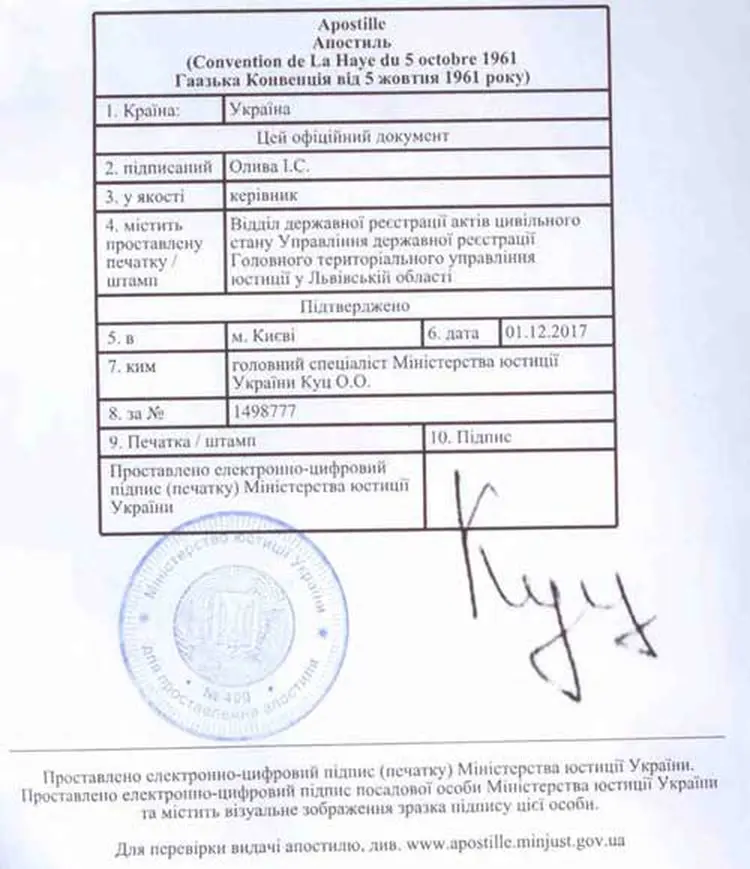
An apostille is a standardized certificate that confirms the authenticity of the signature of a public official, the capacity in which the signatory has acted, and the authenticity of the seal or stamp on the document. It was introduced by the 1961 Hague Convention as an alternative to multi-step consular legalization: instead of a chain of certifications from one ministry to another, a single certificate is issued and recognized by all states parties to the Convention. Ukraine acceded to the Convention on December 22, 2003.
In Ukraine, an apostille takes the form of a quadrilateral certificate (or a printed form/sticker) measuring at least 9 × 9 cm, issued in Ukrainian, and containing the mandatory heading “Apostille” and a reference to the 1961 Hague Convention in French (Convention de La Haye du 5 octobre 1961).
An apostille is required when a Ukrainian document is submitted in another country for official purposes, such as applying for a work visa or residence permit, enrolling at a foreign university, having a diploma recognized, reuniting with family members, handling inheritance matters, or participating in court proceedings abroad. Check directly with the receiving authority which specific documents it requires to be apostilled, as requirements vary.
An apostille is valid exclusively in countries that are parties to the Hague Convention — there are now more than 120 of them, including all European Union member states, the United States, Canada, the United Kingdom, Australia, Israel, Switzerland, and Norway. If the document is intended for a country that has not acceded to the Convention (including a number of countries in Southeast Asia and the Middle East, such as the United Arab Emirates), consular legalization will be required — a fundamentally different and considerably more time-consuming procedure.
What changed as of February 1, 2026?
Order No. 3177/5 of the Ministry of Justice of November 20, 2025 introduced a new apostille procedure, which came into force on February 1, 2026. The reform has made Ukraine's system one of the most technologically advanced: among all states parties to the Hague Convention, fewer than half have a fully-fledged electronic register with online verification and electronic apostilles.
Electronic Apostille Register. The Ministry of Justice, together with the state enterprise “National Information Systems,” is developing a unified digital system for verifying apostilles. The authenticity of an apostille can be verified online through the Apostille Register using the information indicated on the apostille. For apostilles issued from March 1, 2026 onward, a scanned copy of the document is also available during verification. This provides an additional way to verify that the apostille corresponds to the document.
QR code for verifying an apostille in the Register. An apostille contains a QR code that allows users to access information about the apostille in the Apostille Register and verify its authenticity online with a single click.
Electronic Apostille (e-Apostille). Electronic official documents may be eligible for an electronic apostille. Such an apostille exists in electronic form and contains a qualified electronic signature (QES). An electronic apostille can be transmitted to the recipient electronically without the need for international shipment of the paper document. The availability of an e-Apostille depends on the type of document, the competent authority, and the requirements of the destination country or institution, so this should be clarified in advance.
Private notaries. As of February 1, 2026, an application for an apostille through the Ministry of Justice can also be submitted through a private notary, in addition to territorial justice authorities and state notarial offices. There are relatively few state notarial offices in Ukraine, and some cities have none at all. There are thousands of private notaries. This innovation significantly expands the geographical availability of submission beyond regional administrative centers.
Apostilles issued before February 1, 2026 remain fully legally valid. They do not need to be reissued.
Apostille fees in Ukraine in 2026
As of January 1, 2026, the fee is calculated as a percentage of the subsistence minimum for able-bodied persons established at the beginning of the year. In 2026, this amount is UAH 3,328; the final amounts are rounded to the nearest UAH 10. Linking the fee to the subsistence minimum means that the cost may change each year when the subsistence minimum is revised.
| Category | Coefficient | Cost per document |
|---|---|---|
| Individuals | 0.2 | UAH 670 |
| Legal entities | 0.35 | UAH 1,160 |
Until May 2025, the apostille fee for individuals was UAH 51; the current fee of UAH 670 represents an increase of more than twelvefold. The apostille fee is charged separately for each document: a diploma and its supplement are two separate documents, each requiring its own apostille and a separate payment. If an apostille is refused, the fee paid by the applicant is not refunded. Before submitting an application, make sure that the document is eligible for apostille, that it is submitted to the correct authority, and that it is presented in an acceptable form: either as an original or as a duly certified copy, if this method is permitted for the particular document.
Below is an approximate budget for apostilles for typical document packages.
| Situation | Documents | Apostille Fees |
|---|---|---|
| Work visa / employment | Diploma + supplement + birth certificate + certificate of no criminal record | UAH 2,680 |
| Family reunification (one child) | Marriage certificate + child's birth certificate + applicant's birth certificate + certificate of no criminal record | UAH 2,680 |
| Admission to a foreign university | Diploma + supplement + school-leaving certificate | UAH 2,010 |
This covers only the cost of the apostilles. Translation of each document (including the text of the apostille) and notarization of the translation add a substantial amount to the total. The overall budget for preparing the document package should therefore take all stages into account.
Payment method: bank transfer to the account details of the relevant authority. The payment details are available on the websites of the territorial justice authorities, the Ministry of Education and Science, and the Ministry of Foreign Affairs. Proof of payment must be attached to the application when it is submitted. When applying through a private notary, the notary will provide the current bank details.
Where to submit documents: competence of the authorities
Ukraine does not have a single-window system for apostille services — the competent authority depends on the type of document. Applying to the wrong institution means losing a day and risking the loss of the fee paid.
| Document | Authority |
|---|---|
| Birth, marriage, divorce, and death certificates; civil registry office certificates (DRATSs) | Ministry of Justice |
| Certificates of No Criminal Record (paper forms issued by the Ministry of Internal Affairs) | Ministry of Internal Affairs / Ministry of Justice |
| Court decisions, judgments, and rulings | Ministry of Justice |
| Notarized documents (powers of attorney, agreements, statements, affidavits) | Ministry of Justice |
| Diplomas, school-leaving certificates, diploma supplements, academic transcripts | Ministry of Education and Science (Kyiv, 25 V. Chornovola St.; applications accepted Mon–Thu, 9:30 a.m.–1:00 p.m.) |
| Migration-related documents (issued by the State Migration Service) | State Migration Service |
| Tax certificates and registration documents | State Tax Service |
| Archival certificates and archival extracts | State Archival Service |
| Medical certificates (Ministry of Health) and documents issued by other central executive authorities | Ministry of Foreign Affairs |
Documents that are not subject to direct apostille: passports, ID cards, employment record books, military IDs, driving licenses, commercial agreements, invoices, and customs declarations. If information contained in such a document needs to be certified for use abroad, a notarized copy of the document or an official extract/certificate containing the relevant information is generally apostilled instead.
Step-by-step submission procedure
Step 1. Determine the competent authority. Use the table above. If your situation is unusual, call the territorial justice authority in your region and clarify the procedure before traveling. Five minutes on the phone can save you half a day.
Step 2. Gather the documents. The following are required for submission: the original document (or a copy duly certified in accordance with the applicable procedure), the applicant's passport or ID card, proof of payment (UAH 670 per document for individuals), and the prescribed application form, which can be downloaded from the relevant ministry's website or obtained on site.
Step 3. Submit the application.
For Ministry of Justice documents: through any civil status registration office (DRATS) of a territorial justice authority or a private notary (available as of February 1, 2026) — in any locality, without the need to travel to Kyiv. If you are abroad, paper documents may be sent by mail to any DRATS office — this method of submission is expressly provided for under the new procedure. For electronic Ministry of Justice documents, the application is submitted through the Diia Portal — there is no need to physically send anything.
For Ministry of Education and Science documents: in person at 25 Viacheslava Chornovola St., Kyiv (applications accepted Mon–Thu, 9:30 a.m.–1:00 p.m.), or remotely via Nova Poshta — the originals are sent to the ministry's address, with the applicant covering the cost of shipping in both directions.
For Ministry of Foreign Affairs, State Migration Service, and State Tax Service documents: check the procedure and current address on the official websites of the relevant ministries and services.
Step 4. Wait for processing. Standard documents submitted through the Ministry of Justice are usually ready within 1–2 business days in practice. The official maximum processing time is 3 business days. If additional verification is required, processing may take up to 1 month. Processing times for educational documents submitted through the Ministry of Education and Science are provided in the “Processing Times” section below.
Step 5. Collect the document and check it on the spot. Collect it in person or receive it by mail if you submitted the application remotely. Check immediately: the spelling of your surname and first name, the date the apostille was issued, the name of the issuing institution, and the presence of a QR code on apostilles issued from February 2026 onward. It is much easier to correct an error on the spot — returning later is considerably more difficult and costly.
Step 6. Order the translation. Only after receiving the original document with the apostille should you arrange the translation — the translator translates the document together with the text of the apostille. If the translation is prepared before the apostille is issued, the text of the apostille will not be included, and the translation will have to be ordered again at full cost.
Processing times
Through the Ministry of Justice — up to 3 business days from the date the application is registered in the Register. If additional verification is required (for example, a request to another authority or doubts regarding authenticity), processing may take up to 1 month. In practice, certificates and notarized documents are usually ready within 1–2 days.
Through the Ministry of Education and Science (diplomas, school-leaving certificates) — the time required to affix an apostille to educational documents depends on the type of document and whether additional verification is necessary. Current standard and expedited processing times should be confirmed directly with the Ministry of Education and Science before submission.
The difference in processing times is easy to explain: newer diplomas can be verified quickly through the Ministry of Education and Science's electronic registers, while older paper documents must be verified manually through university archives. Soviet-era diplomas (issued before 1991) and documents issued by educational institutions located in territories currently under occupation often take longer than the stated processing times. If an educational institution has been dissolved or the information concerning a document requires additional confirmation, further verification or archival documents may be required. Such cases should be clarified with the Ministry of Education and Science before submission.
In practice, documents are often ready earlier than the official deadlines: newer diplomas within 5–7 days and certificates within 1–2 days. Nevertheless, it is better to plan based on the official maximum processing time rather than the optimistic minimum. If you need to apply for a visa or meet a university admission deadline, start the apostille process at least 2 months in advance. In addition to the apostille processing time, allow time for translation (3–7 days), notarization (1–2 days), and unforeseen delays.
Police Clearance Certificate in Ukraine
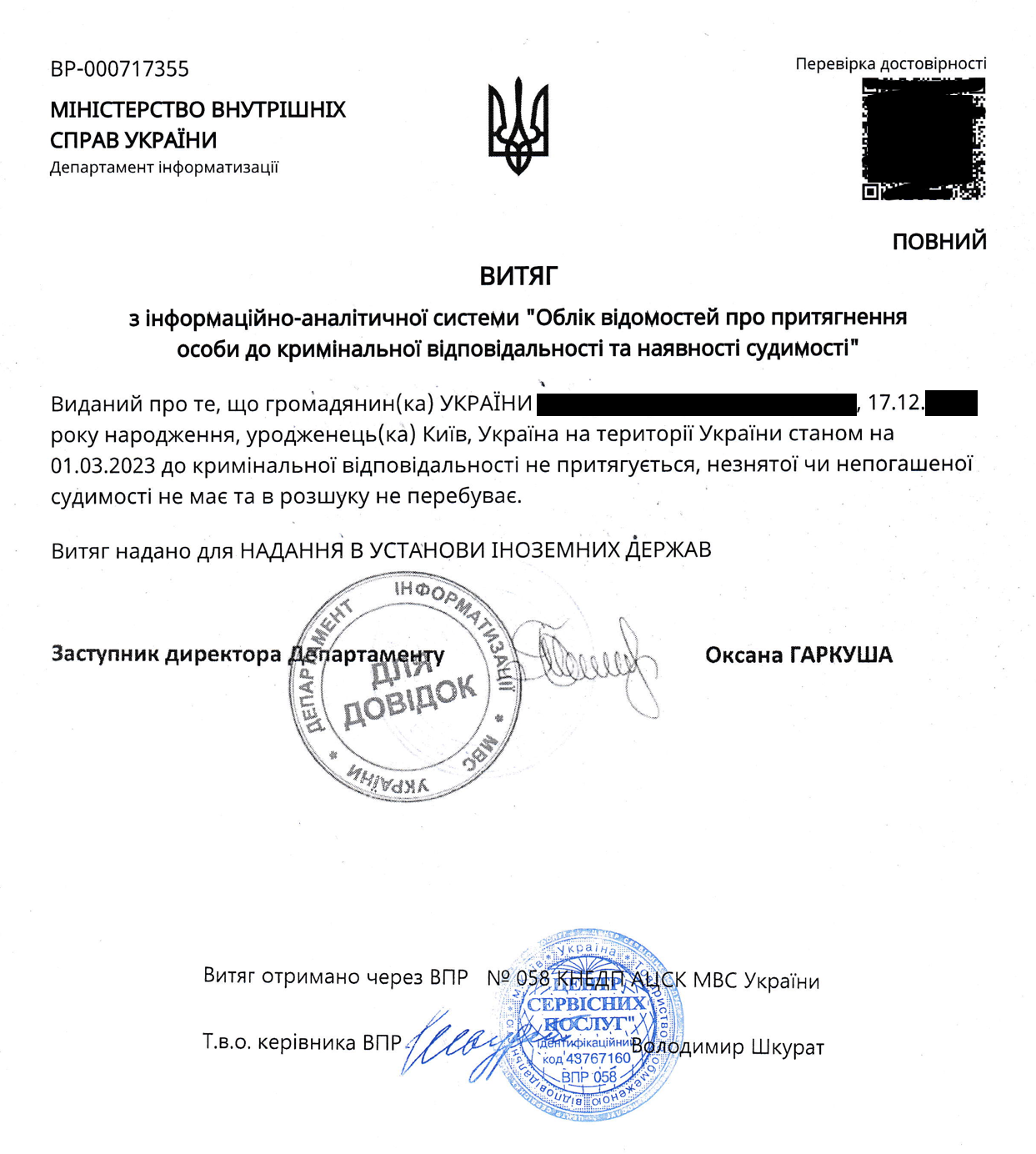
A Certificate of No Criminal Record with an apostille can be ordered directly through the Diia Portal (diia.gov.ua) — without visiting a consulate. This is the most convenient option for Ukrainians abroad: the document is issued electronically with a qualified electronic signature and an apostille. Check in advance whether the institution in the destination country accepts electronic documents, as acceptance depends on its policies.
If the receiving authority requires a paper certificate bearing an original signature and seal, the electronic version obtained through Diia must be submitted to the Ukrainian consulate in the applicant's country of residence for issuance in an official paper format. The certificate can also be ordered through the website of the Main Service Center of the Ministry of Internal Affairs (vytiah.mvs.gov.ua).
There is no universal validity period for a Certificate of No Criminal Record — it is determined by the requirements of the specific destination country or institution (usually between 90 and 180 days). Check this period in advance and order the certificate last, once the other documents are ready: birth certificates, diplomas, and other supporting documents can be apostilled without an expiration date, whereas the receiving authority may impose a limit on how recent the certificate must be.
Apostille for Ukrainian educational documents
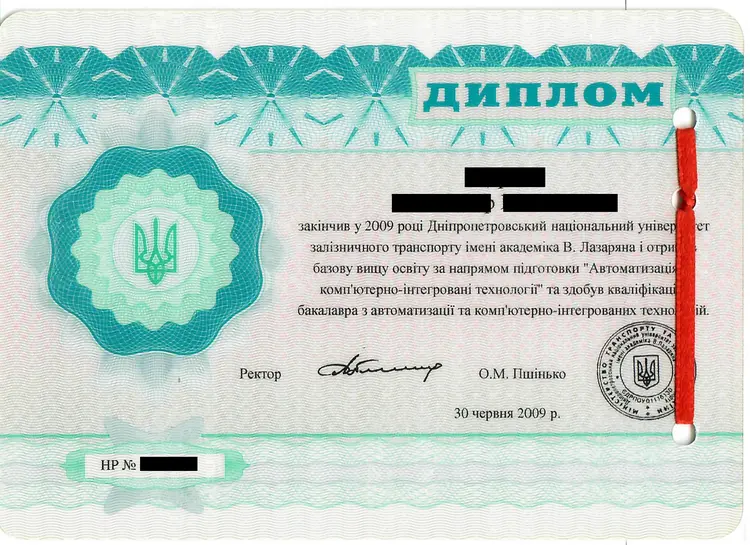
Ukrainian educational documents (diplomas, school-leaving certificates, diploma supplements, academic certificates) are apostilled through the Ministry of Education and Science (MES), not the Ministry of Justice. This is a separate procedure with separate processing times and a separate submission location. For more information about apostille and recognition of Ukrainian diplomas abroad, see our dedicated overview.
Documents can be submitted in two ways: in person or through a representative at the office of the state-owned enterprise “Information and Image Center” (ENIC Ukraine) in Kyiv, or remotely via a courier service. In both cases, an electronic account must first be registered on the Center's website and an application created online. The operator reviews the application within 1–3 business days; an incorrectly completed application will not be accepted for processing.
Key application requirements: the applicant may be any adult with a passport — they do not have to be the document holder; a single application is created for all documents; the application must be completed exclusively in Ukrainian; scanned copies must be in color, legible, in .jpg or .jpeg format, and no larger than 1 MB.
Original documents must be submitted for apostille. For new-format diplomas (plastic cards), the apostille is affixed to a separate sheet, which is attached to the diploma. For old-format diplomas (paper documents), a separate apostille is affixed to each document — the diploma and its supplement.
The authenticity of an apostille already affixed by the MES can be verified online through the ENIC Ukraine service: the database contains apostilles issued since January 18, 2013. Verification requires the apostille number, application number, and date of issuance.
Types of educational documents eligible for apostille:
School education: Certificate of Primary Education, Certificate of Basic Secondary Education, Certificate of Complete General Secondary Education (formerly known as a school-leaving certificate).
Higher education: Junior Bachelor's Diploma, Bachelor's Diploma, Master's Diploma, PhD / Doctor of Arts Diploma, Doctor of Sciences Diploma. Previously issued but no longer awarded: Specialist Diploma, Junior Specialist Diploma, Candidate of Sciences Diploma.
Documents from territories outside Ukraine's control: Crimea and Donbas
The Ministry of Education and Science of Ukraine affixes an apostille only after receiving confirmation from the university that issued the diploma. For educational institutions located in territories outside Ukraine's control, it is impossible to send such a verification request. This applies to universities in Crimea and Sevastopol (since 2014), as well as educational institutions in the Donetsk, Luhansk, Zaporizhzhia, and Kherson regions (since 2022).
Documents issued by the structures of the so-called Donetsk People's Republic (DPR) and Luhansk People's Republic (LPR) are not eligible for either apostille or consular legalization because the entities that issued them are not recognized state authorities of Ukraine. Apostille or legalization is possible only after such documents have been replaced with documents issued by Ukrainian state authorities in accordance with the established procedure.
Original civil status documents issued in Crimea before August 11, 2014 were produced on Ukrainian forms and bear Ukrainian seals, so they can generally be apostilled. For civil status events that occurred before this date, an apostille can be affixed to a reissued duplicate issued by a central civil status registration office (DRATS). Certificates issued by the Russian authorities in Crimea after August 11, 2014 cannot be apostilled by Ukrainian ministries.
Old-format certificates (issued before 2016) must be replaced with new-format documents at a DRATS office before being submitted for apostille. Laminated certificates are not eligible for apostille. The document must be in good physical condition, with clear signatures and seals and without any extraneous inscriptions or stickers.
Apostille for commercial and corporate documents
Corporate documents may need to be apostilled for establishing branches, opening accounts with foreign banks, entering into international transactions, and conducting legal proceedings abroad.
The following categories of business documents are eligible for apostille:
- Corporate registration documents: extract from the Ukrainian Commercial Register (USR), extract from the Ukrainian Land Register, certificates of state registration, and tax registration certificates;
- Constituent documents: notarized copies of articles of association, incorporation agreements, and minutes of shareholders' meetings;
- Notarial documents of legal entities: corporate powers of attorney, statements, and affidavits signed by the director;
- Court decisions in commercial disputes.
In Ukraine, apostilles are affixed exclusively to Ukrainian documents. For corporate documents of foreign companies, the apostille must be obtained in the country where the company was originally registered.
Exemption from legalization: international treaties and the EU regulation
Ukrainian documents do not always require an apostille for use abroad. A number of international agreements simplify or completely eliminate legalization requirements:
Bilateral legal assistance treaties concluded by Ukraine. Ukraine has concluded bilateral agreements abolishing the requirement for apostille and consular legalization of civil status and judicial documents with the following states: Bulgaria, Vietnam, Georgia, Latvia, Lithuania, Mongolia, Poland, Romania, Serbia, Slovakia, Hungary, the Czech Republic, North Macedonia, and Estonia. For the use of Ukrainian documents in these countries, a notarized translation into the official language of the receiving country is generally sufficient (although certain commercial or educational institutions may request an apostille under their internal rules).
Minsk Convention of the CIS. On May 19, 2024, Ukraine officially withdrew from the Convention on Legal Assistance and Legal Relations in Civil, Family and Criminal Matters (the 1993 Minsk Convention). All documents issued in Ukraine after May 19, 2024 for use in CIS countries (Kazakhstan, Armenia, Belarus, etc.) now require an apostille.
Multilingual CIEC extracts (1976 Vienna Convention). Extracts from civil status records (birth, marriage, and death) issued on multilingual forms of the International Commission on Civil Status are accepted without an apostille in the states parties to the Convention: Austria, Belgium, Bosnia and Herzegovina, Bulgaria, Germany, Estonia, France, Italy, Cabo Verde, Croatia, Lithuania, Luxembourg, North Macedonia, Moldova, Montenegro, the Netherlands, Poland, Portugal, Romania, Switzerland, Serbia, Slovenia, Spain, and Turkey.
EU Regulation 2016/1191. Regulation (EU) 2016/1191 of July 6, 2016 abolishes the apostille requirement for certain public documents, but applies exclusively between public authorities of EU Member States. Since Ukraine is not an EU Member State, this Regulation does not directly apply to Ukrainian documents, except where a document has been reissued by a competent authority of an EU Member State.
How to obtain an apostille while abroad
If you need an apostille while you are abroad, there are several ways to organize the process, each with its own advantages and risks. The choice depends on the type of document and where the original is located. If you have the document with you abroad, it can be sent by mail or transferred through a representative. If the original remains in Ukraine, you must first request it remotely from the issuing authority and only then submit it for apostille.
Through an authorized representative — the most reliable option, especially in non-standard situations. A notarized power of attorney can be executed at a Ukrainian consulate in your country of residence. It should expressly state the right to submit an application for an apostille, the right to receive the completed documents, and the right to pay the applicable fees. The more specific the wording, the lower the risk of the representative being refused by the authority. Please note that a power of attorney executed before a foreign notary abroad requires a local apostille itself before it can be presented to Ukrainian authorities.
Through an intermediary. Specialized legal companies can handle the entire process: procuring documents, submitting them for apostille, collecting the completed documents, and forwarding them abroad. This is convenient if you do not have an authorized representative in Ukraine. When choosing an intermediary, check which authorities they work with: not all companies cover the Ministry of Education and Science (MES) and the State Archival Service, where diplomas and archival certificates are submitted.
By mail — for paper documents. For documents processed by the Ministry of Justice, the new procedure expressly provides that an applicant residing abroad may send the original by mail to any civil status registration office (DRATS) in Ukraine. For documents processed by MES, remote submission via Nova Poshta to the ministry's address in Kyiv is available. The applicant bears the cost of shipping in both directions.
Through “Diia” — for electronic official documents, the application is submitted online, and there is no need to physically send the original. The result is also provided electronically. This method is not suitable for paper documents: the original must be sent by mail or transferred through a representative.
| Method | Suitable for | Main risk |
|---|---|---|
| Authorized representative | Any documents | A person in Ukraine is required |
| Intermediary | Any documents | Additional costs; it is important to check the intermediary's reputation |
| Paper documents processed by the Ministry of Justice and MES | Sending originals; risk of loss during transit | |
| Diia | Electronic documents only | Not all foreign institutions accept them |
Apostille and translation: the correct sequence
An apostille and a notarized translation are two different procedures with different purposes. An apostille confirms the authenticity of the original document. A notarized translation certifies the accuracy of the translation. For use abroad, both are generally required: the original document with an apostille plus a certified translation that includes the text of the apostille.
The sequence is crucial:
The text of the apostille contains the date of issuance, registration number, name of the issuing authority, and name of the official — all of which must be included in the translation. If the translation is prepared in Ukraine, it is notarized by a Ukrainian notary (for more information, see notarized document translation in Ukraine). If the document is being prepared for Germany, France, or Spain, it is preferable to have the translation prepared by local sworn translators.
Double Apostille: A number of countries — in particular, Italy, Belgium, France, Switzerland, and Austria — request a double apostille procedure. Under this procedure, the first apostille is affixed to the original document, after which the document is translated and the translation is notarized in Ukraine. The Ministry of Justice of Ukraine then affixes a second apostille to the signature and seal of the notary who notarized the translation.
What is an apostille?
What is an apostille? Why do I need an apostille? How do I get an apostille? - Our video will explain everything you need to know about the apostille. If you have a document that needs to be certified with an apostille for use abroad, Schmidt and Schmidt will assist you! We provide apostille services in more than 100 countries worldwide.
How to order apostille and document legalization services
We provide comprehensive support throughout the apostille and document legalization process — from the initial review of scans to the delivery of completed originals anywhere in the world.
Common Mistakes
-
1
Diploma without the supplement
The diploma and transcript are legally separate documents. Most foreign institutions require both, with apostilles, when recognizing educational qualifications or for employment purposes. Apostilling only the diploma in such cases means a second visit and a second payment.
-
2
Copy instead of the original
An apostille is affixed to the original document or a duly certified copy. A simple photocopy is not acceptable. If the original has been lost, you must first obtain a replacement from the issuing authority. An exception may apply in certain cases where a notary prepares a certified copy in accordance with the prescribed procedure, but this does not apply to all types of documents: check with the relevant authority.
-
3
Incorrect authority
Taking a diploma to the Ministry of Justice or a birth certificate to the Ministry of Education and Science (MES) is a classic example of a wasted day. There is no guarantee that the fee paid will be refunded. Check the authority jurisdiction table before your visit.
-
4
Failing to check the completed apostille upon receipt
A misspelled surname, an incorrect date, or a typo in the name of the institution may result in the document being rejected by a foreign authority. Check all the details on the spot: correcting an error upon receipt is incomparably easier than having to return later.
-
5
One apostille for the entire document package
An apostille is issued for each document separately, with a separate fee payable for each one. There is no “general” apostille covering several documents at once.
-
6
Apostille instead of legalization
An apostille is valid only in countries that are parties to the Hague Convention. If the receiving country is not a party to the Convention, consular legalization is required — a sequential certification by the Ministry of Foreign Affairs of Ukraine and the consulate of the receiving country.
-
7
Underestimating the complexity of Soviet-era and archival diplomas
Diplomas issued before 1991 and documents from universities located in territories currently outside Ukraine's control often require manual archival verification and may take longer than the officially stated processing time. If the educational institution has been dissolved, MES may request additional certificates. Clarify the situation in advance and allow for the maximum processing time.
-
8
Ordering a Police Clearance Certificate too early
It is valid for only 3–6 months. If you order it first while the other documents are still being prepared, its validity period may expire by the time the complete package is submitted. Order the Certificate of No Criminal Record last.
Apostille or consular legalization: what is the difference?
If a Ukrainian document is intended for a country that is not a party to the Hague Convention (for example, the UAE, Qatar, or Vietnam), the apostille procedure does not apply — consular legalization through several stages is required.
Classic consular legalization process for a Ukrainian document:
- Certification of the copy or original by a Ukrainian notary.
- Certification of the authenticity of the notary's signature by the Ministry of Justice of Ukraine.
- Certification of the document by the Consular Service Department of the Ministry of Foreign Affairs of Ukraine in Kyiv.
- Translation of the document into the language of the country of destination and notarization of the translation.
- Certification by the consular section of the embassy of the country of destination.
Unlike apostille procedures, consular legalization applies not only to personal and judicial documents but also to commercial contracts, bills, and invoices, provided that they have first been certified by the Ukrainian Chamber of Commerce and Industry (UCCI).
| Parameter | Apostille | Consular Legalization |
|---|---|---|
| Application | Only between countries that are parties to the 1961 Hague Convention. | Between states where one or both are not parties to the Hague Convention. |
| Complexity | Moderate (one step at the relevant ministry). | High (a chain involving the Ministry of Justice, Ministry of Foreign Affairs, and the consulate). |
| Prior Certification | Generally not required. | Mandatory (notary, Chamber of Commerce and Industry, relevant ministries). |
| Embassy Legalization | Not required. | Mandatory final stage (at the embassy of the destination country). |
What is consular legalization?
In our video we are explaining what consular legalization is and where to apply for it.
Schmidt & Schmidt will assist you in all issues concerning the legalization.
Schmidt & Schmidt offers legalization in more than 80 countries all over the world.
How we can help
If you are outside Ukraine and need to have Ukrainian documents apostilled, we will be happy to handle the entire process for you. You can always contact Schmidt & Schmidt: we have extensive experience working with Ukrainian documents and provide a comprehensive range of services:
- Comprehensive support with apostille and consular legalization through all relevant Ukrainian ministries.
- Organization of document submission through an authorized representative or by mail, without your personal presence.
- Procurement of duplicate civil registry/DRATS certificates and diplomas from any region of Ukraine.
- Specialized support with the legalization of educational documents through ENIC Ukraine.
- Preparation of notarized translations and cooperation with sworn translators in EU countries (Germany, France, Spain).
- Preliminary legal review and assessment of documents before submission.
- Consultations and support in 7 languages (English, German, Russian, French, Chinese, Turkish, Portuguese).
- Secure international express delivery of documents by courier service to any destination worldwide.
With Schmidt & Schmidt, you can be confident that your documents will be prepared in full compliance with legal requirements and accepted by the official authorities of the country of destination.