Whether you are applying for dual citizenship by descent, presenting a Moldovan birth, marriage, or police clearance certificate (Cazier judiciar) to immigration authorities in the United States, the United Kingdom, Canada, Australia, Israel, or the EU, or authenticating Moldovan corporate registry extracts (SRL / SA), cadastral property records, and university degrees: the Republic of Moldova issues Hague Apostilles 100% electronically as digital e-Apostilles (e-Apostila) without physical ink stamps on paper.
Because self-service online filing on Chișinău's government portal requires an active Moldovan qualified electronic signature (MPass / MSign) — and older Soviet-era (MSSR) or Transnistrian records cannot be apostilled without local replacement or re-registration — Schmidt & Schmidt handles the entire on-the-ground workflow in Chișinău remotely, including document procurement, e-Apostila issuance, embassy legalisation, and certified Romanian-to-English translation with tracked worldwide courier delivery.
The Republic of Moldova acceded to the Hague Convention of October 5, 1961 on June 19, 2006, and it entered into force for Moldova on March 16, 2007 — including, following the withdrawal of Germany's long-standing objection, full entry into force between Moldova and Germany on July 17, 2026 (see the HCCH Status Table).
What does a Moldovan e-Apostille certify? A Hague e-Apostila verifies the authenticity of the official's signature, the capacity in which the signatory acted, and, where applicable, the authenticity of the seal or stamp on a Moldovan public document. It does not certify the accuracy of the underlying factual content or replace foreign academic credential evaluation.
Key Takeaways for US, UK, Canadian, Israeli & European Clients (Late 2026)
- 100% Electronic Format (e-Apostila): Moldova issues Apostilles exclusively in electronic form (a digitally signed PDF bearing a QR code, Apostille code, and security code) verified online at apostila.gov.md — traditional wet-ink stamps and ribbon stitching on the back of paper originals are no longer used.
- Major 2026 Milestone — Now Accepted in Germany (Since July 17, 2026): For nearly two decades, Germany was the sole EU state blocking Moldovan Apostilles. Effective July 17, 2026, Germany withdrew its objection, meaning Moldovan e-Apostilles (including valid ones issued earlier) are now accepted across all 27 EU member states, the UK, the US, Canada, Australia, and Israel!
- Non-EU Status vs. CIEC Multilingual Exemptions in Europe: As an EU candidate country (not yet an EU member state), EU Regulation 2016/1191 does NOT apply to Moldova. However, Moldova is party to both Vienna CIEC Convention No. 16 (birth, marriage, death) and Munich CIEC Convention No. 20 (marital capacity), making multilingual ASP civil extracts valid without an Apostille across 24 European states — plus full bilateral exemptions with Romania and several Eastern European neighbours!
- Pre-1992 Soviet (MSSR) & Transnistria Rules: Old USSR green booklets issued in the Moldavian SSR (pre-1992) and laminated certificates cannot be apostilled — a modern extract (Extras) must first be obtained from the Public Services Agency (ASP). Documents issued in unrecognized Transnistria (Tiraspol, Bender / Left Bank of the Dniester) must first undergo official confirmation and registration with constitutional authorities of the Republic of Moldova!
Quick Glossary: Moldovan Authorities & Document Terms (in Romanian — Official State Language)
| Electronic Hague Apostille | e-Apostila (official verification portal: apostila.gov.md) |
| Ministry of Justice & Apostille Agency (ARIJ) | Ministerul Justiției & Agenția Resurselor Informaționale Juridice (ARIJ) |
| Ministry of Foreign Affairs of Moldova | Ministerul Afacerilor Externe (MAE) |
| Public Services Agency (Civil Registry & Registers) | Agenția Servicii Publice (ASP – asp.gov.md) |
| Civil Status Extract (Birth, Marriage, Death) | Extras de pe actul de naștere / căsătorie / deces |
| Certificate of Legal Capacity to Marry / Civil Status | Certificat de capacitate matrimonială / Certificat privind starea civilă |
| Police Clearance / Criminal Record Certificate | Cazier judiciar (Ministry of Internal Affairs – MAI) |
| State Corporate Registry Extract (SRL / SA) | Extras din Registrul de stat al persoanelor juridice (ASP) |
| Authorised Translator & Notary Public | Traducător autorizat & Notar |
Competent Authorities in Chișinău & How “e-Apostila” Verification Works
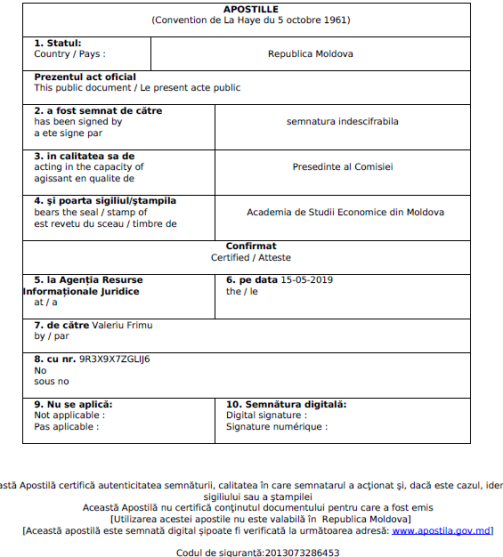
Under Article 6 of the Hague Convention, Apostille jurisdiction in Moldova is divided between two authorities in Chișinău, both issuing certificates digitally through the national e-Apostila system:
| Designated Authority in Chișinău | Scope of Documents Covered |
|---|---|
| Ministry of Justice – Agency for Legal Information Resources (ARIJ) (Chișinău, str. 31 August 1989, nr. 82; portal: apostila.gov.md) |
Primary Competent Authority: Civil status extracts and registry records issued by ASP, police clearance certificates (Cazier judiciar), school and university diplomas, medical certificates, court judgments, prosecutor and bailiff documents, notarial deeds, notarised translations, and state archive records. |
| Ministry of Foreign Affairs of the Republic of Moldova (MAE) (Consular Affairs Directorate, Chișinău, str. Alexei Mateevici, nr. 80) |
Specific administrative documents issued by central public authorities in their own institutional interest, as well as domestic legalisation for non-Hague countries (such as the UAE or Qatar). |
Which Moldovan Documents Can Receive an e-Apostille — and What Is Blocked?
Moldovan e-Apostilles are issued on undamaged, unlaminated official Republic of Moldova records in Romanian (as well as official multilingual and digital civil status records introduced by ASP from November 2025 onward with direct e-Apostila integration):
| Eligible for a Moldovan e-Apostila | Ineligible Without Replacement or Re-Registration |
|---|---|
|
|
Practical Guide: Heritage Claims, Transnistria, Degrees & Exemptions
1. Replacing Soviet (MSSR) Certificates & Re-Registering Transnistrian Records
A massive share of requests from the United States, Israel, the UK, Canada, Italy, Germany, and Romania involve family ancestry, dual-citizenship applications, or immigration visas where the applicant holds either a pre-1992 Moldavian SSR birth/marriage booklet or a certificate issued on the Left Bank of the Dniester (Transnistria / Tiraspol / Bender):
- Pre-1992 MSSR Records: Cannot receive an e-Apostila directly. Under Power of Attorney, we request a fresh modern civil status extract (Extras de pe actul de naștere / căsătorie) from the Public Services Agency (ASP) in Chișinău and immediately obtain the ARIJ e-Apostila.
- Transnistria Records: Must first undergo statutory civil status confirmation / transcription with ASP in Chișinău so that a recognized Republic of Moldova certificate is issued — which can then be apostilled for worldwide use.
2. Where Moldovan Documents Are Exempt From an Apostille in Europe
Remember that Moldova is an EU candidate state, not an EU member — so EU Regulation 2016/1191 does not apply. Even so, two powerful treaty frameworks waive Apostilles in specific European cases:
- Multilingual CIEC Extracts (Conventions No. 16 & No. 20): Because Moldova is a contracting state (since 2008) to both the 1976 Vienna CIEC Convention (birth, marriage, death) and the 1980 Munich CIEC Convention (certificate of legal capacity to marry), multilingual ASP extracts are accepted without an Apostille and without translation in all 24 CIEC No. 16 states: Austria, Belgium, Bosnia and Herzegovina, Bulgaria, Cape Verde, Croatia, Estonia, France, Germany, Italy, Lithuania, Luxembourg, Moldova, Montenegro, Netherlands, North Macedonia, Poland, Portugal, Romania, Serbia, Slovenia, Spain, Switzerland, and Turkey.
- Bilateral Legal-Aid Treaties: Moldova maintains bilateral exemptions with Romania, Ukraine, Latvia, Lithuania, the Czech Republic, and CIS states (though banks and agencies in CIS states increasingly still request an e-Apostila on QR-signed digital ASP extracts). Conversely, for the US, UK, Canada, Australia, Ireland, and Israel, a Moldovan e-Apostila is strictly mandatory!
3. Moldovan University Degrees, Police Clearances & Translations
Graduates of Moldovan universities (such as Nicolae Testemițanu State University of Medicine and Pharmacy in Chișinău) applying for ECFMG/USMLE, GMC (UK), or European medical licensing should note that the Diploma and the Diploma Supplement (transcript) count as two separate documents requiring two separate e-Apostilles (and older diplomas may require prior verification by the Ministry of Education, taking up to 30 working days vs. the standard 3–5 working days at ARIJ).
Pro Tip on Police Checks & Translations: Moldova's Ministry of Internal Affairs can issue the Cazier judiciar (Police Clearance) directly in English as well as Romanian — saving you translation fees for the US, UK, Canada, or Australia! For documents issued in Romanian (constitutionally affirmed as Moldova's official state language in 2023), always get the Moldovan original apostilled first and let our certified translators prepare the official English (or destination-language) translation afterward rather than paying for a second notarisation in Chișinău.
Consular Legalisation in Chișinău (UAE, Qatar, Kuwait, Egypt & Non-Hague Countries)
Consular legalisation is the multi-stage authentication process required for destinations outside the 1961 Hague Apostille Convention, completed by the diplomatic or consular mission of the destination country.
When a Moldovan degree, marriage certificate, SRL corporate extract, or police clearance is destined for a non-Hague country — such as the United Arab Emirates (Dubai / Abu Dhabi), Qatar, Kuwait, Egypt, or Malaysia — an electronic e-Apostila is not valid. Instead, physical paper documents must be authenticated by the relevant Moldovan ministry and the Consular Directorate of the Ministry of Foreign Affairs (MAE) in Chișinău, followed by final attestation at the destination country's accredited embassy (because most Gulf, Asian, and African states accredit their embassies to Moldova out of Bucharest, Romania rather than Chișinău, our cross-border team coordinates the Chișinău-to-Bucharest embassy courier chain end-to-end).
Comparison: Moldovan e-Apostila vs. Consular Legalisation
| Criterion | Electronic Apostille (e-Apostila) | Consular Legalisation |
|---|---|---|
| Where Accepted | ~130 Hague Convention countries — including US, UK, Canada, Australia, Israel, all EU states (incl. Germany since Jul 17, 2026!). | Non-Hague countries (e.g., UAE, Qatar, Kuwait, Egypt, Malaysia). |
| Authorities Involved | ARIJ at the Ministry of Justice (or MAE) online via apostila.gov.md. | Sectoral body + MFA Chișinău (MAE) + Accredited Foreign Embassy (usually in Bucharest). |
| Format & Speed | Digital PDF with QR code; standard 3–5 working days (1-day express for eligible files). | Physical paper stamp chain & cross-border embassy transit; several weeks. |
6 Common Pitfalls When Ordering a Moldovan Apostille From Abroad
-
1
Submitting Pre-1992 Soviet (MSSR) Booklets or Laminated Originals
Old USSR green certificates and laminated documents are automatically rejected by ARIJ — a fresh modern ASP extract (Extras) must be retrieved in Chișinău first.
-
2
Presenting Transnistrian (“PMR”) Certificates Without Moldovan Re-Registration
Records issued in Tiraspol or Bender on the Left Bank of the Dniester cannot receive an Apostille until confirmed and transcribed into the official civil/educational registers of the Republic of Moldova.
-
3
Getting Blocked on apostila.gov.md Without a Moldovan e-Signature (MPass)
Overseas expats and foreign companies cannot file online themselves without an active Moldovan qualified electronic signature (MPass / MSign) and local MPay payment access — requiring an authorised local representative in Chișinău.
-
4
Expecting a Wet-Ink Stamp on the Back of the Paper Document
Moldova no longer uses ink Apostille stamps — you must submit both the original document and the printed/digital e-Apostila certificate showing the QR code and security code verifiable at apostila.gov.md.
-
5
Assuming EU Regulation 2016/1191 Applies — or Following Outdated Pre-July 2026 Germany Rules
Moldova is not yet in the EU (so EU Reg. 2016/1191 does not apply — use CIEC multilingual forms where eligible!), while conversely Germany dropped its Apostille objection on July 17, 2026, ending embassy legalisation for Germany.
-
6
Ordering Translations in Chișinău Instead of the Destination Country
Notarising a translation inside Moldova requires an extra local step and is still frequently rejected by overseas courts and registries — apostille the Moldovan original first and have it translated by a certified translator for your destination country.
Remote Document Procurement in Moldova, Certified Translation & Cheat Sheet
Living in the US, UK, Canada, Israel, Italy, Germany, or anywhere outside Moldova? No flight to Chișinău is needed: Schmidt & Schmidt handles remote document procurement across Moldova by Power of Attorney (replacing Soviet MSSR certificates with modern or multilingual CIEC ASP extracts, assisting with Transnistria re-registrations, ordering English/Romanian Cazier judiciar police checks, and pulling SRL/SA corporate and cadastral extracts), secures the official e-Apostila, prepares certified Romanian-to-English translations, and couriers your originals worldwide via DHL/FedEx.
| Moldovan Document | Required Pre-Step in Chișinău | Competent Authority & International Note |
|---|---|---|
| Birth, Marriage, Death & Marital Capacity Extracts | Current unlaminated ASP extract (post-1992) | ARIJ (e-Apostila) for US/UK/CA/IL; or CIEC form (exempt in 24 European states!). |
| Soviet-Era Certificates (MSSR pre-1992) | Order modern replacement Extras from ASP | Then ARIJ (e-Apostila). |
| Transnistria Documents (Left Bank / Bender) | Official confirmation & transcription at ASP Moldova | ARIJ (e-Apostila) on the newly issued Moldovan certificate. |
| Police Clearance (Cazier judiciar) | Order fresh certificate from MAI (can be issued in English!) | ARIJ (e-Apostila). |
| University Degrees & School Diplomas | Ministry of Education verification (for older/specific awards) | ARIJ (e-Apostila) (Diploma + Supplement = 2 separate Apostilles). |
| Corporate Extracts (SRL/SA) & Land Records | Official extract from ASP registers | ARIJ (e-Apostila) + certified translation. |
| Notarial Powers of Attorney & Court Orders | Executed before a Moldovan Notary or Court | ARIJ (e-Apostila). |
Official Sources & Republic of Moldova Portals
- Official State Portal e-Apostila (apostila.gov.md): Online Verification of Moldovan Electronic Apostilles & Scanned Originals
- Public Services Agency – Agenția Servicii Publice / ASP (asp.gov.md): Civil Registry, Multilingual CIEC Extracts, Corporate & Cadastral Registers
- Agency for Legal Information Resources – ARIJ under the Ministry of Justice (arij.gov.md): Primary Competent Authority
- Ministry of Foreign Affairs of the Republic of Moldova – MAE (mfa.gov.md): Consular Legalisation
- HCCH: Designated Competent Authorities of the Republic of Moldova & July 17, 2026 Entry Into Force With Germany (hcch.net)
Information verified in November 2026 by the International Legalisation Desk at Schmidt & Schmidt — including the entry into force of the Hague Apostille Convention between the Republic of Moldova and Germany on July 17, 2026.
Frequently Asked Questions (FAQ) About Apostilles in Moldova
The primary competent authority is the Agency for Legal Information Resources (ARIJ) under the Ministry of Justice of the Republic of Moldova in Chișinău (handling civil status, criminal record, educational, judicial, corporate, and notarial documents), while the Ministry of Foreign Affairs (MAE) handles specific central administrative acts. Moldova issues Apostilles 100% electronically as an e-Apostila (a digitally signed PDF with a QR code and security code) verifiable free of charge at apostila.gov.md.
Yes! Following Germany's formal withdrawal of its accession objection, the Hague Apostille Convention entered into force between Moldova and Germany on July 17, 2026 (including recognition of valid Moldovan Apostilles issued earlier). Today, Moldovan e-Apostilles are accepted across all 27 EU member states, the United Kingdom, the United States, Canada, Australia, and Israel without consular legalisation.
Not directly. Pre-1992 Soviet certificates issued in the Moldavian SSR as well as laminated documents must first be replaced with a modern civil status extract (Extras) from Moldova's Public Services Agency (ASP). Documents issued in unrecognized Transnistria (Tiraspol, Bender / Left Bank of the Dniester) must first complete official confirmation and transcription into the constitutional registers of the Republic of Moldova before an e-Apostila can be issued. Schmidt & Schmidt handles both procedures remotely.
Because Moldova is an EU candidate country rather than an EU member state, EU Regulation 2016/1191 does not apply. However, Moldova is a contracting party to both Vienna CIEC Convention No. 16 (birth, marriage, death) and Munich CIEC Convention No. 20 (legal capacity to marry), so multilingual ASP civil extracts are accepted without an Apostille or translation in 24 European states (including Italy, Germany, Spain, France, Poland, Romania, Austria, and Switzerland).
Yes! Moldova's Ministry of Internal Affairs issues official Criminal Record Certificates (Cazier judiciar) directly in English as well as Romanian. Under Power of Attorney, Schmidt & Schmidt retrieves your English or Romanian certificate in Chișinău, obtains the official ARIJ e-Apostila within days, and delivers it for USCIS, UK Home Office, IRCC Canada, or Australian immigration filings.
For non-Hague countries (such as the UAE, Qatar, Kuwait, or Egypt), an e-Apostila is not accepted. Documents must undergo consular legalisation — first authenticated at the Ministry of Foreign Affairs of Moldova (MAE) in Chișinău, and then attested at the destination country's accredited embassy (typically located in Bucharest, Romania — a cross-border chain Schmidt & Schmidt manages from start to finish).