Need a Hague Apostille or consular legalization for a Swiss corporate or personal document — such as a Commercial Register extract from Zurich, Zug, or Geneva, a notarized power of attorney, an ETH/university degree, or a civil status record — without navigating Swiss municipal offices, 26 cantonal chancelleries, and federal mail-in rules in Bern? Schmidt & Schmidt handles the entire process remotely across all 26 Swiss cantons and at the federal level, complete with certified translation into English (from German, French, or Italian) and insured worldwide courier delivery.
The Swiss Confederation signed the Hague Convention of October 5, 1961 on its opening day and ratified it on January 10, 1973; the Convention entered into force for Switzerland on March 11, 1973 (note: the Principality of Liechtenstein is a separate contracting party, in force since September 17, 1972). As a result, Swiss public documents bearing an Apostille are recognized directly across roughly 130 member states — including the United States, the United Kingdom, Canada, Australia, Singapore, and all EU member states — without embassy legalization.
What does a Swiss Apostille certify? A Hague Apostille (often grouped under Überbeglaubigung / Légalisation in Switzerland) verifies the authenticity of the official's signature, the capacity in which the signer acted, and the authenticity of the seal or stamp on a public document. It does not validate the underlying content of the document itself.
Key Takeaways for International Corporate & Private Clients
- 27 Competent Authorities (Strict Federalism): Switzerland has no single nationwide office for all records. Cantonal, municipal, and notarial documents are apostilled strictly by the State Chancellery (Staatskanzlei / Chancellerie d'État / Cancelleria dello Stato) of the canton where the document originated (26 cantons; official fee typically CHF 15 to CHF 30). Federal documents (such as Swiss criminal record checks, federal tax residency certificates, or federal court rulings) are apostilled exclusively by the Federal Chancellery in Bern by mail.
- Switzerland Is Not in the EU (EU Regulation 2016/1191 Does Not Apply!): Because Switzerland is outside the European Union, the EU Public Documents Regulation (2016/1191) does not exempt Swiss records. Unless a multilingual CIEC civil status form or a specific bilateral treaty (e.g., with Germany, Austria, or Italy) applies, Swiss documents require a Hague Apostille even within Europe — and always for the US, UK, Canada, Australia, and Asia.
- Paper Originals Only — No Swiss e-Apostille Yet: Neither the Federal Chancellery nor the 26 cantonal chancelleries currently issue electronic Apostilles (e-Apostilles) or maintain an online e-Register. Uncertified internet printouts (such as free Zefix company searches or purely digital PDF criminal record extracts) cannot be apostilled; a physical paper original bearing a wet-ink signature and official stamp is mandatory.
- Multilingual Issuing Options: Depending on the canton, Swiss documents are issued in German, French, or Italian, while major commercial hubs like the Canton of Zurich can issue the Apostille stamp itself in German, English, French, Italian, Spanish, or Portuguese.
Quick Glossary: Essential Swiss Legal & Registry Terms (DE / FR / IT)
| Federal Chancellery (Bern) | Bundeskanzlei (BK) / Chancellerie fédérale / Cancelleria federale |
| Cantonal Apostille Office (State Chancellery) | Staatskanzlei / Chancellerie d'État (Service des légalisations) / Cancelleria dello Stato |
| Municipal Certification Officer (e.g., Zurich) | Gemeindeammannamt / Stadtammannamt (alongside public/civil-law Notariat) |
| Civil Registry Office | Zivilstandsamt / Office de l'état civil / Ufficio dello stato civile |
| Birth / Marriage / Death Certificate | Geburtsschein / Eheschein / Todesschein · Acte de naissance / mariage / décès |
| Individual / Family Civil Status Certificate | Personenstandsausweis / Familienausweis · Certificat individuel d'état civil / de famille |
| Commercial Register Extract | Handelsregisterauszug / Extrait du registre du commerce / Estratto del registro di commercio |
| Criminal Record Check (Federal) | Privatauszug aus dem Strafregister / Extrait du casier judiciaire (VOSTRA – Bern) |
| Debt Enforcement Extract (Solvency Proof) | Betreibungsregisterauszug / Extrait du registre des poursuites |
Who Issues Apostilles in Switzerland? (26 Cantons vs. Federal Level)
Swiss authentication follows a strict territorial jurisdiction rule: a cantonal chancellery can only authenticate signatures registered within its own canton — never documents from a neighboring canton or from a federal agency. Under Switzerland's Article 6 designation with the HCCH (updated July 2026), authority is divided as follows:
| Swiss Authority | Scope of Competence & Official Fees |
|---|---|
| Cantonal State Chancellery (26 offices across Switzerland — e.g., Zurich, Zug, Geneva, Vaud/Lausanne, Basel-Stadt, Bern, Lucerne, Ticino) | Issues Hague Apostilles on all cantonal and municipal records (civil status offices, cantonal commercial registries, debt enforcement offices, cantonal courts) as well as documents certified by notaries or municipal officers (Ammannämter) in that canton. Official fee: Typically CHF 15 to CHF 30 per Apostille (e.g., CHF 30 in Zurich and Solothurn, plus return postage). |
| Swiss Federal Chancellery (Section Finance & Controlling / Legalisations, Gurtengasse 5, 3003 Bern — postal submissions only) | Issues Apostilles on federal documents (e.g., criminal record extracts from the Federal Office of Justice, tax residency certificates from the Federal Tax Administration, rulings of Federal Courts, IPI intellectual property certificates, and ETH/EPFL federal institute records). Also serves as the federal super-legalization body for non-Hague countries. |
| Swiss Notary Public or Municipal Officer (Notariat / Stadt- oder Gemeindeammannamt) | Handles preliminary certification of private signatures (powers of attorney, corporate resolutions, contracts) and true copies before the cantonal State Chancellery affixes the Apostille. |
Which Swiss Documents Can Be Apostilled?
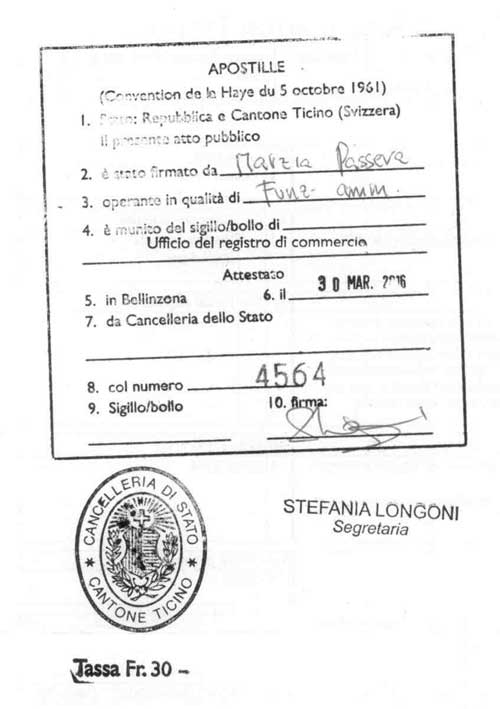
Every Swiss Apostille carries the mandatory French reference “Apostille (Convention de La Haye du 5 octobre 1961)” and measures at least 9 cm square. To qualify, the document must be an original public record bearing a wet-ink signature and official seal (or a duly notarized copy):
| Eligible for Apostille | Not Directly Eligible Under the Hague Convention |
|---|---|
|
|
Practical Guide to High-Demand Swiss Documents
1. Swiss Commercial Register Extracts (Zug, Zurich, Geneva, Basel & All Cantons)
Switzerland — particularly cantons such as Zug, Zurich, Geneva, Vaud, and Basel-Stadt — is a premier global hub for holding companies, commodity traders, pharmaceutical groups, and fintechs. When opening foreign bank accounts, completing KYC/AML checks, or acquiring overseas subsidiaries, a free printout from the federal index (Zefix) is rejected abroad. Note also that Swiss law does not issue a separate Anglo-American “Certificate of Good Standing”: instead, we retrieve an officially certified, wet-signed Commercial Register extract from the competent cantonal registry — which proves active legal existence, capital, and authorized signatories — and have it apostilled directly by that canton's State Chancellery.
2. Swiss Criminal Record Checks (Federal Jurisdiction!)
Unlike municipal residency or debt-register certificates, the Swiss Criminal Record Extract (Extrait du casier judiciaire / Strafregisterauszug) is issued centrally in Bern by the Federal Office of Justice (FOJ). Applicants moving to the US, UK, Canada, Australia, or Spain often make a costly mistake: ordering the standard digital PDF version online. Digital PDF extracts cannot receive a Swiss Apostille — you must specifically order the physical paper extract with hand-signed authentication for use abroad, which is then apostilled by the Federal Chancellery in Bern (not by a cantonal office!).
3. Civil Status Certificates & the 6-Month Rule
Birth, marriage, and death certificates are issued by regional Swiss Civil Registry Offices (Zivilstandsämter / Offices de l'état civil). Be aware that several cantonal chancelleries (such as Solothurn) refuse to apostille Swiss civil status certificates (except death certificates) if they were issued more than 6 months ago. If the certificate is intended for a European state party to CIEC Convention No. 16 (such as Germany, France, Italy, Spain, Austria, the Netherlands, Poland, or Turkey), requesting a multilingual CIEC extract eliminates the need for both an Apostille and a translation.
4. University Degrees, Cantonal Schools & Private Boarding Schools
Authentication rules for Swiss diplomas depend on the institution's legal status:
- Cantonal Universities & Public Schools: In several cantons (notably the Canton of Zurich), public school and university diplomas must first be verified by the Cantonal Department of Education (Bildungsdirektion) before the State Chancellery affixes the Apostille.
- Federal Institutes of Technology (ETH Zurich & EPFL Lausanne): Because ETH and EPFL are federal institutions rather than cantonal universities, direct original authentication falls under the Federal Chancellery in Bern (alternatively, a certified true copy made by a local notary/Ammannamt can be apostilled at the cantonal level if accepted by the foreign recipient).
- Private International & Boarding Schools / Business Schools: Switzerland hosts renowned private boarding schools and private hospitality/business institutes. If a private school does not hold state-accredited public signing authority, its diploma cannot be apostilled directly as a public act — it must first be certified before a Swiss Notary Public.
Consular Legalization of Swiss Documents (For Non-Hague Countries)
When a Swiss corporate or personal document is destined for a country outside the 1961 Hague Apostille Convention — such as the United Arab Emirates (UAE), Qatar, Kuwait, Egypt, or Taiwan — an Apostille is not accepted. Instead, the document undergoes multi-tier consular legalization:
- Cantonal Certification: Authentication by the competent Cantonal State Chancellery (or Chamber of Commerce for commercial/export paperwork) — note that cantons charge a separate regular legalization fee (e.g., CHF 20 in Solothurn) rather than an Apostille fee;
- Federal Super-Legalization in Bern: Verification of the cantonal chancellery's seal and signature by the Swiss Federal Chancellery in Bern (required by most embassies of Middle Eastern and Asian states);
- Embassy / Consular Legalization: Final legalization stamp by the destination country's embassy in Bern or consulate general in Geneva (typically accompanied by a certified translation).
Comparison: Swiss Hague Apostille vs. Consular Legalization
| Criterion | Hague Apostille | Consular Legalization |
|---|---|---|
| Where Accepted | Across ~130 Hague Convention states (including US, UK, Canada, Australia, EU, Japan, Singapore). | Required for non-Hague countries (e.g., UAE, Qatar, Kuwait, Egypt). |
| Authorities Involved | Single-tier (once notarized/prepared): Cantonal State Chancellery or Federal Chancellery. | Multi-tier: Cantonal Chancellery + Federal Chancellery (Bern) + Foreign Embassy in Bern/Geneva. |
| Typical Turnaround | Typically 5–10 business days (faster in-person at major cantonal counters). | Approximately 2–3+ weeks (subject to consular processing times in Bern/Geneva). |
6 Common Mistakes When Ordering a Swiss Apostille
-
1
Sending Documents to the Wrong Canton — or Walking Up to the Federal Chancellery
Zurich's State Chancellery will immediately reject a Zug corporate extract or a Geneva notary deed. Meanwhile, the Federal Chancellery in Bern only handles federal documents and accepts applications strictly by mail (no walk-in counter).
-
2
Ordering a Digital Criminal Record PDF or Printing a Free Zefix Extract
Because Switzerland only issues physical paper Apostilles, digitally signed PDFs from eStrafregister and uncertified Zefix web printouts are rejected. You must obtain a physical, wet-signed certificate first.
-
3
Assuming EU Apostille Exemptions Apply to Switzerland
Expats relocating between Zurich/Geneva and EU countries frequently assume EU Regulation 2016/1191 waives Apostilles. Because Switzerland is not an EU member, EU authorities outside bilateral/CIEC treaties will reject un-apostilled Swiss certificates.
-
4
Skipping Preliminary Steps on Private Documents, Diplomas, or Divorce Decrees
Powers of attorney require prior Swiss notarization, cantonal diplomas in cantons like Zurich require Education Department sign-off, and Swiss divorce judgments will not be apostilled for foreign remarriage unless they bear an official Certificate of Finality (Rechtskraftbescheinigung).
-
5
Submitting Civil Status Records Older Than 6 Months
Old birth or marriage certificates kept in a personal file are routinely rejected by both Swiss cantonal chancelleries and foreign immigration agencies — fresh duplicates issued within the last 6 months are standard.
-
6
Translating Before the Apostille Is Affixed
Cantonal chancelleries like Zurich do not certify translations directly (only a notary's signature on a translator's declaration), and translating beforehand leaves the Apostille stamp untranslated. Always obtain the Swiss Apostille on the original first, then have the complete package translated into English (or the target language).
Remote Document Retrieval Across All 26 Cantons & Certified Translation
Have you relocated away from Switzerland to the US, UK, Canada, or Asia, or is your legal/compliance team managing a transaction involving a Swiss entity in Zug, Zurich, Geneva, Basel, Vaud, Lugano, or Schwyz? Schmidt & Schmidt retrieves fresh civil status duplicates, certified Commercial Register extracts, Articles of Association, and land registry records remotely across all 26 cantons, completes cantonal or federal Apostille authentication (or embassy legalization in Bern/Geneva), prepares certified translations from German, French, or Italian into English (or 50+ other languages), and dispatches the physical originals via tracked courier worldwide.
Quick Reference Cheat Sheet: Document Routing in Switzerland
| Swiss Document | Competent Apostille Office | Mandatory Preparation |
|---|---|---|
| Commercial Register Extract (AG / SA, GmbH / Sàrl) | State Chancellery of the registered canton | Certified paper extract with wet signature from the cantonal Commercial Registry (no Zefix printout). |
| Birth, Marriage, Death / Civil Status Record | State Chancellery of the issuing canton | Original from Zivilstandsamt / Office de l'état civil (generally issued within the last 6 months). |
| Criminal Record Extract (Casier judiciaire / Strafregister) | Federal Chancellery in Bern (by mail only) | Paper original ordered specifically with wet signature/stamp from the Federal Office of Justice. |
| Powers of Attorney, Contracts & True Copies | State Chancellery of the notary's canton | Prior signature or copy certification by a Swiss Notary Public or Gemeinde-/Stadtammannamt. |
| University Degrees & School Diplomas | State Chancellery (or Federal Chancellery for ETH/EPFL) | Prior verification by cantonal Department of Education where required (e.g., Zurich); notarization for private schools. |
| Court Rulings & Divorce Decrees | State Chancellery (or Federal Chancellery for Federal Courts) | Official court copy with wet signature; divorce rulings require a Certificate of Finality. |
Official Sources & Swiss Government Portals
- Swiss Federal Chancellery (bk.admin.ch): Federal Legalisations & Official Directory of All 26 Cantonal Authorities
- HCCH: Designated Competent Apostille Authorities of Switzerland under Article 6 & Fee Ranges (hcch.net)
- Canton of Zurich – State Chancellery (zh.ch): Official Guidelines on Apostilles & Legalizations
- Zefix – Central Business Name Index (zefix.ch): Locate the Competent Cantonal Commercial Registry
- HCCH: Up-to-Date Status Table of ~130 Contracting Parties to the 1961 Apostille Convention
Information verified in November 2026. Final acceptance rules and document recency limits remain subject to the requirements of the receiving authority in the destination country.
Frequently Asked Questions (FAQ) About Apostilles in Switzerland
Competence is split between the federal government and the 26 cantons: cantonal, municipal, and notarial records are apostilled strictly by the State Chancellery (Staatskanzlei / Chancellerie d'État / Cancelleria dello Stato) of the canton where the document was issued. Federal records (such as Swiss criminal record checks, Federal Tax Administration certificates, or Federal Court rulings) are apostilled exclusively by the Swiss Federal Chancellery in Bern by mail.
Swiss corporate law does not use a separate Anglo-American Certificate of Good Standing. Instead, an officially certified Commercial Register Extract (Handelsregisterauszug / Extrait du registre du commerce) issued by the cantonal Commercial Registry — supplemented where needed by a non-bankruptcy / Debt Enforcement extract (Betreibungsregisterauszug) — serves internationally as authoritative proof of active legal existence, share capital, and authorized signatories once apostilled by the cantonal State Chancellery.
Each canton sets its own official fee schedule; across most cantons, the government fee ranges from CHF 15 to CHF 30 per Apostille (for instance, CHF 30 in Zurich and Solothurn, plus return postage). Once we hold the wet-signed original in Switzerland, obtaining the Apostille generally takes just a few business days, or roughly 5 to 14 business days end-to-end when combined with document retrieval and courier shipping.
No. Switzerland does not currently operate an e-Apostille system or an online electronic Apostille register with the HCCH. Both the Federal Chancellery and all 26 cantonal chancelleries issue physical paper Apostilles, which require an original paper document bearing a handwritten official signature. Digital PDF criminal record extracts or free Zefix company printouts cannot be apostilled.
5. Are Swiss documents exempt from an Apostille in the European Union under EU Regulation 2016/1191?
No. Because Switzerland is not an EU member state, EU Regulation 2016/1191 does not apply to Swiss documents. Unless a multilingual civil status extract under CIEC Convention No. 16 (for birth, marriage, or death in participating European countries) or a specific bilateral treaty (e.g., with Germany, Austria, or Italy) applies, Swiss public documents require a Hague Apostille for use in EU member states — as well as in the UK, US, Canada, and Australia.
Because the United States, the United Kingdom, and Canada (in force since January 2024) are all parties to the 1961 Hague Convention, public documents from those countries do not require legalization at a Swiss embassy or consulate. Simply obtain a Hague Apostille from the competent authority in the issuing country and attach a certified translation into the official language of the receiving Swiss canton (German, French, or Italian).