Schmidt & Schmidt provides apostille and legalisation services for public documents issued in Spain, including their subsequent certified translation and delivery to anywhere in the world.
For a document issued in Spain to be submitted to the authorities or courts of another state, it generally has to be legalised. For states party to the 1961 Hague Convention, a simplified procedure applies — the apostille.
The apostille confirms the authenticity of the signature, the capacity (authority) in which the person signing the document has acted and, where appropriate, the authenticity of the seal or stamp on the document. An apostille does not certify the content of the document itself. The procedure is established by the Hague Convention of 5 October 1961 Abolishing the Requirement of Legalisation for Foreign Public Documents.
Spain is a party to the Hague Convention; it entered into force for Spain in 1978. To date, 130 states are party to the Convention. As a rule, documents apostilled in Spain are recognised in the other contracting states, subject to the applicable conditions, and do not require consular legalisation.
For a Spanish document to be submitted to foreign authorities or courts, you will usually need an apostille together with a certified translation into the required language. The specific set of requirements depends on the type of document, the requirements of the receiving authority, and the international treaties in force.
Key points at a glance
- An apostille confirms the authenticity of the signature, the capacity of the signatory and the seal, but does not certify the content of the document.
- Spain has no single apostille authority: the competent body depends on the type of document. Civil status certificates are apostilled through the High Court of Justice (TSJ) or the territorial office of the Ministry of Justice, the certificate of criminal records through the Ministry of Justice, and notarial documents through the Colegio Notarial (Notarial Association).
- The certificate of criminal records — Certificado de Antecedentes Penales (official fee €3.86); the apostille is affixed by the Ministry of Justice.
- Spain has implemented the electronic apostille (Apostilla Electrónica).
- For civil status documents destined for states party to the CIEC conventions, a multilingual form (certificación plurilingüe) is available; for other countries it provides no CIEC exemption — the requirements for legalisation and translation depend on the document, any applicable bilateral treaty, and the receiving authority.
- Spain has bilateral legal-assistance agreements with a number of countries that exempt official documents from legalisation; before submitting, it is worth checking the requirements of the receiving authority.
- Schmidt & Schmidt arranges apostilles, legalisation, document retrieval and translation remotely.
Glossary: key terms in Spanish
| Apostille | Apostilla de La Haya |
| Consular legalisation | Legalización consular |
| Certificate of criminal records | Certificado de Antecedentes Penales |
| Civil registry | Registro Civil |
| Birth certificate | Certificado de nacimiento |
| Marriage certificate | Certificado de matrimonio |
| Death certificate | Certificado de defunción |
| Full (verbatim) certificate | Certificación literal |
| Multilingual certificate | Certificación plurilingüe (internacional) |
| Marginal annotation on the record | Inscripción marginal |
| Commercial register | Registro Mercantil |
| Sworn translator | Traductor-Intérprete Jurado |
| Ministry of Justice electronic portal | Sede electrónica del Ministerio de Justicia |

Which documents can be apostilled in Spain
An apostille is affixed to Spanish public documents — those issued by government authorities, courts and notaries. Private documents can be apostilled only after they have been notarised.
| Can be apostilled | Cannot be apostilled |
|---|---|
|
|
The apostille itself has no expiry, but limits may apply to the validity of the documents themselves.
Specifics of apostille certification in Spain
Spain has no single authority that apostilles all documents. The competent authority depends on the type of document, the nature of the signature and the body that issued or certified the document. The competent authorities are set out in Royal Decree 1497/2011 of 24 October 2011:
| Type of document | Competent apostille authority |
|---|---|
| Judicial documents from the ordinary courts (except the Supreme Court and the Audiencia Nacional) | The Secretaría de Gobierno of the relevant High Court of Justice (Tribunal Superior de Justicia, TSJ), an office of the Ministry of Justice or a Gerencia Territorial — regardless of where the document was issued |
| Documents from the Supreme Court (Tribunal Supremo) and the National Court (Audiencia Nacional) | Exclusively the corresponding Secretaría de Gobierno of those courts |
| Administrative documents, including Registro Civil certificates (birth, marriage, death), commercial register extracts (Registro Mercantil) and the certificate of criminal records | Any of the authorities empowered by Real Decreto 1497/2011 (regardless of where the document was issued): the Secretarías de Gobierno of the TSJ, an office of the Ministry of Justice (Oficina Central de Atención al Ciudadano), the Gerencias Territoriales of the Ministry of Justice, and the Colegios Notariales. In practice, the certificate of criminal records is apostilled by the Ministry of Justice |
| Notarial and private documents with a signature certified by a notary | The Decano of the relevant notarial association (Colegio Notarial) or a member of its Junta Directiva |
| Educational documents | Depends on the type of document, the issuing institution and the way the signature is certified; some documents require prior certification of the signature |
The authorities listed for administrative documents are competent regardless of the part of Spain in which the document was issued.
Since 2011, all Spanish apostilles have been recorded in the Ministry of Justice's electronic apostille register (Registro Electrónico de Apostillas), and for a number of documents an electronic apostille (Apostilla Electrónica) is available, with online verification by security code (CSV) through the Ministry of Justice's sede electrónica. We identify the competent authority for the specific document and manage the entire chain of certifications.
As a rule, the apostille is affixed to the original document or to a notarised copy of it (where the apostille cannot be affixed to the original). The document must be in good condition, with legible seals and signatures, and free of extraneous marks, crossings-out and uncertified corrections. For some multi-page documents, the integrity of the document may need to be ensured in a prescribed manner (binding, page numbering, sealing).
Validity period of a document
No general expiry period is set for the apostille itself. However, the receiving authority or the legislation of the destination country may set a validity period for the document — this particularly often applies to the certificate of criminal records and civil status documents. Check the requirements of the specific authority before submitting.
Specifics of apostille certification for particular documents
Certificate of criminal records (Certificado de Antecedentes Penales)
The certificate of criminal records (Certificado de Antecedentes Penales) contains information on the presence or absence of criminal convictions from the Central Register of Convicted Offenders (Registro Central de Penados). It is issued by the Ministry of Justice; at the applicant's request, the document may include information from the registers of other EU countries (the ECRIS system). The official fee (tasa 006) is €3.86.
For use abroad, the certificate must be apostilled; the apostille is affixed by the Ministry of Justice and can be requested at the same time as the certificate itself. A separate related document is the Certificado de Delitos de Naturaleza Sexual — a certificate for work involving minors.
Required documents:- a document proving the applicant's identity (for example, a DNI or passport, depending on the method of application);
- where an application is made through a representative — a power of attorney (apostilled and translated, if executed abroad);
- form 790-006 with proof of payment of the fee.

Civil status certificates (Registro Civil)
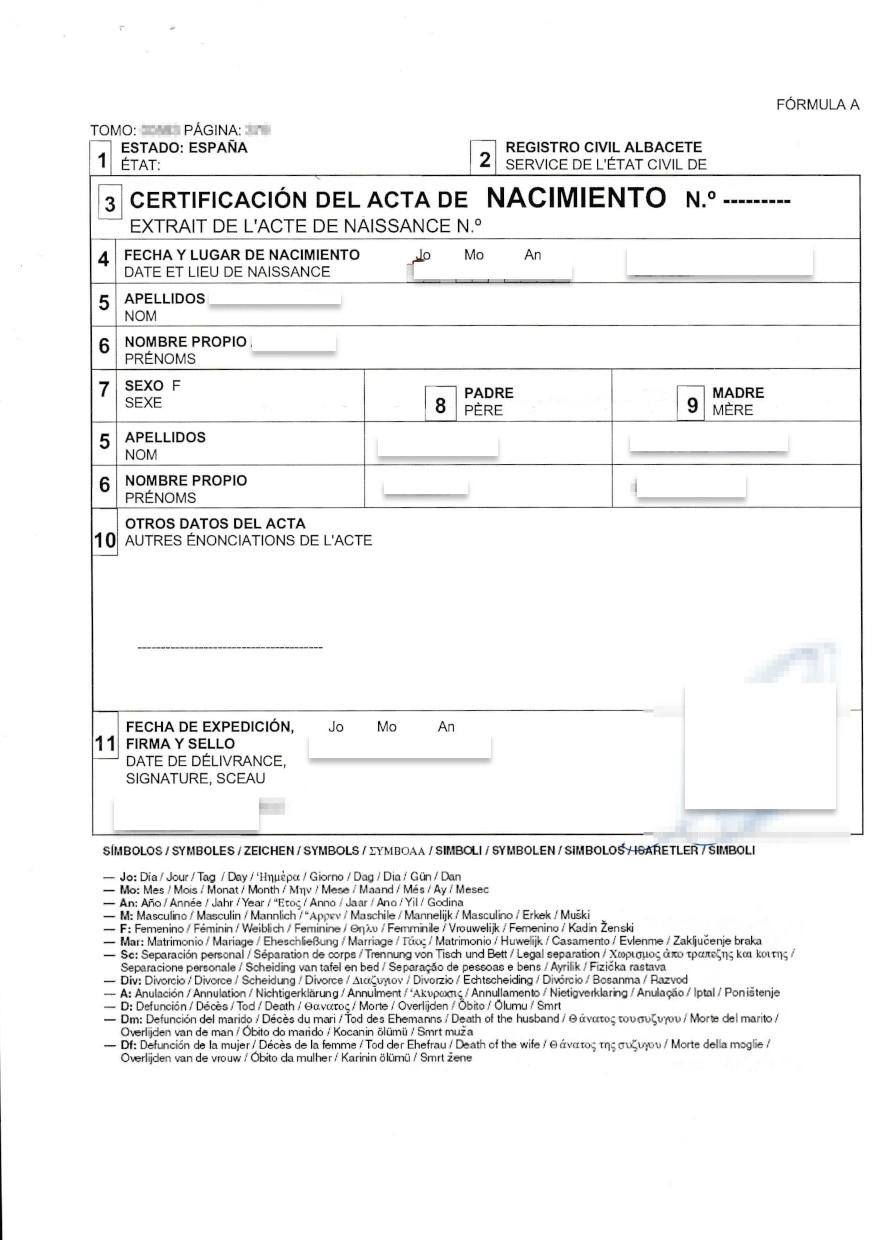
Civil status records in Spain are kept by the Registro Civil. Certificates are issued in several formats: certificación literal — the full content of the record with all marginal annotations (inscripciones marginales); certificación plurilingüe — the multilingual form under the 1976 Vienna CIEC Convention.
For use in states party to the CIEC conventions, the multilingual certificación plurilingüe is generally accepted without an apostille or translation. For countries that are not party to this convention, the plurilingüe form provides no CIEC exemption; the requirements for legalisation and translation depend on the type of document, any applicable bilateral treaty, and the requirements of the receiving authority.
Required documents:- the details needed to locate the record (full name, date and place of the event, information about the parents or spouse);
- a copy of the applicant's identity document;
- where an application is made through a representative — a power of attorney.
Educational documents
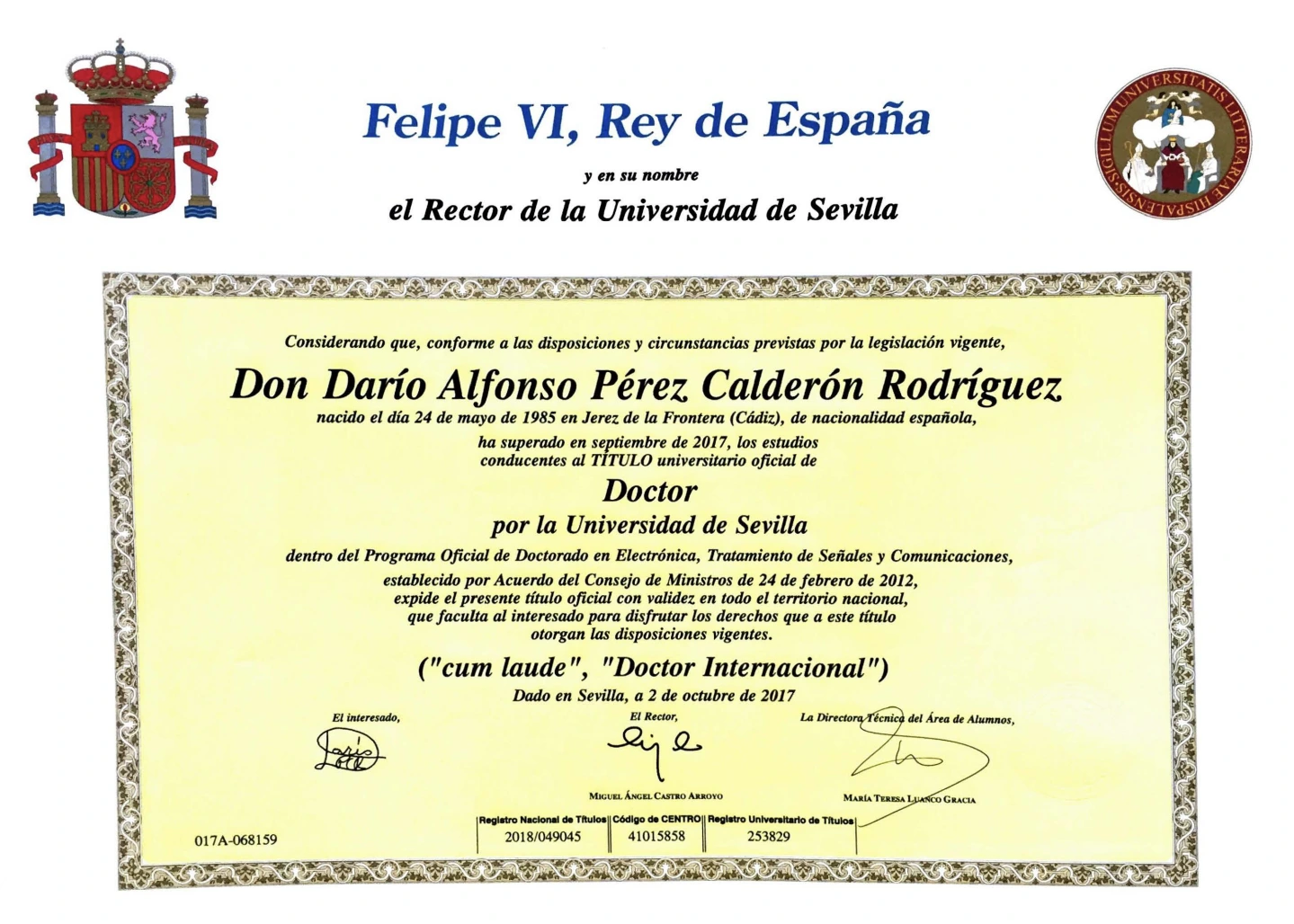
Educational documents include diplomas (Título), school leaving certificates, academic transcripts (Certificado Académico) and certificates of attendance. For such documents to be recognised abroad, they must be apostilled.
The apostille procedure depends on the type of educational document, the body that issued it and the way the signature is certified. For state-issued educational documents, the apostille is usually affixed by the Ministry of Education; for some documents, prior certification of the competent person's signature is required before apostillisation.
Required documents:- the original or a notarised copy of the educational document;
- details of the institution, the field of study and the year of graduation;
- where an application is made through a representative — a power of attorney.
Commercial register extract (Registro Mercantil)
A commercial register extract (Registro Mercantil) confirms the registration details of a Spanish company: its name, legal form, information on directors and authorised representatives, and share capital. For corporate procedures abroad, an up-to-date extract with an apostille and a translation is usually required.
The commercial register extract is apostilled as an administrative document — by one of the authorities empowered to do so under Real Decreto 1497/2011 (in particular, the Gerencias Territoriales of the Ministry of Justice). The place where the extract was issued is irrelevant.
Required documents:- the company name and its registration details;
- an indication of the country of use and the required format;
- where an application is made through a representative — a power of attorney.
Bilateral legal-assistance agreements
In addition to the Hague Convention, Spain is party to a number of bilateral legal-assistance treaties with individual countries. Under treaties of this kind, official documents that meet the conditions of the treaty and bear the official seal of a competent authority or official of one country are exempt from legalisation in the territory of the other; this can also extend to the signatures on the documents. The exemption does not apply to every document, but only to those falling within the scope of the particular treaty.
The requirements of the specific receiving authority may nevertheless differ. Before submitting a document, we therefore recommend checking in advance whether an exemption under a bilateral treaty is sufficient or whether, in your particular case, an apostille will still be required.
Recognition of the authenticity of public documents within the EU
Multilingual documents (CIEC Convention)
Civil status records and certificates of marital capacity issued by one of the contracting states in accordance with the model forms of the conventions of the International Commission on Civil Status (CIEC) are exempt from legalisation and other similar formalities otherwise required for the use of foreign documents.
States party to the Vienna CIEC Convention of 8 September 1976 (multilingual extracts of birth, marriage and death records):
- Austria, Belgium, Bulgaria, Bosnia and Herzegovina, Germany, Spain, Italy, Cape Verde, Lithuania, Luxembourg, Moldova, Netherlands, Poland, Portugal, Romania, North Macedonia, Serbia, Slovenia, Turkey, France, Croatia, Montenegro, Switzerland, Estonia.
States party to the Munich CIEC Convention of 5 September 1980 (multilingual certificate of marital capacity):
- Austria, Germany, Greece, Spain, Italy, Luxembourg, Moldova, Netherlands, Portugal, Turkey.
Many countries are not party to the CIEC conventions on multilingual documents, so issuing a document in the CIEC form provides no exemption from legalisation in those countries. Where a country is not a CIEC member, the requirements for legalisation and translation depend on the type of document, any applicable international treaty (including bilateral agreements, where one exists), and the requirements of the receiving authority.
Regulation (EU) 2016/1191 of 6 July 2016 on public documents
Regulation (EU) 2016/1191 of 6 July 2016 removes — within the scope of the Regulation — the apostille requirement for a number of categories of public document (relating to birth, marriage, death, residence, absence of a criminal record, etc.) presented between EU member states, and introduces multilingual standard forms that in some cases also remove the need for a translation.
Consular legalisation of documents from Spain
If a document is to be used in a state that is not a party to the 1961 Hague Convention (for example, the UAE), consular legalisation is used. The Convention regime also does not apply where the destination country has acceded to the Convention but an objection to that accession is in force in relation to Spain — between those two states the apostille is not used, and consular legalisation may be required. Such cases change over time, so it is best to check the status of a specific country in advance.
Consular legalisation is the process of confirming the authenticity of a document so that it can be recognised in a foreign state, carried out by a diplomatic or consular representative of the country of destination.
This is a longer and more costly procedure: the document goes through several preliminary certifications and is then certified at the embassy or consulate of the country of destination. As a rule, a translation of the document into the official language of the destination country is required before submission.
Differences between an apostille and consular legalisation
| Apostille | Consular legalisation | |
|---|---|---|
| Application | Between states where the Hague apostille regime applies. | Where the apostille regime or another exemption from legalisation does not apply. |
| Complexity | Moderate: a single application to the competent authority of the issuing country. | High: applications to several authorities and to the consulate. |
| Prior certification | Required for some documents (for example, for notarial documents — through the Colegio Notarial). | Prior certification by the issuing authority is required. |
| Consulate of the destination country | Not required. | The final step is at the consulate of the destination country. |
What can go wrong when obtaining an apostille in Spain yourself?
At first glance the procedure looks simple: prepare the document, submit it to the competent authority and wait for the result. In practice, however, most difficulties arise before the apostille is even affixed — at the stage of choosing the authority, notarisation, choosing the certificate format, translation or submission.
-
1
The wrong competent authority is chosen
In Spain, different authorities affix the apostille depending on the document: the courts (Secretaría de Gobierno) for judicial documents; the Gerencias Territoriales and the Ministry of Justice for administrative documents, including Registro Civil certificates, the certificate of criminal records and commercial register extracts; and the Colegio Notarial for notarial documents. Submitting to the wrong authority leads to rejection and lost time. -
2
Civil status certificates submitted to the wrong place
Birth, marriage and death certificates are apostilled as administrative documents — through the Gerencia Territorial of the Ministry of Justice or the Secretaría de Gobierno of the relevant TSJ, not through a notary or the Ministry of Foreign Affairs. -
3
A private document without notarisation
Powers of attorney, declarations and private documents cannot be apostilled directly. The signature must first be certified by a notary, and then confirmed by the Colegio Notarial — only after that is the document eligible for an apostille. -
4
The wrong civil status certificate format is chosen
For many destination countries you need the certificación literal with an apostille and a translation, rather than the multilingual certificación plurilingüe (which is intended for states party to the CIEC conventions). Choosing the wrong format means starting the process over. -
5
Problems with the document's validity period
No expiry period is set for the apostille itself, but the receiving authority or the legislation of the destination country may set a validity period for the document — this particularly often applies to the certificate of criminal records and civil status documents. Check the requirements in advance. -
6
The destination country's requirements and translation are overlooked
Even a correctly affixed apostille does not guarantee that the document will be accepted: the receiving authority may have its own requirements as to format and translation. The apostille does not certify the content of the translation; translation requirements depend on the specific receiving authority.
Useful links: official Spanish sources
- Ministerio de Justicia (mjusticia.gob.es) — apostille, certificate of criminal records, sede electrónica;
- Ministerio de Asuntos Exteriores (exteriores.gob.es) — legalisation of documents and consular matters;
- Consejo General del Notariado (notariado.org) — notarial associations (Colegios Notariales);
- HCCH (hcch.net) — the up-to-date list of states party to the Hague Convention and the competent authorities.
Procurement of documents in Spain
If civil status documents have been lost or damaged, or an up-to-date copy is needed, a duplicate must be procured. This is a common situation for people who have left Spain. Our service allows documents to be procured in Spain remotely: we request the document from the competent authority (Registro Civil, Ministerio de Justicia, educational institution), arrange the apostille and certified translation straight away where required, and deliver the completed package by courier to anywhere in the world.
Certified translation of documents from Spain
A certified translation will be required for submission to foreign authorities. Spain has the institution of the sworn translator (Traductor-Intérprete Jurado), appointed by the Ministry of Foreign Affairs, whose translation carries official status within Spain. Where necessary, the translation is produced taking into account both the text of the document and the apostille affixed to it.
Is the apostille affixed to the translation itself? The apostille does not certify the content of the translation. Depending on the destination country and the type of translation, it may be necessary to certify the translator's signature and then apostille that certification. A translation produced by a Spanish sworn translator (Traductor-Intérprete Jurado) has official status within Spain. For submission abroad, translation requirements depend on the specific receiving authority; a certified (notarised) translation into the local language is often required.
Conclusion
Below is a summary table of the main documents: who affixes the apostille and what is required. The competent authority and the order of the procedure depend on the type of document.
| Document | Competent apostille authority | What is required |
|---|---|---|
| Certificado de Antecedentes Penales (certificate of criminal records) | Ministry of Justice (can be requested when ordering the certificate) | Copy of identity document; form 790-006; fee €3.86. |
| Certificado de nacimiento / matrimonio / defunción (civil status) | As an administrative document: the Gerencia Territorial of the Ministry of Justice (in some autonomous communities also the Secretaría de Gobierno of the TSJ) | Details to locate the record; copy of identity document. |
| Título / Certificado Académico (education) | Depends on the method of certification; usually after prior certification of the signature | Original or certified copy; details of the institution. |
| Registro Mercantil (commercial register) | As an administrative document (authorities under Real Decreto 1497/2011: the Gerencias Territoriales of the Ministry of Justice) | Company registration details; country of use. |
| Notarial documents | The Decano of the notarial association (Colegio Notarial) | Original of the notarial document; country of use. |
Frequently asked questions about the apostille in Spain
Spain has no single apostille authority. Judicial documents from the ordinary courts are apostilled by the Secretaría de Gobierno of the relevant TSJ, an office of the Ministry of Justice or a Gerencia Territorial; documents from the Supreme Court and the Audiencia Nacional exclusively by their own Secretarías de Gobierno. Administrative documents (Registro Civil certificates, Registro Mercantil extracts, the certificate of criminal records) can be apostilled by any of the authorities empowered by Real Decreto 1497/2011, regardless of where they were issued — the Secretarías de Gobierno of the TSJ, an office of the Ministry of Justice, the Gerencias Territoriales or the Colegios Notariales. Notarial documents are handled by the Colegio Notarial.
The apostille on the Certificado de Antecedentes Penales is affixed by the Ministry of Justice. It can be requested at the same time as the certificate itself. The official fee for the certificate (tasa 006) is €3.86.
A certificación literal is the full content of the record with all marginal annotations; it is the one needed for an apostille and for use outside the CIEC countries. A certificación plurilingüe is the multilingual form under the 1976 Vienna Convention, which is accepted in states party to the CIEC without an apostille or translation. For countries that are not party to the CIEC, the plurilingüe form provides no advantage; the specific requirements for legalisation and translation depend on the type of document, any applicable bilateral treaty, and the receiving authority.
Yes. Spain has implemented an electronic apostille system (Apostilla Electrónica): for a number of documents, the apostille can be issued in electronic form through the Ministry of Justice's sede electrónica, with the option of online verification.
Where Spain has a bilateral legal-assistance treaty with the destination country, official documents falling within its scope may be exempt from legalisation, so an apostille is not always required. Because the requirements of the specific receiving authority can differ, it is best to check in advance whether the treaty exemption is sufficient or an apostille will still be needed.
The apostille does not certify the content of the translation. Where necessary, the translator's signature is certified separately, and the apostille can then be affixed to that certification. Translation requirements depend on the specific receiving authority.
Yes. Schmidt & Schmidt handles the entire process remotely — your presence in Spain is not required. We procure the document where necessary, arrange the apostille and translation, and deliver the completed package to the address you specify.
You can also order a certified translation of documents from Spanish into the required language from us.