Schmidt & Schmidt offers legalization services for documents issued in Kazakhstan.
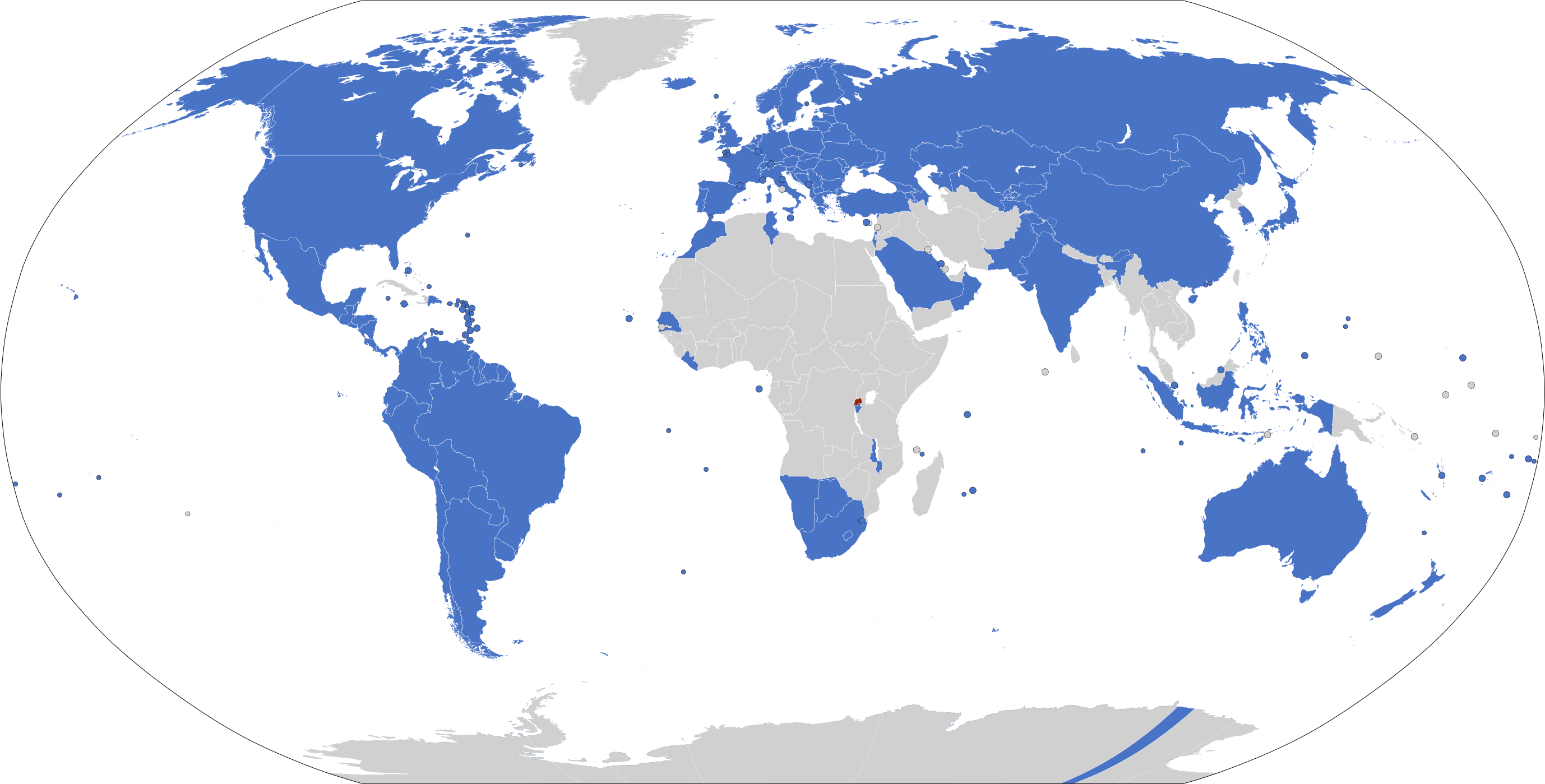
Referring to the Hague Convention of 1961, documents issued by government agencies of one member country of the Convention are valid in all Member States of the Convention and do not require any other form of certification, such as consular legalization, which considerably reduces the costs and time required for the certification of documents. Currently, more than 120 states have joined the Hague Convention.
Kazakhstan joined the Convention in 2001. Therefore, the documents issued in Kazakhstan and certified with an Apostille are recognized in other member countries without consular legalization.
The apostille is a confirmation of the authenticity of the signature and authority of an official document, as stipulated in the Hague Convention Abolishing the Requirement of Legalization for Foreign Public Documents of 5 October 1961.
Thus, no diplomatic authentication or consular legalization of documents from Kazakhstan is required for legal communication with another member state of the Convention. The documents only need to be attested with an apostille certificate by the issuing state's authorities in order to be valid in the state of destination.
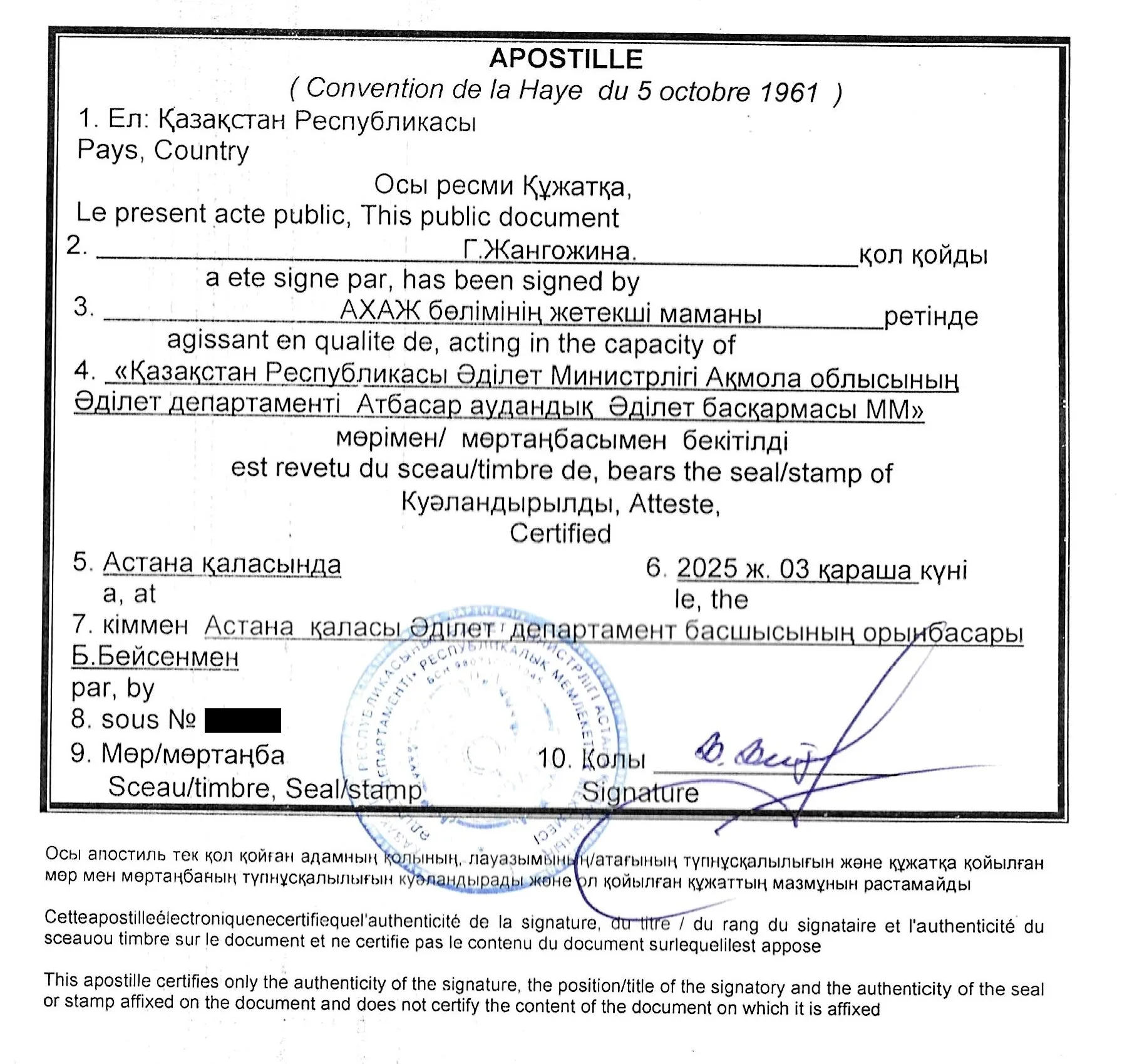
The Apostille in Kazakhstan is a square stamp of at least 9x9 cm in the Kazakh language, containing the obligatory title "Apostille" and a reference to the 1961 Hague Convention in French (Convention de La Haye du 5 octobre 1961), which is a mandatory requirement for an apostille's validity.
Competent authorities of Kazakhstan authorized to issue apostilles
In accordance with Resolution of the Government of the Republic of Kazakhstan No. 545 dated 24 April 2001 “On Approval of the Rules for Issuing Apostilles” and subsequent amendments, apostilles may be issued only by authorized state bodies. Below is up-to-date information on the authorities entitled to certify documents with an apostille in the territory of the Republic of Kazakhstan.
| State Authority | Categories of Documents |
|---|---|
| Ministry of Justice of the Republic of Kazakhstan | Documents issued by justice authorities, civil registry offices (ZAGS), other state bodies, as well as notarized documents. |
| Ministry of Education and Science of the Republic of Kazakhstan | Documents issued by institutions of higher and postgraduate education (diplomas, transcripts, etc.). |
| Ministry of Enlightenment of the Republic of Kazakhstan | Documents issued by institutions of primary, secondary, vocational, and post-secondary education. |
| Ministry of Internal Affairs of the Republic of Kazakhstan | Documents of the migration service, archival certificates, and archival copies issued by the Ministry of Internal Affairs. |
| Ministry of Culture and Information of the Republic of Kazakhstan | Archival certificates and archival copies issued by state archives. |
| Committee for Judicial Administration under the Supreme Court of the Republic of Kazakhstan | Judicial acts: decisions, sentences, rulings, and other court documents. |
| Ministry of Finance of the Republic of Kazakhstan | Documents of structural subdivisions of the Ministry of Finance and territorial financial bodies. |
| General Prosecutor's Office of the Republic of Kazakhstan | Documents issued by prosecution, investigation, and inquiry authorities. |
| Ministry of Defense of the Republic of Kazakhstan | Archival certificates and archival copies from the Central Archive of the Ministry of Defense. |
Which documents can be apostilled
| Can be certified with an apostille | Cannot be certified with an apostille |
|---|---|
|
|
Special aspects of the apostille in Kazakhstan and requirements for documents
The apostille is only affixed to the original or to a notarized copy if the original cannot be apostilled (e.g. passport, driver's license). Documents must be in good condition with a clearly visible seal and signature. Documents should be free of any extraneous inscriptions and marks. The content of the document must be clear and legible with legible signatures of officials and seal impressions. The details of the document (number, date, signature, seal) indicated without erasures or abridgements are mandatory. A document of more than one sheet should be bound, numbered and stamped. If the document has appendices, they must be included.
The documents may be accepted for legalization procedure in its original version, as well as in a notarially certified copy. Inscriptions on the apostille are often duplicated in two languages (one of the languages of the Convention and the national language). In Kazakhstan, apostille is a square stamp of at least 9x9 cm in the Kazakh language, with the obligatory title "Apostille" and a reference to the 1961 Hague Convention in French (Convention de La Haye du 5 octobre 1961). According to the Convention, an apostille shall be affixed on the document itself or on a separate sheet affixed to the document.
List of required documents
- Copy of an identity document
- Original document to be apostilled
- Notarized power of attorney
- If the applicant has changed their surname, copies of documents confirming the name change with a translation into Russian or Kazakh
Electronic Apostille in Kazakhstan
As previously reported by Schmidt & Schmidt, as of June 15, 2024, amendments to the rules for providing the public service of apostillizing official documents in the Republic of Kazakhstan have entered into force. These documents originate from justice authorities, other government bodies, and notaries. The updated procedure provides for full digitalization — applications for apostilles are submitted electronically through the "Electronic Government" portal (Egov) using an electronic digital signature (EDS).
To submit an application through the portal, the following are required:
- an electronic application signed with an EDS (or confirmed by a one-time password if the applicant has a registered phone number);
- a scanned copy of the document to be apostillized;
- a power of attorney (notarized — if submitted by a representative of a natural person; signed by a director — if submitted on behalf of a legal entity);
- additional documents, if necessary.
The application and documents are reviewed by the Public Service Center (PSC), particularly the signature sample and seal imprint on the submitted document, as well as compliance with the requirements of the Hague Convention and national regulations.
If the verification is successful, the authorized official generates the electronic apostille on the same working day using the “E-Apostille” information system. The signed result is sent to the applicant’s personal account on the Egov portal. Apostille processing is completed the next business day after submission.
The electronic apostille is issued in digital format and includes a link to a verification page, where authorities in other countries can confirm its authenticity using the security code and application number. The cost of the service is 0.5 MCI (Monthly Calculation Index) per document, in accordance with subparagraph 7 of Article 615 of the Tax Code of the Republic of Kazakhstan.
Apostille on educational documents from Kazakhstan
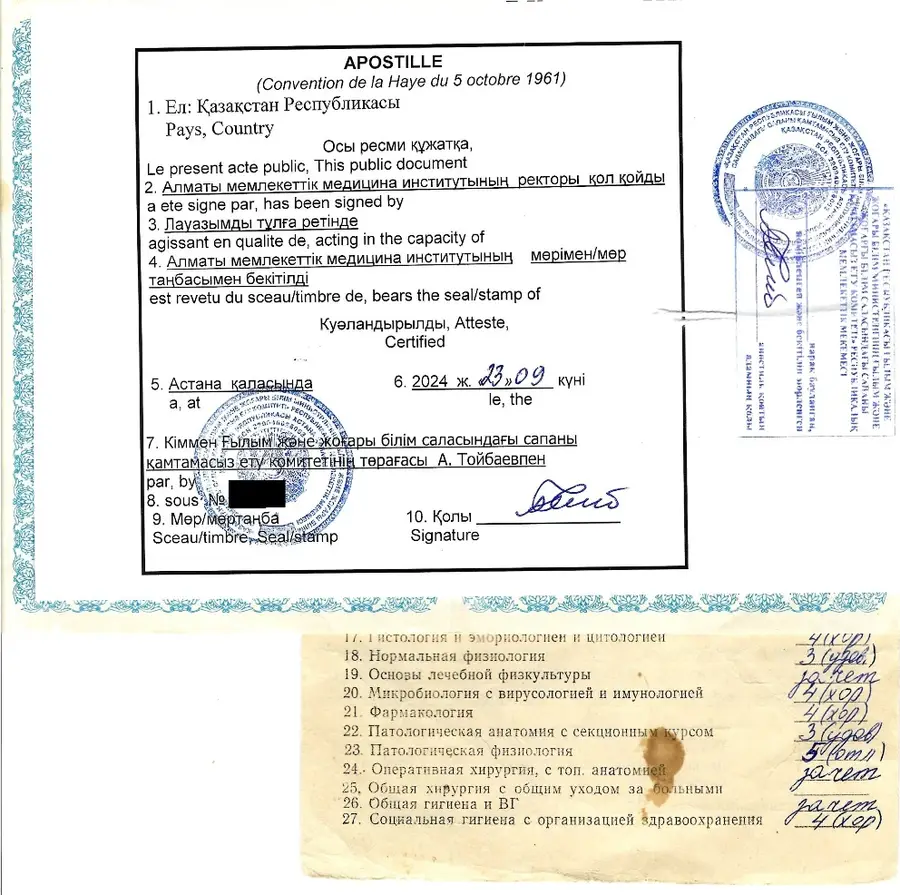
Since December 30, 2023, a new procedure for apostilling documents issued by institutions of higher and postgraduate education has been in effect in Kazakhstan. It was approved by the Order of the Minister of Science and Higher Education dated December 11, 2023.
The apostille for diplomas, diploma supplements, and other official university documents is issued by the Committee for Quality Assurance in the Field of Science and Higher Education of the Ministry of Science and Higher Education of the Republic of Kazakhstan.
How to submit documents for apostille
You can submit an application in two ways:
1. Through the State Corporation “Government for Citizens”
The applicant (or a representative with a power of attorney) must provide:
- an application in the prescribed form;
- an identity document (paper or electronic via the digital documents service);
- the original document to be apostilled;
- the original receipt confirming payment of the state fee.
2. Through the eGov electronic government portal
You must upload:
- an electronic request signed with the applicant’s digital signature;
- an electronic copy of the document that needs to be apostilled.
Information on the payment of the state fee and identity verification is automatically retrieved from government information systems.
Apostille for a criminal record certificate
A criminal record certificate in Kazakhstan is issued by the Ministry of Internal Affairs (or authorized bodies) and usually requires an apostille for use abroad — the procedure confirms the authenticity of the document and the signature of the authorized official. The apostille is affixed by the competent authority (including through the eGov portal, if the electronic version of the document is available).
As a general rule, a criminal record certificate in Kazakhstan is valid for 6 months from the date of issue; when submitting it abroad, many receiving organizations require that the certificate be issued no more than 90–180 days before submission. Therefore, before apostilling and submitting the document, it is important to clarify the requirements of the specific country (whether an apostille is needed on the original or on a notarized copy, whether a translation and notarization of the translation are required).
Apostille for Commercial Documents
An apostille on commercial documents is required for the use of Kazakh corporate documents abroad, for example, when opening a representative office or a branch. The following documents are subject to apostille:
- registration documents of a legal entity: Extract from the Commercial Register, extract from the Land Register, certificate of state registration, notarized copy of the charter, copies of other founding documents, affidavit with the director’s signature, etc.;
- notarial documents of legal entities: powers of attorney, applications, notarized copies, etc.;
- court documents.
In Kazakhstan, an apostille is affixed only to Kazakh documents. For commercial documents of foreign companies, an apostille can only be obtained in the country where they were issued.
Exemption from apostille and consular legalization
According to Art. 13 of the Convention on Legal Assistance and Legal Relations in Civil, Family and Criminal Matters (also called the Minsk Convention), the documents of the participating countries do not require legalization. Kazakhstan has been a party to the Minsk Convention since 1995. Other countries that are parties to the Convention are Armenia, Azerbaijan, Belarus, Georgia, Kyrgyzstan, Moldova, Russia, Tajikistan, Turkmenistan, Uzbekistan, and Ukraine. For these states, an apostille certificate for documents issued in Kazakhstan is not required; instead, a notarized translation will suffice.
Consular legalization of documents from Kazakhstan
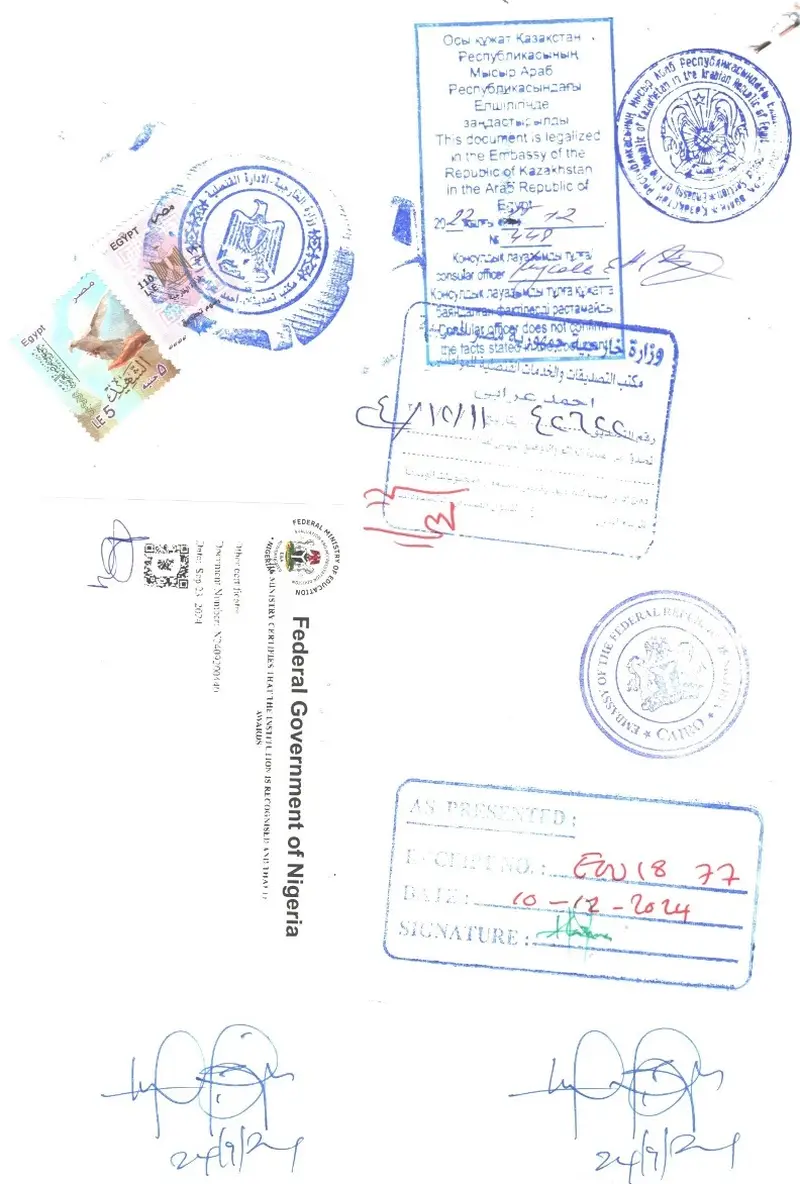
Furthermore, in the case of a document to be used in a country that does not recognise the Hague Convention, such as China, the United Arab Emirates or other countries not listed, the certificate must be consular legalized. A complete list of countries that accept and use apostilles can be found here.
Consular legalization is a procedure for recognising the legality of documents that is more complex, longer and more expensive than authentication with an apostille.
Consular legalization is a more time-consuming and expensive procedure than the apostille, in which the certificate goes through several pre-certification procedures and is then certified in the consulate of the destination country in Kazakhstan. Often the document has to be translated by a certified translator into the official language of the destination country.
It should be noted that the certificate is only valid in the country whose consular mark it bears and cannot be used in other countries.
The duration of consular legalization of a document is generally not limited, but the validity of the certificate itself might be restricted.
The main differences between an apostille and consular legalization of documents
The common feature between apostille and consular legalization is that they authenticate an official document for presentation to institutions in another country. However, they have many differences.
| Apostille | Consular legalization | |
|---|---|---|
| Validity | Can only be used between countries that are members of the Hague Convention on the Simplified Legalization of Documents. | Use between States one or both of which is not a member of the Hague Convention, or where one of the contracting States has protested the accession of the other. |
| Obtaining difficulty | Moderate. To obtain an apostille, contact the competent authority of the country where the document was issued. | High. For consular legalization must contact various authorities and consulates of the country where the document was issued. |
| Advance Authentication | Not required. | A prior certificate from the issuing authority is required. |
| Legalization at the Consulate of the country of destination | No need to contact the Consulate of the country of destination. | The final step of legalization takes place in the consulate of the country of destination, usually in the country of issue. |
Apostille and consular legalisation in all 20 regions of the Republic of Kazakhstan
We offer professional apostille, consular legalisation, and document retrieval (re-issuance) services across all 17 regions and 3 cities of national significance in Kazakhstan.

Abai Region
Akmola Region

Aktobe Region

Almaty

Almaty Region

Astana

Atyrau Region

East Kazakhstan Region
Jambyl Region

Jetisu Region

Karaganda Region
Kostanay Region
Kyzylorda Region

Mangystau Region
North Kazakhstan Region

Pavlodar Region

Shymkent
Turkistan Region

Ulytau Region
West Kazakhstan Region
Procurement of documents from Kazakhstan
Often important documents are lost or damaged, or current copies of the documents need to be obtained. In this case, it is necessary to request a duplicate of the documents. It is not unusual for people who have left Kazakhstan to encounter difficulties with this procedure. Our service allows you to apply for your documents remotely in Kazakhstan, and we can arrange for your documents to be sent by courier anywhere in the world.
Certified translation of documents from Kazakhstan
Copies and transcripts of civil status documents can be translated into any language by a sworn translator in Kazakhstan or the translation can be done in the country of destination. We offer certified translations of civil status documents with further certification. The cost of the work is calculated according to the volume of the document in question.
Does the translation have to be certified by an apostille?
Any foreign document issued in one country and required for use in another country must be legalised. It is important to remember that a translation of a document that has already been apostilled that has been made in Kazakhstan will still have the status of a foreign document for which an apostille is required. Consequently, many authorities may not accept certified translations from Kazakhstan. To avoid this, translations should be made in the country where the document is to be used.