
If you need to use an official document issued in Georgia abroad — for example, for marriage registration, residence permits, citizenship applications, university admission, employment, or business operations — an apostille is generally required. Georgia acceded to the Hague Convention of 5 October 1961 Abolishing the Requirement of Legalisation for Foreign Public Documents on 21 August 2006, and the Convention entered into force in the country on 14 May 2007.
An apostille is an official certificate that verifies the authenticity of the signature, the capacity (authority) in which the person signing the public document has acted, and the identity of the seal or stamp which the document bears. It does not certify the accuracy of the content of the underlying document itself.
Documents issued in Georgia and authenticated with an apostille are recognized in all other contracting states of the Hague Convention (currently more than 125 countries, including the United States, the United Kingdom, Canada, Australia, and all European Union member states) without the need for further consular legalization.
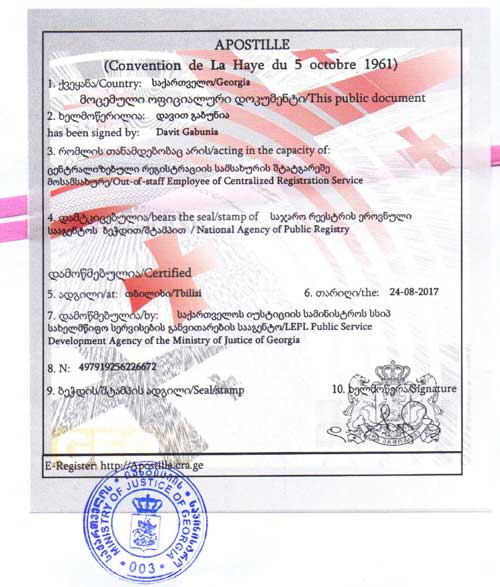
A Georgian apostille takes the form of a square certificate measuring at least 9 cm per side, issued in Georgian and English, with the mandatory heading “Apostille” and a reference to the 1961 Hague Convention in French (Convention de La Haye du 5 octobre 1961). It is affixed directly to the document or attached on a separate sheet bound to the document.
For countries that are not parties to the Hague Convention (such as the United Arab Emirates, Qatar, or Thailand), public documents must go through the multi-step consular legalization procedure.
Competent Authorities Authorized to Issue Apostilles in Georgia
According to Georgia’s official notification to the depositary of the Hague Convention, three state authorities are designated to issue apostilles depending on the category of the document:
| Competent Authority | Document Categories |
|---|---|
| Public Service Development Agency (PSDA) of the Ministry of Justice of Georgia | All public documents not falling under the competence of other designated bodies: civil status records (vital records), administrative documents, court decisions, notarial acts, medical certificates, as well as official translations prepared by the Agency. |
| National Center for Educational Quality Enhancement of the Ministry of Education, Science and Youth of Georgia | University diplomas, diploma supplements, school certificates, and other educational credentials. Applications are submitted via the Public Service Hall (PSDA) and forwarded electronically to the Center. |
| Service Agency of the Ministry of Internal Affairs of Georgia (MIA) | Documents issued by bodies of the Ministry of Internal Affairs — primarily police clearance certificates (certificates of no criminal record). |
Applications for apostilles within the jurisdiction of the Ministry of Justice and the Ministry of Education can be filed at any territorial office of the PSDA or branch of the Public Service Hall (House of Justice) nationwide, regardless of which Georgian city originally issued the document.
Which Documents Can and Cannot Be Apostilled in Georgia
| Eligible for Apostille | Not Eligible for Apostille |
|---|---|
|
|
Specifics of Apostille Certification in Georgia and Document Requirements
- Crucial rule regarding copies: Unlike in many other jurisdictions, notarized copies cannot be apostilled in Georgia. An apostille is affixed strictly to the original document, an official duplicate/registry extract, or a copy whose accuracy has been officially certified by the original issuing administrative authority itself.
- Electronic registry extracts: An apostille may also be placed on a printed electronic extract from a Georgian state registry (e.g., issued by a Public Service Hall with an electronic barcode), provided it is certified by an authorized officer.
- Physical condition: Documents must be in good physical condition with clearly legible seals and signatures, free of extraneous markings, corrections, or lamination. Multi-page documents must be bound, numbered, and sealed.
- Soviet-era documents (Georgian SSR): Vital records issued during the Soviet period (prior to 1991) are generally not accepted for apostille certification. In such cases, a new duplicate certificate in the current Georgian format must be obtained first.
- Territorial reservations (Abkhazia and South Ossetia): Upon acceding to the Hague Convention, Georgia declared that the Convention does not apply to documents issued by de facto authorities in Abkhazia and the former South Ossetian Autonomous Oblast — such documents cannot be apostilled in Georgia.
Electronic Apostille (e-Apostille) and Online Verification Registry in Georgia
Georgia is a pioneer in digital government services and has been issuing electronic apostilles (e-Apostilles) under the Hague Conference’s e-APP program since October 2020. The e-Apostille is available for dozens of document types issued by state agencies as well as educational and medical institutions.
An apostille application in Georgia can be submitted:
- online via the PSDA portal (
sda.gov.ge) or the unified citizen portalmy.gov.geusing a qualified electronic signature; - from abroad via live video identification with a PSDA officer;
- through Georgian diplomatic missions and consulates abroad;
- in person or through a representative at any Public Service Hall in Georgia (for simply obtaining an apostille on an existing original document, no power of attorney from the document holder is required — any interested person may apply).
Important practical note: Despite the widespread use of digital records in Georgia, government agencies, courts, and universities in many countries (including the United States, the United Kingdom, Germany, France, and Spain) generally still require physical paper originals bearing a wet-ink stamp or physical apostille certificate. Always confirm with the receiving institution whether a digital e-Apostille is acceptable before ordering.
Online verification: Every Georgian apostille is recorded in an electronic registry. Its authenticity can be verified online using the apostille number and security code via the official PSDA portal (sda.gov.ge), or on the MIA Service Agency portal for police clearance certificates.
Apostille Processing Times in Georgia
One of the major advantages of the Georgian system is the availability of official expedited processing for an additional state fee — including same-day issuance for many document types:
| Competent Authority / Document Category | Standard Processing Time | Expedited Processing Options |
|---|---|---|
| PSDA / Public Service Hall (civil status, notarial acts, registries, medical certificates) | 8 business days | 4 or 2 business days, next business day, or same-day service |
| MIA Service Agency (police clearance certificate) | 5 business days (certificate issuance) | 3 or 1 business day (apostille can be requested simultaneously) |
| National Center for Educational Quality Enhancement (diplomas, transcripts) | 15 business days | 8, 4, or 2 business days (when records are available in the electronic registry) |
Note: If an archival inquiry is required (for example, when retrieving older vital records or verifying degrees issued several decades ago), the review period may be extended by the authority.
Specifics for Selected Document Types
Educational Documents (University Diplomas and School Certificates)
Inter-agency procedures are governed by Joint Order No. 93/ნ — No. 170 of the Minister of Education and the Minister of Justice of Georgia. The original document is submitted at a Public Service Hall (PSDA) and forwarded electronically to the National Center for Educational Quality Enhancement. Once the academic records and degree authenticity are verified, the apostille is issued.
Police Clearance Certificate (Certificate of No Criminal Record)
Issued by the Service Agency of the Ministry of Internal Affairs of Georgia in Georgian. Because the MIA itself is the designated apostille authority for its own records, the apostille can be requested at the same time as the certificate application.
Important: Police clearance certificates issued by Georgian consulates abroad cannot be apostilled. For official use abroad, you must obtain a paper certificate directly from the MIA in Georgia with an apostille. Keep in mind that most destination countries require police certificates to be no older than 3 to 6 months from the date of issue.
Corporate and Commercial Documents
For opening foreign bank accounts, registering subsidiaries, or participating in international tenders, extracts from the Entrepreneurial Register, Public Registry extracts, copies of articles of association issued or certified by the National Agency of Public Registry, as well as notarized powers of attorney and shareholder resolutions can be apostilled. Commercial contracts and invoices are excluded from apostille certification.
International Agreements and Exemptions from Apostille Requirements
In addition to the Hague Apostille Convention (which applies to all EU member states, the US, the UK, Canada, Australia, and over 120 other jurisdictions), Georgia remains a party to the 1993 Minsk Convention on Legal Assistance (despite withdrawing from the CIS in 2009; Georgia has not ratified the 2002 Chisinau Convention). Under Article 13 of the Minsk Convention, official documents bearing a state seal are formally exempt from apostille requirements (requiring only a notarized translation) in relations between Georgia and Armenia, Azerbaijan, Belarus, Kazakhstan, Kyrgyzstan, Moldova, Russia, Tajikistan, Turkmenistan, and Uzbekistan.
- Relations with Ukraine: Following Ukraine’s withdrawal from the Minsk Convention, an apostille is now required for the mutual recognition of documents between Georgia and Ukraine.
- Practice in CIS countries: Despite the formal exemption under the Minsk Convention, banks, civil registries, and immigration authorities in countries such as Russia, Kazakhstan, and Armenia frequently insist on an apostille in practice.
- EU and other states: Initial objections raised by Germany and Greece upon Georgia’s accession to the Hague Convention were withdrawn in 2010 and 2015 respectively — Georgian apostilles are fully recognized across the entire European Union. The only active objection applies to Kosovo (since January 2016).
Consular Legalization of Documents from Georgia
If a Georgian document is intended for use in a country that is not a party to the Hague Apostille Convention (such as the United Arab Emirates, Qatar, Kuwait, or Thailand), consular legalization is required. An up-to-date list of contracting states is available on the HCCH website.
In Georgia, legalization operates under a streamlined “one-stop shop” model:
- The document is submitted to the Public Service Development Agency (Public Service Hall), which conducts initial verification and forwards it to the Consular Department of the Ministry of Foreign Affairs of Georgia.
- Following authentication by the Georgian MFA, the document must be legalized by the embassy or consulate of the destination country (if the destination state does not maintain a diplomatic mission in Tbilisi, legalization is completed through its accredited mission in a neighboring country, such as Ankara or Baku).
Consular legalization has no expiration date (subject to the validity period of the underlying document), but it confers legal validity exclusively within the territory of the state whose consulate affixed the legalization stamp.
Key Differences Between an Apostille and Consular Legalization
| Criteria | Apostille | Consular Legalization |
|---|---|---|
| Scope of Application | Valid in all contracting states of the 1961 Hague Convention (over 125 countries, including the US, UK, Canada, and EU states). | Required for countries outside the Hague Convention (e.g., UAE, Qatar, Thailand). |
| Complexity | Low: Issued by a single designated authority in Georgia (1 to 15 business days). | High: Verification by PSDA and Georgian MFA, followed by legalization at the destination country’s consulate. |
| Territorial Validity | Can be presented in any contracting state of the Convention. | Valid solely in the country whose diplomatic mission legalized the document. |
Document Retrieval (Duplicates) in Georgia
If vital records have been lost, laminated, or issued during the Soviet era, or if you need a fresh police clearance certificate or registry extract, we can remotely obtain new duplicate documents in Georgia under a power of attorney and deliver them via courier anywhere in the world.
Translation of Georgian Documents and Apostille on Translations
The Public Service Development Agency (Public Service Hall) provides official translations of Georgian documents into English, German, French, Italian, Spanish, Greek, Russian, and Turkish, followed by apostille certification of the translation itself.
Should the Translation Be Done in Georgia or in the Destination Country?
An official translation prepared in Georgia is itself considered a Georgian public document and requires its own separate apostille for use abroad (forming a package of “original with apostille + translation with apostille”).
Recommendation for the US, UK, Canada, and EU: While US USCIS and UK authorities frequently accept the Georgian apostilled translation package, authorities in countries such as Germany, Austria, Spain, France, and Italy usually require a translation performed by a locally sworn or court-certified translator in the destination country. Always confirm translation requirements with the receiving body before ordering a translation in Georgia.
How to Order Your Georgian Apostille or Duplicate Through Schmidt & Schmidt
- Free Preliminary Assessment: Send us a scan or photo of your document along with the destination country and purpose of use. We verify the document format and competent authority in advance.
- Transparent Quote & Turnaround Selection: You receive a clear quotation with processing speed options (from standard service to expedited 1–2 business day issuance).
- Courier Pickup or Remote Retrieval: If you already hold the original document, our courier picks it up from anywhere in the world. If a new certificate is needed, we obtain a duplicate in Georgia via power of attorney.
- Apostille Certification & Delivery: Once apostilled, we send you a scan for immediate review (verifiable online in Georgia’s registry) and deliver the physical original to your doorstep via international courier.
Official Sources
- HCCH: Full Text of the Hague Convention of 5 October 1961
- HCCH: Status Table of Contracting States and Reservations
- HCCH: Competent Apostille Authorities in Georgia
- Public Service Development Agency of Georgia (PSDA): Online Apostille Verification Portal
- Unified Citizen Portal of Georgia (my.gov.ge)
Information reviewed and updated in November 2026. Please confirm the specific requirements of the receiving institution in the destination country before submitting your application.