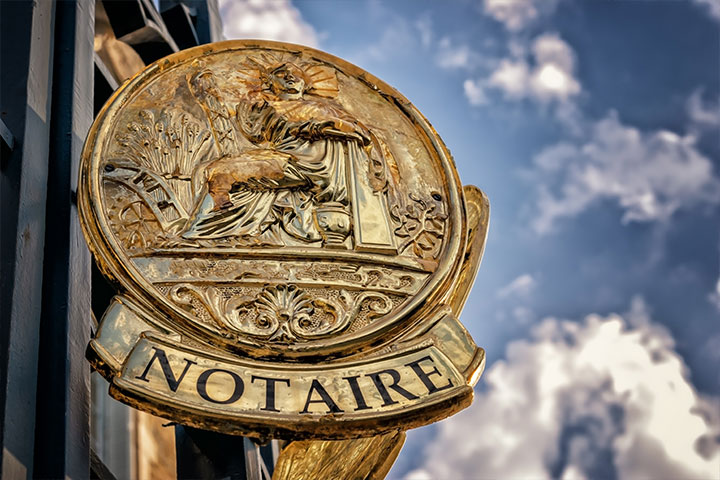
Whether you are a former expat or English teacher needing a South Korean Police Clearance (CRC) for visa or job applications in the US, UK, Canada, or Australia, a graduate authenticating a degree from Seoul or Busan, a family ordering Korean Family Relation Certificates for immigration, or a legal team verifying a Korean corporation (Chusik Hoesa): getting documents apostilled in Seoul from abroad is rarely straightforward without a Korean digital certificate, domestic phone number, and local representation at the integrated counter in Jongno-gu. Schmidt & Schmidt handles the entire workflow on the ground in Seoul for private and corporate clients worldwide — including remote retrieval, Korean notarization, paper or e-Apostilles, certified English translation, and tracked international courier shipping.
The Republic of Korea acceded to the Hague Convention of October 5, 1961 on October 25, 2006, and it entered into force on July 14, 2007 with zero contracting-state objections (see the HCCH Status Table). South Korean public documents bearing an Apostille are accepted directly across roughly 130 member jurisdictions — including the United States, the United Kingdom, Canada, Australia, New Zealand, Singapore, Japan, China, and all EU member states — without embassy legalization.
What does a South Korean Apostille certify? An Apostille (아포스티유) verifies the authenticity of the official's signature, the capacity in which the signer acted, and the authenticity of the seal or stamp affixed to a public document. It does not validate or vouch for the underlying content of the document itself.
Key Takeaways for US, UK, Canadian, Australian & International Clients
- Mandatory Across All Hague Countries: South Korea has no bilateral civil-document Apostille waivers with the US, UK, Canada, Australia, or EU states. Every South Korean public record — from police checks and family certificates to university degrees and corporate extracts — requires a South Korean Hague Apostille to be legally valid abroad.
- Integrated One-Stop Service Center in Seoul (OKA & MOJ): Following South Korea's administrative reorganization, walk-in Apostille services are no longer handled by the old MOFA Passport Division. Instead, both the Overseas Koreans Agency (OKA) and the Ministry of Justice (MOJ) operate side-by-side at the Integrated Service Center in Twin Tree Tower A (15th Floor, Yulgok-ro 6, Jongno-gu, Seoul). The statutory government stamp fee is just KRW 1,000 (under US $1.00).
- Government Records Directly — Private Records Require Korean Notarization: Official government, police, and court certificates are apostilled directly without notarization. Documents issued by private entities — including paper diplomas from private South Korean universities, employment letters, private powers of attorney, and contracts — must first be notarized by a Korean Notary Public (공증) and then apostilled by the Ministry of Justice.
- New Rule Since December 1, 2025 for Public Hospitals: Selected medical certificates as well as birth and death certificates issued by designated Public Medical Institutions in South Korea can now be apostilled directly through OKA without prior notarization!
- Free e-Apostille (apostille.go.kr) — With a Catch for Former Expats: South Korea issues free digital e-Apostilles for roughly 40 government-issued certificates (such as Supreme Court family records and National Police criminal checks). However, logging into apostille.go.kr requires an active Korean financial/joint digital certificate and Korean identity verification — which most expats lose as soon as they leave Korea and close their Alien Registration Card (ARC) / local phone line.
Quick Glossary: Essential Korean Legal & Registry Terms (With Hangul)
| Hague Apostille | 아포스티유 (Apostiyu) |
| Overseas Koreans Agency (Service Center) | 재외동포청 (OKA – apostille.go.kr) |
| Ministry of Foreign Affairs & Ministry of Justice | 외교부 (MOFA) & 법무부 (MOJ) |
| National Court Administration (Supreme Court) | 대법원 법원행정처 (electronic family & corporate registries) |
| Notarization (Mandatory for Private Documents) | 공증 (Gongjeung) |
| Basic Certificate (Replaces Birth Certificate!) | 기본증명서 (Gibon-jeungmyeongseo – Detailed version: 상세 / Sangse) |
| Family Relation Certificate (Parents & Children) | 가족관계증명서 (Gajok-gwangye-jeungmyeongseo) |
| Marriage Relation Certificate (Marital History) | 혼인관계증명서 (Honin-gwangye-jeungmyeongseo) |
| Hospital Birth Certificate | 출생증명서 (Chulsaeng-jeungmyeongseo) |
| Criminal / Investigation Records Check Reply (CRC) | 범죄·수사경력회보서 (Korean National Police Agency – 경찰청) |
| Corporate Register Extract & Power of Attorney | 법인등기사항전부증명서 (Commercial Register) & 위임장 (Wiimjang) |
Who Issues Apostilles in South Korea? (OKA, MOFA, MOJ & Courts)
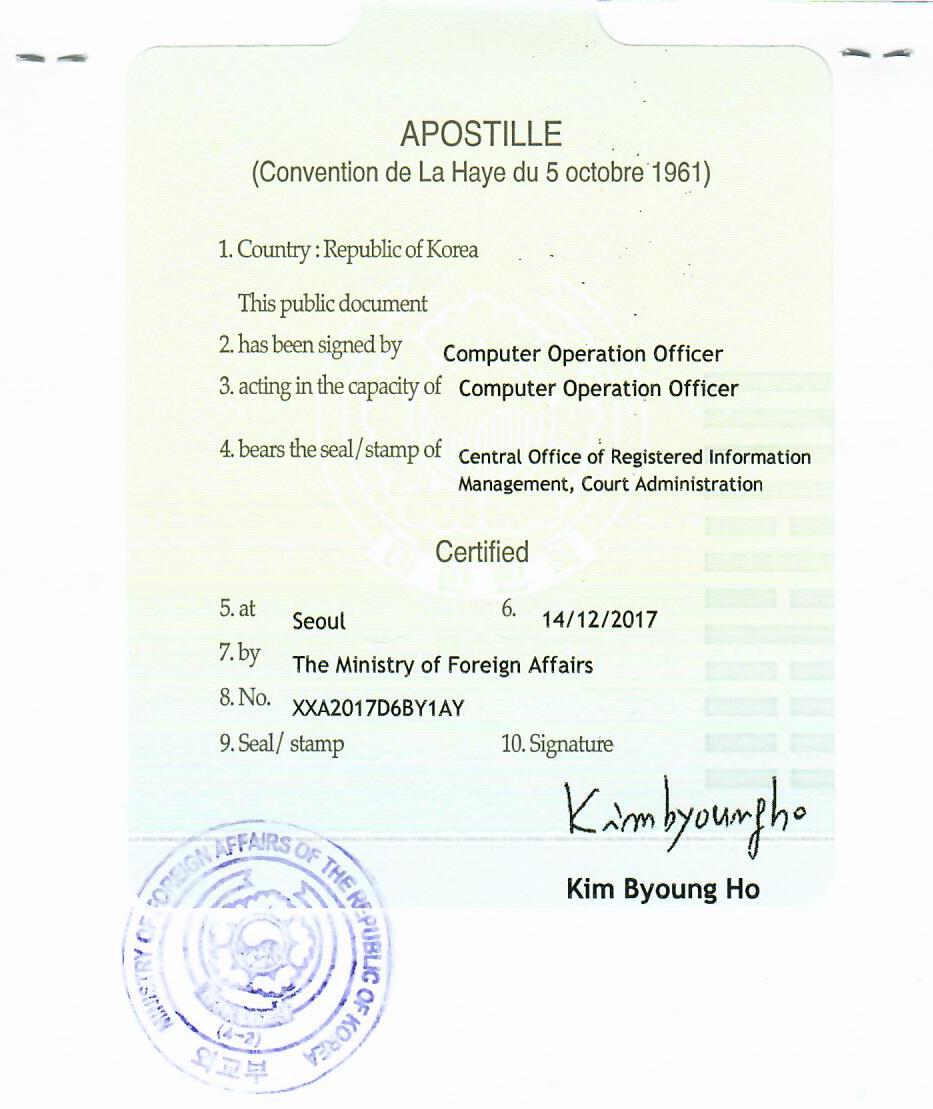
Under South Korea's official Article 6 designation with the HCCH (updated October 15, 2026), four public bodies hold legal authority, with all walk-in submissions in Seoul consolidated on the 15th Floor of Twin Tree Tower A (Yulgok-ro 6, Jongno-gu, Seoul):
| Competent Authority in Seoul | Scope of Documents Handled |
|---|---|
| Overseas Koreans Agency (OKA) & Ministry of Foreign Affairs (MOFA) (Portal: apostille.go.kr; Counter: Twin Tree Tower A, 15F) |
Government & Public Administrative Records: Documents issued by central ministries, local governments, the National Police Agency (Criminal Record Checks), public schools/national universities, and — since Dec 1, 2025 — designated Public Medical Institutions (issued as a physical security sticker on paper or as a digital e-Apostille for eligible online certificates). |
| Ministry of Justice (MOJ) (Counter also at Twin Tree Tower A, 15F) |
Judicial & Notarized Documents: Records signed by prosecutors or judicial officers, plus all notarized private documents (powers of attorney, corporate resolutions, contracts, passport/driver's license copies, notarized translations, and paper diplomas from private universities). |
| National Court Administration (Supreme Court of Korea) |
Judicial registry records — specifically integrating Supreme Court family relation certificates and corporate registry extracts into the national Apostille framework. |
South Korean embassies and consulates abroad (e.g., in Washington, New York, Los Angeles, London, Toronto, Sydney, or Singapore) cannot issue Hague Apostilles on Korean documents.
Which South Korean Documents Can Be Apostilled?
Many South Korean government portals and universities issue official certificates directly in Korean or English (or bilingually); both versions qualify directly for an Apostille:
| Eligible for Apostille | Not Directly Eligible Without Prior Steps / Excluded |
|---|---|
|
|
Practical Guide to High-Demand South Korean Documents
1. South Korean Police Clearance Certificate (범죄·수사경력회보서) for Former Expats
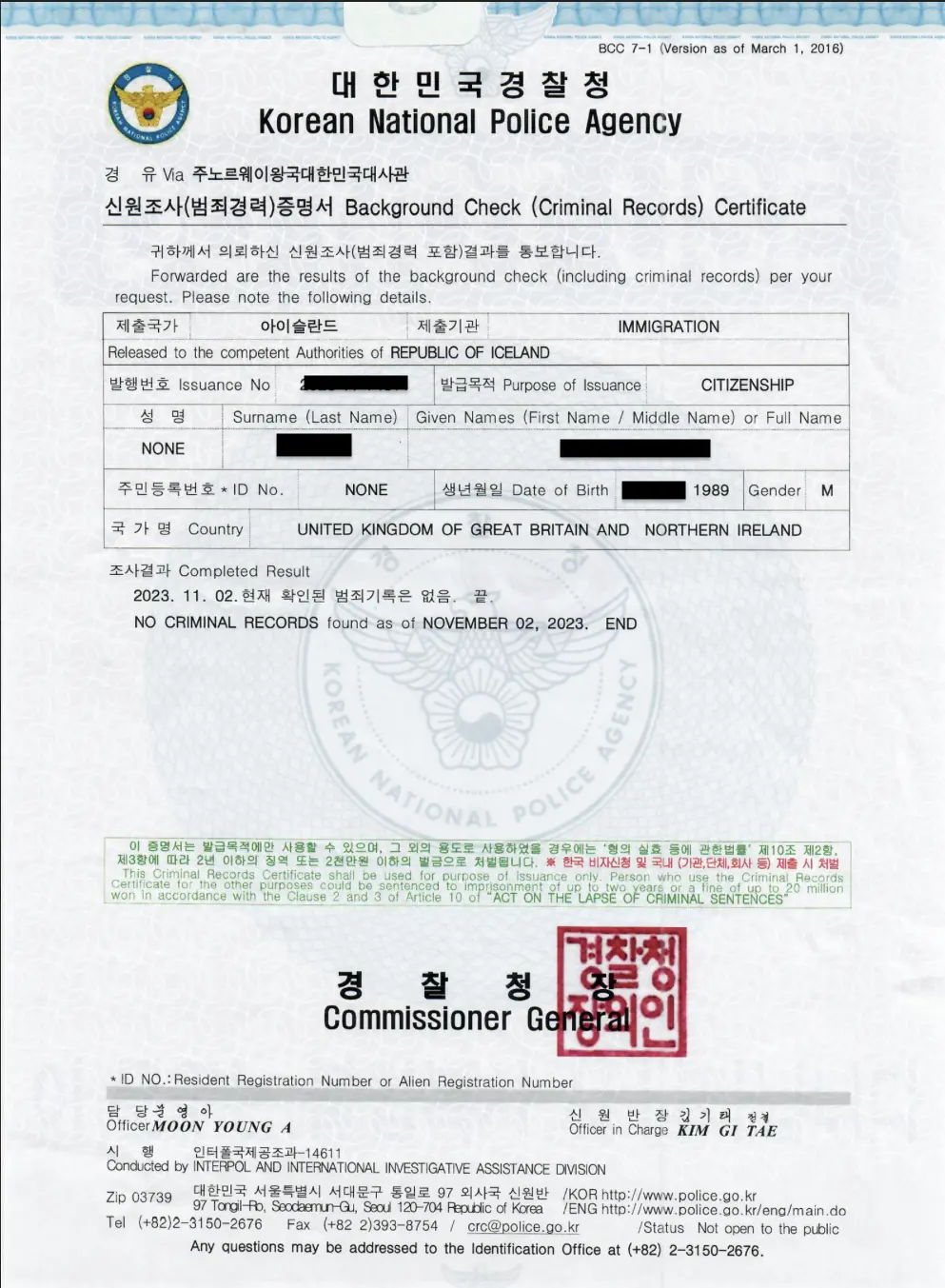
Anyone who has lived, studied, or taught English in South Korea (e.g., E-2, D-2, D-10, or F-series visa holders) will routinely need a South Korean Criminal (Investigation) Records Check Reply (범죄·수사경력회보서), issued bilingually in Korean and English by the Korean National Police Agency (경찰청), when applying for permanent residency, citizenship, K-1/CR-1 visas, or teaching/healthcare licenses via USCIS, the UK Home Office, IRCC Canada, or Australian Home Affairs. Because it is a government-issued public record, it requires no notarization prior to receiving an OKA Apostille.
How to obtain the certificate (and the #1 mistake to avoid):
- Inside South Korea: In person at any police station with a foreign affairs desk (issued immediately, free of charge) or requested online via crims.police.go.kr for in-person pickup;
- From Abroad: Via a South Korean Embassy or Consulate (requires an in-person visit; takes roughly 1–2 weeks — note that embassies cannot affix an Apostille, so if your immigration authority requires a Hague Apostille, the process must be routed through Seoul!).
Crucial Scope Rule: When requesting the check for visa or immigration filings, always select the scope “For permission of foreign country immigration and stay” (외국 입국·체류 허가용)! Domestic-use formats can trigger legal restrictions or immigration RFEs. Because foreign agencies typically require checks issued within the last 3 months, our Seoul team handles power-of-attorney filing and rapid Apostille stamping on your behalf.
2. South Korean Educational Documents (Degrees, Diplomas & Transcripts)
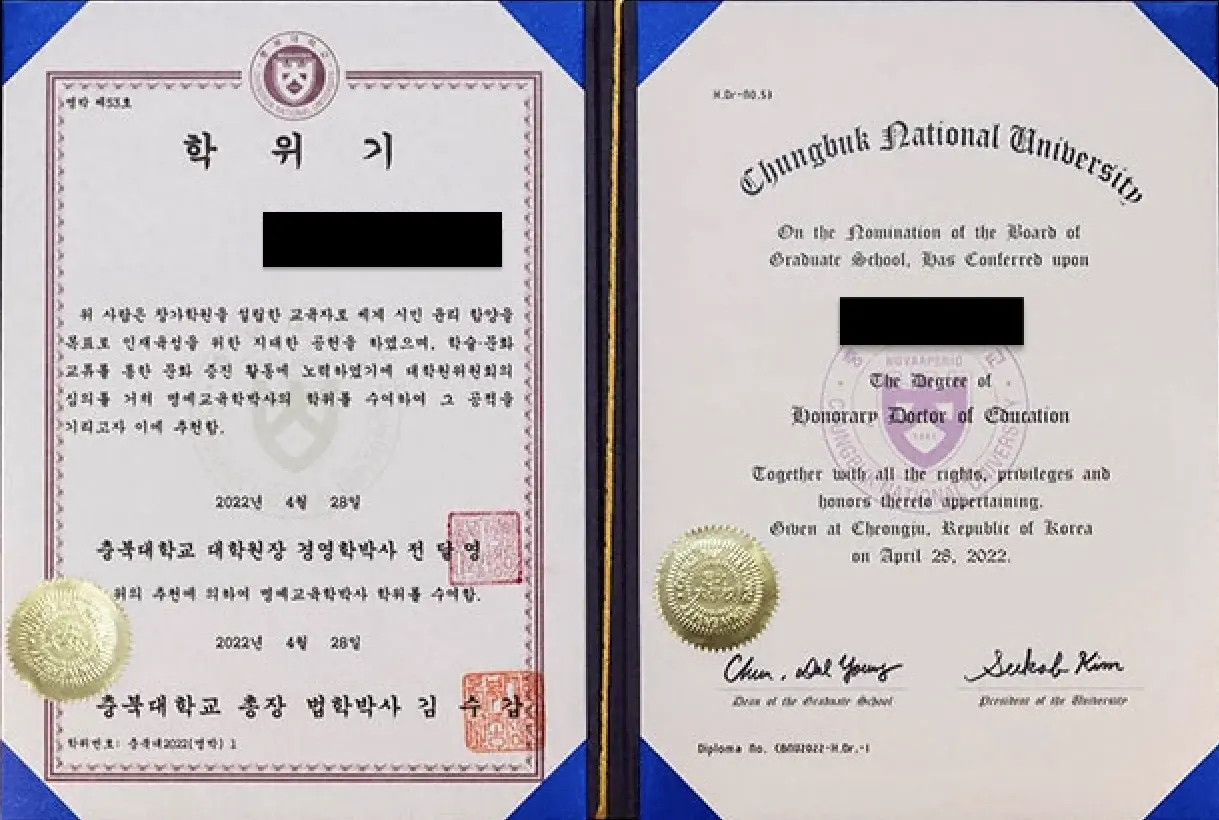
For South Korean school reports, university degree certificates (Bachelor's, Master's, PhD), transcripts of records, and enrollment certificates to be accepted abroad — whether for graduate admissions, WES/NACES credential evaluation, professional licensing, or overseas employment visas — they must be authenticated with a Hague Apostille (or consular legalization for non-Hague states).
In South Korea, many top-tier universities are legally private foundations (such as Yonsei, Korea University, Sungkyunkwan, and Hanyang), whereas institutions like Seoul National University (SNU) are national/public corporations:
- Public Schools & National Universities: Official graduation certificates and English/Korean transcripts issued by the registrar (or bearing an electronic verification code supported by OKA) qualify directly for an Apostille without notarization.
- Private Universities & Protecting Your Original Diploma: To keep your irreplaceable wall diploma unmarked — and where paper records from private universities are submitted — the standard workflow is to obtain an official degree certificate/copy from the university registrar and have a notarized true copy (공증) certified by a Korean Notary Public, which is then apostilled by the Ministry of Justice (MOJ) at Twin Tree Tower.
3. Birth, Marriage & Immigration Filings: Why Korea Has No Single “Birth Certificate”
Applicants filing I-130 / I-485 green card petitions with USCIS (following the US Department of State Visa Reciprocity Schedule), UK spouse visas, or Canadian sponsorship applications are often surprised to learn that South Korea abolished the old family-head register (Hoju) in 2008 and does not issue a single Western-style government birth certificate for Korean citizens. Instead, foreign immigration authorities require up to three separate Supreme Court certificates — always in the “Detailed” version (“상세 / Sangse”):
- Basic Certificate (기본증명서 – 상세): Establishes the individual's birth details, legal name changes, and nationality;
- Family Relation Certificate (가족관계증명서 – 상세): Establishes legal parentage (mother, father, spouse, and children — required alongside the Basic Certificate by USCIS to prove birth & parentage!);
- Marriage Relation Certificate (혼인관계증명서 – 상세): Establishes current marital status as well as full history of prior marriages and divorces.
All three certificates are government public records eligible for direct Apostille stamping without notarization. (For non-Korean nationals born in South Korea who are not in the Korean Family Register, a hospital Birth Certificate — 출생증명서 — is used instead; if issued by a designated Public Medical Institution, it no longer requires notarization as of December 1, 2025!)
4. Corporate Records (Chusik Hoesa / Yuhan Hoesa)
When conducting M&A, opening international corporate bank accounts, or establishing overseas subsidiaries for a South Korean company (such as a joint-stock company Chusik Hoesa / 주식회사 or LLC Yuhan Hoesa / 유한회사), foreign counsel typically require two distinct documents: the judicial Certificate of All Registered Matters (법인등기사항전부증명서) from the Supreme Court Corporate Registry (confirming active existence, share capital, and Representative Directors) and the Business Registration Certificate (사업자등록증명) issued in Korean or English by the National Tax Service (NTS). We retrieve both directly in Seoul, secure the Apostille, and provide certified English translations.
Consular Legalization in South Korea (UAE, Qatar, Taiwan & Non-Hague Countries)
If your South Korean document is destined for a jurisdiction outside the 1961 Hague Apostille Convention — such as the United Arab Emirates (UAE), Qatar, Kuwait, Egypt, Malaysia, or Taiwan (TECO) — an Apostille cannot be used. Instead, the document undergoes multi-step consular legalization: first, domestic consular authentication in Seoul via the OKA / Ministry of Foreign Affairs counter (preceded by Korean notarization for private documents), followed by final legalization at the embassy, consulate, or representative mission of the destination territory in Seoul.
Comparison: South Korean Hague Apostille vs. Consular Legalization
| Criterion | Hague Apostille (아포스티유) | Consular Legalization |
|---|---|---|
| Where Accepted | Across ~130 Hague Convention countries (including US, UK, Canada, Australia, EU, China, Japan). | Non-Hague jurisdictions (e.g., UAE, Qatar, Vietnam, Malaysia, Egypt, Taiwan). |
| Authorities in Seoul | Integrated Center of OKA / MOFA or Ministry of Justice (MOJ) (paper sticker or e-Apostille). | Notary (if private) + OKA / MOFA Consular Authentication + Foreign Embassy in Seoul. |
| Fee & Speed | KRW 1,000 state stamp fee (e-Apostille free); often same-day or a few business days in Seoul. | Higher embassy fees and multi-week processing depending on consular rules in Seoul. |
5 Common Pitfalls When Requesting an Apostille in South Korea
-
1
Ordering “General” (일반) Instead of “Detailed” (상세) Family Certificates — or Wrong CRC Scope
USCIS, IRCC, and European registries routinely issue Requests for Evidence (RFEs) when applicants submit General (일반) Korean family or marriage certificates that omit prior marital or parentage entries — always order Detailed (상세) certificates! Likewise, ensure your Police Clearance specifies “외국 입국·체류 허가용” (for foreign immigration and stay).
-
2
Getting Locked Out of apostille.go.kr After Leaving Korea
Former expats often assume they can download an e-Apostille from home, only to discover that apostille.go.kr requires an active Korean bank/joint digital certificate and Korean identity verification tied to an ARC and local mobile carrier.
-
3
Submitting Private Documents or Original Passports Without Korean Notarization
Employment verification letters, powers of attorney, and private institute diplomas are rejected without prior Korean notarization (공증). Original passports and driver's licenses cannot be apostilled directly and must be submitted as notarized true copies to the Ministry of Justice.
-
4
Overpaying for Notarized Translations Inside Korea
South Korea does not have court-sworn translators — a Korean notary merely notarizes the declarant's signature on a translation, requiring a second Apostille fee. For filings in the US, UK, Canada, or Australia, it is cleaner and more widely accepted to apostille the Korean original first and have our certified translators issue an English translation with a signed Certificate of Accuracy matching exact passport romanization.
-
5
Using an Apostille for Vietnam, the UAE, or Taiwan
Apostilles are rejected in non-Hague destinations frequently linked with Korean expats and supply chains (such as Vietnam, the UAE, or Taiwan) — those require MOFA consular authentication plus embassy/mission legalization in Seoul.
Remote Document Handling in Seoul, Certified Translation & Cheat Sheet
Skip the flight back to Seoul and the frustration of expired Korean digital certificates: Schmidt & Schmidt retrieves South Korean Corporate Register extracts, real estate records, and authorized civil/police certificates on the ground, handles Korean Notary Public certification for private and academic records, submits your paperwork at the Twin Tree Tower Integrated Service Center, prepares certified Korean-to-English translations, and ships the physical originals worldwide via tracked courier.
| South Korean Document | Mandatory Pre-Step | Competent Apostille Office in Seoul |
|---|---|---|
| Family Registry Certificates (Basic, Family, Marriage) | Select Detailed (상세) version; no notarization required | OKA / Court Administration (Twin Tree Tower or e-Apostille). |
| Police Clearance (CRC) (범죄·수사경력회보서) | Request scope “외국 입국·체류 허가용” from KNPA (경찰청); no notarization needed | OKA / MOFA (paper sticker or e-Apostille). |
| Corporate Register & Business Registration | Official extract from Court Registry or National Tax Service (NTS) | OKA / Court Administration / MOFA (no notarization needed). |
| Public Hospital Medical / Birth / Death Records | Since Dec 1, 2025: no notarization required for designated Public Medical Institutions! | Directly at OKA in Seoul. |
| Public vs. Private University Degrees | Public: direct registrar certificate; Private / Copy: Korean notarization (공증) | Public: OKA; Notarized copy: Ministry of Justice (MOJ). |
| Powers of Attorney, Contracts & Passport Copies | Mandatory certification before a Korean Notary Public (공증) | Ministry of Justice (MOJ) (Twin Tree Tower A, 15F). |
Official Sources & South Korean Government Portals
- Official Republic of Korea e-Apostille & Verification Portal (apostille.go.kr – Korean/English)
- Overseas Koreans Agency – OKA (oka.go.kr): Integrated Consular & Apostille Service Center in Seoul
- Korean National Police Agency – CRIMS (crims.police.go.kr): Criminal Records Check Portal
- Ministry of Foreign Affairs Consular Portal – MOFA (0404.go.kr)
- Supreme Court of Korea Internet Registry Office – IROS (iros.go.kr): Corporate & Real Estate Registries
- HCCH: Designated Competent Apostille Authorities of the Republic of Korea under Article 6 – Updated Oct 2026 (hcch.net)
Information verified in November 2026 (incorporating the October 2026 HCCH authority update and the December 1, 2025 exemption for designated Public Medical Institutions). Final acceptance of electronic Apostilles and document recency limits remain subject to the receiving authority in the destination country.
Frequently Asked Questions (FAQ) About Apostilles in South Korea
Under South Korea's HCCH designation (updated October 2026), authority is shared among the Overseas Koreans Agency (OKA), the Ministry of Foreign Affairs (MOFA), and the National Court Administration (for government, police, and public registry documents), alongside the Ministry of Justice (MOJ) (for judicial records and all notarized private documents). Walk-in submissions in Seoul are handled centrally on the 15th Floor of Twin Tree Tower A in Jongno-gu, with digital e-Apostilles issued via apostille.go.kr.
While a South Korean Embassy abroad can issue a Criminal (Investigation) Records Check Reply (범죄·수사경력회보서 — always request the scope “For permission of foreign country immigration and stay”), embassies cannot affix a Hague Apostille, and former expats without an active ARC/Korean digital certificate cannot log into apostille.go.kr. Schmidt & Schmidt can assist via local power of attorney in Seoul to obtain and apostille your police clearance directly through OKA and ship the original to you worldwide.
Government-issued records (police clearances, family registry extracts, corporate/tax certificates, court rulings, and public school diplomas) — as well as selected medical, birth, and death certificates from designated Public Medical Institutions (effective December 1, 2025) — do not require notarization. Documents from private entities (paper diplomas from private universities, employment letters, private clinic records), powers of attorney, contracts, and copies of passports or driver's licenses must first be notarized by a Korean Notary Public (공증) before the Ministry of Justice affixes the Apostille.
The statutory government stamp fee at the Seoul counter is KRW 1,000 (under US $1.00) per physical Apostille, while digital e-Apostilles issued on apostille.go.kr for supported electronic certificates are free of government charge. Korean notary fees (where private documents require notarization), local representation, certified English translation, and international courier shipping apply separately.
For Korean nationals, foreign immigration agencies (including USCIS under the US Visa Reciprocity Schedule) require both the Basic Certificate (기본증명서) and the Family Relation Certificate (가족관계증명서) — plus the Marriage Relation Certificate (혼인관계증명서) where applicable — strictly in the Detailed (“상세 / Sangse”) version, accompanied by a Hague Apostille and a certified English translation.
Yes. We retrieve Supreme Court Corporate Register extracts (법인등기사항전부증명서), Business Registration Certificates, and real estate records directly in South Korea, handle Korean notarization and Apostille submission at the Twin Tree Tower Service Center in Seoul for academic and private documents, and courier the completed originals (with certified English translations) worldwide.