Whether you are doing business with a Japanese corporation (Kabushiki Kaisha – KK) in Tokyo, Osaka, Yokohama, or Nagoya, ordering a Koseki Tōhon family registry extract for marriage or immigration, or authenticating a Japanese university degree or police clearance after living in Japan: getting a Japanese Hague Apostille from abroad involves strict local rules that trip up overseas applicants.
Crucially, Japan's Ministry of Foreign Affairs (Gaimushō / MOFA) does not accept international mail-in submissions and returns authenticated documents only to addresses inside Japan. Schmidt & Schmidt coordinates the entire process across all 47 Japanese prefectures via local representation in Japan — covering document retrieval, Notary One-Stop Service, MOFA Apostille stamping, embassy legalisation, and certified translation from Japanese into English with tracked worldwide courier delivery.
Quick Navigation: Key Rules & 2026 Updates · MOFA & Notary One-Stop Service · Eligible Documents & 3-Month Rule · Koseki, Corporate Extracts & Degrees · Common Pitfalls · FAQ
Japan ratified the Hague Convention of October 5, 1961 on May 28, 1970, and it entered into force for Japan on July 27, 1970 (see the HCCH Status Table). Japanese public documents bearing an Apostille are accepted directly across roughly 130 contracting states — including the United States, the United Kingdom, Canada, Australia, New Zealand, South Korea, and all EU member states — without embassy legalisation.
What does a Japanese Apostille certify? A Hague Apostille issued by Japan's Ministry of Foreign Affairs confirms the authenticity of the official seal or signature and the capacity in which the signatory acted on a public document. It does not certify or validate the accuracy of the underlying factual content itself.
Key Takeaways for US, UK, Canadian, Australian & International Clients (Late 2026)
- No International Mail-In & Domestic-Only Return: Japan's MOFA does not accept applications mailed from outside Japan and returns completed documents only within Japan (e.g., via Japan Post Letter Pack). Overseas applicants need a representative with a Japanese address — which Schmidt & Schmidt provides end-to-end.
- Two Major 2026 MOFA Updates (QR Verification & Tokyo Bookings): Since June 1, 2026, Japanese Apostilles include a QR code and access code allowing online authenticity verification! In addition, since October 5, 2026, walk-in submissions at MOFA Tokyo (14:00–16:00) require a prior online reservation.
- ¥0 State Stamp Fee — Strict 3-Month Document Age Limit: MOFA charges no government fee for issuing an Apostille (typical turnaround ~3 working days plus postal transit). However, official registry extracts and certificates (such as Koseki Tōhon, Jūminhyō, or corporate registry extracts) generally must be issued within the past 3 months (one-time original diplomas are exempt).
- Public Records Direct — Private Documents & Most University Degrees via Notary / One-Stop: Official government, municipal, and court records are apostilled directly by MOFA. Private documents (powers of attorney, contracts, translations) as well as diplomas from private universities and National University Corporations (incorporated state universities) must go through a Japanese Notary Public (Kōshōnin) and Legal Affairs Bureau (Hōmukyoku) — streamlined in 8 regions via the paid One-Stop Service.
Quick Glossary: Japanese Authorities, Registries & Document Terms
| Ministry of Foreign Affairs (Apostille Authority) | 外務省 (Gaimushō / MOFA – Authentication Section: 証明班 / Shōmeihan) |
| Official Seal Confirmation (Consular Legalisation) | 公印確認 (Kōin Kakunin) |
| Legal Affairs Bureau (Commercial / Land Registry) | 法務局 (Hōmukyoku) |
| Notary Office & Notary Public | 公証役場 (Kōshō Yakuba) & 公証人 (Kōshōnin) |
| Certificate of Notary's Seal | 公証人押印証明 (Kōshōnin Ōin Shōmei) |
| Family Register Extract (Birth, Marriage, Lineage, Death) | 戸籍謄本 / 全部事項証明書 (Koseki Tōhon / Zenbu Jikō Shōmeisho) |
| Certificate of Residence | 住民票 (Jūminhyō) |
| Registered Seal Certificate | 印鑑証明書 (Inkan Shōmeisho) |
| Commercial / Corporate Registry Extract | 履歴事項全部証明書 (Rireki Jikō Zenbu Shōmeisho) |
| Real Estate / Land Registry Extract | 不動産登記事項証明書 (Fudōsan Tōki Jikō Shōmeisho) |
| Graduation Certificate | 卒業証明書 (Sotsugyō Shōmeisho) |
Where Are Apostilles Issued in Japan? (MOFA Tokyo/Osaka & One-Stop Service)
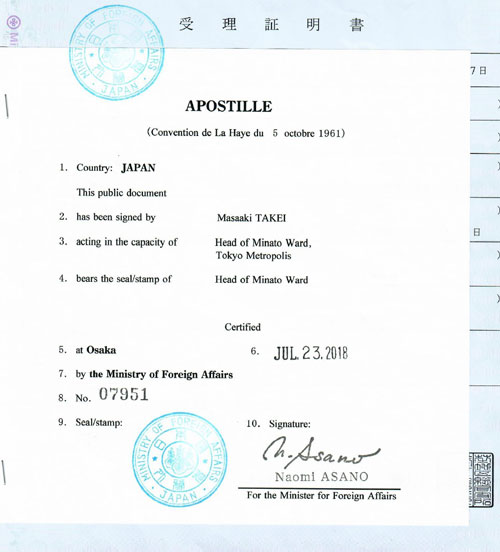
In Japan, the Apostille is issued in English (with the mandatory French header “Convention de La Haye du 5 octobre 1961”) as a separate bound sheet (allonge) permanently attached to the document, featuring a QR verification code and access code for certificates issued from June 1, 2026 onward. How a document is routed depends on whether it is a direct public record or a private/notarised record:
| Authority / Office in Japan | Role in the Apostille Process |
|---|---|
| Ministry of Foreign Affairs (MOFA / 外務省) Tokyo: Kasumigaseki 2-2-1, Chiyoda-ku (14:00–16:00 counter requires online booking from Oct 5, 2026) Osaka: Ōtemae 4-1-76, Chūō-ku (weekdays without booking) |
Sole Competent Authority: Issues Apostilles (or Kōin Kakunin seal confirmations for non-Hague countries) directly on original Japanese government, municipal, and court records. Returned solely by domestic mail within Japan in roughly 3 working days. |
| Notary Offices (公証役場) & Legal Affairs Bureaus (法務局) | Notarial Route for Private Records & University Degrees: Private deeds, powers of attorney, contracts, translations, and degrees from private or incorporated universities are first notarised before a Kōshōnin (Notary Public), followed by confirmation of the notary's seal (Kōshōnin Ōin Shōmei) at the regional Hōmukyoku before MOFA issues the Apostille. |
| Integrated “One-Stop Service” (ワンストップサービス) in 8 Prefectures / Districts |
Single-Stop Notary + MOFA Processing: In Tokyo, Kanagawa (Yokohama), Osaka, Aichi (Nagoya), Fukuoka, Shizuoka, Miyagi (Sendai), and Hokkaido (Sapporo district), participating notary offices handle notarisation, Legal Affairs Bureau seal confirmation, and MOFA Apostille issuance in one paid procedure. (In Saitama, Chiba, Ibaraki, Tochigi, Gunma, Nagano, and Niigata, notary and Legal Affairs Bureau steps are combined, while MOFA filing takes place separately.) |
Which Japanese Documents Can Be Apostilled — and Key Requirements
For MOFA to apostille a public document directly, it must be an original (or official certified duplicate) issued within the last 3 months for standard registry/municipal records, clearly stating the date of issue, issuing authority, official's title, and an official government seal (Kōin) — a personal name stamp (hanko/mitome-in) or signature without an official agency seal is not accepted.
| Eligible for a Japanese Apostille | Not Directly Apostillable at MOFA / Excluded |
|---|---|
|
|
Practical Guide to High-Demand Japanese Documents
1. Birth, Marriage & Immigration: The Japanese Family Register (Koseki Tōhon)
Rather than issuing standalone Western-style birth or marriage certificates for Japanese citizens, Japanese municipalities record birth, parentage, marriage, divorce, name changes, and death in the household family register (戸籍 – Koseki). Foreign immigration offices, marriage registrars, and courts typically require a full Koseki Tōhon (全部事項証明書) issued by the relevant municipal office within the last 3 months and apostilled directly by MOFA.
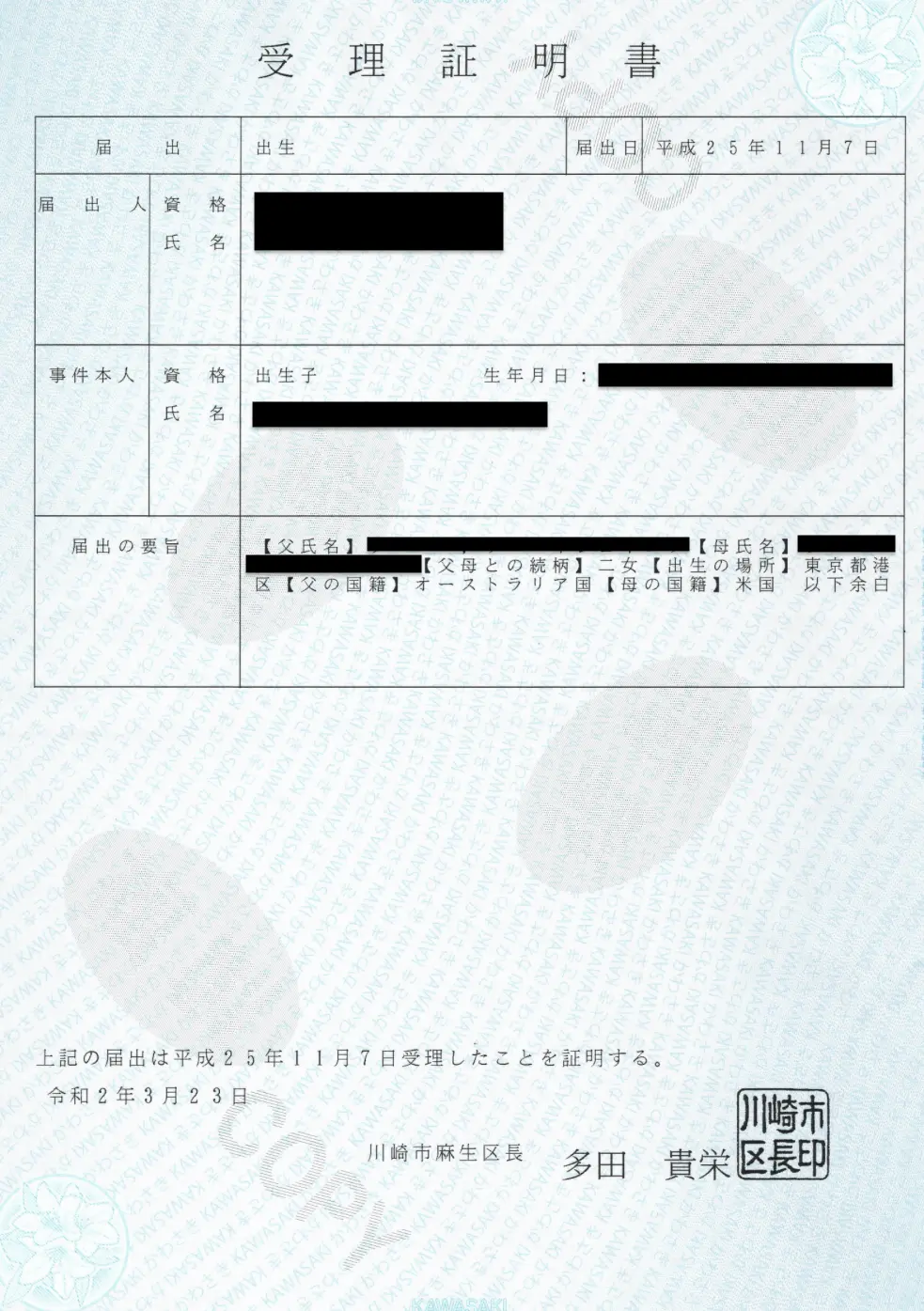
Foreign Nationals Born in Japan: Non-Japanese citizens do not have a Koseki. If a child was born in Japan to foreign parents, the municipal office where the birth notification was filed can issue an official certificate of acceptance of birth notification (出生届受理証明書 – Shussei Todoke Juri Shōmeisho) for MOFA Apostille stamping.
2. Japanese University Degrees (Private & National University Corporations)
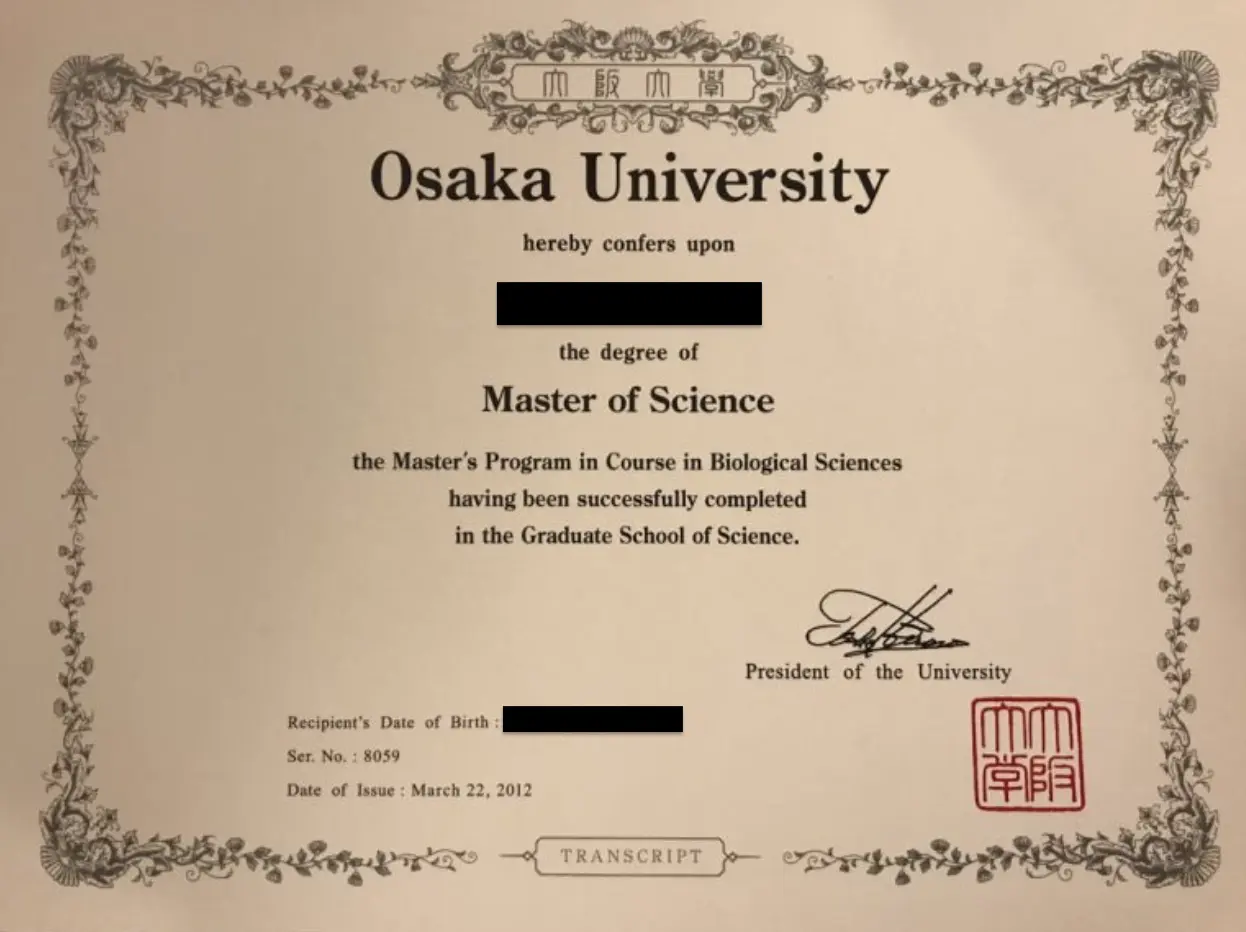
A frequent trap with Japanese academic credentials is assuming that a former “national” university qualifies for direct MOFA stamping. Following Japan's university incorporation reform, many prominent public universities (such as the University of Tokyo, Kyoto University, and Osaka University) operate as National University Corporations (国立大学法人) — meaning their certificates, alongside those of private universities (such as Waseda, Keio, or Sophia), cannot be apostilled directly by MOFA and must first be notarised (conveniently via the One-Stop Service in participating regions).
Because MOFA's Apostille attachment cannot be removed once affixed, applicants often prefer to obtain an official university Graduation Certificate (卒業証明書 – Sotsugyō Shōmeisho) and academic transcript rather than risking permanent alteration of a ceremonial diploma. Note that an Apostille confirms document authenticity, not automatic academic recognition or credential evaluation abroad.
3. Japanese Corporate Registry Extracts (Rireki Jikō Zenbu Shōmeisho) & Land Records
For bank KYC reviews, overseas subsidiaries, or cross-border transactions involving a Japanese company (such as a Kabushiki Kaisha – KK), Legal Affairs Bureaus (Hōmukyoku) issue official Commercial Registry extracts (履歴事項全部証明書) and real estate registry extracts (不動産登記事項証明書). Because these are official registry records issued within the 3-month window, MOFA apostilles them directly — whereas corporate powers of attorney, Articles of Incorporation, or board declarations go through the notary and Legal Affairs Bureau seal verification route first.
Consular Legalisation in Japan (“Kōin Kakunin” for Non-Hague Countries)
Consular legalisation is the multi-step authentication process carried out by the diplomatic or consular mission of the destination country so a foreign document is legally recognised within that state's jurisdiction.
When a Japanese document is needed in a country that is not a party to the 1961 Hague Apostille Convention (such as the United Arab Emirates, Qatar, or Kuwait) or where the Convention does not apply between the relevant states, consular legalisation is required instead of an Apostille:
- Preliminary certification: Obtaining the required public document or, for private documents, notarisation before a Kōshōnin plus seal verification at the Legal Affairs Bureau (Hōmukyoku);
- MOFA Official Seal Confirmation (公印確認 – Kōin Kakunin): Confirmation of the official seal at MOFA in Tokyo or Osaka (free of charge; roughly 3 working days; no Apostille is issued);
- Final Embassy / Consular Legalisation: Legalisation by the destination country's embassy or consulate in Japan (subject to that mission's translation, document, and fee rules).
Documents authenticated by MOFA with Kōin Kakunin cannot be re-authenticated by a Japanese embassy abroad, and MOFA does not accept documents bearing a consular stamp from a Japanese diplomatic mission overseas.
Comparison: Japanese Hague Apostille vs. Consular Legalisation
| Criterion | Hague Apostille | Consular Legalisation |
|---|---|---|
| Where Valid | Across contracting states where the 1961 Hague Convention applies. | Only in the specific country whose consulate completed the legalisation. |
| Competent Authorities | MOFA (Tokyo/Osaka) or Notary via One-Stop Service (8 regions). | Preliminary office/notary + MOFA (Kōin Kakunin) + Destination Embassy in Japan. |
| Complexity & Steps | Streamlined: direct MOFA filing for public records, or single-stop notary route where available. | Higher: multiple domestic verification steps plus consular processing in Japan. |
| Destination Consulate | Not required. | Required as the final step in Japan. |
6 Common Pitfalls When Getting a Japanese Apostille From Abroad
-
1
Trying to Mail Documents Directly From Abroad to MOFA
MOFA does not accept international mail-in submissions and only returns documents domestically within Japan — requiring a representative in Japan and a trackable return envelope (such as a Japan Post Letter Pack).
-
2
Submitting Registry or Municipal Extracts Older Than 3 Months
MOFA generally refuses standard public extracts (such as Koseki Tōhon, Jūminhyō, or corporate registry extracts) issued more than 3 months before application, forcing a fresh order and extra delay.
-
3
Sending Private or Incorporated University Diplomas Directly to MOFA
Private school/university records and incorporated state university degrees are not apostilled directly by MOFA and must first go through notarisation and Legal Affairs Bureau seal confirmation (or the One-Stop Service).
-
4
Showing Up in Tokyo Without an Online Booking (From Oct 5, 2026)
In-person submissions at MOFA Tokyo (14:00–16:00) require a prior online appointment from October 5, 2026 onward, whereas Osaka accepts weekday submissions without an appointment.
-
5
Opening a Sealed Police Clearance Envelope or Submitting Uncertified Copies
Police certificates issued in a sealed envelope or plain copies/spare printouts without an official agency seal are not accepted in that form for MOFA Apostille stamping.
-
6
Relying on a Japanese Notarised Translation Abroad Without Checking Rules
Because Japan has no state-sworn translators, a translation done in Japan is treated as a private document requiring notary and MOFA steps — and may still face local rules in the destination country, making translation in the country of use often more practical.
Remote Document Retrieval in Japan, Certified Translation & Cheat Sheet
Living outside Japan or managing cross-border filings from abroad often involves language barriers, power-of-attorney formalities, and strict 3-month issuance windows. Schmidt & Schmidt retrieves corporate registry extracts, real estate records, and authorised civil certificates (such as Koseki Tōhon) remotely across Japan, handles MOFA and Notary One-Stop Service filings locally, provides certified translations, and ships completed documents worldwide by courier.
| Japanese Document | Required Pre-Step | Competent Authority / Route |
|---|---|---|
| Family Register (Koseki Tōhon) & Residence (Jūminhyō) | Official municipal record with agency seal (issued within 3 months) | MOFA (Tokyo or Osaka). |
| Corporate & Real Estate Registry Extracts | Official Legal Affairs Bureau (Hōmukyoku) record (issued within 3 months) | MOFA (Tokyo or Osaka). |
| Police Clearance Certificate | Original police record with official seal (keep sealed envelope intact if issued sealed) | MOFA. |
| Private & Incorporated University Diplomas | Notarisation + Legal Affairs Bureau seal check (consider Sotsugyō Shōmeisho) | Notary / One-Stop Service + MOFA. |
| Powers of Attorney, Contracts & Translations | Notarisation before a Kōshōnin + Legal Affairs Bureau seal confirmation | Notary / One-Stop Service (8 regions) + MOFA. |
| Documents for Non-Hague Countries | Required pre-authentication + MOFA Kōin Kakunin | MOFA (Kōin Kakunin), then Destination Consulate in Japan. |
Official Sources & Japanese Government Portals
- Ministry of Foreign Affairs of Japan – MOFA (mofa.go.jp): Apostille & Seal Confirmation Procedures, Counters & Verification
- MOFA (mofa.go.jp): Documents Eligible for Authentication & University Rules
- Japan National Notaries Association (koshonin.gr.jp): Notary Offices & One-Stop Service Information
- Ministry of Justice – Legal Affairs Bureaus / Hōmukyoku (moj.go.jp)
- HCCH: Designated Competent Authority of Japan under Article 6 (hcch.net)
Information verified in November 2026 (including QR/access-code verification from June 1, 2026 and online reservation rules for MOFA Tokyo from October 5, 2026). Final acceptance and document recency rules remain subject to the receiving authority in the destination country.
Frequently Asked Questions (FAQ) About Apostilles in Japan
Japan's competent authority for Apostilles is the Ministry of Foreign Affairs (外務省 – Gaimushō / MOFA) via its offices in Tokyo (Kasumigaseki, Chiyoda-ku) and Osaka (Ōtemae, Chūō-ku). Public records from government and municipal offices are apostilled directly by MOFA, while private documents and most university degrees must first be notarised before a Notary Public (Kōshōnin) and confirmed by a Legal Affairs Bureau (Hōmukyoku).
No. MOFA does not accept applications mailed from outside Japan and returns completed documents only to a mailing address inside Japan. Applicants outside Japan must use a representative in Japan — Schmidt & Schmidt handles local filing and international courier forwarding on your behalf.
MOFA charges no government fee for issuing an Apostille and typically processes straightforward submissions in around 3 working days (longer for 10 or more documents, plus domestic mail return). Notary fees, Legal Affairs Bureau verification, the paid One-Stop Service (where applicable), translation, and international courier shipping are separate.
While the Apostille itself has no expiration date, MOFA generally requires standard public certificates and registry extracts (such as Koseki Tōhon, Jūminhyō, or corporate registry extracts) to be issued within the past 3 months. One-time original records such as diplomas are exempt from the 3-month issuance limit, though receiving authorities may set their own recency rules.
Degrees from private universities and National University Corporations cannot be apostilled directly by MOFA without prior notarisation and Legal Affairs Bureau seal confirmation. In eight regions (including Tokyo, Kanagawa, Osaka, Aichi, Fukuoka, Shizuoka, Miyagi, and the Sapporo district of Hokkaido), the paid One-Stop Service at participating notary offices combines notarisation, Legal Affairs Bureau seal confirmation, and MOFA Apostille issuance in a single step.
Yes. For Apostilles issued from June 1, 2026 onward, authenticity can be checked online via the printed QR code or by entering the certificate number, issue date, and access code through the official verification system.