
If you need to use an official document issued in the Republic of Armenia abroad — for example, for marriage registration, residence permits, citizenship applications, university admission, employment, or business operations — an apostille is generally required. Armenia acceded to the Hague Convention of 5 October 1961 Abolishing the Requirement of Legalisation for Foreign Public Documents in 1993, and the Convention entered into force in the country on 14 August 1994.
An apostille is an international certificate that verifies the authenticity of the signature, the capacity (authority) in which the person signing the public document has acted, and, where appropriate, the identity of the seal or stamp which the document bears. It does not certify the accuracy of the content of the underlying document itself.
Documents issued in Armenia and authenticated with an apostille are recognized in all other contracting states of the Hague Convention (currently more than 125 countries, including the United States, the United Kingdom, Canada, Australia, and all European Union member states) without the need for further consular legalization.
Key feature of Armenia — 100% digital transition: Since 26 April 2021, the Ministry of Justice of the Republic of Armenia authenticates official documents exclusively by electronic apostille (e-Apostille) issued in Armenian and English. Traditional wet-ink paper apostille stamps are no longer issued by the Ministry of Justice.
For countries that are not parties to the Hague Convention (such as the United Arab Emirates, Qatar, Kuwait, or Thailand), public documents must go through the multi-step consular legalization procedure.
Competent Authorities Authorized to Issue Apostilles in Armenia
According to the Republic of Armenia’s official notification to the depositary of the Hague Convention, two state ministries are designated to issue apostilles:
- Ministry of Justice of the Republic of Armenia (MoJ): The primary competent authority issuing electronic apostilles for the vast majority of public documents — including civil status records (vital records), notarial acts, court judgments, university diplomas and school certificates, police clearance certificates, state registry extracts, and certified translations.
- Ministry of Foreign Affairs of the Republic of Armenia (MFA): Competent for apostilling specific categories of official documents issued by the Ministry of Foreign Affairs itself or state agencies within its purview.
How the Electronic Apostille (e-Apostille) in Armenia Works and How to Verify It
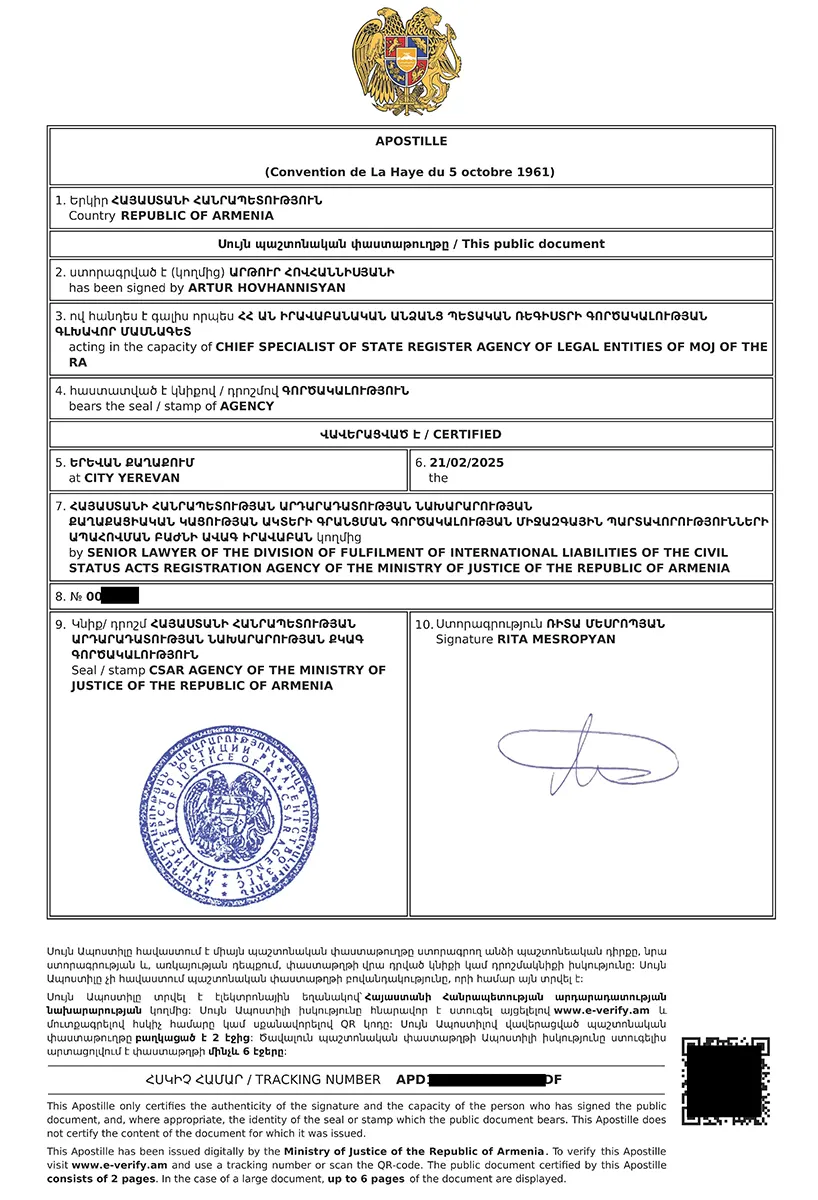
An Armenian e-Apostille is issued as a secure PDF certificate in Armenian and English, featuring the mandatory heading “Apostille” and a reference to the 1961 Hague Convention in French (Convention de La Haye du 5 octobre 1961).
- Not physically stapled to paper: The electronic apostille is not glued or sewn onto the paper original; instead, it is generated in a centralized electronic registry and delivered digitally to the applicant.
- Security & online verification: Each certificate bears a unique 12-digit identification number and a QR code. Its authenticity can be verified anytime free of charge on the official government portal e-verify.am.
- Displays full scan of the underlying document: A major advantage of Armenia’s system is that verifying the code on
e-verify.amdisplays not only the apostille certificate itself, but also the complete scanned copy of the authenticated original document, eliminating any risk of forgery.
e-verify.am.
Which Documents Can Be Apostilled in Armenia
| Eligible for Apostille | Not Eligible for Apostille |
|---|---|
|
|
Document Requirements and Procedural Specifics
- Original or notarized copy: To apply for an electronic apostille at the Ministry of Justice of Armenia, you must submit the official original document or a notarized copy (where the original itself cannot be apostilled, such as ID documents). Documents must be in good physical condition with clearly legible seals and signatures, and free of lamination or extraneous markings.
- Soviet-era documents (Armenian SSR): Civil registries and the Ministry of Justice frequently decline to apostille old Soviet vital records (issued prior to 1991) due to worn forms, illegible stamps, or lack of digitization in the modern electronic civil registry. In such cases, a new duplicate certificate in the current Armenian format must be obtained first.
- Validity period: The e-Apostille itself has no expiration date and remains valid indefinitely. However, receiving authorities abroad typically impose recency limits on the underlying document — for instance, police clearance certificates and marital status records are usually accepted only if issued within the past 3 to 6 months.
Processing Times and State Fees in Armenia
Applications for an electronic apostille are submitted through unified public service offices or electronically. The standard state fee charged by the Ministry of Justice of Armenia is 7,000 Armenian Drams (AMD) per document.
| Service / Document Category | Estimated Turnaround | Notes |
|---|---|---|
| Electronic Apostille (Ministry of Justice) — vital records, notarial acts, certificates | 1–5 business days | Up to 10–15 business days if signature verification with the issuing officer is required |
| Apostille for Diplomas and School Certificates | 5–14 business days | Includes authenticity verification via the Ministry of Education / educational institution |
| Retrieval of Civil Registry Duplicates / Police Clearance | 3–10 business days | Depends on availability in the electronic registry and selected processing speed |
International Agreements: Hague Convention, Minsk & Chisinau Conventions
In relations with the United States, the United Kingdom, Canada, Australia, all EU member states, and over 120 other jurisdictions, the 1961 Hague Apostille Convention applies exclusively. Additionally, Armenia is a party to the 1993 Minsk Convention and the 2002 Chisinau Convention on Legal Assistance, under which official documents bearing a state seal are formally exempt from apostille requirements (requiring only a notarized translation) in relations with Armenia, Azerbaijan, Belarus, Kazakhstan, Kyrgyzstan, Moldova, Russia, Tajikistan, Turkmenistan, and Uzbekistan.
- Relations with Ukraine: Following Ukraine’s withdrawal from the Minsk and Chisinau Conventions (effective May 2024), an apostille is now mandatory for the mutual recognition of documents between Armenia and Ukraine.
- Practice in CIS countries: Despite formal treaty exemptions, commercial banks, employers, and immigration authorities in countries such as Russia and Kazakhstan frequently insist on an apostille in practice. Because Armenia issues e-Apostilles quickly and affordably, obtaining one in advance is strongly recommended.
Consular Legalization of Documents from Armenia
If an Armenian document is intended for use in a country that is not a party to the Hague Apostille Convention (such as the United Arab Emirates, Qatar, Kuwait, or Thailand), consular legalization is required. An up-to-date list of Hague Convention contracting states is available on the official HCCH website.
Consular legalization is a multi-step authentication procedure performed by the national ministries of the issuing country and the diplomatic mission of the destination country, conferring legal validity on a public document in states outside the Hague Convention.
The consular legalization procedure in Armenia involves the following steps:
- Preparation of the original document or a notarized copy, along with a translation into the official language of the destination country (notarized in Armenia if required by the receiving consulate);
- Certification of the notary’s or official’s signature and seal by the Ministry of Justice of the Republic of Armenia;
- Authentication by the Consular Department of the Ministry of Foreign Affairs of the Republic of Armenia (MFA);
- Final legalization by the embassy or consulate of the destination country (in Yerevan, or through its accredited diplomatic mission in a neighboring country such as Tbilisi or Moscow if the country has no mission in Armenia).
A document legalized through consular channels is legally valid exclusively within the territory of the state whose diplomatic mission affixed the legalization stamp.
Key Differences Between an e-Apostille and Consular Legalization
| Criteria | Apostille (e-Apostille) | Consular Legalization |
|---|---|---|
| Scope of Application | Valid in all contracting states of the 1961 Hague Convention (over 125 countries, including the US, UK, Canada, and EU states). | Required for countries outside the Hague Convention (e.g., UAE, Qatar, Thailand). |
| Format & Complexity | Low: Issued electronically via the Ministry of Justice (or MFA) of Armenia within 1–5 business days. | High: Sequential authentication by the MoJ, MFA, and the destination country’s consulate. |
| Territorial Validity | Can be presented in any contracting state of the Convention. | Valid solely in the country whose diplomatic mission legalized the document. |
Document Retrieval (Duplicates) in Armenia
If vital records have been lost, laminated, or issued during the Armenian SSR era, or if you need a fresh police clearance certificate or commercial registry extract, we can remotely obtain new duplicate records in Armenia under a power of attorney and ship the physical originals via courier worldwide.
Translation of Armenian Documents (in Armenia or the Destination Country)
Armenian documents can be translated either by a certified translator in Armenia (with notarization and a subsequent e-Apostille) or directly in the destination country.
Recommendation for the US, UK, Canada, Australia, and EU: While US USCIS accepts certified translations accompanied by a translator’s certificate of accuracy, authorities in European Union countries (such as Germany, Spain, France, and Italy) almost always require a translation completed by a locally sworn or court-certified translator. Therefore, it is generally best to obtain the e-Apostille in Armenia first and then have the original and e-Apostille printout translated locally in your destination country.
How to Order Your Armenian Apostille or Duplicate Through Schmidt & Schmidt
- Free Preliminary Assessment: Send us a scan or photo of your document along with the destination country and purpose of use. We check the document format and requirements in advance.
- Transparent Quote & Timeline: You receive a clear quotation with realistic turnaround times.
- Remote Retrieval or Courier Pickup: If a new certificate is needed, we obtain a duplicate in Armenia via power of attorney. If you already hold the physical original, our courier picks it up from anywhere in the world for presentation to the Armenian Ministry of Justice.
- e-Apostille Delivery & Original Return: As soon as the e-Apostille is issued, we email it to you immediately (verifiable online at
e-verify.am) and return your physical original via international courier.
Official Sources
- HCCH: Full Text of the Hague Convention of 5 October 1961
- HCCH: Status Table of Contracting States and Accession Dates
- HCCH: Competent Apostille Authorities of the Republic of Armenia
- Official Verification Portal for Electronic Documents and Apostilles of Armenia (e-verify.am)
- Ministry of Justice of the Republic of Armenia (moj.am)
Information reviewed and updated in November 2026. Please confirm the specific requirements of the receiving authority in the destination country before submitting your application.
Frequently Asked Questions (FAQ)
e-verify.am, which displays both the apostille certificate and the full scanned copy of the authenticated original. For paper filings, a printout of the e-Apostille is submitted together with the original document and certified translation.
e-verify.am verification code (such as a recently issued civil status certificate or police clearance certificate), shipping the paper document may not be necessary. However, for older paper originals, university diplomas, and notarial acts, the Ministry of Justice of Armenia requires presentation of the physical original for scanning and signature verification — in which case our courier picks up your original and returns it after processing.