Schmidt & Schmidt provides apostille and legalization services for public documents issued in Belarus.
The Republic of Belarus is a contracting party to the Hague Convention of October 5, 1961, which abolishes the requirement of consular legalization for foreign public documents through a simplified apostille procedure. Belarus acceded to the Hague Convention in 1992 (by succession). Under the Convention, public documents issued by official authorities in one contracting state are recognized as valid in any other contracting state without the need for consular legalization, provided they bear an apostille stamp.
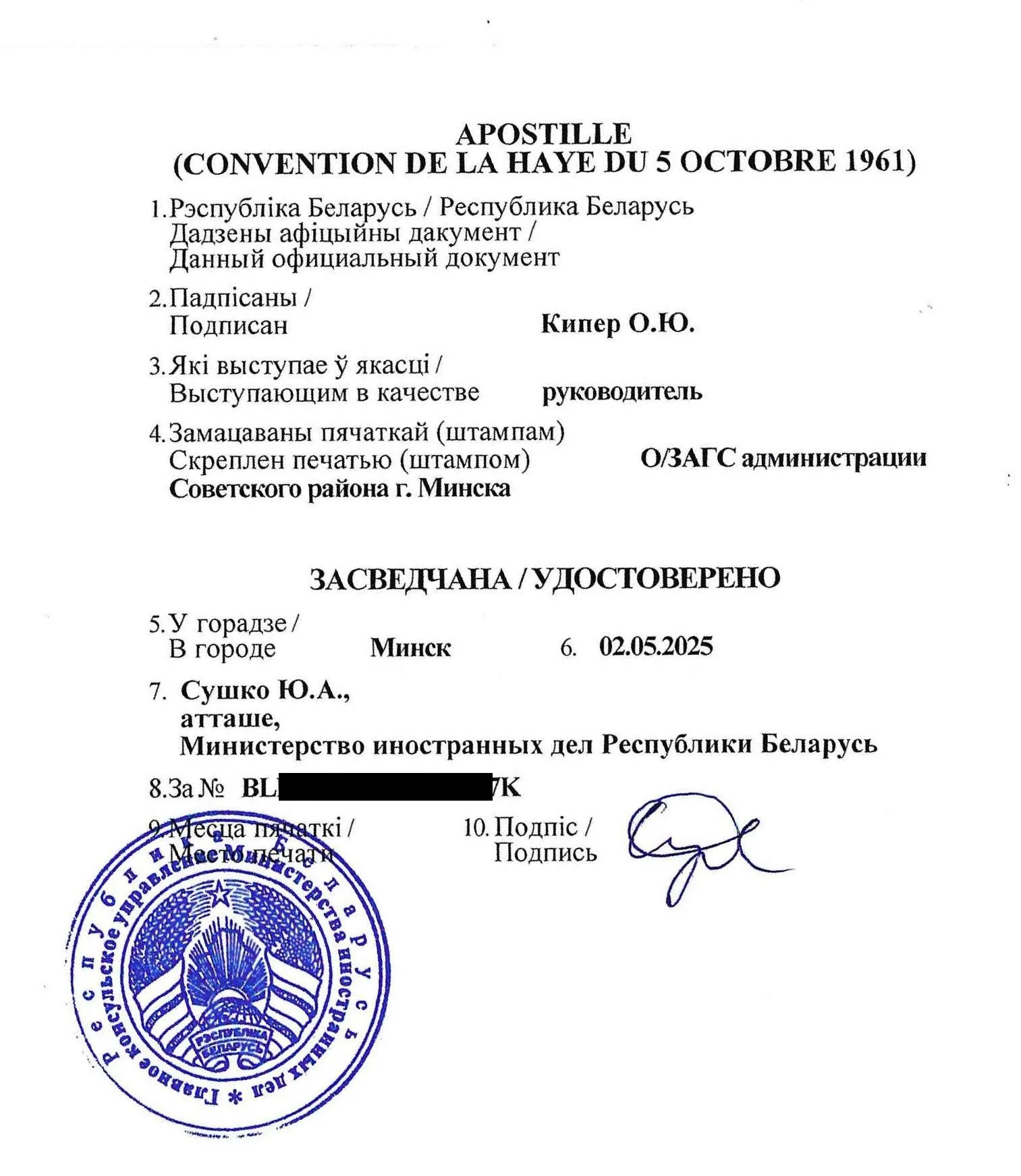
An apostille certifies the authenticity of the signature, the capacity in which the person signing the document has acted, and, where appropriate, the identity of the seal or stamp which the document bears.
In Belarus, an apostille takes the form of a square stamp measuring at least 9 x 9 cm in the Belarusian language. It must contain the mandatory heading “Apostille” and a reference to the 1961 Hague Convention in French (Convention de La Haye du 5 octobre 1961).
Competent Authorities for Issuing Apostilles in Belarus
| Public Authority | Document Categories |
|---|---|
| Main Justice Departments of the Minsk City Executive Committee and Regional Executive Committees | Documents emanating from courts, notarial archives, and notaries. |
| Ministry of Education of the Republic of Belarus in Minsk | Documents issued by educational institutions (diplomas, transcripts, certificates, etc.). |
| Department for Archives and Records Management of the Ministry of Justice in Minsk | Documents issued by the state archives of the Republic of Belarus. |
| Main Consular Department of the Ministry of Foreign Affairs in Minsk | All other types of public documents. |
During the apostille legalization process in Belarus, the competent authority verifies and certifies the authenticity of the signature on the original public document, the capacity of the signatory, and, where applicable, the authenticity of the seal or stamp affixed to the document. Subsequently, the apostille certificate is attached to the document. Typically, the apostille is placed on the reverse side of the original document or on a separate attached sheet (allonge) firmly bound to the document.
The apostille itself is a square-shaped stamp completed in the official language of the issuing authority. The French heading “Apostille (Convention de La Haye du 5 octobre 1961)” is a mandatory requirement for the apostille's validity.
Documents Eligible for an Apostille
| Eligible for Apostille | Not Eligible for Apostille |
|---|---|
|
|
Specific Requirements for Apostilles in Belarus
- Soviet-era documents (USSR): Civil registry offices may occasionally refuse to affix an apostille to original certificates issued during the Soviet era. In such cases, a new certificate in the current Belarusian format must be obtained to replace the USSR-issued document. We can assist you in promptly retrieving new replacement documents from Belarus.
- Condition of documents: An apostille is affixed exclusively to original documents or—if the original itself cannot be stamped (e.g., passports or driver's licenses)—to notarized copies. Documents must be in good physical condition, with clearly legible seals and signatures, and free from foreign markings, corrections, or stickers. Laminated documents cannot be apostilled.
- Content and formatting requirements: The text of the document must be clear and legible, with distinct signatures of officials and clear seal impressions. Mandatory document details (reference number, date, signature, seal) must be present without any erasures or uncertified additions. Documents consisting of more than one page must be bound, numbered, and sealed. If a document has annexes or transcripts, they must be included.
Required Documents
- Copy of a valid identity document (passport or national ID)
- Original document to be apostilled
- Notarized Power of Attorney
- If the applicant's name has changed: copies of documents confirming the name change (e.g., marriage certificate or name change certificate)
Exemptions from Legalization and Apostille (Minsk and Chisinau Conventions)
Pursuant to Article 13 of the Convention on Legal Assistance and Legal Relations in Civil, Family and Criminal Matters (also known as the Minsk Convention), which is in force across its signatory states, public documents from participating countries do not require legalization.
Alongside Belarus, the contracting states to this Convention include: Armenia, Azerbaijan, Georgia, Kazakhstan, Kyrgyzstan, Moldova, Russia, Tajikistan, Turkmenistan, and Uzbekistan.
Belarus has been a party to the Minsk Convention since 1993. Consequently, public documents issued in Belarus do not require an apostille for use in any of the aforementioned states.
To use documents issued in Belarus within the territories of these countries, a notarized translation is generally sufficient.
Furthermore, the Republic of Belarus has ratified the successor agreement of October 7, 2002 (known as the Chisinau Convention). In relations between the states that have ratified the Chisinau Convention (Armenia, Azerbaijan, Belarus, Kazakhstan, Kyrgyzstan, and Tajikistan), its provisions apply, similarly exempting official documents from both apostille and consular legalization. In legal relations with states that have not ratified the Chisinau Convention (including Russia and Uzbekistan), the 1993 Minsk Convention remains in force.
Apostille for Educational Documents from Belarus
The Ministry of Education of the Republic of Belarus affixes apostilles to educational credentials provided that they:
- were issued by general secondary schools, vocational-technical institutions, specialized secondary colleges, or higher education institutions in Belarus;
- bear the official emblem seal of the respective institution or the Ministry of Education of the Republic of Belarus.
The apostille procedure for educational documents in Belarus is carried out strictly by prior appointment. Appointments must be booked via a dedicated electronic portal, specifying the exact details of the document.
Consular Legalization in Belarus
If a Belarusian document is intended for use in a country that is not a party to the Hague Apostille Convention (or where the Convention does not apply between the two states due to an objection), the document must undergo consular legalization. A complete list of contracting states that accept and issue apostilles can be found here.
Consular legalization is a significantly more time-consuming and costly procedure than obtaining an apostille. The legalization process for documents issued in Belarus typically involves the following steps:
- Having a copy of the document certified by a notary
- Translating the document into the official language of the destination country (including notarization of the translator's signature)
- Certifying the authenticity of the notary's signature and seal at the Ministry of Justice
- Authenticating the document at the Main Consular Department of the Ministry of Foreign Affairs of the Republic of Belarus
- Final legalization of the document at the consular section of the embassy (or consulate) of the destination country in Belarus
Please note that a document legalized in this manner will have legal validity solely within the territory of the specific country whose consulate affixed the final legalization stamp; it cannot be used in third countries.
Unlike the apostille process, consular legalization can be applied not only to public and notarial documents, but also to commercial documents, provided they have first been certified by the Chamber of Commerce and Industry.
The validity period of consular legalization itself is generally unlimited; however, statutory time limits may apply to the validity of the underlying document itself (such as a police clearance certificate).
Differences Between Apostille and Consular Legalization
Both an apostille and consular legalization serve to authenticate an official document for presentation to authorities in another country. However, there are significant differences between the two procedures:
| Apostille | Consular Legalization | |
|---|---|---|
| Validity and Scope | Can only be used between countries that are contracting parties to the 1961 Hague Apostille Convention (provided no objection applies) and is universally recognized across all member states. | Used between states where one or both are not parties to the Hague Convention, or where one state has objected to the accession of the other. Valid only for the specific destination country. |
| Complexity | Moderate. To obtain an apostille, you apply directly to the designated competent authority in the country where the document was issued. | High. Consular legalization requires navigating a multi-step chain of certifications involving various ministries and the consulate of the destination country. |
| Prior Authentication | Generally not required. | Requires prior authentication by the issuing bodies and relevant ministries of the country of origin. |
| Consular Involvement | No involvement of the destination country's consulate is required. | The final stage of legalization must take place at the embassy or consulate of the destination country, usually in the country where the document was issued. |
Document Procurement in Belarus
Important civil status documents are frequently lost or damaged, or foreign authorities may require an updated copy issued recently. In such cases, it is necessary to request duplicates (replacement certificates) from the competent authorities. Individuals who have left Belarus often face significant logistical hurdles when trying to obtain these records. Our service enables you to procure documents in Belarus remotely, complete with worldwide courier delivery to your doorstep.
Certified Translation of Documents from Belarus
Copies and duplicates of civil status documents can be translated into any language either by a registered translator in Belarus (with notarial certification) or by a sworn or certified translator in the country of destination. We provide certified and notarized translation services for civil status documents, including full authentication. The cost of the service is calculated based on the volume of the specific document.
Does the Translation Also Need to Be Apostilled?
Any foreign public document issued in one country and intended for official use in another must be properly authenticated. It is important to keep in mind that if an already apostilled document is translated in Belarus and certified by a Belarusian notary, the translation itself takes on the legal status of a new foreign notarial document—which in turn requires its own separate apostille. Furthermore, public authorities in many receiving countries (such as across the EU, the UK, the US, and Canada) often prefer or strictly require translations to be completed locally by an accredited, sworn, or certified translator in the destination country. To avoid double apostille fees and potential rejection by local authorities, it is generally recommended to have the translation prepared in the country where the document will ultimately be used.