Schmidt & Schmidt provides apostille and legalisation services for public documents issued in Germany, including their subsequent certified translation and delivery to anywhere in the world.
Suppose a German citizen is planning to get married abroad and needs to submit her birth certificate and a certificate of marital status to the civil registry office in that country. The receiving official does not speak German and cannot independently verify which authority issued the documents or whether the signatures and seals are genuine. It is precisely for situations like these that the apostille exists — a standardised confirmation of the authenticity of an official document for use abroad.
An apostille confirms the authenticity of the signature, the capacity (authority) in which the person signing the document has acted and, where appropriate, the authenticity of the seal or stamp on the document. An apostille does not certify the content of the document itself. The procedure is established by the Hague Convention of 5 October 1961 Abolishing the Requirement of Legalisation for Foreign Public Documents.
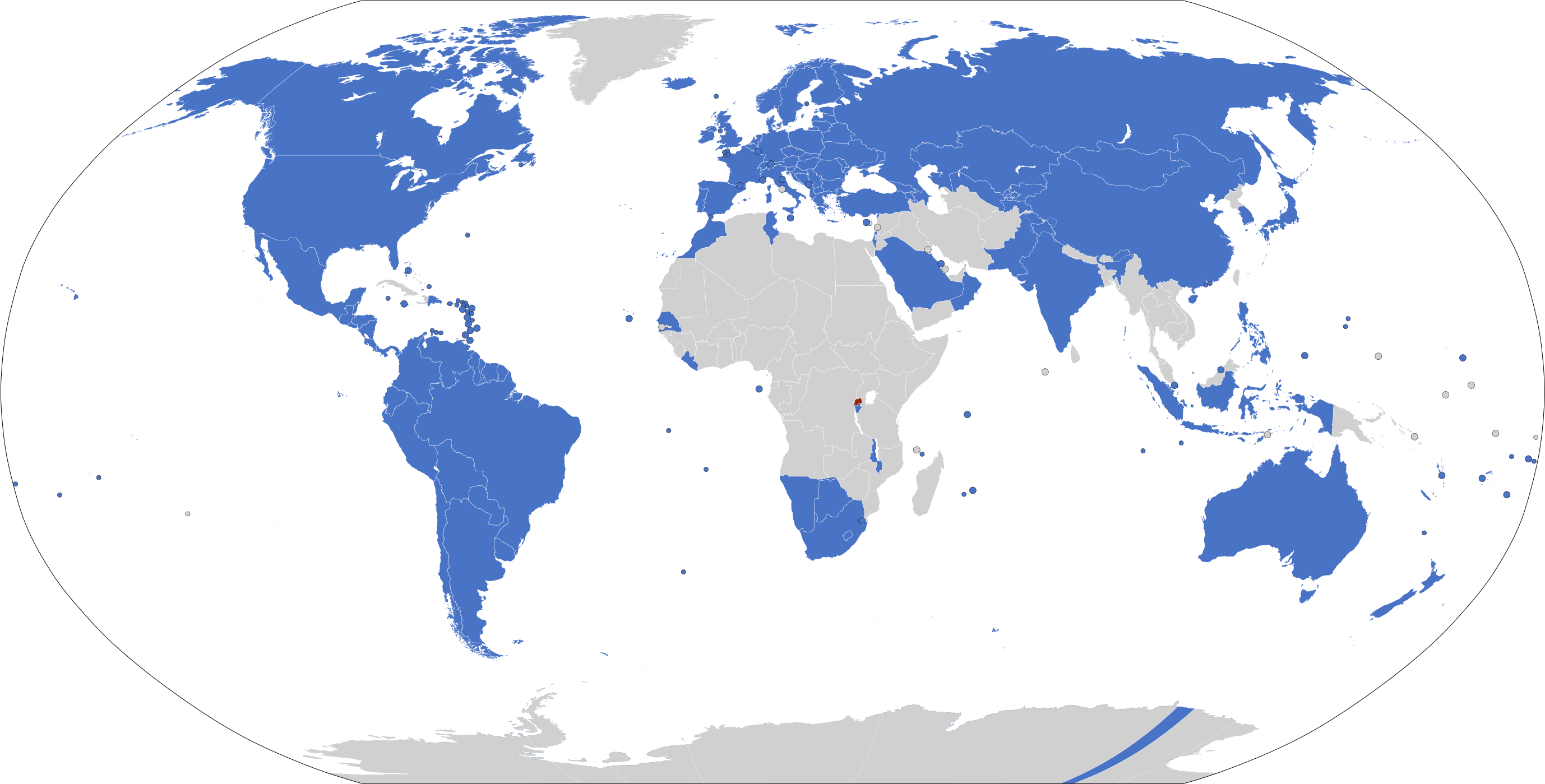
Germany acceded to the Hague Convention on 15 December 1965, and the Convention entered into force for Germany on 13 February 1966. To date, 130 states are party to the Convention. As a rule, documents apostilled in Germany are recognised in the other contracting states, subject to the applicable conditions, and do not require consular legalisation.
For a German document to be submitted to foreign authorities or courts, you will usually need an apostille together with a certified translation into the required language. The specific set of requirements depends on the type of document, the requirements of the receiving authority, and the international treaties in force.
If you wish to use a document issued abroad in Germany, you can find detailed information on our country-specific pages.
Key points at a glance
- An apostille confirms the authenticity of the signature, the capacity of the signatory and the seal, but does not certify the content of the document.
- There is no single apostille authority in Germany: the competent body depends on the type of document and the federal state (Bundesland). Federal documents and the certificate of good conduct are apostilled by the BfAA (Federal Office for Foreign Affairs).
- The certificate of good conduct (Führungszeugnis) is issued by the Federal Office of Justice (Bundesamt für Justiz, BfJ) for €13; since December 2024 the apostille must first be requested from the BfAA, and the certificate is then ordered from the BfJ quoting the BfAA application number.
- For use abroad you will usually need an apostille and a certified translation; the final requirements are set by the receiving authority.
- If the destination country is not a party to the Hague Convention, consular legalisation is required.
- Schmidt & Schmidt arranges apostilles, legalisation, document retrieval and translation in all 16 federal states, including remotely.
Glossary: key terms in German
| Haager Apostille | Apostille |
| Konsularische Legalisation | Consular legalisation |
| Vorbeglaubigung / Endbeglaubigung | Preliminary / final certification |
| Vereidigter (beeidigter) Übersetzer | Sworn translator |
| Führungszeugnis | Certificate of good conduct |
| Geburtsurkunde | Birth certificate |
| Heiratsurkunde / Eheurkunde | Marriage certificate |
| Sterbeurkunde | Death certificate |
| Ehefähigkeitszeugnis | Certificate of no impediment to marriage |
| Meldebescheinigung | Certificate of registered residence |
| Handelsregisterauszug | Commercial register extract |
| Abiturzeugnis / Zeugnis der allgemeinen Hochschulreife | School leaving certificate |
| Diplomurkunde / Hochschulzeugnis | University degree certificate |
| Immatrikulationsbescheinigung | Certificate of enrolment |
Which documents can be apostilled in Germany
An apostille is affixed to German public documents — those issued by government authorities, courts and notaries. Private documents can be apostilled only after they have been notarised.
| Can be apostilled | Cannot be apostilled |
|---|---|
|
|
Specifics of apostille certification in Germany
Germany has no single apostille authority. Responsibility for issuing apostilles is divided between federal and state (Land) authorities and depends both on the type of document and on the federal state in which it was issued. As a result, the procedure may involve several steps, and processing times vary considerably from one state to another.
| Type of document | Competent apostille authority |
|---|---|
| Documents from federal authorities and courts, including the certificate of good conduct (Führungszeugnis) | Federal Office for Foreign Affairs (Bundesamt für Auswärtige Angelegenheiten, BfAA), Brandenburg an der Havel |
| Documents from ordinary courts and notaries (in some states, also educational documents) | Presidents of the regional courts (Präsident des Landgerichts) or the state ministries of justice |
| Documents from administrative authorities (civil registry offices, municipalities, etc., other than the justice sector) | Depends on the state: state interior ministries, Regierungspräsidium, Bezirksregierung; in Berlin — LABO; in Lower Saxony — the police directorates; in Rhineland-Palatinate — Aufsichts- und Dienstleistungsdirektion (ADD) |
| Documents from the Patent Office and the Federal Patent Court | President of the German Patent and Trade Mark Office (DPMA), Munich |
Because of this decentralisation — 16 federal states and a different authority for each type of document — handling the apostille yourself in Germany is often time-consuming. We identify the competent authority and manage the entire chain of certifications. As a rule, affixing an apostille requires the original document in good condition with legible seals and signatures; in some systems electronic documents (e-Apostille) are also available.
Validity period of a document
No general expiry period is set for the apostille itself. However, the receiving authority in the destination country may require a "recent" document — this most often applies to certificates of good conduct and documents relating to marital status (usually no older than 3–6 months, counted from the date of issue rather than the date of the apostille). Check the requirements at the place of submission in advance.
Electronic apostille (e-Apostille) in Germany
The handling of electronic documents in Germany is governed by Sections 371a(3) and 371b of the Code of Civil Procedure (Zivilprozessordnung, ZPO): documents issued by public authorities and signed with a qualified electronic signature are recognised as authentic — but only with respect to domestic German documents. Germany has not implemented the electronic apostille (e-APP) within its legal system: the act ratifying the Hague Convention recognises only the paper apostille, and any deviation from the conditions of the Convention, according to the position of the Federal Constitutional Court, requires a separate piece of legislation. Apostilles in Germany are therefore issued in paper form.
As a consequence, the recognition of foreign electronic documents and electronic apostilles in Germany is not regulated by law: such documents have no automatic evidential value and may require additional verification of authenticity, and in some cases may be rejected if the electronic document or signature is not treated as equivalent to paper form bearing a handwritten signature. This is why, for German documents, we arrange a paper apostille, which is recognised without such limitations.
Specifics of apostille certification for particular documents
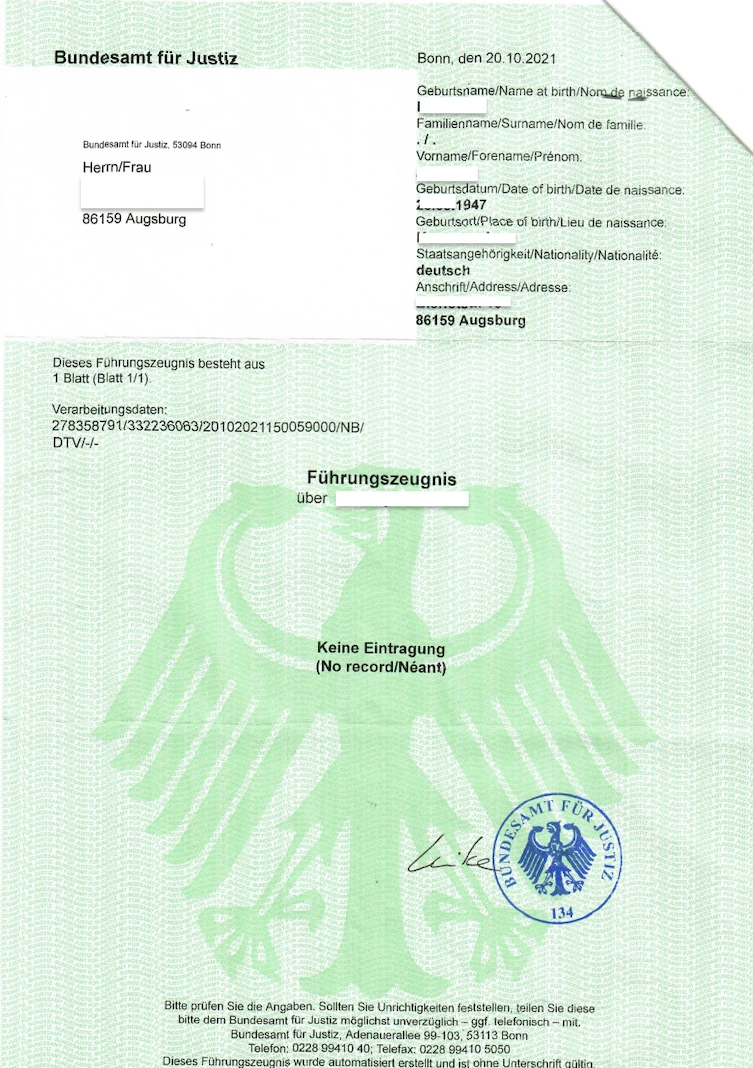
Certificate of good conduct (Führungszeugnis)
The certificate of good conduct (Führungszeugnis) is one of the documents most frequently submitted for an apostille: it is required for employment abroad, for obtaining a residence permit, for marriage and for immigration. The certificate is issued by the Federal Office of Justice (Bundesamt für Justiz, BfJ) in Bonn on the basis of data held in the Federal Central Criminal Register (Bundeszentralregister). The official fee is €13; the document is issued in German only.
There are several types of certificate:
- the standard certificate for personal use (einfaches / privates Führungszeugnis);
- the extended certificate (erweitertes Führungszeugnis) — for example, for work involving children;
- the European certificate (Europäisches Führungszeugnis) — for citizens of EU member states;
- the official certificate (Behördenführungszeugnis) — for submission to a German authority.
New procedure as of December 2024
The apostille on a Führungszeugnis is affixed not by the BfJ but by the Federal Office for Foreign Affairs (BfAA). If an apostille is required, the application for it is submitted first online to the BfAA; once the fee has been paid, the BfAA issues an application number. The certificate itself is then ordered from the BfJ quoting this number — the BfJ produces it and forwards it to the BfAA for the apostille to be affixed, after which the BfAA sends the completed document to the applicant.
- a copy of the applicant's identity document;
- where an application is made through a representative — a power of attorney (apostilled and translated, if executed abroad);
- an indication of the country in which the certificate will be used.
Civil status certificates (Personenstandsurkunden)
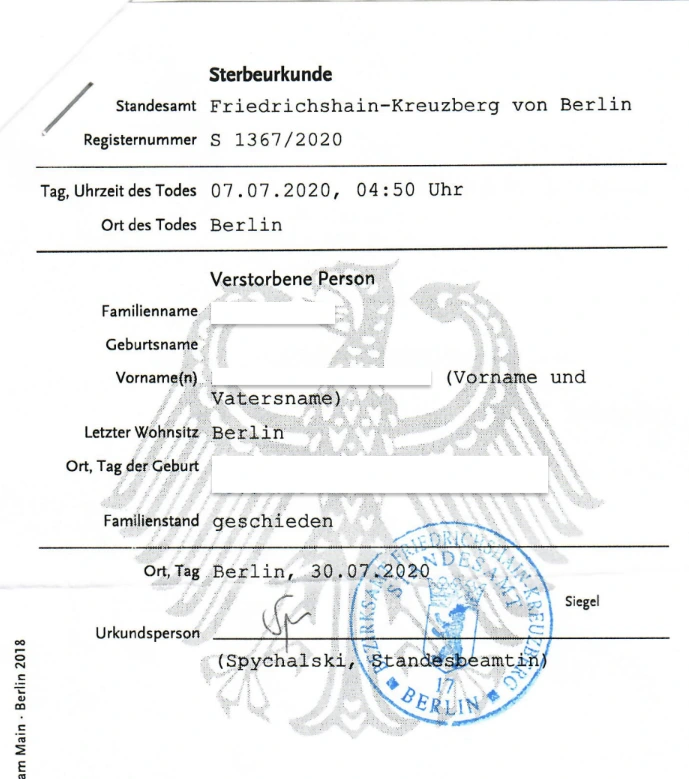
Civil status documents include birth certificates (Geburtsurkunde), marriage certificates (Heiratsurkunde / Eheurkunde) and death certificates (Sterbeurkunde). They are issued by the civil registry office (Standesamt) where the event was registered. The apostille on such documents is affixed by the administrative authority of the relevant federal state.
For use in states party to the 1976 Vienna Convention of the International Commission on Civil Status (CIEC), the civil registry office can issue an international (multilingual) form (internationale / mehrsprachige Personenstandsurkunde), which is generally accepted without an apostille or translation. For countries that are not party to this convention, this form offers no advantage — an apostille and a certified translation will be required.
Required documents:- the details needed to locate the record (full name, date and place of the event, information about the parents or spouse);
- a copy of the applicant's identity document;
- where an application is made through a representative — a power of attorney.
Educational documents
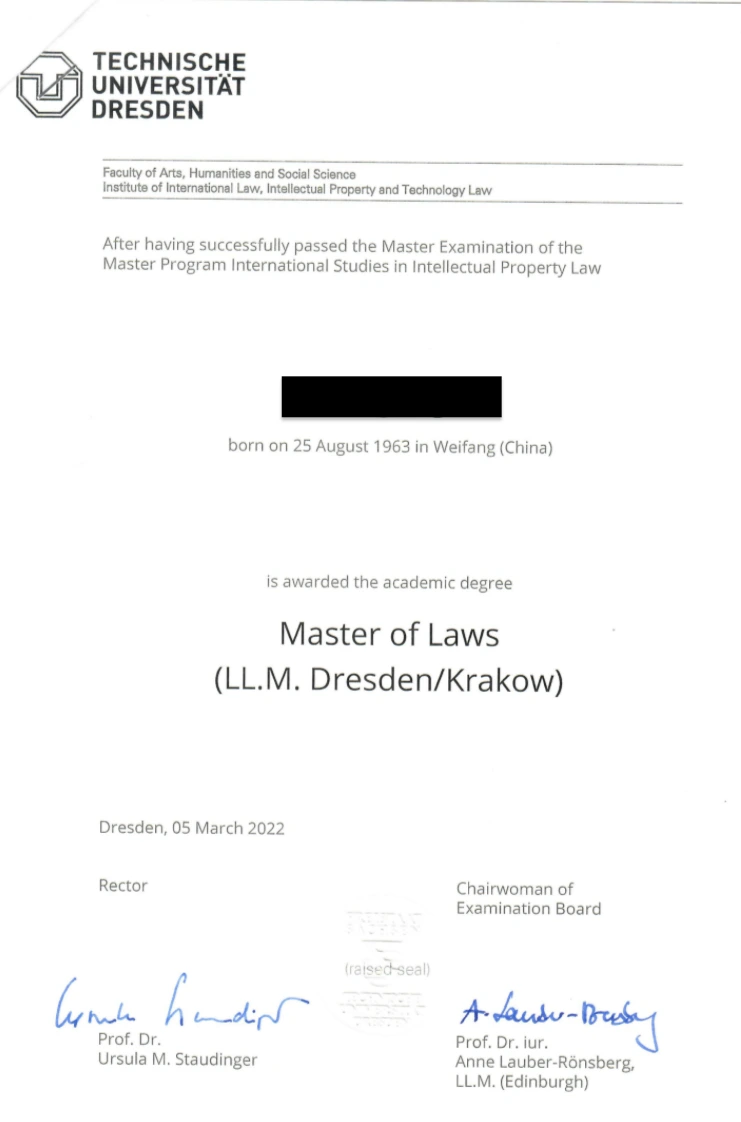
Educational documents issued in Germany — degree certificates (Diplomurkunde), school leaving certificates (Abiturzeugnis) and enrolment certificates (Immatrikulationsbescheinigung) — have no automatic legal force abroad. An apostille may be required, for example, when applying to a foreign university for a master's or doctoral programme, or when enrolling at a university abroad.
Responsibility for issuing apostilles on educational documents depends on the federal state: in some states the apostille is affixed by the presidents of the regional courts, in others by the state administrative authorities, and a number of states (for example, Baden-Württemberg, Brandenburg and Saarland) apply special rules. In some cases the original must first be pre-certified, which increases the processing time. To be apostilled, the document must be drawn up in German.
Required documents:- a copy of the educational document;
- details of the institution, the field of study and the year of graduation;
- where an application is made through a representative — a power of attorney.
Commercial register extract (Handelsregisterauszug)
A commercial register extract (Handelsregisterauszug) confirms the registration details of a German company: its name, legal form, information on managing directors and authorised representatives, and share capital. The register is maintained by the local courts (Amtsgericht acting as the register court, Registergericht); an extract can also be obtained through the handelsregister.de portal.
As the extract falls under documents issued by the ordinary courts, the apostille on it is affixed by the president of the regional court (Präsident des Landgerichts). For corporate procedures abroad, an up-to-date extract with an apostille and a translation is usually required.
Required documents:- the company name and its registration number (HRB/HRA);
- an indication of the country of use and the required format;
- where an application is made through a representative — a power of attorney.
Recognition of the authenticity of public documents within the EU
Germany has concluded bilateral agreements with the following countries:
- Austria, Belgium, Greece, Denmark, Italy, Luxembourg, France, Switzerland.
Under these agreements, certain documents are exempt from the requirement of certification if they bear the seal of the competent administrative authorities.
Multilingual documents (CIEC Convention)
Civil status records and certificates of marital capacity issued by one of the contracting states in accordance with the model forms of the conventions of the International Commission on Civil Status (CIEC) are exempt from legalisation and other similar formalities otherwise required for the use of foreign documents.
States party to the Vienna CIEC Convention of 8 September 1976 (multilingual extracts of birth, marriage and death records):
- Austria, Belgium, Bulgaria, Bosnia and Herzegovina, Germany, Spain, Italy, Cape Verde, Lithuania, Luxembourg, Moldova, Netherlands, Poland, Portugal, Romania, North Macedonia, Serbia, Slovenia, Turkey, France, Croatia, Montenegro, Switzerland, Estonia.
States party to the Munich CIEC Convention of 5 September 1980 (multilingual certificate of marital capacity, Ehefähigkeitszeugnis):
- Austria, Germany, Greece, Spain, Italy, Luxembourg, Moldova, Netherlands, Portugal, Turkey.
Many countries are not party to the CIEC conventions. For the use of German documents in a country that is not a member, the multilingual form offers no advantage — an apostille and a certified translation will be required.
Regulation (EU) 2016/1191 of 6 July 2016 on public documents
Regulation (EU) 2016/1191 of 6 July 2016 removes the apostille requirement for a number of categories of public document (relating to birth, marriage, death, residence, absence of a criminal record, etc.) presented between EU member states, and introduces multilingual standard forms that in some cases also remove the need for a translation.
Consular legalisation of documents from Germany
If a document is to be used in a state that is not a party to the 1961 Hague Convention (for example, the UAE or Egypt) and no other international treaty applies, consular legalisation is used.
Special case: countries to whose accession Germany has objected
Even if a state has formally acceded to the Hague Convention, the apostille is not valid in relations with Germany if Germany has lodged an objection to that state's accession. For such countries, German documents require consular legalisation rather than an apostille. According to the Federal Foreign Office (Auswärtiges Amt, 2026), these include: Algeria, Burundi, Dominican Republic, India, Kosovo, Liberia, Mongolia, Morocco, Pakistan, Philippines, Rwanda, Senegal, Tajikistan, Tunisia, Uzbekistan and Vietnam. This list changes over time, so check the current status of a specific country in advance.
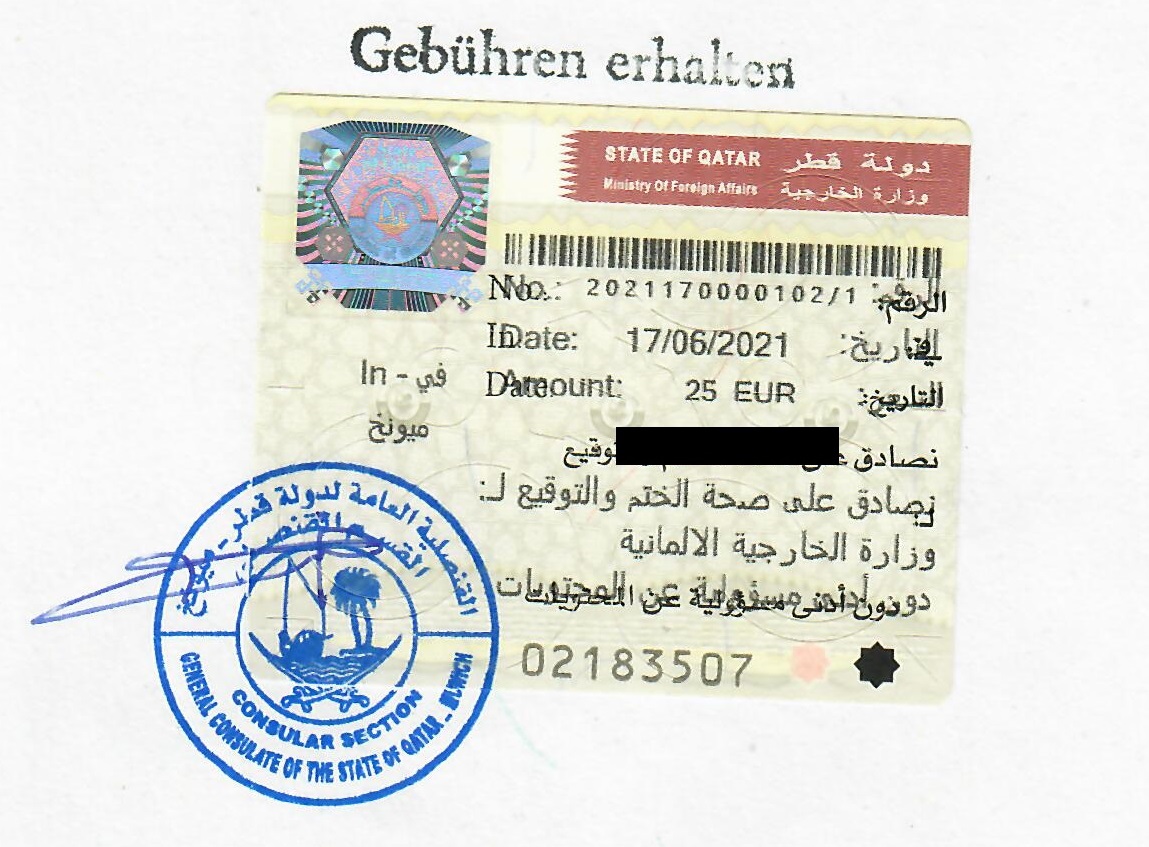
Consular legalisation is the process of confirming the authenticity of a document so that it can be recognised in a foreign state, carried out by a diplomatic or consular representative of the country of destination.
This is a longer and more costly procedure: the document goes through several preliminary certifications and is then certified at the consulate of the country of destination located in Germany. Legalisation confirms the authenticity of the document for one specific country; to use it in another country, the procedure has to be carried out again.
Differences between an apostille and consular legalisation
| Apostille | Consular legalisation | |
|---|---|---|
| Application | Between states where the Hague apostille regime applies. | Where the apostille regime or another exemption from legalisation does not apply. |
| Complexity | Moderate: a single application to the competent authority of the issuing country. | High: applications to several authorities and to the consulate. |
| Preliminary check | As a rule, none is carried out. | Prior certification by the issuing authority is required. |
| Consulate of the destination country | Not required. | The final step is at the consulate of the destination country. |
What can go wrong when obtaining an apostille in Germany yourself?
At first glance the procedure looks simple: prepare the document, submit it to the competent authority and wait for the result. In practice, however, most difficulties arise before the apostille is even affixed — at the stage of choosing the authority, pre-certification, notarisation, translation or submission.
-
1
The wrong competent authority is chosen
Germany has no single apostille authority: the body depends both on the type of document and on the federal state in which it was issued. Submitting to the wrong authority leads to rejection and lost time — this applies in particular to educational documents and documents from administrative authorities, where the rules vary from state to state. -
2
Pre-certification (Vorbeglaubigung) is skipped
Some German documents cannot be apostilled directly — the signature of the official must first be pre-certified by a particular authority. If this step is skipped, the document will not be accepted for the apostille. -
3
A private document without notarisation
Powers of attorney, declarations, consents and copies are private documents and cannot be apostilled on their own. The signature or copy must first be certified by a notary (notarielle Beglaubigung) — only then does the document become eligible for an apostille. -
4
The wrong order for the certificate of good conduct (Führungszeugnis)
The procedure changed in December 2024: the apostille must first be ordered online from the BfAA (which issues an application number), and only then is the certificate ordered from the BfJ quoting that number. Doing it the other way round — ordering the certificate first — means the apostille cannot be obtained under the new procedure, and everything has to be done again from scratch. -
5
Problems with the document's validity period
No expiry period is set for the apostille itself, but the receiving authority often requires a "recent" document — as a rule, no older than 3–6 months, with the period counted from the date of issue rather than the date of the apostille. This applies in particular to certificates of good conduct and documents relating to marital status: if the procedure is started too late, the document may "expire" before it is even submitted abroad. -
6
The destination country's requirements are overlooked
Even a correctly affixed apostille does not guarantee that the document will be accepted: the receiving authority may have its own requirements as to language, format, date of issue and translation. A translation made in Germany is not accepted in a number of countries — it has to be carried out and certified in the destination country. And for countries to whose accession Germany has objected (for example, India, Pakistan and Vietnam), the apostille is not valid at all — consular legalisation is required.
Apostille in all 16 federal states of Germany
We provide apostille, legalisation and document retrieval services in all 16 federal states. In each state the procedure has its own specifics: depending on the type of document and the issuing authority, the apostille is affixed by different government bodies.

Baden-Württemberg

Bavaria

Berlin

Brandenburg

Bremen

Hamburg

Hesse

Mecklenburg-Western Pomerania

Lower Saxony

North Rhine-Westphalia

Rhineland-Palatinate

Saarland

Saxony-Anhalt

Saxony

Schleswig-Holstein

Thuringia
Useful links: official German authorities
- Bundesamt für Justiz (bundesjustizamt.de) — ordering the certificate of good conduct (Führungszeugnis), including online;
- Bundesamt für Auswärtige Angelegenheiten (bfaa.diplo.de) — apostilles on federal documents and certificates of good conduct;
- Auswärtiges Amt (auswaertiges-amt.de) — international circulation of documents and consular legalisation;
- Handelsregister (handelsregister.de) — extracts from the German commercial register;
- HCCH (hcch.net) — the up-to-date list of states party to the Hague Convention and the competent authorities.
Procurement of documents from Germany
If civil status documents have been lost or damaged, or an up-to-date copy is needed, a duplicate must be procured. This is a common situation for people who have left Germany. Our service allows documents to be procured in Germany remotely: we request the duplicate from the competent authority (civil registry office, register court, educational institution), arrange the apostille and certified translation straight away where required, and deliver the completed package by courier to anywhere in the world. Your presence in Germany is not required.
Certified translation of documents from Germany
A certified translation will be required for submission to foreign authorities. Germany has the institution of the sworn translator (vereidigter / beeidigter Übersetzer), whose translation carries official status. Where necessary, the translation is produced taking into account both the text of the document and the apostille affixed to it.
Is the apostille affixed to the translation itself? A translation is not a public document — it is an expert service, so the apostille is not affixed to the text of the translation. Where necessary, the signature of the sworn translator can be certified separately, and an apostille can then be affixed to that certification. In some countries the translation into the local language must be produced and notarised in the destination country itself — check the requirements of the receiving authority.
Conclusion
Below is a summary table of the main documents: who affixes the apostille and what is required. Please note that the competent authority and the order of the procedure depend on the type of document and the federal state.
| Document | Competent apostille authority | What is required |
|---|---|---|
| Führungszeugnis (certificate of good conduct) | BfAA (apostille application first, then the certificate from the BfJ) | Copy of identity document; country of use; power of attorney if acting through a representative. |
| Geburtsurkunde / Heiratsurkunde / Sterbeurkunde | Administrative authority of the federal state | Details to locate the record; copy of identity document. |
| Diplomurkunde / Abiturzeugnis (education) | Depends on the state: regional court or administrative authority | Copy of the document; details of the institution; pre-certification if required. |
| Handelsregisterauszug (commercial register) | President of the regional court (Landgericht) | Company name and registration number; country of use. |
| Notarielle Urkunden (notarial documents) | President of the regional court (Landgericht) | Original of the notarial document; country of use. |
Frequently asked questions about the apostille in Germany
Germany has no single apostille authority. The competent body depends on the type of document and the federal state: federal documents and the certificate of good conduct are apostilled by the BfAA, documents from courts and notaries by the presidents of the regional courts, and documents from administrative authorities by the bodies of the relevant federal state.
The procedure changed in December 2024: the apostille is first ordered online from the BfAA (which issues an application number and takes the fee), and only then is the certificate ordered from the Bundesamt für Justiz quoting that number. The BfJ produces the certificate and forwards it to the BfAA for the apostille to be affixed.
Yes. The certificate of good conduct is ordered from the BfJ by post or online (the fee is €13). Schmidt & Schmidt arranges the document, the apostille and the translation remotely and delivers the completed package by courier to any country.
German documents are issued in German; for use abroad a certified translation into the required language is usually needed. The apostille is not affixed to the text of the translation — a translation is not a public document. Where necessary, the signature of the sworn translator is certified separately, and the apostille can then be affixed to that certification.
No expiry period is set for the apostille itself. However, the receiving authority may require a "recent" document — most often no older than 3–6 months, with the period counted from the date of issue rather than the date of the apostille. This applies in particular to certificates of good conduct and of marital status.
If no apostille regime or other international treaty applies between the two states, consular legalisation is required instead of an apostille — a multi-step procedure with certification at the consulate of the destination country in Germany.
Germany has no single apostille authority: the competent body depends on the type of document and the federal state, and some documents require prior certification (Vorbeglaubigung). We identify the right authority and manage the entire chain in order to reduce processing times.
Yes. Schmidt & Schmidt handles the entire process remotely — your presence in Germany is not required. We procure the document where necessary, arrange the apostille and translation, and deliver the completed package to the address you specify.
You can also order a certified translation of documents into the required language from us.