Schmidt & Schmidt provides a full spectrum of Apostille, consular legalization, and remote document retrieval services for official public documents issued in the Kingdom of Morocco. We manage the entire authentication workflow end-to-end — from retrieving fresh registry extracts locally and filing via the national portal apostille.ma to certified translation from Arabic or French and insured worldwide courier delivery.
The Kingdom of Morocco acceded to the Hague Convention of October 5, 1961 Abolishing the Requirement of Legalisation for Foreign Public Documents, with the Convention entering into force on August 14, 2016. Following Germany's withdrawal of its earlier objection effective February 22, 2019, there are no active objections from any contracting party — Moroccan Apostilles are recognized across all 125+ Hague Convention member states worldwide.
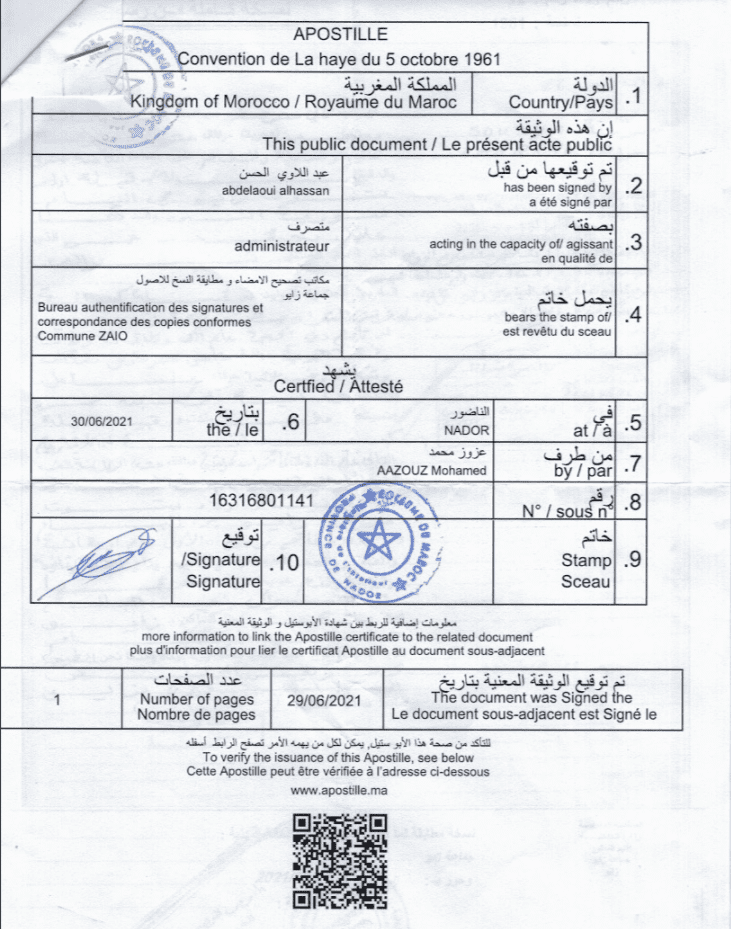
An Apostille (or “Hague Apostille”) is an internationally standardized certificate that verifies the authenticity of the signature, the capacity in which the signing official acted, and the seal or stamp on a public document. It does not certify the accuracy of the underlying content of the document itself.
Key Takeaways (Morocco ↔ US, UK, EU, Canada & Worldwide)
- Moroccan Documents for Use Abroad: Moroccan public documents bearing a valid Apostille are recognized directly in the United States, the United Kingdom, Canada, Australia, all EU member states (including Germany, France, Spain, and Italy), and all other Hague Convention countries without embassy legalization.
- Foreign Documents for Use in Morocco: Public documents issued in Hague Convention member states (such as US birth certificates, FBI background checks, UK ACRO certificates, or corporate records) require only a Hague Apostille from the issuing country and an official translation into Arabic or French — legalization at a Moroccan embassy or consulate is not required.
- Non-Hague Destination Countries: If a Moroccan document is intended for use in a country outside the Hague Convention (such as the United Arab Emirates, Qatar, Kuwait, Egypt, Jordan, or Thailand), traditional multi-step consular legalization applies. Check the latest treaty membership on the official HCCH Status Table.
Designated Competent Apostille Authorities in Morocco
Apostille applications in Morocco are registered electronically via the official government platform apostille.ma, while physical issuance is decentralized according to the category of the document:
| Document Category | Competent Apostille Authority in Morocco |
|---|---|
| Administrative & Civil Status Documents (municipal birth and death certificates, residency and administrative certificates, pre-certified school and university diplomas) | Local Administrative Authorities (Walis and Governors) of Prefectures and Provinces (Wilayas, Préfectures et Provinces — Ministry of the Interior) at the place of issuance |
| Judicial Records, Criminal Checks & Notarial Acts (court judgments, divorce decrees, criminal record checks, notarial acts, and court-homologated Adoul marriage certificates) | Public Prosecutor's Office (Procureur du Roi at the Court of First Instance, or Procureur général du Roi at the Court of Cassation) |
| Ministry of Justice Records (documents issued directly by central justice departments) | Secretary General of the Ministry of Justice (Secrétaire général du Ministère de la Justice) in Rabat |
Moroccan embassies and consulates abroad (e.g., in Washington D.C., New York, London, Paris, Madrid, or Ottawa) are not authorized to issue Apostilles on Moroccan documents. Every Moroccan Apostille carries a unique verification number allowing foreign authorities to confirm its authenticity online via apostille.ma.
Which Moroccan Documents Can Be Apostilled?
| Eligible for Apostille | Not Directly Eligible for Apostille |
|---|---|
|
|
Consular Legalization of Moroccan Documents (For Non-Hague Countries)
If a Moroccan public document is intended for use in a country that is not a party to the Hague Apostille Convention (such as the United Arab Emirates, Qatar, Kuwait, Egypt, Jordan, or Thailand), traditional multi-stage consular legalization is required instead of an Apostille:
- Pre-certification by the competent Moroccan authority (Court of First Instance, provincial authority, supervising ministry, or Chamber of Commerce CCIS for commercial documents);
- Authentication by the Moroccan Ministry of Foreign Affairs (Ministère des Affaires étrangères) in Rabat or its regional annexes (in Tangier, Nador, Agadir, or Béni Mellal);
- Certified translation into the official language of the destination country (where required by the receiving embassy);
- Final legalization stamp at the embassy or consulate of the destination country in Rabat or Casablanca.
Comparison: Hague Apostille vs. Consular Legalization in Morocco
| Criterion | Hague Apostille (US, UK, EU, Canada, Australia, etc.) | Consular Legalization |
|---|---|---|
| Scope of Validity | Valid across all 125+ Hague Convention member states (including Germany since Feb 22, 2019). | Required strictly for non-Hague countries (e.g., UAE, Qatar, Kuwait, Egypt, Jordan). |
| Procedural Complexity | Low to Moderate: Online registration via apostille.ma and issuance by Province/Prefecture or Public Prosecutor. | High: Supervising authority + Moroccan Ministry of Foreign Affairs + foreign embassy in Rabat. |
| Typical Turnaround | Approximately 5–10 business days once the original is in hand locally. | Approximately 10–15+ business days (depending on embassy appointment slots). |
Common Mistakes When Authenticating Moroccan Documents
-
1
Submitting a Short Birth Extract Instead of a “Copie Intégrale”
Immigration authorities (including USCIS for US green card petitions and European civil registries) frequently reject abbreviated Moroccan birth extracts (Extrait d'acte de naissance) and strictly require an apostilled Copie intégrale de l'acte de naissance showing full parentage and marginal notes.
-
2
Routing Adoul Marriage Certificates or Diplomas to the Wrong Office
While municipal birth certificates are apostilled at the Prefecture/Province, homologated Adoul marriage records must go to the Public Prosecutor at the Court of First Instance, and university degrees require prior certification from the Ministry of Higher Education before apostilling.
-
3
Relying on Outdated Pre-2019 Guides Regarding Germany
Outdated online sources still claim that Germany rejects Moroccan Apostilles. Since February 22, 2019, Germany fully accepts Moroccan Apostilles and the German Embassy in Rabat no longer legalizes Moroccan documents.
-
4
Translating the Document Before the Apostille Is Issued
Translating an Arabic or French document into English prior to obtaining the Apostille leaves the Apostille certificate untranslated, often resulting in Requests for Evidence (RFEs) or rejections abroad.
Document Retrieval in Morocco & Certified Translation from Arabic and French
If you reside abroad and need a fresh Copie intégrale birth record, an Adoul marriage certificate, a criminal record extract (Casier judiciaire), or a commercial register extract (Modèle J), our local specialists in Morocco can retrieve a new official original and obtain its Apostille immediately — with no personal travel required.
Official public records in Morocco are issued in Arabic (with business, court, and higher education documents frequently issued bilingually or in French). Once the Apostille is affixed in Morocco, we provide certified and sworn translations into English, German, French, Spanish, Italian, and over 50 other languages, covering both the original record and the Apostille certificate.
How to Order a Morocco Apostille or Legalization Through Schmidt & Schmidt
- Free Preliminary Check: Send us a clear scan of your Moroccan document along with the destination country and intended purpose (e.g., immigration visa, marriage, citizenship, academic credential evaluation, corporate setup). We verify signatures, stamps, and exact authority jurisdiction.
- Transparent Fixed-Price Quote: Receive a clear, binding quote detailing all fees and realistic turnaround times (typically 5 to 14 business days) with no hidden charges.
- End-to-End Processing & Courier Delivery: We arrange courier pickup of your original (or retrieve a new duplicate directly in Morocco), complete the apostille.ma filing and physical issuance, prepare certified translations if needed, and ship your completed originals worldwide via tracked courier.
Official Sources
- HCCH: Full Text of the Hague Convention of October 5, 1961
- HCCH: Status Table of Contracting Parties (Morocco in force since August 14, 2016)
- HCCH: Designated Competent Apostille Authorities in Morocco
- Official National Apostille Portal of the Kingdom of Morocco (apostille.ma)
Information verified in November 2026. Final acceptance requirements and document recency rules remain subject to the regulations of the receiving authority in the destination country.