


A criminal record certificate (Führungszeugnis) is an official document issued by the justice authorities that confirms whether a person has criminal convictions on record at the time of issue or whether their convictions have been expunged.
A criminal record certificate may be required in the following situations:
- Applying for a visa;
- Applying for a temporary residence permit;
- Applying for a residence permit;
- Applying for citizenship;
- Applying for employment;
- Applying for admission to an educational institution;
- Background checks for adoption and guardianship proceedings;
- Submitting evidence in court proceedings;
- Getting married.
Key facts at a glance
- In Germany, criminal record certificates (Führungszeugnisse) are issued by the Federal Office of Justice (Bundesamt für Justiz, BfJ) in Bonn on the basis of information held in the Federal Central Criminal Register (Bundeszentralregister).
- The official fee for a certificate is €13.00. The document is issued in German only.
- A criminal record certificate cannot be obtained on behalf of another person under a power of attorney: the application must be signed personally by the individual whose records are being requested. Exceptions apply to legal representatives of minors and persons lacking legal capacity.
- Apostilles for criminal record certificates are issued by the Federal Office for Foreign Affairs (Bundesamt für Auswärtige Angelegenheiten, BfAA).
- Since December 2024, applicants applying from abroad must first request an apostille from the BfAA and obtain an application reference number. They must then apply for the certificate to the BfJ, providing that reference number.
- For countries that are not parties to the Hague Apostille Convention, consular legalisation is used instead of an apostille.
- Schmidt & Schmidt arranges apostille certification, legalisation, translation, and delivery of completed documents worldwide.
Glossary
| Criminal record certificate | Führungszeugnis |
| Federal Central Criminal Register | Bundeszentralregister |
| Federal Office of Justice | Bundesamt für Justiz (BfJ) |
| Federal Office for Foreign Affairs | Bundesamt für Auswärtige Angelegenheiten (BfAA) |
| Apostille and Claims Management Division | Referat Apostillen und Forderungsmanagement |
| Extended criminal record certificate | Erweitertes Führungszeugnis |
| European criminal record certificate | Europäisches Führungszeugnis |
| Citizens' Registration Office / Registration Authority | Bürgeramt / Meldebehörde |
| Apostille | Apostille |
| Consular legalisation | Konsularische Legalisation |
| Sworn translator | Beeidigter / vereidigter Übersetzer |
| Online identification application | AusweisApp |
What is a Criminal Record Certificate in Germany?
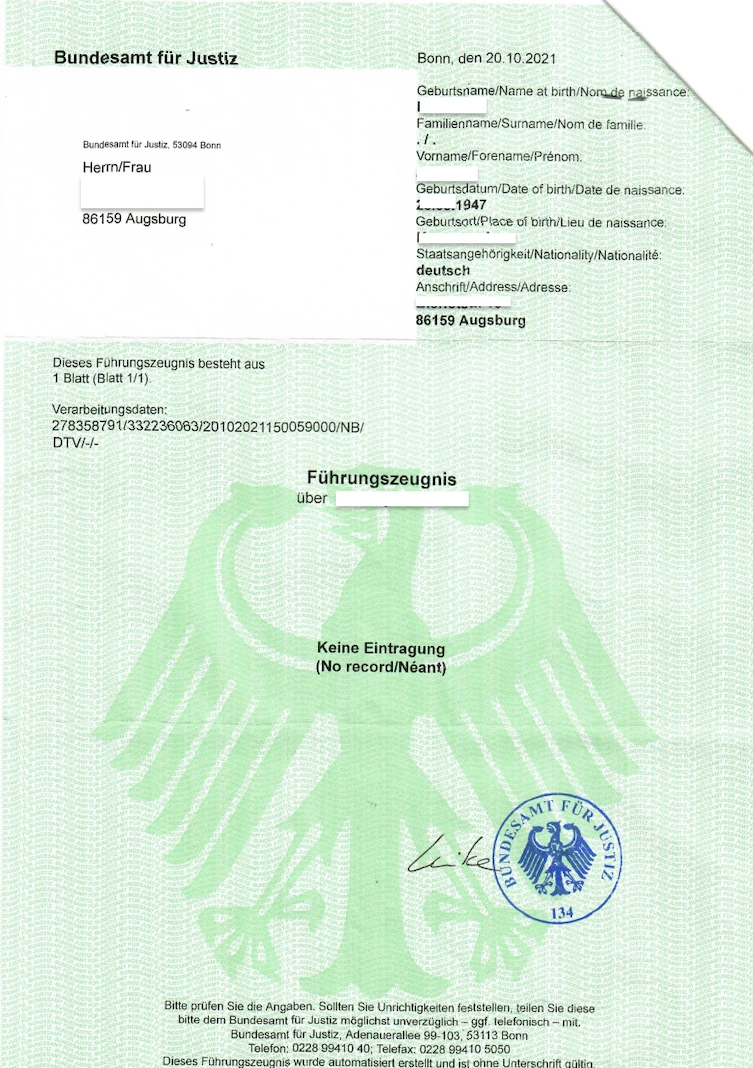
In Germany, a criminal record certificate is called a “certificate of conduct” (Führungszeugnis). It is also commonly referred to as a “police certificate of conduct” (polizeiliches Führungszeugnis), although it is not issued by the police. The authority responsible for maintaining the criminal records register and issuing certificates is the Federal Office of Justice (Bundesamt für Justiz, BfJ) in Bonn. Information on criminal convictions is stored in the Federal Central Criminal Register (Bundeszentralregister).
The issuance of criminal record certificates in Germany is governed by the Federal Central Criminal Register Act (Bundeszentralregistergesetz) and other applicable legislation.
The system for issuing criminal record certificates in Germany is considerably more complex than in most other countries. The application process cannot be completed entirely under a notarised power of attorney, and the documents required for an application can be relatively complicated to prepare.
A criminal record certificate is a paper document prepared on the basis of information held in the Federal Central Criminal Register. The document is issued in German.
Germany issues several types of criminal record certificates:
- Criminal record certificate for private purposes;
- Criminal record certificate for a public authority (sent directly by the Federal Office of Justice to the relevant institution);
- Extended criminal record certificate for personal purposes (required for individuals planning to work with children or persons with disabilities);
- Extended criminal record certificate for a public authority;
- European criminal record certificate (issued to citizens of other EU Member States);
- Criminal record certificate for volunteers (issued under a simplified procedure).
The certificate contains the individual's surname (including surname at birth), first name, date and place of birth, nationality, and information about criminal convictions.
For apostille certification and subsequent use abroad, a paper criminal record certificate for private purposes is generally used.
Cost of a Criminal Record Certificate in Germany
The official fee charged by the Federal Office of Justice for a criminal record certificate is €13.00 per document. Payment is generally made in advance by bank transfer, and proof of payment is enclosed with the application.
Additional charges apply for apostille certification, translation, and delivery. The Federal Office for Foreign Affairs charges a government fee for issuing an apostille; the exact amount should be confirmed at the time of application. Schmidt & Schmidt's service fees are calculated individually, depending on the services required and the destination country.
Processing time for a Criminal Record Certificate in Germany
Germany has a relatively long processing time for criminal record certificates. When an application is submitted from abroad, the Federal Office of Justice generally processes the certificate within approximately 3–6 weeks of receiving the application. Processing times are usually shorter for applications submitted within Germany. Additional time is required for apostille certification, translation, and delivery.
The total end-to-end processing time may extend to several months, depending on the city, the specifics of the request, whether legalisation is required, and the delivery address.
How to obtain a Criminal Record Certificate in Germany
There are several ways to obtain a criminal record certificate in Germany:
- Submit an application in person at the local citizens' registration office (Bürgeramt) in the municipality where you reside;
- Submit an application in person to the Federal Office of Justice;
- Submit an application by post;
- Submit an application electronically.
The application procedure differs depending on whether the applicant is residing in Germany or abroad.
German Criminal Record Certificate in person
To apply in person, you should visit the citizens' registration office responsible for your registered address or place of residence. The staff will accept your application on the prescribed form and forward it to the Federal Office of Justice. The certificate is then sent back to the registration office and issued to the applicant.
An alternative option is to obtain the prescribed application form from your local citizens' registration office, complete it there, and then submit it in person to the Federal Office of Justice through its visitor service. This route is faster but requires travelling to Bonn. In addition to the original application, you must bring an identity document bearing a photograph. If the application was submitted through the online service, the certificate cannot be collected in person from the Federal Office of Justice.
An application for a criminal record certificate may be submitted in person from the age of 14.
Criminal Record Certificate in Germany by post
This method is available to both residents of Germany and applicants living abroad. One important requirement is that, when submitting a written application, the applicant's signature must be officially certified either by an authorised authority (such as a consulate) or by a notary.
The certificate is generally sent to the applicant's registered address. However, certain exceptions apply. If the applicant is temporarily residing at another address or is moving, they may specify an alternative delivery address, but the applicant must remain the named recipient. If the applicant's signature is certified by a German consulate abroad, the delivery address must be in the relevant country.
Criminal Record Certificate online in Germany
To obtain a criminal record certificate electronically, you must have an electronic identity card or an electronic residence permit with the online identification function activated. If you have the appropriate digital identification document, you can submit an application through the Federal Office of Justice's online portal.
To apply online, you will need an NFC-enabled smartphone and the appropriate software, such as AusweisApp, the free application provided by the German federal government.
If your identity card was issued after July 2017, the online identification function is activated automatically. You can check its status using the “Check device and identity card” function in the AusweisApp or by contacting your local citizens' registration office.
Certificate under a power of attorney
One specific feature of German law is that a criminal record certificate cannot be obtained on behalf of another person under a power of attorney. This option is not available even to lawyers. The application must be signed personally by the individual whose records are being requested, and the certificate may be delivered either to that individual or directly to an authorised public authority. The only exceptions apply to legal representatives of minors under the age of 18 and persons lacking legal capacity. In such cases, the applicant's representative status must be documented.
The applicant may arrange for the certificate to be delivered to the address of a trusted person or to the office of an agent who will subsequently handle the legalisation and delivery of the document. However, the applicant themselves must be named as the recipient.
Obtaining a Criminal Record Certificate Through a Consulate
German consulates abroad do not issue criminal record certificates themselves. Instead, they act as authorities responsible for certifying signatures and forwarding documents. It should be noted that German consulates are not authorised to certify the signatures of citizens of certain foreign countries, including Russia.
When applying for a criminal record certificate, it is essential to check all personal details carefully, as any error or typographical mistake may render the document invalid.
Apostille for a German Criminal Record Certificate
Germany acceded to the Hague Convention Abolishing the Requirement of Legalisation for Foreign Public Documents on 15 December 1965. The Convention entered into force on 13 February 1966.
An apostille is an internationally standardised form of authentication used to certify a document for presentation in countries that recognise this form of legalisation. It usually takes the form of a special stamp or certificate. In recent years, electronic apostilles (e-Apostilles) have also become more widespread. An e-Apostille is a digital certification confirming the authenticity of documents issued in electronic form. Germany, however, uses paper apostilles in its current practice.
Apostilles for German criminal record certificates are issued by the Federal Office for Foreign Affairs (Bundesamt für Auswärtige Angelegenheiten, BfAA). The responsible department within the BfAA is the Apostille and Claims Management Division (Referat Apostillen und Forderungsmanagement), located in Brandenburg an der Havel.
New procedure effective December 2024: If an apostille is required, an application must first be submitted online to the BfAA. After payment of the fee, the BfAA issues an application reference number. The applicant must then request the criminal record certificate from the Federal Office of Justice, providing this reference number. The BfJ issues the certificate and forwards it to the BfAA for apostille certification. The BfAA then sends the completed document to the specified delivery address.
What is an apostille?
What is an apostille? Why do I need an apostille? How do I get an apostille? - Our video will explain everything you need to know about the apostille. If you have a document that needs to be certified with an apostille for use abroad, Schmidt and Schmidt will assist you! We provide apostille services in more than 100 countries worldwide.
Consular legalisation of a German Criminal Record Certificate
If the country in which the German criminal record certificate is intended to be used is not a party to the 1961 Hague Convention, such as the United Arab Emirates (UAE), the document will require the more complex and costly procedure of consular legalisation.
Consular legalisation is a multi-stage procedure for verifying the authenticity of a document intended for use in countries that are not parties to the 1961 Hague Convention.
To complete the consular legalisation of a German criminal record certificate, the following steps must be followed:
- Obtain the criminal record certificate;
- Have the certificate certified by the competent notarial authority;
- Arrange an official translation of the document;
- Have the document legalised by the consulate or consular section of the embassy of the destination country.
Due to the number of steps involved, the procedure is time-consuming and expensive. Some countries do not have consulates in Germany, meaning that the final stage of legalisation may need to be completed in another country where the relevant consulate is located.
What is consular legalization?
In our video we are explaining what consular legalization is and where to apply for it.
Schmidt & Schmidt will assist you in all issues concerning the legalization.
Schmidt & Schmidt offers legalization in more than 80 countries all over the world.
Official translation of a German Criminal Record Certificate
A German criminal record certificate is issued in German. To use it abroad, an official translation must be prepared in accordance with the laws of the country where the document will be submitted. Depending on the destination country's requirements, the translation may need to be completed by a sworn, certified, notarised, or court-appointed translator in the destination country.
Translations of criminal record certificates prepared in Germany are unlikely to be accepted abroad, except in cases where they are produced as part of the consular legalisation procedure.
Useful links: official German resources
- bundesjustizamt.de — Federal Office of Justice (Bundesamt für Justiz): applications for criminal record certificates, including online applications;
- bfaa.diplo.de — Federal Office for Foreign Affairs (Bundesamt für Auswärtige Angelegenheiten): apostilles for criminal record certificates;
- auswaertiges-amt.de — Federal Foreign Office: international document use and consular legalisation;
- hcch.net — up-to-date list of parties to the Hague Convention and designated competent authorities.
Document delivery
After obtaining a criminal record certificate and having it apostilled or legalised, it is often necessary to send the document to another country. In such cases, both the speed and security of delivery are important, particularly when original official documents are involved.
Schmidt & Schmidt arranges international document delivery worldwide. We use reliable logistics solutions and modern tracking systems, allowing shipments to be monitored at every stage of transit and helping ensure timely delivery to the recipient.
Our specialists handle documents carefully and confidentially and assist with issues that may arise during international shipping, including carrier requirements and customs clearance procedures.
We can arrange delivery of completed criminal record certificates, apostilled documents, translations, and other official papers to most countries worldwide, serving both private clients and companies and organisations.
How can we help?
We will be happy to assist you in obtaining a criminal record certificate in Germany, including apostille certification and legalisation for use abroad, as well as translation and delivery anywhere in the world.
You can always contact Schmidt & Schmidt. We have extensive experience in obtaining and legalising a wide range of documents. We provide all the necessary services in this area, including obtaining notarised copies, translation, preparing powers of attorney, legalising documents with government authorities and consulates, and delivering completed documents to most countries worldwide.
You can find more information about the legalisation and apostille procedures on our website.


