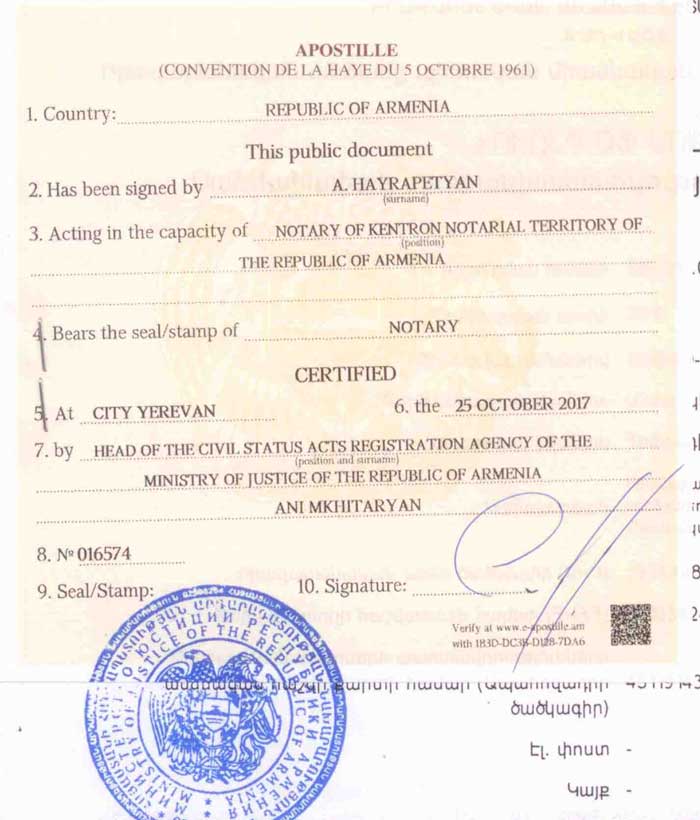
Authorities issuing apostilles:
- Ministry of Foreign Affairs
- Ministry of Justice
Document requirements:
An apostille is applied only to the original document or to a notarized copy if the original cannot be apostilled (e.g., passport, driver’s license). Documents must be in good condition with clearly visible stamps and signatures. There must be no extraneous markings or inscriptions on the documents. Civil registry certificates issued in the USSR are also subject to apostille.Which documents can be apostilled
| Can be apostilled | Cannot be apostilled |
|---|---|
|
|
Exemption from apostille and consular legalization
According to Article 13 of the Convention on Legal Assistance and Legal Relations in Civil, Family, and Criminal Matters (also known as the Minsk Convention), which is in force in the territories of the signatory countries, documents from member states do not require legalization. The member states of the Convention include: Azerbaijan, Armenia, Belarus, Georgia, Kazakhstan, Kyrgyzstan, Moldova, Russia, Tajikistan, Turkmenistan, Uzbekistan, and Ukraine. Armenia has been a member of the Minsk Convention since 1994. For these countries, documents issued in Armenia do not require legalization through apostille. To use documents issued in Armenia in the territories of the above-mentioned countries, a notarized translation is required. Typically, the apostille certification of documents takes between 5 and 14 business days.Сonsular legalization from Armenia
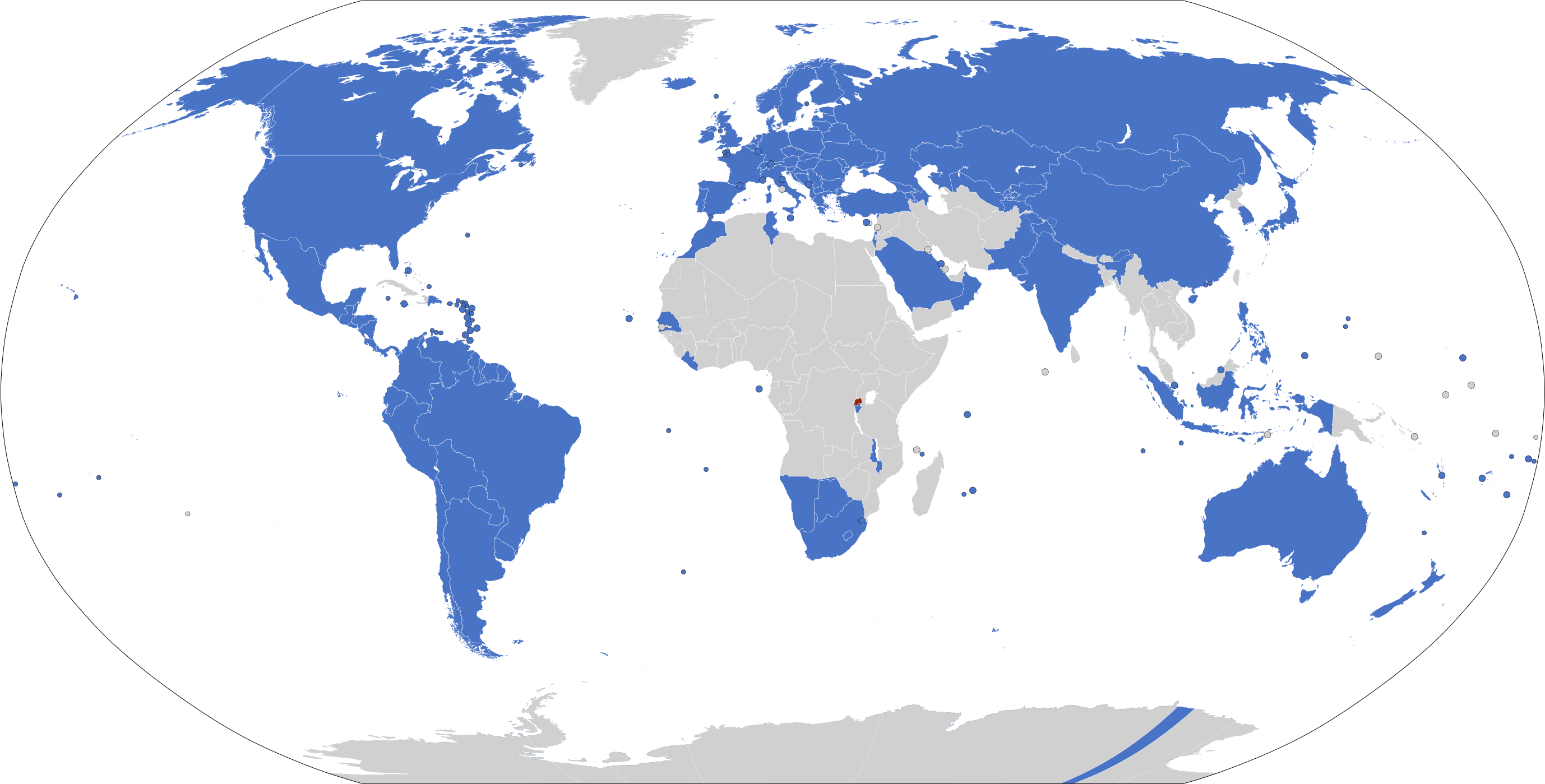
If a document is to be used in a country that does not recognize the Hague Convention, such as the United Arab Emirates or other non-member states, the procedure of consular legalization (also called “embassy attestation”) applies. A complete list of countries that accept and use the Apostille can be found separately. In this case, a notary, on the basis of the original document, issues a notarial deed — a notarized copy of the original together with confirmation of its authenticity. The notarized documents must then be certified by the local Department of Foreign Affairs responsible for the notary’s office. Finally, the document can be legalized at the general consulate of the country where it will be used. Consular legalization is the process of authenticating or certifying a legal document so that the legal system of a foreign country will recognize it as valid. This procedure is carried out by the diplomatic or consular representation of the destination country. Consular legalization is more complex, time-consuming, and expensive than the simpler Apostille procedure. While an Apostille is usually issued in a single step, consular legalization requires several preliminary authentications before the public document can be certified at the embassy or consulate of the destination country in Armenia. As a general requirement, the document must be translated into the official language of the destination country before submission to the embassy. The foreign mission makes the final decision on the legalization procedure.The main differences between an apostille and consular legalization of documents
The common feature between apostille and consular legalization is that they authenticate an official document for presentation to institutions in another country. However, they have many differences.
| Apostille | Consular legalization | |
|---|---|---|
| Validity | Can only be used between countries that are members of the Hague Convention on the Simplified Legalization of Documents. | Use between States one or both of which is not a member of the Hague Convention, or where one of the contracting States has protested the accession of the other |
| Obtaining difficulty | Moderate. To obtain an apostille, contact the competent authority of the country where the document was issued | High. For consular legalization must contact various authorities and consulates of the country where the document was issued. |
| Advance Authentication | Not required | A prior certificate from the issuing authority is required |
| Legalization at the Consulate of the country of destination | No need to contact the Consulate of the country of destination | The final step of legalization takes place in the consulate of the country of destination, usually in the country of issue |
Procurement of documents in Armenia
It often happens that civil status documents are lost, damaged, or there is a need to obtain updated copies. In such cases, it is necessary to procure duplicate documents. This procedure is often challenging for those who have left Armenia. Our service allows you to procure documents in Armenia remotely, and we can arrange courier delivery of the document to any part of the world.Notarized translation of documents from Armenia
Copies and duplicates of civil status documents can be translated into any language either by a sworn translator in Armenia or in the destination country. We provide notarized translation services for civil status documents with subsequent certification. The cost of the service is calculated based on the volume of the specific document.updated: