Summary: The Safety Justification (OB) for Machinery and Pressure Equipment
- Mandatory Approval Document: The Safety Justification (Russian: Obosnovanie bezopasnosti – OB) is a legally required core document for EAC Certification and EAC Declaration under TR CU 010/2011 (Machinery) and TR CU 032/2013 (Pressure Equipment).
- Normative Structure: Content and layout are governed by GOST 33855-2016 and GOST R 54122-2010, which were developed with reference to the European Machinery Directive 2006/42/EC.
- Two Statutory Forms: The standard distinguishes between the abridged (declarative) form and the full form (including all measurement, testing, and calculation reports for complex or regulated facilities).
- Lifecycle Accompaniment & 10-Year Archiving: The Safety Justification is drafted as early as the design and engineering phase, updated following modifications or major repairs, and must be archived for at least 10 years after the EAC approval expires.
- Engineering Compilation: Schmidt & Schmidt develops legally compliant Safety Justifications including integrated Risk Assessments based on your EU design files—executed with full sanctions compliance via Passau and Kazakhstan.
What Is a Safety Justification (OB) and What Is Its Purpose?
A Safety Justification is a technical verification record that systematically consolidates the Risk Assessment as well as all design-related and operational protective measures of a machine, industrial plant, or pressure vessel. It accompanies the equipment across every stage of its operational lifecycle.
Whereas European manufacturers compile an internal risk assessment under EN ISO 12100 for CE marking and retain it within their factory technical file, the legislation of the Eurasian Economic Union (EAEU) requires a standalone, formalized document in Russian that must be actively submitted to the certification body and handed over to the end operator.
The Safety Justification must be continuously updated during operation as well as after repairs or retrofits with the findings of new risk analyses in order to reliably protect operating personnel, the environment, and property against industrial accidents.
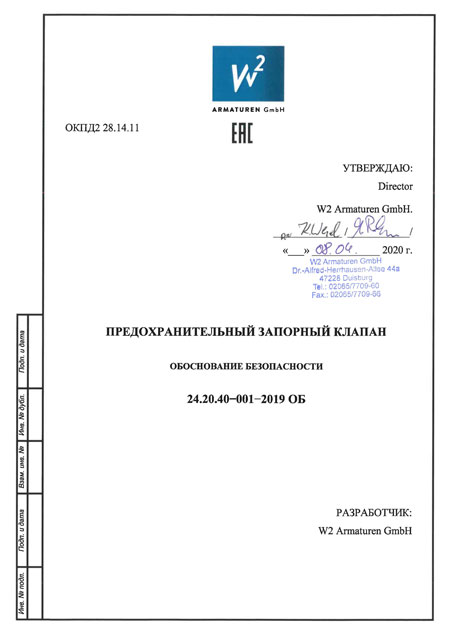
Normative Basis and Forms: Abridged vs. Full Safety Justification
The obligation to compile a Safety Justification stems directly from Technical Regulations TR CU 010/2011 "On Safety of Machinery and Equipment" and TR CU 032/2013 "On Safety of Pressure Equipment".
Its layout and methodology are anchored in GOST 33855-2016 ("Safety Justification – Development Recommendations") and GOST R 54122-2010 ("Safety of Machinery and Equipment. Requirements for Safety Justification"). The latter was developed taking into account EU Machinery Directive 2006/42/EC and its Annex VII.
| Criterion | Abridged Form of Safety Justification | Full Form of Safety Justification |
|---|---|---|
| Nature | Declarative summary of design-based protective measures without attaching extensive test reports. | Comprehensive engineering dossier including all measurement, testing, and calculation records as well as a written safety concept. |
| Application | Serial machinery and standard equipment within regular conformity assessment procedures. | Complex custom installations, high-category pressure equipment, and machinery used in hazardous production facilities (OPO). |
| Scope of Review | Relies on design documentation and the Risk Assessment. | Additionally incorporates strength calculations, NDT results, and verification of all safety systems. |
Drafting, Archiving, and Structural Layout
The Safety Justification is prepared during the project engineering and design phase and may cover multiple structurally related models, types, or product series. The original remains with the manufacturer or engineering office, while copies are provided to the Authorized Representative and the facility operator. Under TR CU 010/2011, the Safety Justification and all supporting records must be archived for at least 10 years following the expiration of the EAC approval.
Structure: Introduction and 11 Mandatory Sections under GOST R 54122-2010
- Section 1: Core parameters and technical specifications of the machine or installation
- Section 2: General safety concept applied in the design of the machine
- Section 3: Reliability and fail-safety requirements of the machine
- Section 4: Qualification and safety requirements for operating and maintenance personnel
- Section 5: Detailed Risk Assessment (hazard analysis and risk reduction)
- Section 6: Safety requirements during installation and commissioning of the machine
- Section 7: Safety management requirements during ongoing operation
- Section 8: Quality management requirements during operation and maintenance
- Section 9: Environmental management requirements during commissioning, operation, and disposal
- Section 10: Requirements for collecting and analyzing safety-related operational data
- Section 11: Safety requirements during decommissioning and disposal of the machine
Required Source Documents for Compilation
- Operation Manual in Russian (drafted to GOST 2.601 / 2.610)
- Existing certificates and conformity records for safety-critical purchased components
- Technical Passport of the machine or installation
- Detailed drawings, circuit diagrams, design calculations, and test reports
- Installation and commissioning plan as well as maintenance and repair instructions
- Personnel qualification criteria, emergency response procedures, and first-aid measures
- Quality management system documentation (e.g., ISO 9001) and disposal procedures for hazardous operating substances
Our Offer & Costs of the Safety Justification
Our export consultants and specialist engineers possess extensive experience compiling technical documentation for all types of conformity assessments, including EAC Certifications, EAC Declarations, State Registrations (SGR), and Fire Safety Certifications. Costs are determined individually based on the complexity and scope of the equipment. We provide transparent consultation and billing in Euros through our headquarters in Passau and our engineering teams in Kazakhstan (Sanctions Compliance) and ensure timely delivery of all original documents.