Summary: The Certification Matrix for Complex Industrial and Large-Scale Projects
- Strategic Planning Instrument for Plant Engineering: When supplying multi-component industrial plants, production lines, or turnkey projects to the Eurasian Economic Union (EAEU), the Certification Matrix defines all required approvals, tests, and companion documents at the component level in advance based on your Bill of Materials (BOM).
- Preventing Customs Blockades & Duplicate Certifications: Through exact mapping of customs tariff numbers (HS codes / TN VED) and Technical Regulations, the matrix prevents both missing mandatory certificates during staggered partial shipments and unnecessary duplicate testing of identical assemblies.
- Comprehensive Coverage of All Approval Types: Alongside EAC Certificates (including Scheme 9C for industrial installations) and EAC Declarations, the matrix also covers State Registrations (SGR), Fire Safety Certificates, Measuring Instrument Approvals, and Exemption Letters.
- Control of All GOST Documentation: For every line item, the matrix bindingly specifies which records (Technical Passport, Pressure Vessel Passport, Safety Justification, Operation Manual, Strength Calculation, Safety Data Sheet) must be compiled.
- Integrated Sanctions & Export Control Screening in Euros: Schmidt & Schmidt screens your BOM list in parallel against EU export control and sanctions regulations (Regulation (EU) No 833/2014 / SECO) and manages the entire execution with full legal certainty via Germany and Kazakhstan.
Why Large-Scale Projects and EPC Contractors Need a Certification Matrix
The legislation of the Eurasian Economic Union (EAEU) (Russia, Belarus, Kazakhstan, Armenia, and Kyrgyzstan) stipulates that mandatory proof of conformity—specifically an EAC Certificate or an EAC Declaration—must be in place prior to importing and commissioning regulated industrial equipment.
While approval requirements for standalone serial products can usually be determined straightforwardly, large-scale projects in mechanical and plant engineering consist of dozens or hundreds of distinct assemblies from numerous sub-suppliers: process apparatuses, control cabinets, pumps, pressure vessels, pipelines, valves, sensors, measuring instruments, spare parts, and operating consumables. When a multi-component industrial plant is shipped in partial consignments over several months, missing even a single certificate halts customs clearance at the border.
The Certification Matrix creates complete planning, budget, and schedule certainty for engineering, procurement, logistics, and customs departments: it maps every delivery item from the Bill of Materials (BOM) and assigns each component its applicable Technical Regulations (TR CU / TR EAEU), optimal conformity assessment schemes, and required technical documentation.
Customs and Approval Strategy: Complete Plant vs. Individual Component Certification
For complex production lines and process installations, the customs delivery structure itself determines the workload and cost of EAC conformity assessment. Within the Certification Matrix, our specialists evaluate both options under EAEU customs rules (including EAEU Board Decision No. 130):
| Strategy | Customs & Technical Starting Position | Implementation in the Certification Matrix |
|---|---|---|
| 1. Complete Plant under a Single Unified HS Code | Supply of a functionally integrated production line based on a customs classification ruling (complete system shipped assembled or disassembled). | Consolidation into one overarching EAC Certificate (frequently under document-based Scheme 9C without sample testing) plus a unified Technical Passport and Safety Justification. |
| 2. Staggered Partial Shipments & Individual Components | Shipment over several months under separate customs tariff numbers (HS codes) or direct drop-shipments by international sub-suppliers, plus spare parts packages. | Component-by-component breakdown by HS code: targeted individual approvals for regulated assemblies, utilization of existing serial certificates, and Exemption Letters for non-regulated parts. |
Structure and Layout of a Professional Certification Matrix
The matrix is compiled as a clear, filterable Excel control tool that guides your project team from the bidding and engineering phases through final customs clearance and commissioning at the end customer's site:
| Module / Column Group | Captured Project, Customs, and Regulatory Data |
|---|---|
| 1. Item & Goods Master Data | BOM item number, technical designation of the component/assembly, model/type, serial number reference, manufacturer/sub-supplier, country of origin, and customs tariff number (HS code / TN VED). |
| 2. Sanctions & Export Control Check | Preliminary screening of HS codes and control lists against EU sanctions regulations (Regulation (EU) No 833/2014), Swiss SECO rules, and dual-use restrictions (Sanctions Compliance). |
| 3. Regulatory Classification | Applicable Technical Regulations (TR CU 010, TR CU 004, TR CU 020, TR CU 012, TR CU 032, TR CU 016, etc.) or classification as exempt from mandatory certification. |
| 4. Required Approvals & Scheme | Type of approval (EAC Certificate, EAC Declaration, SGR, Measuring Instrument Approval, Exemption Letter) and optimal scheme recommendation (e.g., Scheme 9C for plants, 3C/4C for batches/single units). |
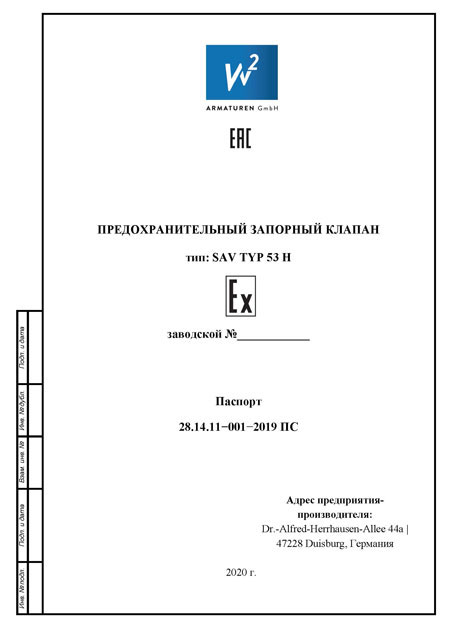
| 5. Mandatory Technical Documents (GOST) | Exact mapping of required technical documentation (Technical Passport, Pressure Vessel Passport, Safety Justification, Operation Manual, Strength Calculation, SDS). |
| 6. Schedule, Costs & Registry Status | Lead times, line-item and total budget, test sample requirements (customs procedure Code 061), accredited testing laboratory, registration numbers, and validity periods. |
Overview of Covered Approvals and Technical Documentation
1. Conformity and Regulatory Certificates
- EAC Certificates under EAEU Technical Regulations (including EAC Ex Certificates under TR CU 012/2011);
- EAC Declarations under EAEU Technical Regulations;
- Certificates of State Registration (SGR) for chemical and water-treatment products;
- Fire Safety Certificates and Declarations;
- Pattern Approval Certificates for Measuring Instruments as well as calibration certificates;
- Exemption Letters (Negative Certificates) for smooth customs clearance of non-regulated spare parts and components.
2. Technical Companion Documents under GOST
- Technical Passport drafted to GOST 2.601-2019 / GOST 2.610-2019;
- Pressure Vessel Passport and Strength Calculation under TR CU 032/2013 and GOST 34347-2017;
- Safety Justification (OB) and Risk Assessment under TR CU 010/2011;
- Operation Manual and nameplate specifications in Russian;
- Documentation for operation in hazardous production facilities (OPO);
- Safety Data Sheets (SDS) per GOST 30333 for chemical operating media and auxiliary substances.
Your Added Value with Schmidt & Schmidt: Sanctions-Compliant End-to-End Management for Plant Engineers
Large-scale international plant engineering projects demand a single project partner capable of uniting European engineering standards, Eurasian certification practice, and international export control rules (Regulation (EU) No 833/2014 and Swiss SECO provisions).
Why Leading International Plant Manufacturers and EPC Contractors Trust Schmidt & Schmidt:
- Proactive Sub-Supplier Coordination: We verify your sub-suppliers' existing EAC certificates for registry validity (FGIS), close documentation gaps, and consolidate similar components into cost-effective approval packages.
- Seamless Compilation of All GOST Records: Based on the approved matrix, our engineers draft every required passport, safety justification, strength calculation, and operation manual consistently from a single source.
- 100% Sanctions-Compliant Contracting & Billing in Euros: All contracts and invoices are processed with full legal security in Euros via our headquarters in Passau, working alongside our accredited offices in Kazakhstan (Sanctions Compliance); we act as your independent Authorized Representative and deliver all original certificates on schedule.
In 6 Steps from Bill of Materials (BOM) to Turnkey EAC Overall Approval
We guide your project management, engineering, and logistics teams systematically through every phase of your export project: