We provide extracts from the commercial register of the Principality of Liechtenstein with a certified translation and an apostille.
Although the Principality of Liechtenstein is not a member of the European Union, it has been part of the European Economic Area (EEA) since May 1, 1995, having harmonized its corporate and financial legislation with EU directives. Liechtenstein's corporate and fiduciary framework combines high standards of confidentiality, political stability, and strict compliance with OECD and FATF transparency requirements. As a result, the Principality is one of Europe's leading jurisdictions for international holding companies, establishments, investment funds, and family wealth management structures.
Liechtenstein's attractive tax regime has also made it a prominent jurisdiction for international holding structures and foreign-owned enterprises.
What Is the Commercial Register of Liechtenstein
The Commercial Register of Liechtenstein is a public state information resource designed to ensure legal certainty in commercial transactions by disclosing the private-law relationships of companies with individuals and legal entities.
The Commercial Register of the Principality of Liechtenstein was established in 1866 and has been maintained in electronic form since 2004. Since February 1, 2013, the register has been administered by the Office of Justice of the Principality of Liechtenstein (Amt für Justiz — AJU), which also manages the Land Register (Grundbuch). Today, the Commercial Register of Liechtenstein contains records on more than 30,000 active companies, establishments, and fiduciary structures. Official registry documents are issued exclusively in the state language (German), although the electronic search portal of the Office of Justice operates in both German and English.
An extract from the Commercial Register of Liechtenstein is an official document containing publicly available data on enterprises registered in the Principality, including their registration status, governing bodies, registered address, and share capital. It serves as the primary legal document confirming a legal entity's corporate capacity, its registration under the Liechtenstein Persons and Companies Act (PGR), and the scope of authority of its directors and trustees. It is required to verify corporate details during any formal interaction with government authorities, courts, and banking institutions.
Organizations are identified in the register by their registered business name and their unified state registration number — the FL-Number (format: FL-000X.XXX.XXX-X).
Obtaining an officially certified paper extract (Beglaubigter Handelsregisterauszug / Amtlicher Ausdruck) requires submitting a formal request to the Office of Justice of Liechtenstein (Amt für Justiz) in Vaduz. The Principality's registry is fully centralized (unlike Germany, which operates over 600 local registration courts). The document is prepared manually by the registrar's office on official security stationery, signed by a state registrar, affixed with the embossed state seal of the Principality, and dispatched to the applicant.
This process takes 2 to 5 business days and incurs a statutory court fee. A certified paper original is the only document format eligible for subsequent authentication with an Apostille by the Government Chancellery of the Principality of Liechtenstein (Regierungskanzlei).
Liechtenstein law imposes strict requirements on the uniqueness of corporate names: registering companies with identical or misleading names within the Principality is prohibited. Furthermore, every Liechtenstein entity is required to appoint an officially registered local representative (Repräsentant) holding a Liechtenstein trustee or attorney license.
Liechtenstein does not maintain a publicly accessible register of beneficial owners for companies limited by shares (AG), most establishments (Anstalt), private foundations (Stiftung), or trusts. Information on beneficial owners is protected by statutory fiduciary secrecy and stored exclusively at the corporate level — in a private share register (Aktienbuch) or in the restricted Beneficial Ownership Register (VwbP). Disclosure of this confidential information to third parties is permitted only pursuant to a court order or within the scope of criminal proceedings.
Main use cases for a commercial register extract from Liechtenstein:
- Transactions and contracts: verifying signatory authority and the legal standing of a counterparty.
- Banking operations: opening corporate accounts, securing loans, and passing compliance checks (KYC/AML).
- Notarial procedures: executing real estate transactions or corporate charter amendments.
- Tenders and licensing: confirming registration to participate in procurement tenders and obtain regulatory permits.
- Litigation: filing lawsuits and proving the legal capacity of a plaintiff or defendant.
- Investment audit: verifying corporate structure and history (Due Diligence).
- Immigration processes: applying for work visas and residence permits.
Retrieving information from the commercial register involves two stages. The online database of the Office of Justice provides basic electronic details limited to the organization's name, registered address, and registration number. Obtaining full corporate records requires a formal request and is granted only if the applicant demonstrates a legitimate interest.
Once approved by the Office of Justice, the extract can be obtained as an electronic PDF document in German with a certified translation. Upon request, the extract can also be dispatched by post in notarized or apostilled form.
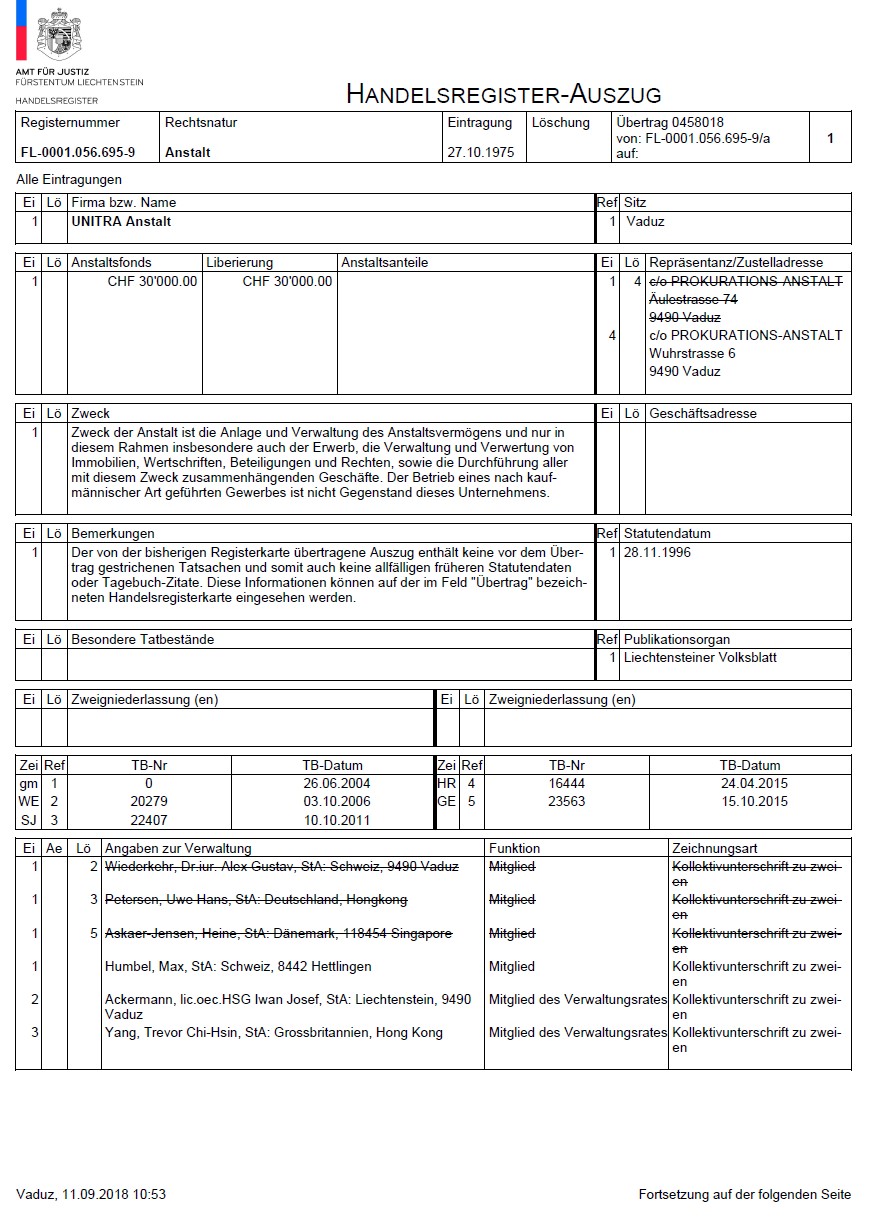
A current extract (Aktueller Handelsregisterauszug) is an official document containing up-to-date information on a company as of the date of issuance, including its name, registered address, incorporation date, directors, and share capital. It serves as the primary document confirming a company's legal status in Liechtenstein (analogous to a Certificate of Incorporation) and can be certified with an apostille.
A current extract from the Commercial Register of Liechtenstein contains:
- company name;
- registration number (FL-Number);
- legal form;
- registered office address;
- date of registration;
- articles of association details;
- audit and inspection records;
- share capital;
- composition of the board of directors and authorized signatories;
- details of statutory auditors;
- copies of constitutional filings;
- financial reporting filing status.
* Certain details may not be publicly available for specific legal entities or may incur an additional statutory fee.
The following documents can also be requested from the Liechtenstein register:
- Historical extract — in addition to current details, provides a chronological record of corporate changes, such as changes of name, registered address, legal form, and appointments or dismissals of directors.
- Company dossier — contains all corporate filings submitted by the company to the register and permitted for public disclosure under Liechtenstein law.
Order processing time: from 30 minutes.

A historical extract (Historischer Handelsregisterauszug) contains all the details of a current extract, along with a complete chronological history of changes made to the company since its incorporation.
A full corporate file (Vollakt) can also be requested from the register.
Order processing time: from 30 minutes.
Searching and obtaining an extract from the Commercial Register of Liechtenstein is possible using the following criteria:
- full company name;
- partial company name and registered address;
- registration number (FL-Number).
Main Legal Forms of Enterprises in Liechtenstein
Corporate Legal Entities (Körperschaften):
- AG (Aktiengesellschaft) — public company limited by shares (joint-stock company). Minimum share capital is CHF/EUR/USD 50,000. Shareholder rights are evidenced by registered or book-entry shares.
- GmbH (Gesellschaft mit beschränkter Haftung) — private limited liability company. Minimum share capital is CHF/EUR/USD 10,000. Information on shareholders is recorded in the public register.
- Anstalt (Establishment) — a private-law establishment, an autonomous legal form unique to Liechtenstein. It has no mandatory membership or shareholders and is governed by the founder (Gründerrechte), whose rights can be transferred by assignment.
- Stiftung — foundation, a dedicated pool of assets established to fulfill a founder's purpose. Divided into public-benefit foundations (Gemeinnützige Stiftung, subject to mandatory open registration) and private family foundations (Familienstiftung / hinterlegte Stiftung, registered by deposit without public access).
- Treuunternehmen (Trust Enterprise) — a business trust with separate legal personality established for investment or commercial purposes (Art. 932a PGR).
- Genossenschaft — cooperative society.
- Verein — non-profit registered association.
- SICAV / SICAF / InvG — investment companies with variable or fixed capital.
Unincorporated Business Forms and Fiduciary Structures:
- Einzelunternehmung — sole proprietorship / individual entrepreneur.
- Kollektivgesellschaft — general partnership with unlimited joint and several liability of partners.
- Kommanditgesellschaft — limited partnership.
- Einfache Gesellschaft — simple civil-law partnership (contractual association without separate legal personality).
- Treuhänderschaft (Trust) — a classic trust (Art. 897–932 PGR). Liechtenstein is the only civil-law jurisdiction in continental Europe to have integrated the Anglo-Saxon trust directly into its national code, governing the fiduciary relationship between the Settlor, Trustee, and Beneficiaries.
Register of Beneficial Owners of Liechtenstein
On August 1, 2019, the Beneficial Ownership Register Act (Gesetz über das Verzeichnis der wirtschaftlichen Eigentümer inländischer Rechtsträger — VwEG) entered into force in Liechtenstein.
Under this legislation, trust providers and relevant legal entities are required to submit beneficial ownership information to the Office of Justice for inclusion in the central register (VwbP, maintained in German).
The register is not open to the general public. Access to the information is restricted to:
- Competent authorities: Financial Market Authority (FMA);
- Financial Intelligence Unit (Stabsstelle FIU);
- Office of the Public Prosecutor (Staatsanwaltschaft) and law enforcement bodies;
- Obliged entities conducting statutory due diligence (including banks);
- Third parties upon formal application demonstrating a legitimate interest.
Records of dissolved entities are retained permanently in the archives of the Office of Justice of Liechtenstein. To confirm liquidation or closure, a chronological or archival extract is requested bearing a notation of liquidation (in Liquidation), cancellation of registration (gelöscht), or compulsory strike-off (Amtslöschung).
Annual Financial Statements of Enterprises in Liechtenstein
Under the Liechtenstein Persons and Companies Act (Personen- und Gesellschaftsrecht — PGR), commercial limited liability companies — public limited companies (AG), private limited liability companies (GmbH), partnerships limited by shares (KGaA), European companies (SE), as well as partnerships whose partners are corporate entities — are required to annually approve and file their annual financial statements (Jahresrechnung) with the Office of Justice of Liechtenstein (Amt für Justiz — AJU), which maintains the Commercial Register. Documents must be submitted electronically no later than 12 months after the balance sheet date (filing is recorded via a notice in the Official Gazette — Amtsblatt).
Financial statements filed with the Office of Justice are accessible to third parties upon completion of statutory formalities and verification of legitimate interest (medium-sized and large companies disclose more extensive financial data, while micro and small enterprises benefit from abridged disclosure rules). Copies of financial statements can be requested using the company's name or registration number (FL-Number).
Public companies whose securities are traded on a regulated market, as well as banks, insurers, and financial institutions, must apply International Financial Reporting Standards (IFRS). Other businesses follow Liechtenstein accounting rules under the PGR or may voluntarily adopt IFRS.
Enterprise Categories, Reporting Scope, and Mandatory Audit
The scope of disclosed financial information depends on company size (meeting at least two of three criteria for two consecutive financial years):
- Micro and small enterprises: micro-enterprises (balance sheet total up to CHF 450,000, net turnover up to CHF 900,000, up to 10 employees) and small enterprises (balance sheet total up to CHF 7.4 million, net turnover up to CHF 14.8 million, up to 50 employees) file only an abridged balance sheet, profit and loss statement, and notes (exempt from preparing a management report);
- Medium-sized and large companies: entities exceeding small company thresholds (medium-sized: balance sheet total up to CHF 25.9 million, net turnover up to CHF 51.8 million, up to 250 employees) submit a full set of financial statements — balance sheet, profit and loss statement, notes, and management report (Jahresbericht);
- Mandatory audit: required for public-interest entities, medium-sized and large companies, as well as small AGs and GmbHs unless they have exercised the statutory audit exemption (opting-out, available to non-public micro and small companies).
Apostille on Extracts from Liechtenstein
Liechtenstein acceded to the Hague Convention Abolishing the Requirement of Legalisation for Foreign Public Documents on July 19, 1972, and the Convention entered into force on September 17, 1972.
Accordingly, official documents issued in Liechtenstein are eligible for simplified legalization via an apostille. Following a certified translation, these documents acquire full legal force in all signatory states.
An apostille is a standardized international certificate verifying the authenticity of the signature, the capacity in which the person signing the document acted, and the seal or stamp on the public document in accordance with the Hague Convention of October 5, 1961.
The standard turnaround time for obtaining an extract with an apostille is 3 to 5 weeks.
All documents from the Liechtenstein Commercial Register are issued in German. For international use, a professional legal translation is required. Translations can be executed by a court-sworn translator in Europe or notarized in the destination country. Schmidt & Schmidt provides comprehensive legal translation services for corporate documentation with subsequent official certification.
Validity Period of an Extract from the Register of Liechtenstein
- Electronic extract: reflects the company's status at the exact time of retrieval. For internal compliance and counterparty checks, it is recommended to use an extract issued within the past 1 to 2 weeks.
- Paper extract with apostille: courts, notaries, and banking institutions typically require that an extract from a foreign commercial register be issued no more than 30 days prior to submission or legalization.
Comparison of Extract Types
| Characteristic | Electronic Extract | Paper Extract with Apostille |
|---|---|---|
| Format | PDF file | Original paper document with Apostille |
| Processing time | From 30 minutes | 3–5 weeks |
| Legal force | Informational certificate | Official public document for government agencies and courts |
| Legalization | Not possible | Affixed (Apostille by Regierungskanzlei) |
| Application | Counterparty checks, contract preparation | Foreign courts, corporate bank account openings, notarial deeds |
| Cost | from 20 € | from 250 € |
Document Delivery
Once a register extract is issued and apostilled, the physical original often needs to be dispatched abroad. In such cases, transit speed and shipment security are paramount.
Schmidt & Schmidt arranges international courier delivery of documents from Liechtenstein worldwide. We use reliable logistics solutions and end-to-end tracking systems, allowing you to monitor your shipment at every stage and ensuring timely delivery to the recipient.
Commercial register extracts are provided in strict compliance with the legislation of the Principality of Liechtenstein and European data protection regulations (GDPR).
Requests are processed within one business day. Courier delivery of an apostilled extract is charged separately according to courier service tariffs.
You can request preliminary information regarding a company's registration in the Commercial Register of Liechtenstein free of charge on our website.
Free Preliminary Check and Price Overview
We offer a free, no-obligation preliminary check to verify whether the target company is registered in the Commercial Register of Liechtenstein and which documents are available to order:
- Verification of the company's record and its current status in the Liechtenstein register (Amt für Justiz)
- Availability of public corporate documents, company dossiers, and annual financial statements
- Exact calculation of the total cost and order fulfillment timeframes
- Provision of a sample document (if available)
| Service | Price (excl. VAT) |
|---|---|
| Current extract from the register of Liechtenstein | 20.00 € |
| Historical extract from the register of Liechtenstein | 30.00 € |
| Liechtenstein register extract with apostille (excluding delivery) | from 250.00 € |
| Certified translation of documents from German | from 50.00 € |
All prices are net prices in euros (€), excluding statutory VAT, and apply exclusively to commercial customers and resellers (B2B). For clients based in Germany, statutory German VAT (19%) will be added. For business clients within the EU with a valid VAT ID, the reverse-charge mechanism applies (0% VAT). Services provided to business clients outside the EU are generally not subject to German VAT. International courier delivery costs for paper documents with an apostille are calculated based on actual expenses.