
The system in Japan for foreign-educated individuals seeking admission to educational institutions reflects flexibility in acknowledging diverse educational backgrounds while maintaining standards for academic readiness. The qualifications are divided into curriculum equivalence which determines if the duration of schooling in the foreign country matches the Japanese system (12 years for university, 16 years for graduate school). If this is the case, the individual is recognized as qualified to enter higher-level schools in Japan.
Alternatively, if the individual exceeds this time frame, an admission can still be possible through a screening process.
In this process the following conditions and procedures are measured and required:
University Admission:
- The applicant must be at least 18 years old
- They should demonstrate academic abilities equivalent to those of a Japanese high school graduate
Graduate School Admission:
- The applicant must be at least 22 years old
- They must show academic competencies comparable to a university graduate in Japan
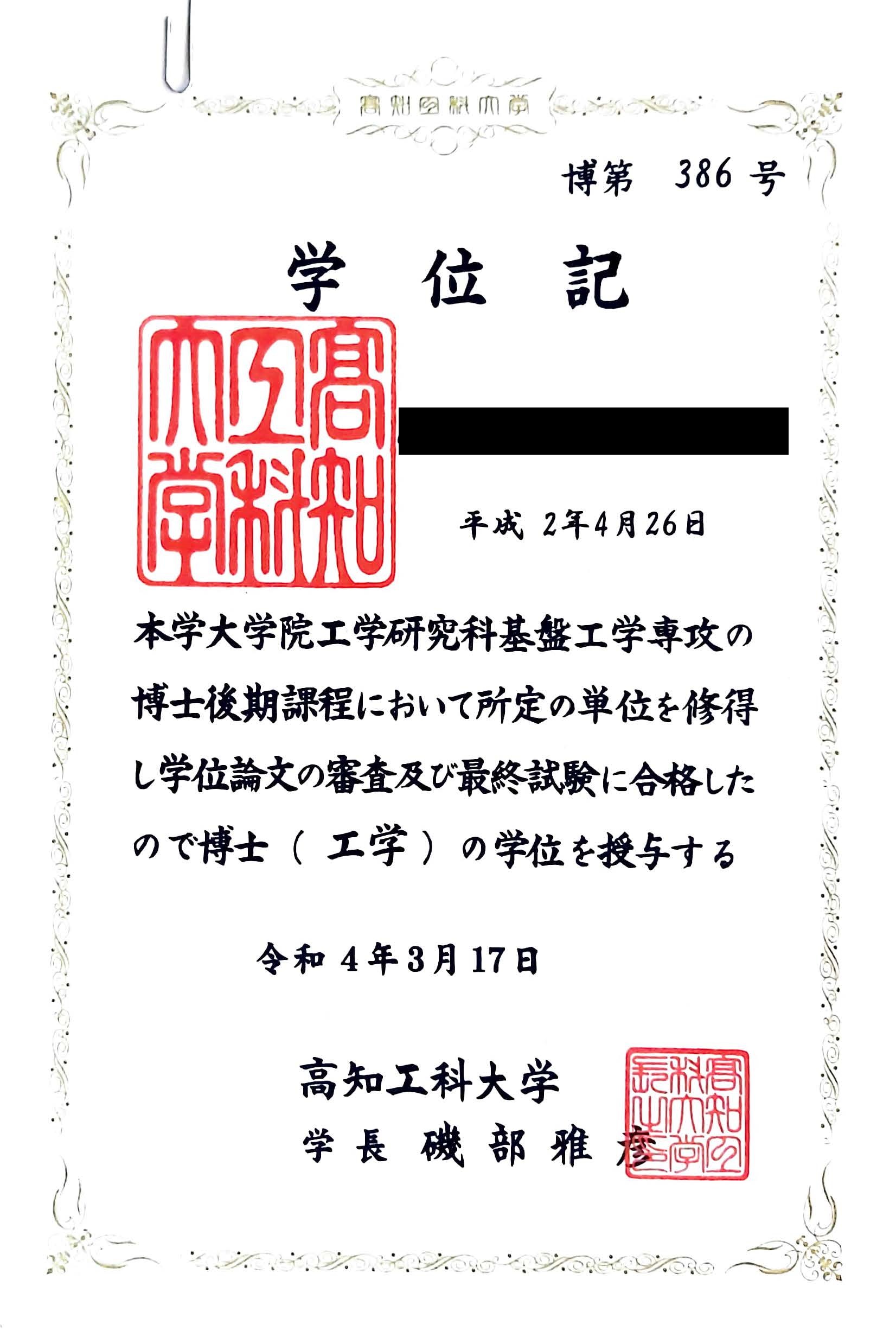
Candidates may also be required to present transcripts and certificates from their previous educational institutions, a curriculum overview to show subjects studied and hours of instruction and a personal statement or portfolio showcasing their academic readiness.
Additionally, they might be required to take an entry exam as well as conducting an interview to evaluate the candidate's motivations, academic goals, and preparedness.
Each institution may have its own set of rules, requirements, and processes for evaluating applicants, so candidates need to research and follow specific guidelines provided by the institution they are applying to.
This screening process is a way to create opportunities for candidates with non-traditional educational paths while ensuring they are academically prepared for higher studies. It emphasizes inclusivity while maintaining Japan's rigorous academic standards.
Global Convention on the Recognition of Qualifications concerning Higher Education
The 2019 Global Convention on the Recognition of Qualifications concerning Higher Education, to which Japan has joined, is a landmark international treaty adopted by UNESCO on November 25, 2019. It is the first legally binding United Nations agreement aimed at improving the recognition of higher education qualifications on a global scale. This Convention marks a significant step toward fostering international mobility, collaboration, and trust in higher education systems worldwide.
The Convention promotes principles of transparency, non-discrimination, and fairness in the recognition of qualifications. It encourages countries to acknowledge the diversity of education systems while fostering mutual trust and understanding.
Member states are encouraged to develop efficient and transparent mechanisms for assessing foreign qualifications, making it easier for individuals to have their degrees, diplomas, or certificates recognized abroad.
The treaty supports academic mobility by ensuring that qualifications obtained in one country can be more easily understood and recognized in another, benefiting students, workers, and professionals seeking opportunities in different parts of the world.
While the Global Convention facilitates academic mobility and trust in qualifications, apostille legalization ensures that the documents supporting those qualifications (such as diplomas or transcripts) are authentic and legally valid for submission abroad.
Why and in what case is an apostille needed?
An apostille is a special stamp that confirms the authenticity of an official document. It can be used to certify documentation issued by government agencies, local government bodies, and structures that the state has granted special powers.
Commercial documents cannot be apostilled . Therefore, if you received a certificate of completion of training courses at a private company that does not have an educational license, you will not be able to certify it with an apostille. Only documents from certified educational institutions that have an official state license can be legalized through the apostille procedure.
An apostille stamp can only be placed on the territory of the country in which the document was issued. It is impossible to do this through diplomatic or consular offices.
Most commercial organizations, when hiring an employee for positions that do not require special access, will not require him to have his diploma legalized by apostille.
What is an apostille? - explained
The procedure for affixing an apostille to diplomas in Japan
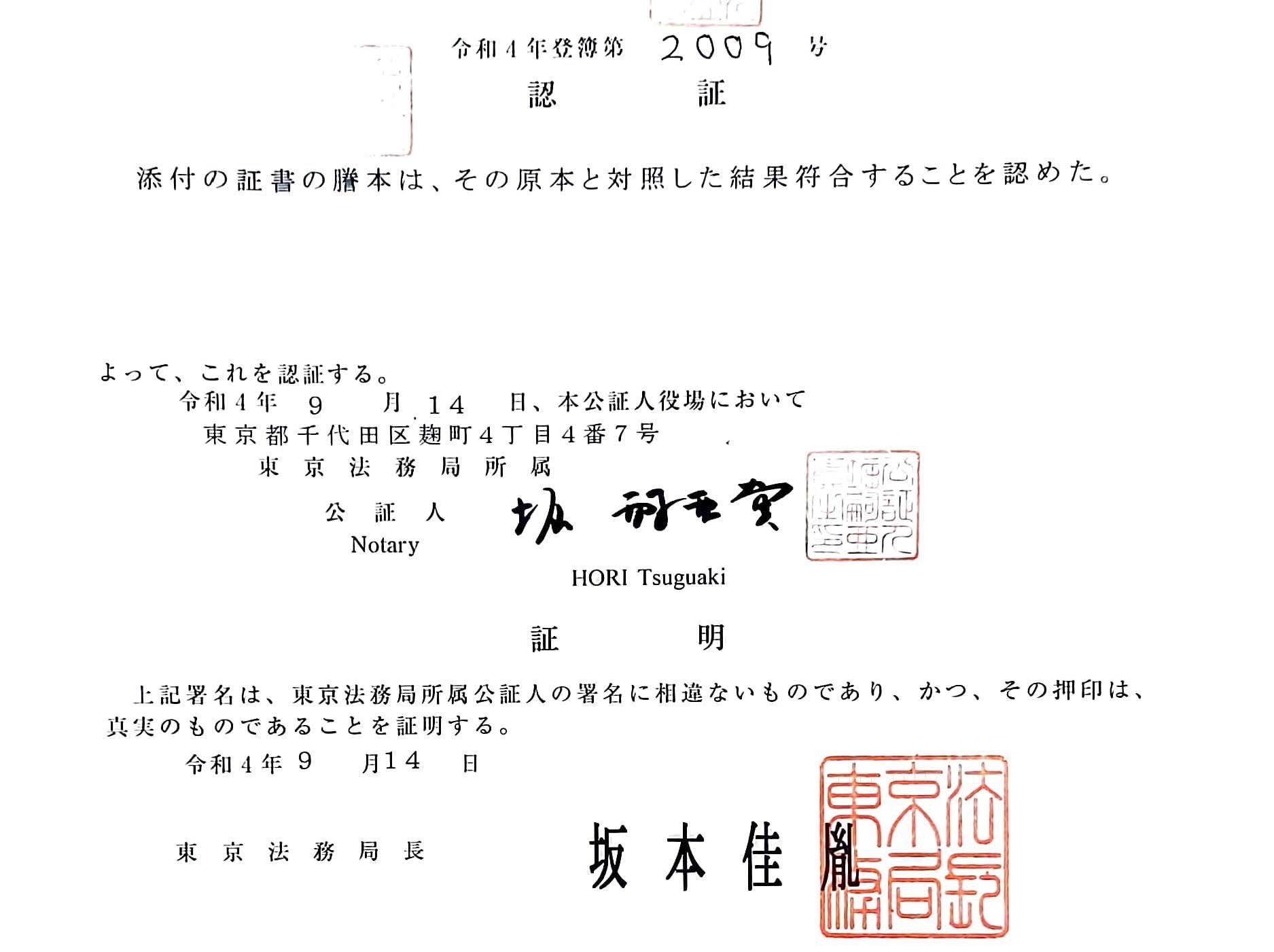
The procedure for certifying documents with an apostille in Japan is quite simple and consists of only two stages: making a notarized copy of the diploma and affixing an apostille at the Ministry of Foreign Affairs.
The first step is to obtain a notarized copy from a Japanese notary.
The notary confirms the authenticity of the diploma only upon presentation of the original diploma. When making a notarized copy, information about the notary is written on the back of the diploma, his seal and signature are put, and the date of certification is also indicated.
After the document is certified, it must be submitted to Tokyo, to the Japanese Ministry of Foreign Affairs.
The second stage is obtaining an apostille from the Japanese Ministry of Foreign Affairs.
An apostille can only be affixed in Tokyo, at the Ministry of Foreign Affairs.
Usually, affixing an apostille at the Japanese Ministry of Foreign Affairs takes 1-5 business days. However, the timeframes may change due to the workload of the government agency.
Consular legalization of educational documents in Japan
If your diploma is to be used in a country that is not a member of the Hague Convention, such as China, the UAE or Egypt, then such a document is subject to consular legalization. This is a more complicated procedure than apostille. The procedure for consular legalization of diplomas in Japan takes place in several stages:
- Making a notarized copy of a document
- Certification by the state-run Japan Academy of Law (JAL). This usually takes 2-3 weeks
- Certification at the embassy of the destination country. As a rule, this takes 1-5 working days, depending on the embassy's work schedule and its workload
The first stage takes place at the prefectural level. The last two stages must be certified at the Law Academy and the consulate of the destination country, both located in Tokyo.
What is consular legalisation? - explained
What's next?
When you have received a diploma with legalization, as well as a copy of it with a notarized translation attached to it, the documents can be considered officially suitable for use in the country of destination given the apostille convention is recognized there. With such a package of documents, you can apply to universities for enrollment in a master's program or postgraduate study for the purpose of recognition of qualifications.
You can always contact Schmidt & Schmidt, we have accumulated vast experience in legalizing a wide variety of documents and we provide all the necessary services in this area, including making notarized copies, translation, preparing the necessary powers of attorney, legalizing documents in government agencies and consulates of foreign countries, as well as delivering finished documents to most countries in the world.