
Schmidt & Schmidt provides extracts from the commercial register of the Cayman Islands with a translation and an apostille.
The Cayman Islands is a British Overseas Territory in the Caribbean Sea. The form of government is a constitutional monarchy, and the state system is based on the principles of parliamentary democracy under the Westminster system. The head of state is the British monarch (currently King Charles III), represented by an appointed Governor. The official currency is the Cayman Islands dollar (KYD), pegged to the US dollar (1 KYD = 1.20 USD).
The jurisdiction's economy is driven by financial and related professional services, accounting for over 50% of GDP. The Cayman Islands is a global leader in the registration of investment and hedge funds, as well as one of the largest international banking centers, with over 115,000 active legal entities registered. Tourism is traditionally the second most important sector of the economy.
The Cayman Islands has aligned its legislation with transparency standards: the jurisdiction has been successfully removed from the FATF "grey list" and similar EU AML/CFT blacklists.
The activities of commercial enterprises are governed by the current version of the Companies Act, the Limited Liability Companies Act, the Confidential Information Disclosure Act (CIDA), economic substance regulations (International Tax Co-operation (Economic Substance) Act), and acts of the Cayman Islands Monetary Authority (CIMA).
The most sought-after type of corporate structure for international business and investment is the Cayman Islands Exempted Company. This entity type is exempt from local taxes for up to 20 years (extendable up to 30 years) and is prohibited from conducting operational business within the Islands themselves.

The primary document provided by the Cayman Islands General Registry is a Company Search Report — an informational profile of the company in English.
An extract from the Cayman Islands register contains:
- full company name;
- registration number;
- date of incorporation;
- current status (Active / Dissolved / In Good Standing);
- legal form;
- registered office address;
- name and contact details of the licensed registered agent;
- registration details with the Cayman Islands Monetary Authority (CIMA), if licensed.
* The scope of information may vary depending on the entity type and registration date.
The standard processing time for an electronic request is 1 business day.
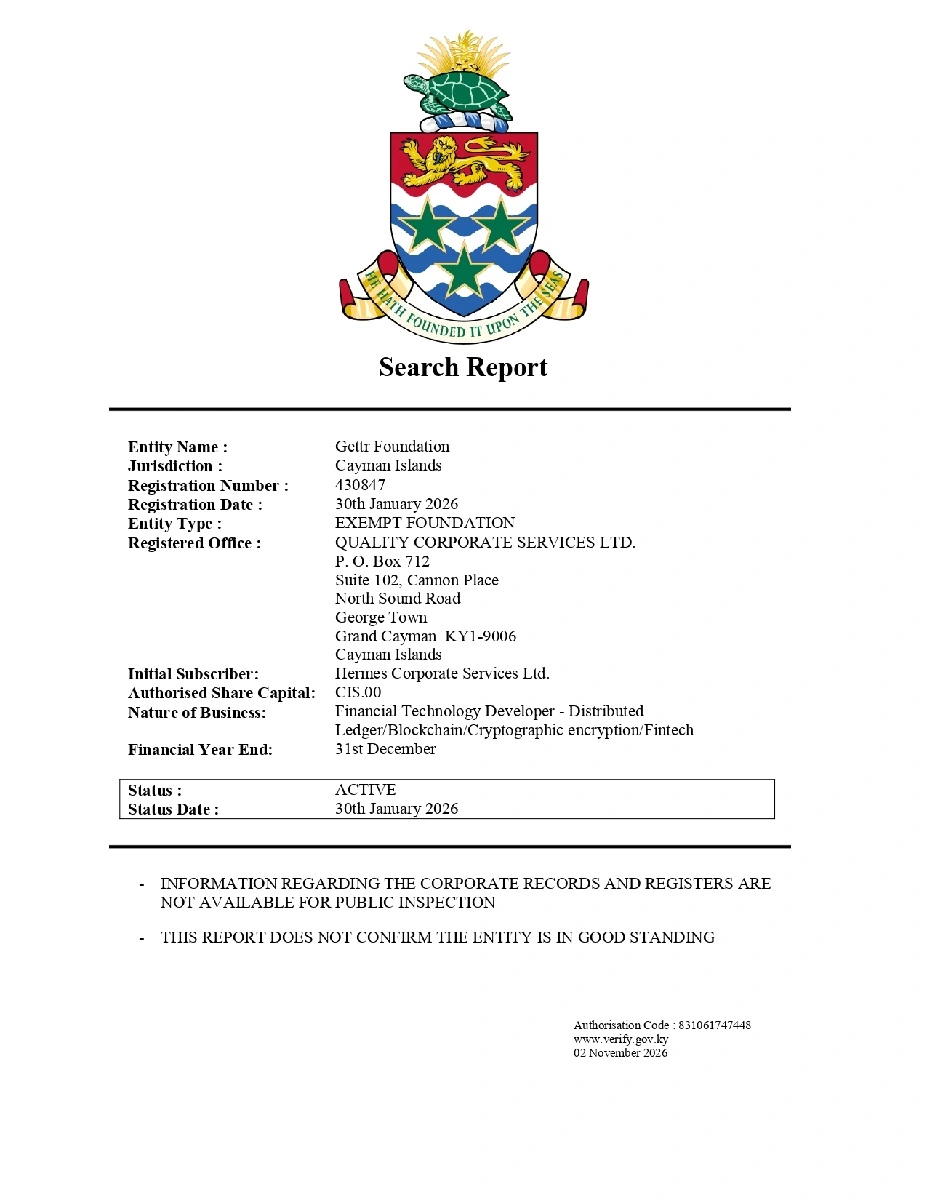
An Extended Extract, unlike the basic version, additionally contains details on the initial subscriber, authorized share capital, and the nature of the company's business.
The standard processing time for an electronic request is 1 business day.
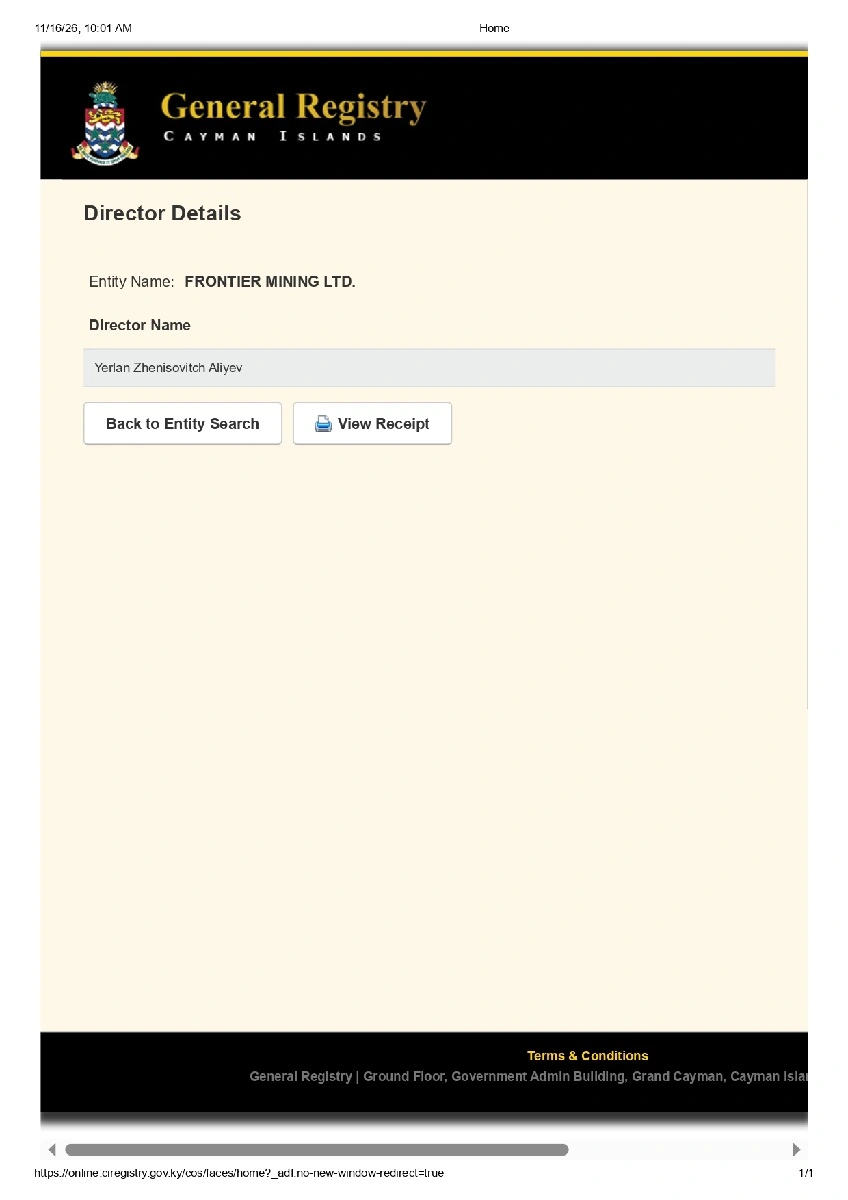
The Current List of Directors displays the name of the current director, without historical records or passport details.
The standard processing time for an electronic request is 1 business day.
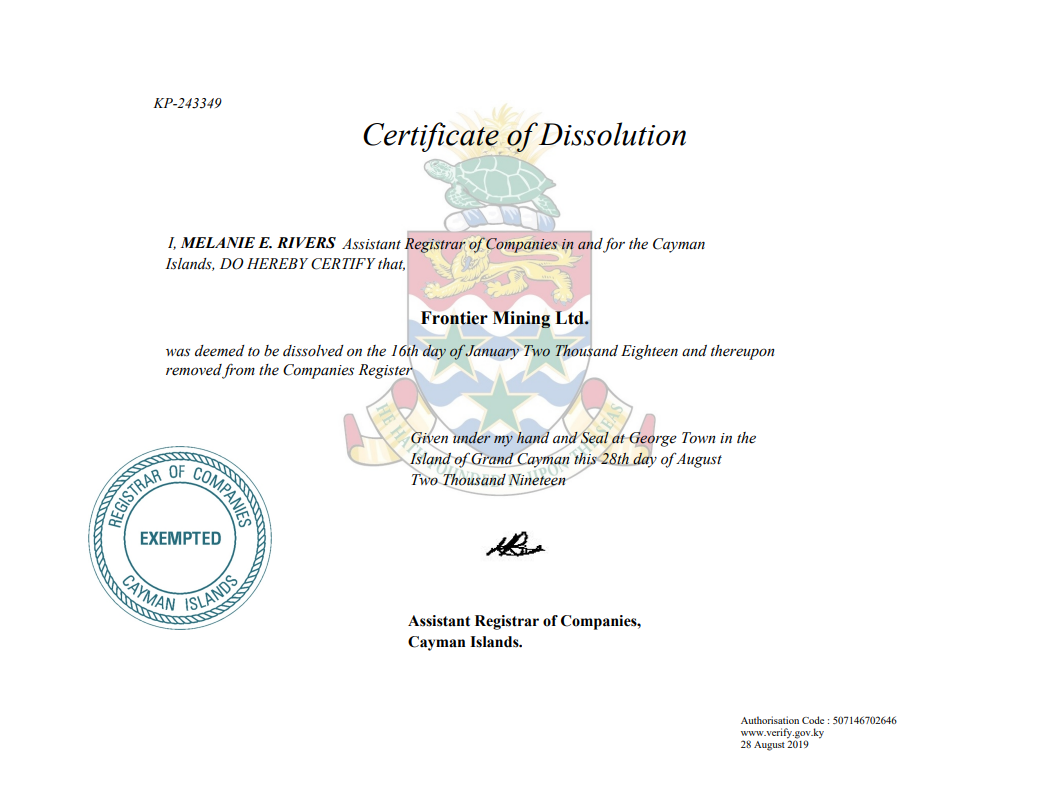
A Certificate of Dissolution is an official document from the Cayman Islands register certifying the termination of a company's existence and the completion of the liquidation procedure.
The Certificate of Dissolution contains:
- company name;
- registration number;
- date of completion of liquidation and striking off the register;
- endorsement of the Registrar of Companies.
Order processing time: from 30 minutes (for an initial check) to 3–5 business days to obtain an archival certificate.
An extract from the Cayman Islands register can be used:
- for compliance checks (KYC/AML) and counterparty due diligence;
- for drafting international trade and investment agreements;
- for opening accounts with banks and payment systems;
- for filing court and arbitration claims;
- for confirming company status and director authority before notaries and registrars.
Cayman Islands Beneficial Ownership Register
Under BOTA rules, a beneficial owner is an individual who directly or indirectly:
- controls more than 25% of the shares or voting rights;
- holds the right to appoint or remove a majority of the directors;
- exercises actual control over the company's decisions.
The register is not publicly accessible. Each company submits compliance documents to its licensed Corporate Services Provider (CSP), which verifies the ownership chain and uploads the data to an encrypted centralized government hub (Competent Authority) isolated from the internet.
Who has lawful access to the information:
- Government agencies and regulators (direct access): information is accessed exclusively by authorized Cayman Islands authorities — the financial regulator (CIMA), the Financial Reporting Authority (FRA), the Department for International Tax Cooperation (DITC), and law enforcement agencies within criminal proceedings.
- Third parties (access upon request): only upon documented proof of a legitimate interest — for example, in connection with official anti-money laundering (AML) or counter-terrorist financing investigations. Standard commercial interest is not recognized as grounds for disclosure.
Documents on Liquidated Companies
Records of struck-off entities are retained in the archives of the Cayman Islands General Registry. To confirm closure, an official register extract (Company Search Report) or a Certificate of Status indicating that the company is officially Dissolved or Struck Off is issued, and upon completion of formal liquidation, a Certificate of Dissolution.
Because the registers of members and beneficial owners in the Cayman Islands are not public, confirming the ownership structure requires a separate legal procedure: requesting internal corporate registers through the company's registered agent, working with the records of the appointed liquidator, or obtaining a court disclosure order.
Main Legal Forms of Enterprises in the Cayman Islands
The legislation of the Islands provides for the following business structures:
- Cayman Islands Exempted Company — the primary entity form for international business, holding companies, and investment funds; exempt from direct taxation.
- Cayman Islands Limited Liability Company (LLC) — a hybrid entity form combining corporate protection with partnership flexibility, analogous to US LLCs.
- Cayman Islands Ordinary Non-Resident Company — a non-resident ordinary company that does not conduct commercial activities within the Islands.
- Cayman Islands Ordinary Resident Company — a resident company established to conduct business directly in the domestic market of the Cayman Islands.
- Cayman Islands Exempted Limited Partnership (ELP) — the global standard model for private equity funds.
- Cayman Islands Foundation Company — a foundation company combining features of a corporate entity and a traditional trust.
- Cayman Islands Foreign Company — a branch or registered office of a foreign company in the Islands.
- Cayman Islands Trusts — trust structures of various types.
Search criteria for companies in the register:
- full company name;
- registration number.
Annual Financial Statements of Companies in the Cayman Islands
Public Disclosure and Mandatory Audit
- Standard companies and holding structures — financial statements are strictly confidential, are not filed with the General Registry, and can only be obtained directly from the company itself;
- Regulated financial institutions and funds (CIMA) (mutual and private funds, banks, insurers, and trust companies) — must undergo an annual audit by a locally approved auditor under IFRS or US GAAP and file audited accounts with CIMA within 6 months after the financial year-end (these filings remain non-public).
Apostille of Documents in the Cayman Islands
The United Kingdom extended the 1961 Hague Convention Abolishing the Requirement of Legalisation for Foreign Public Documents to the Cayman Islands on February 24, 1965 (entered into force on April 25, 1965).
All documents issued by government authorities and the Registrar of the Cayman Islands are subject to legalization via the apostille procedure. Documents bearing an apostille and accompanied by a sworn translation hold full legal force in any member states of the Hague Convention.
Apostille certification of extracts and certificates in the Cayman Islands typically takes 2 to 3 weeks, excluding international courier delivery time.
Certified Translation
Extracts and other corporate documents from the commercial register can be translated into the required language and notarized in the destination country. Schmidt & Schmidt provides professional legal translation services followed by notarization. The final cost is calculated individually based on the volume of the specific document.
Document Delivery
After obtaining an extract and having it apostilled, it is often necessary to send the document to another country. In such cases, not only speed but also delivery security is crucial.
Schmidt & Schmidt arranges international document delivery worldwide. We use reliable logistics solutions and modern tracking systems, allowing us to monitor the shipment at every stage of its journey and guarantee timely delivery to the recipient.
Validity Period of an Extract from the Commercial Register
Cayman Islands legislation does not establish a fixed validity period for an extract from the commercial register (Company Search Report) or a Certificate of Good Standing. An extract records the legal status and company details strictly as of the exact moment (date and time) of its issuance.
The period of legal validity of the document is determined by the requirements of the institution to which it is submitted:
- Banks, financial institutions, and compliance (KYC/AML): typically require a document issued no more than 30–90 days prior (the Cayman Islands Registrar also recommends a maximum age of 30 days when accepting third-party certificates).
- Notaries and courts: in most jurisdictions, the acceptable age of an extract to confirm the legal capacity and authority of the parties is usually 1 to 3 months.
- Apostille: the apostille stamp itself has no expiration date, but if an authority or institution imposes a recency requirement on the underlying document (for example, up to 3 months), an apostilled extract older than that period will not be accepted.
Extracts from the commercial register are provided by us in strict compliance with Cayman Islands legislation and data protection laws.
Requests are processed within one business day. Courier delivery of an apostilled extract is charged separately according to courier service rates.
You can request a free preliminary check of company records in the Cayman Islands commercial register on our website.
Free Preliminary Check and Price Overview
We offer a free, no-obligation preliminary check to verify whether the target company is registered in the Cayman Islands commercial register and which documents are available to order:
- Verification of the company's record and its current status in the Cayman Islands General Registry
- Availability of public corporate documents and information on current directors
- Exact calculation of the total cost and order fulfillment timeframes
- Provision of a sample document (if available)
| Service | Price (excl. VAT) |
|---|---|
| Current Extract from the Cayman Islands Register (Company Search Report) | 60.00 € |
| Extended Extract from the Cayman Islands Register | 120.00 € |
| Current List of Directors | 120.00 € |
| Certificate of Dissolution | 60.00 € |
| Current Extract from the Cayman Islands Register with apostille (excluding delivery) | 800.00 € |
| Extended Extract from the Cayman Islands Register with apostille (excluding delivery) | 800.00 € |
| Current List of Directors with apostille (excluding delivery) | 800.00 € |
| Certificate of Dissolution with apostille (excluding delivery) | 800.00 € |
| Certified translation of documents from English | from 50.00 € |
All prices are net prices in euros (€), excluding statutory VAT, and apply exclusively to commercial customers and resellers (B2B). For clients based in Germany, statutory German VAT (19%) will be added. For business clients within the EU with a valid VAT ID, the reverse-charge mechanism applies (0% VAT). Services provided to business clients outside the EU are generally not subject to German VAT. International courier delivery costs for paper documents with an apostille are calculated based on actual expenses.