Schmidt & Schmidt provides comprehensive Apostille and consular legalization services for official public documents issued across all 10 Canadian provinces and 3 territories, as well as federal government bodies — including Global Affairs Canada, the Royal Canadian Mounted Police (RCMP), Immigration, Refugees and Citizenship Canada (IRCC), and Canadian federal courts.
We assist corporate and private clients across the United States, the United Kingdom, Europe, and worldwide entirely remotely. You work with a dedicated international specialist without needing to travel to Canada or navigate complex provincial versus federal filing jurisdictions on your own.
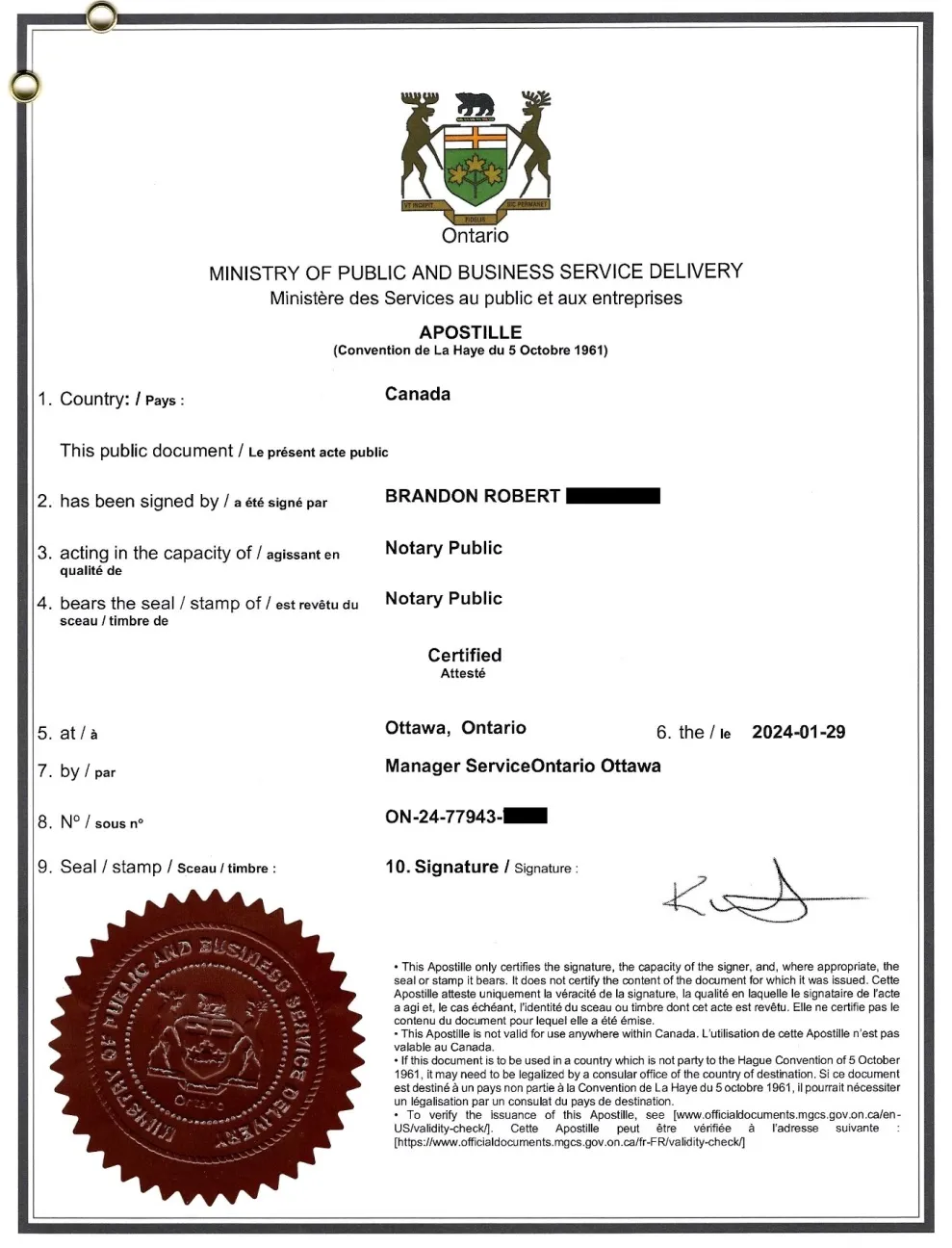
An Apostille (or “Hague Apostille”) is an official certificate that verifies the authenticity of the signature, seal, or stamp on a public document, as well as the capacity in which the signing official acted (e.g., on a birth, marriage, or death certificate, RCMP criminal record check, court judgment, corporate registry extract, or notarized instrument). It does not certify the accuracy of the underlying content of the document itself.
Have a Document from the US, UK, or EU for Use in Canada?
Canadian authorities only issue Apostilles for documents originating in Canada. While Canadian federal law does not impose a blanket authentication requirement on all foreign records, Canadian courts, provincial registries, employers, and licensing bodies frequently require an Apostille. If you need to present a foreign document in Canada (e.g., for IRCC immigration, marriage registration, or professional licensing), the Apostille must be obtained in the issuing country — and since January 11, 2024, legalization by a Canadian embassy or consulate is no longer required.
Learn more about procedures in major jurisdictions on our pages for Apostille in the United States and Apostille in Germany.
If the destination country is not a contracting party to the Hague Apostille Convention (such as Qatar, Kuwait, Vietnam, Egypt, or Taiwan), the document must instead undergo multi-step consular legalization through the competent Canadian authority and the destination country's embassy or consulate in Canada. We handle both procedures end-to-end.
Competent Apostille Authorities in Canada
Canada does not have a single centralized office that processes all Apostille requests. Responsibility is divided between the federal government (Global Affairs Canada) and five provinces that operate their own competent Apostille authorities. Jurisdiction is determined strictly by where the document was issued or notarized — not by the applicant's current place of residence. If a document is submitted to the wrong office, it will be returned unprocessed rather than forwarded internally.
| Issuing Body / Jurisdiction | Competent Apostille Authority in Canada |
|---|---|
| Federal Authorities (RCMP, IRCC, federal courts, federal departments) and documents issued in Manitoba, New Brunswick, Newfoundland and Labrador, Northwest Territories, Nova Scotia, Nunavut, Prince Edward Island, and Yukon | Global Affairs Canada – Authentication Services Section (JLAC), Ottawa |
| Ontario (including Toronto and Ottawa – provincial records & Ontario notaries) | Ministry of Public and Business Service Delivery – Official Documents Services (ODS), Toronto |
| British Columbia (including Vancouver and Victoria – provincial records & documents notarized in BC) | Ministry of the Attorney General – BC Authentication Program, Victoria |
| Alberta (including Calgary and Edmonton – provincial records & Alberta notaries) | Ministry of Justice – Official Documents and Appointments, Edmonton |
| Quebec (including Montréal and Quebec City – provincial records & documents notarized in Quebec) | Ministère de la Justice du Québec – Délivrance des apostilles, Montréal / Quebec City |
| Saskatchewan (provincial records & Saskatchewan notaries) | Ministry of Justice and Attorney General – Authentication Services, Regina |
Which Canadian Documents Can Be Apostilled?
Civil Status and Personal Documents (for immigration, citizenship by descent, marriage abroad, or residency permits)
- Birth, marriage, death, and divorce certificates (Long-Form / Certified True Copies), Certificates of Non-Impediment, and Single Status Declarations;
- Federal fingerprint-based criminal record checks issued by the RCMP (Certified Criminal Record Check);
- Adoption decrees, custody orders, and court judgments;
- Notarized powers of attorney, wills, probate grants, and statutory declarations (Affidavits);
- Notarized true copies of Canadian passports and driver's licenses.
Academic and Educational Credentials (for foreign credential evaluation, university admissions, or professional licensing)
- High school diplomas and academic transcripts;
- University and college degrees (Bachelor's, Master's, Ph.D.) and Official Transcripts of Records;
- Enrollment verifications and course descriptions from recognized Canadian institutions.
Corporate and Commercial Documents
- Canadian corporate registry extracts, Certificates of Incorporation, and Certificates of Good Standing / Compliance (Corporations Canada and provincial corporate registries);
- Articles of Incorporation, Bylaws, and shareholder or board resolutions;
- Land registry extracts and property title deeds;
- Notarized corporate powers of attorney, bank reference letters, and certificates of origin.
Documents That Cannot Be Apostilled in Canada
- Religious Records: Baptismal certificates, church marriage records, or documents issued by religious organizations (foreign authorities require government-issued provincial vital statistics certificates);
- Uncertified Photocopies and Plain Online Printouts lacking an original wet signature, embossed seal, or verifiable official signature;
- Foreign Documents: Canadian authorities only authenticate or apostille documents issued within Canada;
- Laminated, Glued, or Damaged Documents (including older wallet-sized plastic birth certificate cards, which are rejected by both Canadian Apostille offices and foreign civil registries);
- Commercial Customs Documents such as commercial invoices, bills of lading, or packing lists without prior notarization.
- Documents Not Written in English or French: Canadian Apostille offices only authenticate documents drafted in English or French. If a private document is written in another language, a certified translation into English or French must be attached prior to notarization and Apostille submission.
Special Requirements for RCMP Checks, Birth Certificates & Diplomas
1. RCMP Criminal Record Checks (Certified Criminal Record Check)
For foreign work visas, residency applications, citizenship, or international adoptions, receiving authorities require a federal fingerprint-based police certificate issued by the Royal Canadian Mounted Police (RCMP) in Ottawa (Certified Criminal Record Check). Because the RCMP is a federal agency, the Apostille is issued exclusively by Global Affairs Canada in Ottawa — never by a provincial office. Name-based local police checks are generally not sufficient for international legal use.
2. Vital Statistics Certificates: “Long-Form” vs. “Wallet-Size”
Most Canadian provinces issue two formats of birth and marriage certificates: a short-form extract (Wallet-Size / Short-Form Certificate) and a full-length certified extract (Long-Form / Certified Copy of Registration) listing full parental details and registry entries. Foreign civil registries, embassies, and immigration authorities almost exclusively require the Long-Form certificate. If you only hold a short-form card, we can retrieve a fresh Long-Form certificate from the relevant provincial Vital Statistics office prior to apostilling.
3. Canadian Academic Credentials (Diplomas & Official Transcripts)
Because Canadian universities and colleges are autonomous institutions, original degrees often do not bear a government official's signature on file with the Apostille office. Depending on the province and institution, the diploma or sealed Official Transcript must first be verified by the institution's Registrar and/or notarized by a Canadian Notary Public before being submitted to the competent provincial Apostille authority (such as Ontario, British Columbia, Quebec, or Alberta) or Global Affairs Canada. For Hague Convention countries, subsequent embassy legalization is no longer required.
4. Electronic Apostilles (e-Apostille) in Canada
Following Canada's accession to the Hague Convention in 2024, Canadian federal and provincial authorities generally issue Apostilles in physical paper format (an official stamp or securely attached certificate). Moreover, civil registries, courts, and banks in many destination countries still require a physical paper original bearing a wet signature and official seal.
Consular Legalization of Canadian Documents for Non-Hague Countries
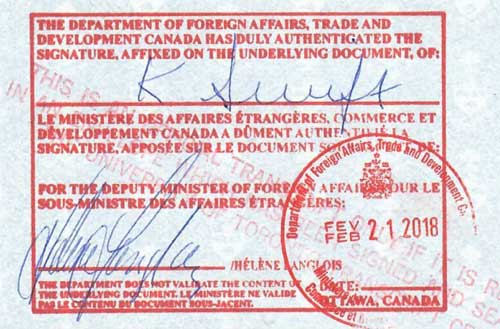
If a Canadian document is intended for use in a country that is not a party to the Hague Apostille Convention (for example, Qatar, Kuwait, Vietnam, Egypt, Thailand, or Taiwan), an Apostille is not valid. Instead, the document must complete full consular legalization. You can check the current list of contracting states on the HCCH Competent Authorities list.
Consular legalization is the multi-stage authentication procedure whereby a document's authenticity is certified sequentially by the competent provincial authority, Canada's federal foreign ministry (Global Affairs Canada), and finally the embassy or consulate of the destination country in Canada.
Standard Consular Legalization Chain in Canada:
- Notarization of the document by a Canadian Notary Public (where an original government certificate is not already eligible);
- Authentication by the competent provincial authority and/or Global Affairs Canada in Ottawa;
- Certified translation into the official language of the destination country (if required by the receiving diplomatic mission);
- Final consular legalization stamp by the destination country's embassy or consulate in Ottawa, Toronto, Montréal, or Vancouver.
Key Differences Between an Apostille and Consular Legalization
| Criterion | Apostille (Hague Convention) | Consular Legalization |
|---|---|---|
| Scope of Validity | Valid across all contracting states of the 1961 Hague Convention (including Canada, USA, UK, EU states, Australia). | Required for countries outside the Hague Apostille Convention (e.g., Qatar, Kuwait, Vietnam, Egypt). |
| Complexity | Moderate: Single submission to the competent provincial Apostille office or Global Affairs Canada. | High: Multi-step chain involving provincial authorities, Global Affairs Canada, and the destination embassy. |
| Prior Authentication | Not required for eligible government originals; notarization required for private documents. | Mandatory government authentication before submission to the foreign embassy or consulate. |
| Embassy / Consulate Involvement | No embassy or consular visit required. | Mandatory final step at the destination country's diplomatic mission. |
Retrieval of Official Documents from Canada
If your original Canadian document has been lost, damaged, or laminated — or if a foreign authority requires a freshly issued Long-Form birth certificate or current corporate extract — our specialists can retrieve new official duplicates directly from Canadian registries (learn more about document retrieval in Canada) and have them apostilled immediately. No personal travel to Canada is required.
Common Mistakes When Applying for a Canadian Apostille
-
1
Sending Documents to the Wrong Authority (Federal vs. Provincial)
Five provinces (Ontario, BC, Alberta, Quebec, and Saskatchewan) process their own documents, while Global Affairs Canada handles federal records and the remaining provinces/territories. Misdirected applications are not forwarded and are returned unprocessed after weeks of delay.
-
2
Submitting a “Wallet-Size” Birth Certificate Card
Wallet-sized plastic birth cards omit parental information and are routinely rejected by foreign civil registries and immigration authorities. Always obtain the full Long-Form certificate.
-
3
Cross-Provincial Notarization in BC or Quebec
British Columbia and Quebec only apostille notarized documents if the notary is commissioned within that same province. Having a BC document notarized in another province leads to rejection by BC's Apostille office.
-
4
Submitting Religious Baptismal or Marriage Certificates
Church or religious certificates are not public civil records and cannot be apostilled by Canadian government authorities.
-
5
Translating the Document Before Obtaining the Apostille
If a document is translated prior to apostilling, the Apostille stamp itself remains untranslated, causing foreign authorities to reject the translation. Always obtain the Apostille first.
-
6
Following Outdated Pre-2024 Embassy Legalization Guides
For documents used in Hague Convention countries, embassy legalization is no longer required as of January 11, 2024 — a single Apostille from the competent Canadian authority is sufficient.
-
7
Ordering Time-Sensitive Documents Too Early
While a Hague Apostille itself never expires, receiving authorities abroad typically require police checks (such as RCMP records) or corporate certificates of good standing to be issued within the last 3 to 6 months. Always order time-sensitive records last so that the validity window starts as late as possible.
Certified Translation of Canadian Documents
Canadian public documents are issued in English or — particularly in Quebec — in French. When submitting Canadian documents to authorities, courts, universities, or civil registries in non-English/French-speaking countries (such as Germany, Spain, Italy, or Russia), a certified translation into the local official language is required.
We prepare certified translations through sworn/certified translators only after the Apostille has been affixed, ensuring that both the underlying document and the Apostille certificate are translated in full. Translations are available in more than 50 languages.
How to Order Your Canadian Apostille Through Schmidt & Schmidt
- Free Preliminary Check: Send us a clear scan of your Canadian document along with the destination country and intended purpose.
- Binding Fixed-Price Quote: We verify the competent provincial or federal authority, check whether prior notarization or retrieval is required, and send you a transparent quote with estimated turnaround times.
- Processing & Courier Delivery: Once confirmed, we handle submission in Canada, optional certified translation, and insured international courier delivery directly to your address.
Need corporate verification on a Canadian company? We also provide Canadian commercial registry extracts complete with Apostille and certified translation.
Official Sources
- HCCH: Full Text of the Hague Apostille Convention of October 5, 1961
- HCCH: Status Table of Contracting Parties (including Canada since January 11, 2024)
- HCCH: Competent Apostille Authorities in Canada
- Global Affairs Canada: Authentication of Documents & Apostille Guidelines
Information verified in November 2026. Final acceptance requirements remain subject to the rules of the receiving authority in the destination country.