
Schmidt & Schmidt provides up-to-date commercial register extracts from Spain. Upon request, the commercial register extract from Spain can be apostilled and translated.
When Are Commercial Register Extracts Required?
An extract from the commercial register is the primary official document confirming the legal status and managerial authority of a Spanish company. It is essential for verifying corporate legal details during any formal interaction with public authorities, courts, and financial institutions.
Main use cases:
- Transactions and contracts: verifying signatory authority and the legal standing of a counterparty (Due Diligence).
- Banking operations: opening corporate accounts, securing loans, and passing compliance checks (KYC/AML).
- Notarial procedures: executing real estate transactions or corporate charter amendments.
- Tenders and licensing: confirming registration to participate in public procurement and obtain permits.
- Litigation: filing lawsuits and proving the legal capacity of a plaintiff or defendant.
- Investment audits: verifying ownership and shareholding history.
- Immigration processes: applying for work visas and residence permits.
What Is the Spanish Commercial Register?
The commercial register — Registros Mercantiles — in Spain has a long history. Its predecessors include a ship and flag registry — the Ordenanzas de Bilbao (1737), the Commercial Code Código de Comercio of 1885, the formal establishment of the Commercial Register in 1885, and subsequent regulations from 1919 and December 14, 1956, as amended by the decree of July 21, 1973. Today, the register operates on the basis of the Act of 1998.
The Commercial Register is an official public institution established in all provincial capitals. The registry is maintained under the supervision of the Directorate General for Registries and Notariats of the Ministry of Justice. The system is decentralized and consists of Territorial Registries (Registros Mercantiles Territoriales) located in each provincial capital, and the Central Commercial Register (Registro Mercantil Central) in Madrid.
Entries are processed by authorized registrars following the classification and detailed verification of the data submitted by the enterprise. Registration in the Spanish Commercial Register is a mandatory stage in establishing a business and forms an integral part of the incorporation procedure. Its primary objective is to mitigate risks in commercial transactions — mandatory document verification guarantees a high level of data reliability. The registry contains information on more than 3 million companies. Official registry records are issued in Spanish, though electronic search portals may support an English interface.
Today, the register is maintained electronically, and extracts can be obtained in either digital (PDF) or physical paper format.
An electronic extract from the Spanish Commercial Register (Nota informativa mercantil) is an official informational document issued by registrars containing publicly accessible corporate records.
The Following Entities Must Be Registered in the Commercial Register:
- Sole traders / individual entrepreneurs (Empresario Individual);
- Commercial partnerships and corporations;
- Civil law partnerships and legal entities;
- Credit and insurance institutions;
- Pension funds and investment funds;
- Branch offices and representative offices;
- Foreign companies and their operating branches located in Spain.
Information from the Spanish Commercial Register is provided as an electronic PDF document with certified translation into English or other languages. Where required, documents can be dispatched via courier in certified paper form or with an apostille.
Specifics of Obtaining a Paper Extract
If you require a document for apostillation, a standard electronic Nota informativa mercantil will not suffice. Obtaining an official certificate (Certificación) involves a more formal procedure: an application must be filed with the relevant provincial registry where the company is registered. The certificate is drawn up by the registrar and authenticated with their signature and official seal. This process typically takes 3 to 7 business days and is always subject to statutory fees. This format is mandatory for international document circulation when subsequent authentication of the registrar's signature by the Spanish College of Registrars (Colegio de Registradores) and an apostille are required.
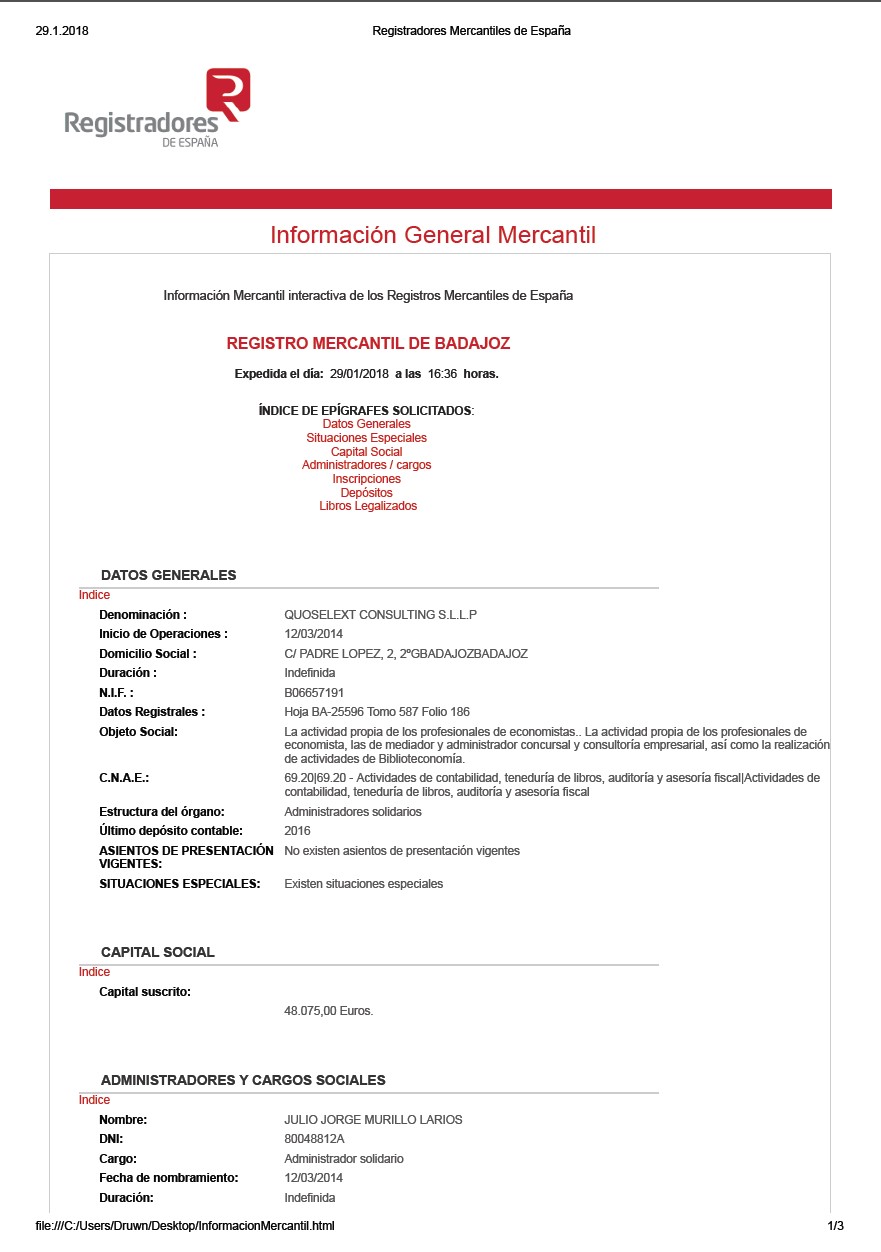
Commercial register extracts from Spain are available in two main formats:
- The electronic extract (Nota informativa mercantil) is available in digital format and serves purely informative purposes. It carries no formal legal weight as an official document.
- The certified extract (Certificación) is a certified copy of a document filed with the registry, signed and sealed by the registrar. It is issued as a physical hard copy upon written application and holds full legal force. This format is mandatory for international document traffic and subsequent apostillation.
A standard extract contains the following information:
- Company name and legal form
- Corporate identification number (NIF/CIF)
- Registered office and contact information
- Business scope (Core activity / corporate purpose)
- Share capital
- Details of management and authorized representatives
- Details of branch offices
- Data from annual financial statements
- Records concerning insolvency, bankruptcy, or liquidation
* Certain information may not be publicly accessible for specific entity types or may require an additional fee.
Inquiries are typically processed from 30 minutes.
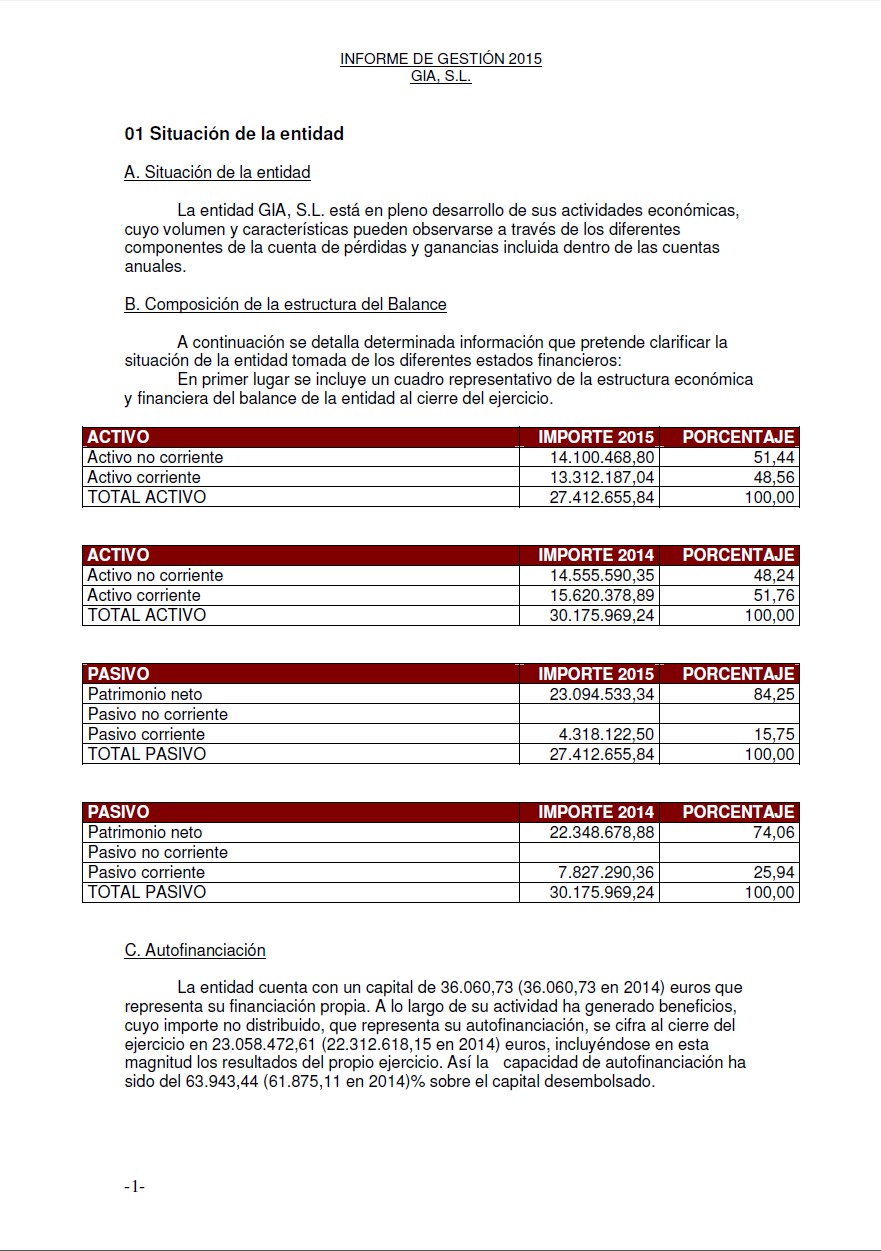
An annual financial statement (Cuentas Anuales) consists of a balance sheet, a profit and loss statement, an auditor's report, and a management report. Based on this information, it is possible to gain a comprehensive overview of the financial standing and economic situation of a company. The document is provided in Spanish.
Inquiries are typically processed from 30 minutes.
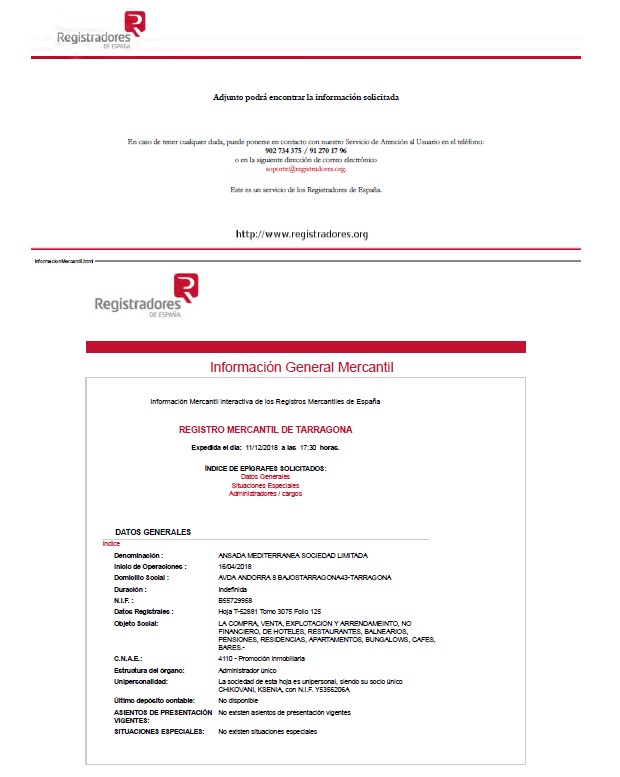
Searching for companies in which a specific natural person is involved is possible in the Spanish Commercial Register based on the following criteria:
- Full name (due to name similarities, this may not always yield an unequivocal result)
- Foreign tax identification number / Tax ID (NIE)
A registry search strictly using regular passport data is not supported by the system.
Inquiries are typically processed from 30 minutes.
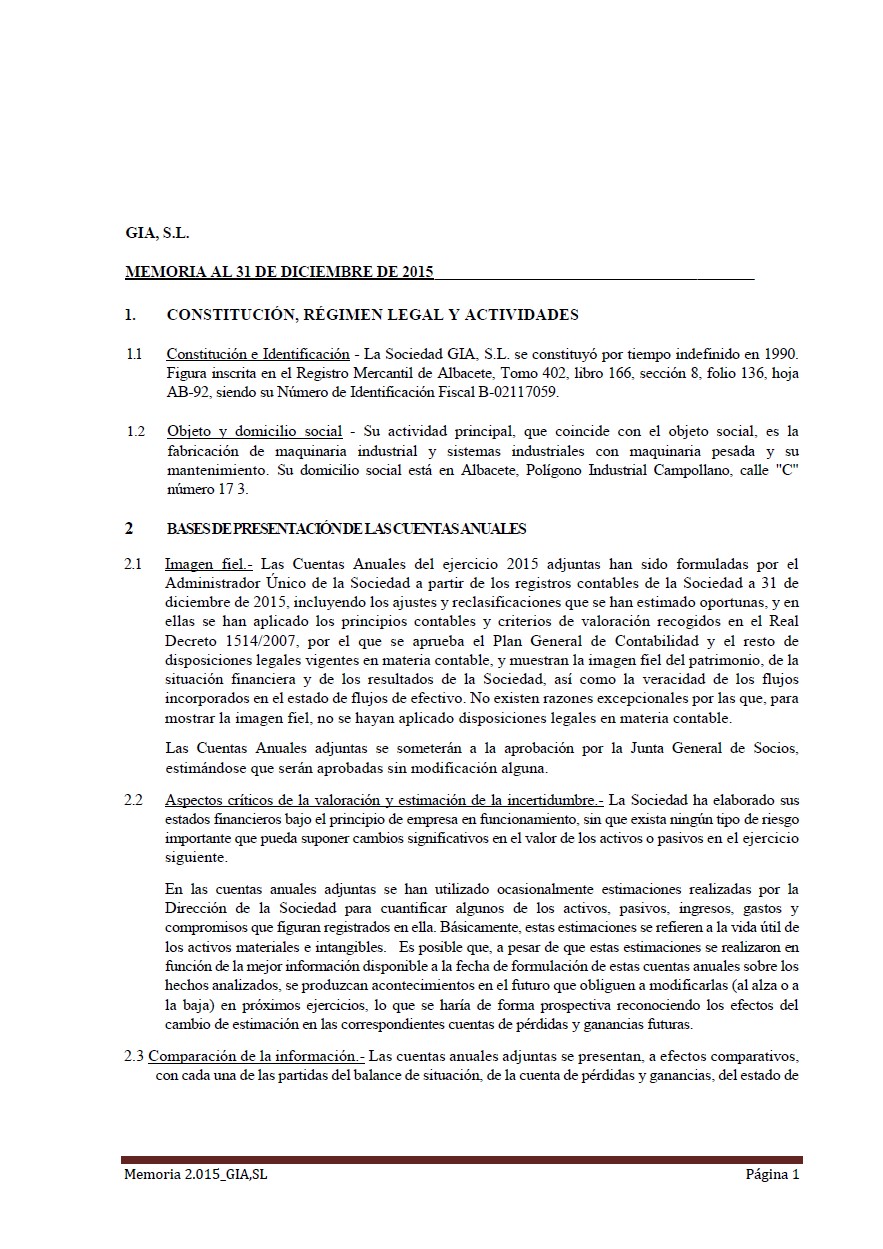
Furthermore, the following records and corporate acts are maintained by the Commercial Register of Spain:
- Reports and official disclosures
- Articles of association, incorporation deeds, and similar corporate documents
Inquiries are typically processed from 30 minutes.
Search Criteria and Tax Identifiers
A registry search and retrieval of an extract are possible based on the following criteria:
- Full legal company name
- Partial name combined with the registered address
- Company's tax identification number (CIF/NIF)
There are three primary types of identification and tax numbers used in Spain:
- DNI (Documento Nacional de Identidad) – National identity card and tax number for Spanish citizens.
- NIE (Número de Identidad de Extranjero) – Identification and tax number for foreign nationals.
- NIF (Número de Identificación Fiscal) – Tax identification number for legal entities (companies).
The DNI consists of 8 digits followed by a control letter. The NIE begins with a letter that defines the residency status, followed by 7 digits and a control letter. In the case of the NIF, the first letter defines the type of corporate entity, followed by 8 digits.
Types of Companies in Spain
Corporations (Entities with distinct legal personality):
- Sociedad anónima (SA) – Public limited company / joint-stock company
- Sociedad de responsabilidad limitada (SRL / SL) – Limited liability company
- Sociedad Limitada Nueva Empresa (SLNE) – Simplified LLC format designed for new business startups
- Sociedad Limitada Unipersonal (SLU) – Single-member limited liability company
- Sociedad comanditaria por acciones (Soc. Com. p.a.) – Partnership limited by shares
Partnerships and other structures (Entities without separate legal personality):
- Empresario Individual – Sole proprietorship / individual entrepreneur
- Sociedad Civil (SC) – Civil law partnership / general partnership
- Sociedad colectiva (Soc.Col.) – Registered general partnership
- Sociedad comanditaria simple (Soc.Com.) – Limited partnership
The Spanish Beneficial Ownership Register (RBE)
In accordance with Regulation 319/2018, Spanish corporate entities are required to disclose their ultimate beneficial owners. A beneficial owner is defined as any natural person who directly or indirectly:
- holds more than 25% of the company's share capital;
- controls more than 25% of the company's voting rights;
- exercises control over management by any other means.
Only publicly traded listed companies are exempt from this reporting obligation. Furthermore, companies with indirect beneficial owners must disclose information on all legal entities within the corporate ownership and control chain. If a company has no direct or indirect beneficial owners, it must identify the members of its governing management body in the declaration. In subsequent years, this declaration only needs to be re-filed if changes occur regarding the previously identified beneficial owners.
What Other Important Registries Exist in Spain?
- Registro de la Propiedad: Property and Land Registry (real estate).
- Registro de Bienes Muebles: Movable Property Registry (vehicles, machinery, equipment).
- Registro de Cooperativas: Registry of Cooperatives.
- Registro de Fundaciones: Registry of Foundations.
Documents of Dissolved Companies and Entities in "Cierre Registral" Status
Information on Spanish companies that have been struck off or removed from the active registry remains preserved within the historical archive of the Registro Mercantil. In these cases, a formal certificate featuring the remark "Cancelación de asientos" (Cancellation of entries) or "Extinción" (Extinction of the entity) is issued, specifying the date and cause of dissolution. These records are critical in judicial proceedings to prove a defendant's lack of legal capacity or to substantiate liability claims against former directors.
Specifics of the Registry Lock Status (Cierre Registral):
In Spain, registry blocking — known as Cierre Registral — is a widespread enforcement measure. It occurs when a company fails to file its annual financial statements (Cuentas Anuales) or update its beneficial ownership data for more than one year. Under this status:
- The registrar refuses to record any new corporate resolutions (with the sole exception of the resignation or dismissal of directors).
- Acquiring an updated official certificate (Certificación) for an apostille becomes blocked or impossible until compliance defaults are fully remedied.
- The informational extract (Nota Simple) displays the remark "Hoja cerrada" (closed register sheet). For such entities, we assist in retrieving historical records and underlying documents that triggered the lock, helping clients prove counterparty non-compliance in court or before financial institutions.
Annual Financial Statements of Companies in Spain
Under the Spanish Commercial Code and the Corporate Enterprises Act (LSC), commercial companies in Spain (S.A., S.L., S.Com. p. A.) must approve their annual financial statements (cuentas anuales) within 6 months after the end of the financial year and file them with the Provincial Commercial Registry (Registro Mercantil) within 1 month of approval (by July 30 for a calendar financial year; listed companies also report to the CNMV). The Spanish General Accounting Plan (PGC) applies, while consolidated financial statements of listed groups are prepared under IFRS.
Financial statements filed with the Registro Mercantil are public and can be requested by company name or tax ID number (NIF / CIF) (late filing triggers a registry block on corporate changes — cierre registral). Sole proprietors (autónomos) are not required to file financial statements with the registry, while small businesses publish abridged versions.
Scope of Reporting and Mandatory Audit
- Micro and small enterprises (PGC / PGC-Pymes) (not exceeding 2 of 3 criteria for two consecutive years: assets — EUR 4 million, turnover — EUR 8 million, average headcount — 50 employees; micro — EUR 1 million / EUR 2 million / 10 employees) — file an abridged balance sheet, profit and loss account, and abridged notes;
- Medium-sized and large companies — submit a full balance sheet, profit and loss account, statements of changes in equity and cash flows, full notes to the financial statements, and a management report (informe de gestión);
- Mandatory audit — required for public, financial, and insurance companies, as well as companies exceeding 2 of 3 thresholds for two consecutive years: assets — EUR 2.85 million, turnover — EUR 5.7 million, average headcount — 50 employees.
Apostille from Spain
Spain acceded to the Hague Apostille Convention on July 27, 1978, and the convention entered into force on September 25, 1978.
Consequently, public documents issued in Spain are eligible for simplified legalization via an apostille. Following a certified translation, these documents attain full legal force in all contracting states.
As a rule, authenticating an extract with an apostille takes approximately two to three weeks. Additionally, you can order certified translations of documents from Spanish through our service.
Comparison of Extract Types
| Feature | Electronic Extract | Extract with Apostille |
|---|---|---|
| Format | PDF file | Hard-copy paper original with Hague Apostille |
| Delivery time | From 30 minutes | 2–3 weeks (Registry certification + apostille) |
| Legal validity | Non-binding informational reference | Official public document for state authorities and courts |
| Legalization | No | Yes (Apostille) |
| Application | Counterparty checks, drafting contracts | Court proceedings, corporate bank account openings, notary appointments |
| Cost | from 60 € | from 300 € |
Validity Period of a Spanish Register Extract
The duration of validity depends entirely on the requirements of the receiving institution. Within Spain, a commercial register extract is generally considered current for a period of 3 months.
- Electronic extract: For international applications, it is recommended to use digital files that are no older than 1 week.
- Extract with apostille: Most global authorities and banks accept documents up to 3 to 6 months old. Where strict procedural court deadlines apply (e.g., 30 days), the timeframe is calculated from the date the apostille stamp was appended, provided the underlying extract was issued reasonably close to the legalization date.
Sworn and Certified Translations
Schmidt & Schmidt provides professional translation services carried out by sworn and court-certified translators. We can organize certified translations produced either by Spanish-based sworn translators (Traductor Jurado) or by court-authorized translators in the respective target country. Costs are calculated individually based on the volume of the specific text.
Shipping and Logistics
Upon acquiring the extract and completing its apostillation, we arrange worldwide courier shipping for original physical documents from Spain. We partner with reliable global courier networks offering complete shipment tracking to guarantee a secure and timely delivery.
All registry inquiries and data processing tasks are performed in strict compliance with Spanish commercial legislation, domestic statutory requirements, and the General Data Protection Regulation (GDPR).
Requests processed through the digital platform are answered within one working day. Courier expenses for physical logistics are billed separately according to the rates of the delivery service provider.
Preliminary checks to determine whether a specific company is listed in the Spanish commercial register can be requested on our website free of charge.
Free Preliminary Check and Price Overview
We offer a free, no-obligation preliminary check to verify whether the target company is registered in the Spanish commercial register and which documents are available to order:
- Verification of the company's record and its current status in the Spanish register (Registro Mercantil)
- Availability of public corporate documents and annual financial statements
- Exact calculation of the total cost and order fulfillment timeframes
- Provision of a sample document (if available)
| Service | Price (excl. VAT) |
|---|---|
| Electronic commercial register extract from Spain (Nota informativa mercantil) | from 60.00 € |
| Annual financial statements from Spain (Cuentas Anuales) | from 60.00 € |
| Search for natural persons in the Commercial Register of Spain | from 60.00 € |
| Additional documents from the Commercial Register of Spain | from 60.00 € |
| Commercial register extract from Spain with an apostille (excluding international shipping) | from 300.00 € |
| Annual financial statements from Spain with an apostille (excluding international shipping) | from 300.00 € |
| Search for natural persons in the Commercial Register of Spain with an apostille (excluding international shipping) | from 300.00 € |
| Additional documents from the Commercial Register of Spain with an apostille (excluding international shipping) | from 300.00 € |
| Certified translation of documents from Spanish | from 50.00 € |
All prices are net prices in euros (€), excluding statutory VAT, and apply exclusively to commercial customers and resellers (B2B). For clients based in Germany, statutory German VAT (19%) will be added. For business clients within the EU with a valid VAT ID, the reverse-charge mechanism applies (0% VAT). Services provided to business clients outside the EU are generally not subject to German VAT. International courier delivery costs for paper documents with an apostille are calculated based on actual expenses.