Summary: Risk Assessment for Machinery and Plants in the EAEU
- Mandatory Statutory Requirement: Placing machinery and industrial equipment on the Eurasian Economic Union (EAEU) market strictly requires a systematic Risk Assessment in accordance with TR CU 010/2011.
- Harmonized Normative Basis: The methodology follows GOST ISO 12100-2013 (equivalent to ISO 12100), ISO 13849-1, and GOST R 51344-99, sharing strong structural parallels with EU Machinery Directive 2006/42/EC.
- Integral Part of the Safety Justification: The Risk Assessment forms Section 5 of the Safety Justification (OB). To facilitate clear review by certification bodies, compiling it as a standalone annex is recommended.
- Three-Step Protective Principle: Each identified hazard is evaluated by severity of harm and probability of occurrence, then minimized step-by-step through inherently safe design, technical safeguarding, and user information.
- Sanctions-Compliant Implementation: Schmidt & Schmidt converts your existing EU/international risk analyses into standard-compliant Russian verification records—legally executed through our German and Kazakh specialists.
Purpose and Significance of the Risk Assessment under EAEU Law
Placing machinery or industrial plants on the market of the Eurasian Economic Union requires full compliance with the safety objectives of Technical Regulation TR CU 010/2011. The centerpiece of this proof is conducting a formalized Risk Assessment.
The Risk Assessment is performed in accordance with harmonized standards GOST ISO 12100-2013 (ISO 12100-1 / ISO 12100-2), ISO 13849-1, and GOST R 51344-99, closely aligning in methodology with European Machinery Directive 2006/42/EC. However, a mere copy of an English- or German-language CE risk matrix does not satisfy Eurasian authorities: the document must be compiled in Russian, reference applicable GOST standards, and be integrated into the Safety Justification.
The Risk Assessment spans all lifecycle phases of the machine: design, manufacturing, transport, installation, commissioning, normal operation, maintenance, troubleshooting, as well as dismantling and disposal.
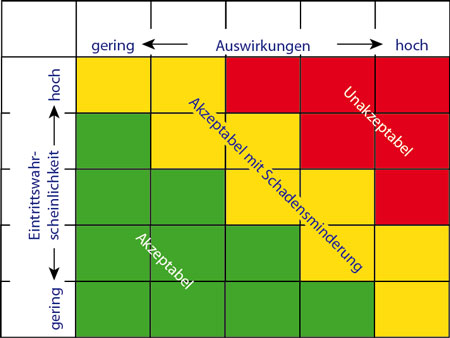
The Three Procedural Steps of the Risk Assessment
Under GOST ISO 12100-2013, the Risk Assessment is carried out as an iterative, traceable process consisting of three consecutive stages:
1. Risk Analysis
- Determining the limits of the machine: Intended use, spatial limits, energy sources, operating consumables, emissions, and service life;
- Hazard identification: Mechanical, electrical, and thermal hazards, noise, vibration, radiation, hazardous substances, as well as slipping, tripping, and falling risks;
- Risk estimation: Listing all hazardous situations, hazard sources, and conditions of occurrence.
2. Risk Evaluation
For each identified hazard, risk is quantified using two core parameters:
- Severity of harm: Degree of potential injury or health damage, number of exposed persons, as well as environmental and property damage;
- Probability of occurrence: Frequency and duration of exposure in the hazard zone, alongside technical and human capabilities to avoid or limit harm.
3. Risk Reduction (3-Step Method)
Pursuant to GOST ISO 12100 Section 5, a mandatory hierarchy of protective measures applies:
- Inherently safe design: Eliminating the hazard directly at the design stage;
- Technical safeguarding: Physical guards, light curtains, emergency-stop systems;
- Information for use: Warnings in the Operation Manual and safety signs affixed to the machine.
Formal Requirements and Mandatory Content
A Risk Assessment must be structured and documented so that its derivations and calculations can be verified and reproduced at any time by independent experts not involved in the machine's design (such as certification body auditors).
- Clear technical description of the machine or installation and its operating modes;
- Complete inventory of all identified hazards across all lifecycle phases;
- Defined safety objectives and applied harmonized standards (GOST / ISO / IEC);
- Documented protective measures for hazard elimination or risk reduction;
- Identification and evaluation of remaining residual risks (including references to required personal protective equipment);
- Results of the quantitative risk assessment (risk matrix before and after protective measures).
Our Service Package for Your EAEU Conformity
Our export consultants and engineers support you with complete technical documentation for EAC Certifications, EAC Declarations, State Registrations, and Fire Safety Certifications:
- Comprehensive regulatory consulting on import and approval obligations in the EAEU;
- Issuance of required certificates and declarations of conformity;
- Compilation of all technical GOST documents (Safety Justification, Technical Passport, Operation Manual);
- Specialized technical translations into Russian (labels, nameplates, manuals);
- Customs clearance and customs-compliant sample logistics, as well as sanctions-compliant project execution in Euros via Germany and Kazakhstan (Sanctions Compliance);
- Reliable delivery of all original documents via courier.