


If you need to use a Chinese certificate of marriage capacity abroad, the document usually has to be issued as a Chinese notarial certificate and then authenticated for international use. Depending on the destination country, this may require an apostille or consular legalization.
A Chinese citizen who intends to get married abroad may be required to provide a document confirming that there are no legal obstacles to the marriage. Depending on the country where the marriage will be registered, this document may be referred to as a certificate of marriage capacity, a certificate of no impediment to marriage, a single status certificate, a marital status certificate, or a document confirming that the applicant is not currently married.
In China, this document is usually not issued as a single standard government certificate under one universal name. In practice, it is most often prepared in the form of a Chinese notarial certificate, known in Chinese as a 公证书. The notarial certificate is issued by a Chinese notary office on the basis of official records and supporting documents provided by the applicant.
For foreign authorities, such as civil registry offices, immigration departments, embassies, consulates, or marriage registration authorities, this Chinese notarial certificate normally serves as the official document confirming the applicant’s marital status and capacity to marry.
What is a certificate of marriage capacity in China?
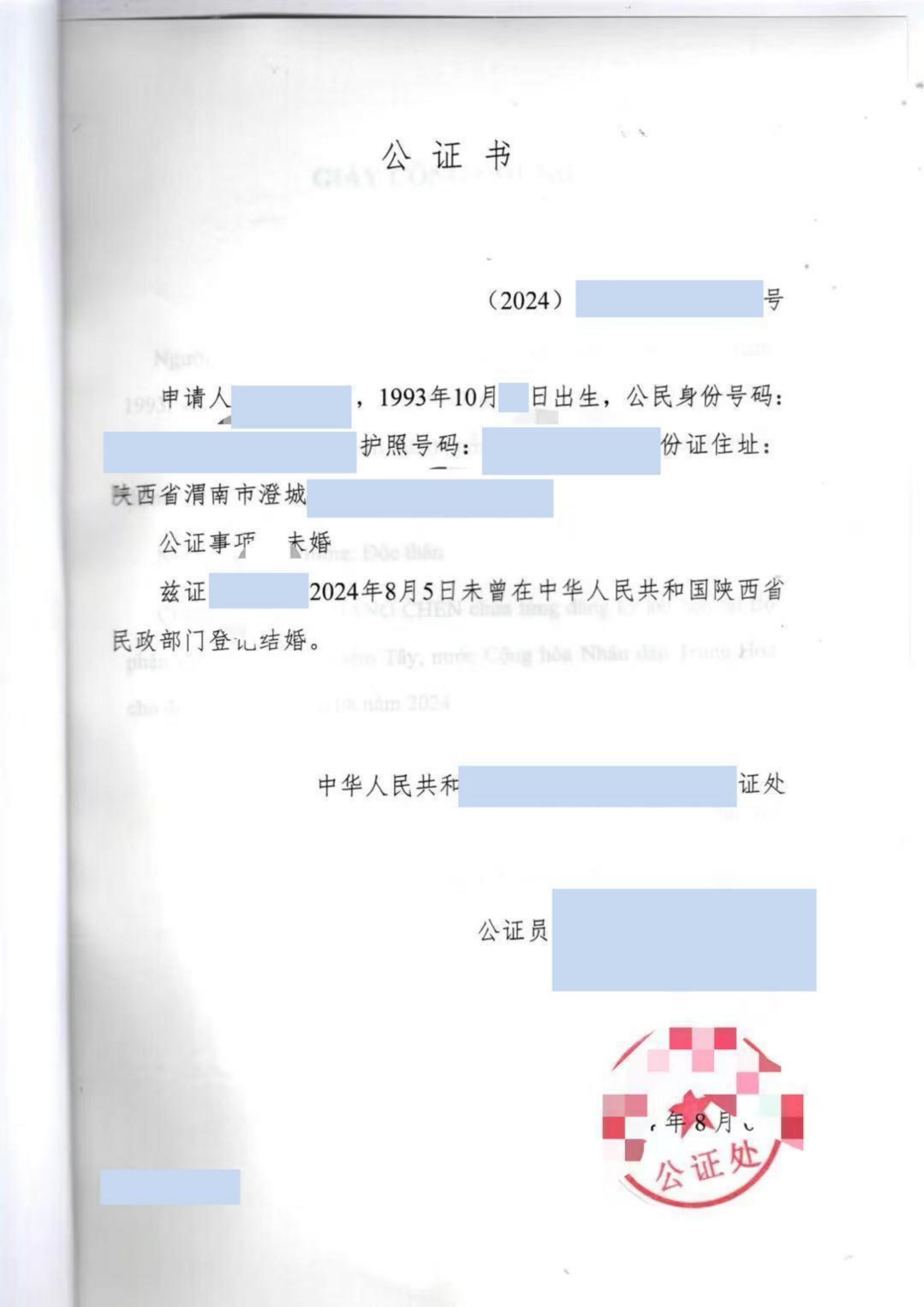
A certificate of marriage capacity in China is generally a notarized statement confirming a specific legal fact. The notary office may certify that the Chinese citizen is currently unmarried, divorced, or widowed, and that there are no registered legal obstacles preventing the person from entering into a new marriage.
The exact wording of the notarial certificate may depend on the applicant’s personal circumstances and on the requirements of the foreign authority where the document will be submitted. For this reason, it is important to clarify in advance whether the receiving authority requires a certificate of no impediment to marriage, proof of single status, confirmation of marital status, or another specific type of document.
This distinction is important because foreign authorities often use different terminology, while the Chinese administrative system may issue the document through one practical route: preparation of a relevant notarial certificate by a Chinese notary office.
When is a Chinese certificate of marriage capacity required?
A Chinese certificate of marriage capacity may be required when a Chinese citizen plans to marry abroad, apply for a residence permit as a spouse, register a marriage with a foreign civil registry office, or submit documents to an embassy or consulate. In many cases, the foreign authority needs official proof that the applicant is not currently married and is legally able to enter into marriage.
This document may also be requested in cross-border family law matters, immigration procedures, long-term visa applications, or other administrative procedures where the applicant’s marital status must be officially confirmed.
Common names of this document
Different countries and authorities may use different names for documents confirming marital status or marriage capacity. In practice, the following terms are often used for similar purposes:
| Common English name | Meaning |
|---|---|
| Certificate of Marriage Capacity | Confirms that the person is legally able to marry. |
| Certificate of No Impediment to Marriage | Confirms that there are no known legal obstacles to the marriage. |
| Single Status Certificate | Confirms that the applicant is not currently married. |
| Marital Status Certificate | Confirms the current marital status of the applicant. |
| Notarial Certificate of Marital Status | A Chinese notarial certificate confirming a legal fact related to marital status. |
Where to apply for a certificate of marriage capacity in China
The first step is to contact a Chinese notary office — 公证处. In most cases, the application should be submitted to the notary office located at the place of the applicant’s household registration, known as 户口. In some cases, a notary office at the applicant’s current place of residence may also accept the application, but this depends on local practice and the documents available.
A Chinese notary office is the competent body responsible for certifying legal facts and issuing notarial certificates for domestic and international use. When a Chinese citizen needs to prove marital status abroad, the notary office usually checks the applicant’s identity documents, household registration records, and any documents related to previous marriages, divorces, or the death of a spouse.
Because requirements may vary between provinces, cities, and individual notary offices, it is advisable to check the exact document list before starting the procedure. This is especially important if the applicant no longer lives in China, has changed household registration, was previously married, or needs the document for a country with strict formal requirements.
Documents usually required for obtaining a Chinese certificate of marriage capacity
The precise list of documents should always be confirmed with the relevant notary office. However, in a standard case, the following documents are commonly required:
- the original Chinese resident identity card — 居民身份证;
- the household registration booklet — 户口簿;
-
documents confirming the applicant’s current marital status, depending on the situation:
- if the applicant was previously married — the divorce certificate 离婚证;
- if the divorce was granted by a court — the court judgment or mediation document, together with proof that it has entered into legal effect;
- if the applicant is widowed — the death certificate of the former spouse;
- any additional documents requested by the notary office depending on the applicant’s personal situation.
The household registration booklet is often a key document because it may contain information about the applicant’s registered marital status. However, the notary office may not rely on this document alone. Depending on the case, it may require additional evidence or conduct its own verification before issuing the notarial certificate.
How the notarization procedure works
After the application is submitted, the notary office reviews the applicant’s identity documents, household registration records, and supporting documents related to marital status. If the applicant was previously married, the notary office will usually check the documents confirming that the previous marriage was legally terminated. If the applicant is widowed, the death certificate of the spouse may be required.
Once the information has been verified, the notary office prepares a notarial certificate confirming the relevant legal fact. For marriage registration abroad, this usually means confirmation that the Chinese citizen is not currently married and may enter into marriage according to the available official records.
The notarial certificate may be issued in Chinese only or together with a foreign-language translation, depending on the service available at the notary office and the requirements of the destination country. In many international cases, the notarial certificate is prepared as a bound set that includes the Chinese notarial text and the translation.
Processing time for a Chinese certificate of marriage capacity
The processing time depends on the notary office, the applicant’s place of household registration, the completeness of the documents, and the destination country. In a standard case, preparation of the Chinese notarial certificate usually takes about 5–10 business days after all required documents have been submitted and accepted by the notary office.
If the document also needs to be apostilled for use in a Hague Apostille Convention country, additional time should be allowed for certification by the competent Chinese authority. In practice, apostille certification by the Ministry of Foreign Affairs of China or an authorized local Foreign Affairs Office may take approximately 4–7 business days, depending on the place of submission and current workload.
These timeframes are indicative only. Additional time may be required if the notary office requests supplementary documents, if the applicant was previously married, if court divorce documents need to be checked, if the document must be legalized by a foreign embassy, or if international courier delivery is required.
Translation of a Chinese certificate of marriage capacity
In many cases, the Chinese notary office can prepare the notarial certificate together with a certified translation. The translation may be bound together with the Chinese notarial certificate and form part of the same notarized document package.
However, a translation prepared through a Chinese notary office is not automatically accepted by every foreign embassy, consulate, civil registry office, or immigration authority. Some destination countries require a translation prepared by a locally accredited translator, a sworn translator, an embassy-recognized translation provider, or a translation agency approved in that specific jurisdiction.
For this reason, the translation requirements should be checked before the document is prepared. If the receiving authority requires its own translation format or a translation by an accredited provider, it may be better to obtain the Chinese notarial certificate first and arrange the required translation separately in the destination country or through an approved translator.
Can the document be obtained if the applicant is outside China?
In some cases, the procedure can be completed through an authorized representative in China. The notary office may request a power of attorney, a copy of the applicant’s passport or Chinese identity document, the household registration booklet, and other supporting documents.
The exact requirements depend on the applicant’s household registration, current citizenship, marital history, and the practice of the local notary office. Some notary offices may accept representation based on a properly prepared power of attorney, while others may require the applicant’s personal presence or additional verification.
If the applicant is a former Chinese citizen or no longer has access to Chinese identity documents, the procedure may require additional steps, including confirmation of household registration cancellation.
Using a Chinese certificate of marriage capacity abroad
If the certificate of marriage capacity is intended for use outside China, notarization by a Chinese notary office is usually only the first stage. The document must normally be additionally authenticated for international use. The required procedure depends on the country where the document will be submitted.
For countries that are parties to the Hague Apostille Convention, the Chinese notarial certificate generally needs to be certified with an apostille — in Chinese practice often referred to as 海牙认证. The Apostille Convention entered into force for the People’s Republic of China on 7 November 2023, which means that eligible public documents issued in mainland China can be used in other member countries after apostille certification, without further consular legalization. For a detailed explanation of the Chinese apostille procedure, competent authorities, required documents, processing steps, and common practical issues, please see our guide to apostille in China.
In mainland China, apostilles are issued by the Ministry of Foreign Affairs of the People’s Republic of China or by authorized local Foreign Affairs Offices. Chinese documents intended for countries that participate in the Apostille Convention can generally be used abroad after being apostilled by these competent authorities.
If the destination country is not a party to the Hague Apostille Convention, the document usually has to go through consular legalization. In this case, the Chinese notarial certificate is first authenticated by the competent Chinese authority and then submitted to the embassy or consulate of the destination country in China for legalization.
Apostille for a Chinese certificate of marriage capacity
When the document is required for a Hague Convention country, the usual route is as follows:
- preparation of the Chinese notarial certificate by a notary office;
- translation, if required by the destination country;
- submission of the notarial certificate to the Ministry of Foreign Affairs of China or an authorized local Foreign Affairs Office;
- issuance of an apostille for international use;
- delivery of the completed document to the applicant or directly to the destination country.
It is important to understand that an apostille does not confirm the content of the document itself. It confirms the authenticity of the signature, seal, and official capacity of the authority that issued or certified the document. The content of the certificate remains the responsibility of the issuing notary office.
Consular legalization for countries outside the Hague Apostille Convention
If the certificate of marriage capacity is needed for a country that does not accept apostilles, the document must usually be legalized through the traditional consular legalization procedure. This process is more complex than apostille certification and normally includes several stages.
First, the Chinese notarial certificate is authenticated by the competent Chinese authority. After that, the document is submitted to the embassy or consulate of the destination country in China. The foreign consular authority then confirms the Chinese authentication so that the document can be accepted in that country.
Processing times, fees, translation requirements, and appointment rules may differ significantly depending on the destination country. Some embassies require the translation to be prepared in a specific language or format, while others may request additional copies, application forms, or supporting documents.
The common feature between apostille and consular legalization is that they authenticate an official document for presentation to institutions in another country. However, they have many differences.
| Apostille | Consular legalization | |
|---|---|---|
| Legal effect | Can be used in all countries that are party to the Hague Convention on the Simplified Legalization of Documents. | Use between States one or both of which is not a member of the Hague Convention, or where one of the contracting States has protested the accession of the other. |
| Difficulty | Moderate. To obtain an apostille, contact the competent apostille authority of the state of origin of the document. | High. For consular legalization, various inland authorities and a diplomatic mission of the state of destination must be involved. |
| Pre-certification | Usually not required. | Is obligatory. |
| Attestation at the state of destination embassy in the state of origin of the document | No need to contact the Consulate of the country of destination. | Is the final step of legalization. |
How long is a Chinese certificate of marriage capacity valid?
The validity period is usually determined not by the Chinese notary office, but by the foreign authority that receives the document. Many civil registry offices and immigration authorities require marital status documents to be recently issued, often within three or six months before submission.
For this reason, the timing of notarization, apostille or consular legalization should be planned according to the deadline set by the destination country. If the document is issued too early, the receiving authority may consider it outdated by the time it is submitted.
Important practical considerations
The wording of the notarial certificate is important. Some countries accept a general certificate confirming that the applicant is unmarried. Others may require a more specific statement that there are no legal impediments to marriage. Before starting the procedure, it is advisable to check the exact requirements of the foreign civil registry office or other receiving authority.
If the applicant was previously married, additional time may be needed to verify the divorce or death of the former spouse. In court divorce cases, a divorce judgment alone may not be sufficient unless it clearly shows that the decision has entered into legal effect. If the documents are incomplete, outdated, or inconsistent with the household registration record, the notary office may request additional evidence.
Applicants who are outside China should also check whether the procedure can be completed through an authorized representative. In many cases, a power of attorney may be required. The form of the power of attorney, its notarization, and possible legalization or apostille will depend on where it is signed and how the Chinese notary office accepts foreign-issued authorization documents.
Former Chinese citizens and changed citizenship
The procedure may be different for former Chinese citizens who have acquired another nationality. If the person previously held Chinese citizenship and had a household registration record in China, the authorities may first check whether the original 户口 was formally cancelled.
In practice, the Chinese administrative procedure in such cases can be quite formal and document-based. If the household registration has not been properly closed, the applicant may be asked to provide documents connected with the former Chinese identity, such as the Chinese identity card and household registration booklet. If these documents are no longer available or cannot be renewed, the practical route is usually to obtain a Certificate of Household Registration Cancellation — 户籍注销证明.
Only after the 户籍注销证明 has been issued can it usually become possible to request new Chinese documents or proceed with notarization based on the applicant’s previous records. This certificate can normally be obtained either through a Chinese consulate abroad or by applying in person at the police station responsible for the place where the original household registration was recorded.
Step-by-step procedure
- Check the requirements of the foreign authority where the document will be submitted.
- Confirm whether the authority needs a certificate of marriage capacity, certificate of no impediment, single status certificate, or marital status certificate.
- Contact the competent Chinese notary office at the place of household registration or residence.
- Prepare the Chinese identity card, household registration booklet, and documents confirming current marital status.
- Submit the application to the notary office.
- Obtain the Chinese notarial certificate — 公证书. In a standard case, this may take approximately 5–10 business days.
- Check whether the translation prepared by the Chinese notary office will be accepted by the receiving authority, or whether a separate sworn, certified, or accredited translation is required.
- Apply for an apostille if the document will be used in a Hague Convention country. This may take approximately 4–7 business days after submission to the competent Chinese authority.
- Apply for consular legalization if the destination country does not accept apostilled Chinese documents.
- Arrange secure delivery of the completed document.
FAQ: Chinese certificate of marriage capacity
Is a certificate of marriage capacity in China the same as a single status certificate?
In many international cases, these terms are used for similar purposes. In China, the document is usually issued as a notarial certificate confirming the applicant’s marital status or absence of legal obstacles to marriage.
Can a Chinese certificate of marriage capacity be apostilled?
Yes. If the document is intended for use in a Hague Apostille Convention country, the Chinese notarial certificate can usually be apostilled by the competent Chinese authority.
Do I need consular legalization?
Consular legalization is usually required only if the destination country does not accept apostilled Chinese documents or is not a party to the Hague Apostille Convention.
How long does it take to obtain a certificate of marriage capacity in China?
In a standard case, preparation of the Chinese notarial certificate usually takes about 5–10 business days. If an apostille is required, certification by the competent Chinese authority may take an additional 4–7 business days. The total timeframe may be longer if additional documents, embassy legalization, translation, or international delivery are required.
Is the translation made by a Chinese notary office always accepted abroad?
Not always. Although Chinese notary offices often prepare certified translations as part of the notarial certificate package, some foreign authorities require translations made by sworn translators, locally accredited translators, embassy-approved translation providers, or translation agencies recognized in the destination country.
Can Schmidt & Schmidt obtain the document without the applicant being in China?
This depends on the applicant’s documents, place of household registration, marital history, and the requirements of the local notary office. In many cases, representation may be possible with a properly prepared power of attorney.
What if I am a former Chinese citizen?
Former Chinese citizens may need to prove that their previous household registration was cancelled. In such cases, the Certificate of Household Registration Cancellation — 户籍注销证明 — may be required before further documents can be obtained.
Does the apostille confirm the content of the Chinese notarial certificate?
No. An apostille confirms the authenticity of the signature, seal, and official capacity of the issuing or certifying authority. It does not verify the factual content of the document itself.
How Schmidt & Schmidt can assist
Schmidt & Schmidt can assist with obtaining and preparing Chinese documents for use abroad, including notarial certificates confirming marital status and marriage capacity. Through our own office in China, 上海史密德商务咨询有限公司, we can support clients at different stages of the procedure and coordinate the preparation of documents for international use.
Our services may include preliminary document assessment, clarification of the required document type, assistance with notarization in China, translation, apostille, consular legalization where applicable, preparation of powers of attorney, and international courier delivery of the completed documents.
Before starting the procedure, we recommend providing information about the applicant’s citizenship, place of household registration, current marital status, previous marriages if any, country of intended use, and the requirements of the receiving authority. This allows us to determine the appropriate route and reduce the risk of rejection due to incorrect wording, missing legalization, or an unsuitable document format.

