On April 8, 2026, Decision No. 36 of the Council of the Eurasian Economic Commission (EEC) dated March 13, 2026, was officially published. This decision introduces significant amendments to the Technical Regulation of the Customs Union "On the safety of machinery and equipment" (TR CU 010/2011).
The new version will enter into force on September 1, 2026, with the exception of certain provisions that will become applicable as of April 1, 2028.
Key Changes
Several terms and definitions have been updated, and the scope of the regulation has been partially expanded. The regulation now also includes a list of exemptions. Furthermore, the requirements for marking and documentation have been tightened in the new version. For instance, user manuals must now mandatory include information about the EAC certificate or EAC declaration.
New Requirements for Self-Propelled Machinery and Trailers
A separate block of requirements has been incorporated into the regulation:
- Requirements for the identification of self-propelled machinery and specialized trailers
- New mandatory form: "Technical Description"
- Regulations for modifications to already certified machinery
Certification or Declaration – What Has Changed?
The most far-reaching update is the revision of the lists of products that are subject to either certification or declaration.
The following products are now subject to mandatory certification:
- Trackless ground vehicles for industrial use
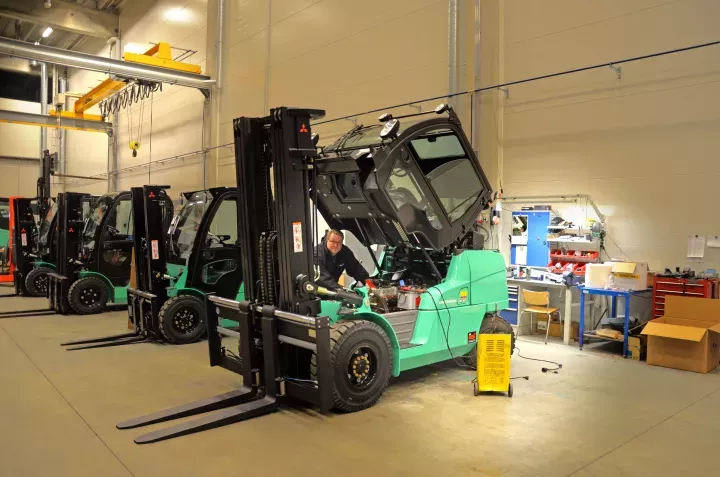
- Forklifts, electric forklifts, stacking equipment
- Construction and road-building machinery
- Earthmoving and mining machinery
- Forestry equipment
- Municipal equipment (non-stationary)
- Industrial tractors
New Products Subject to Certification
- Personal mobility devices (E-scooters, hoverboards)
- Three-wheeled utility vehicles
- Apron buses (airport buses)
- Off-road dump trucks
- Golf course machinery
- Ice resurfacing machines
- Snow grooming machines
- Equipment for processing raw materials
- Equipment for aviation maintenance
Clarifications and Terminology Changes
- Snowmobiles and ATVs are now classified as off-road vehicles.
- The term "garage equipment" has been replaced by "lifting and tilting devices".
- Agricultural machinery now explicitly includes attachments.
- Expansion of the small-scale mechanization category (including tractors up to 19 kW).
- Tools now encompass:
- electric tools
- pneumatic tools
- hydraulic tools
Practical Implications for Companies After Entry into Force:
- Increased burden for companies (in terms of both cost and time)
- Increase in the number of products requiring certification
- Stricter requirements for technical documentation
- More rigorous controls by certification bodies
Risks of Non-Compliance
- Rejection of certificates or declarations
- Sales ban
- Fines and delivery stops
- Customs clearance issues
Conclusion
These amendments aim to further elevate the level of safety and standardization within the Eurasian Economic Union (EAEU).
However, this may make processes more expensive and complicated for manufacturers. While a simpler declaration was often sufficient in the past, a full certification will be required in many cases going forward.
How can we help?
In this rapidly changing regulatory environment, Schmidt & Schmidt provides comprehensive support for exporters to EAEU countries. Our service portfolio includes EAC certification, adaptation to specific product categories, and customized solutions to meet the technical and legal requirements of these markets. We are committed to facilitating companies' entry and expansion in these regions by providing the most up-to-date information and guidelines.
Technical expertise, diligence, and accuracy in the preparation of documents are prerequisites for the smooth distribution and operation of products, machinery, or equipment in the EAEU territory. Furthermore, the technical documentation must be compiled in Russian or in the official language of the respective member state where the product is to be sold or used.
To avoid any potential issues, we are happy to assist you in preparing new technical documentation or review existing documents for completeness as well as linguistic and terminological accuracy in Russian.
Thanks to years of experience, our experts can also provide you with specific industry knowledge in the fields of plant engineering, mechanical engineering, metal construction, measurement technology, electrical engineering, automation technology, medical technology, food technology, and the furniture industry.
What is an EAC Certification?
In our video, we explain what an EAC Certification is and how and where to certify or declare your products for introduction into the EAEU market.
The EAC Certification and the EAC Declaration are complex procedures that confirm your products' conformity with the applicable technical regulations of the EAEU and require extensive technical know-how. Schmidt & Schmidt offers you reliable support with certification for the Eurasian Economic Union market.