
Police Clearance Certificate is an official document issued by the internal affairs authorities confirming that a person currently has no criminal record, is not wanted for criminal offenses, or that any previous convictions have already been expunged. It is one of the most commonly required documents for international mobility.
A Police Clearance Certificate is often required in the following situations:
- Obtaining a visa;
- Applying for a temporary residence permit;
- Applying for a residence permit;
- Obtaining citizenship;
- Employment;
- Admission to an educational institution;
- Background checks for adoption or guardianship;
- Providing evidence in court;
- Marriage registration.
What is a Criminal Record Certificate in Lithuania?
The full official name of criminal record certificates in Lithuania is “Certificates from the Register of Suspects, Accused and Convicted Persons” (Įtariamųjų, kaltinamųjų ir nuteistųjų registro pažymos). The document is often referred to in short as a “Certificate on Pre-trial Investigation or Convictions” or simply a “Criminal Record Certificate.”
The issuance of criminal record certificates in Lithuania is governed by the “Rules on the Approval of the Registration of Suspects, Accused and Convicted Persons and the Provision of Data,” approved by Order No. 5V-68 of the Director of the Information and Communications Department under the Ministry of the Interior of Lithuania dated July 21, 2021, as well as other legal acts.
A criminal record certificate is a paper or electronic document generated based on data from the Register of Suspects, Accused and Convicted Persons, maintained by the Information and Communications Department of the Ministry of the Interior of Lithuania. The certificate is issued in Lithuanian and in one of the EU languages.
At the applicant’s request, two main types of certificates may be issued (containing the relevant information):
- A criminal record certificate for the applicant’s personal use;
- An extract for a Lithuanian employer.
How to obtain a Criminal Record Certificate in Lithuania
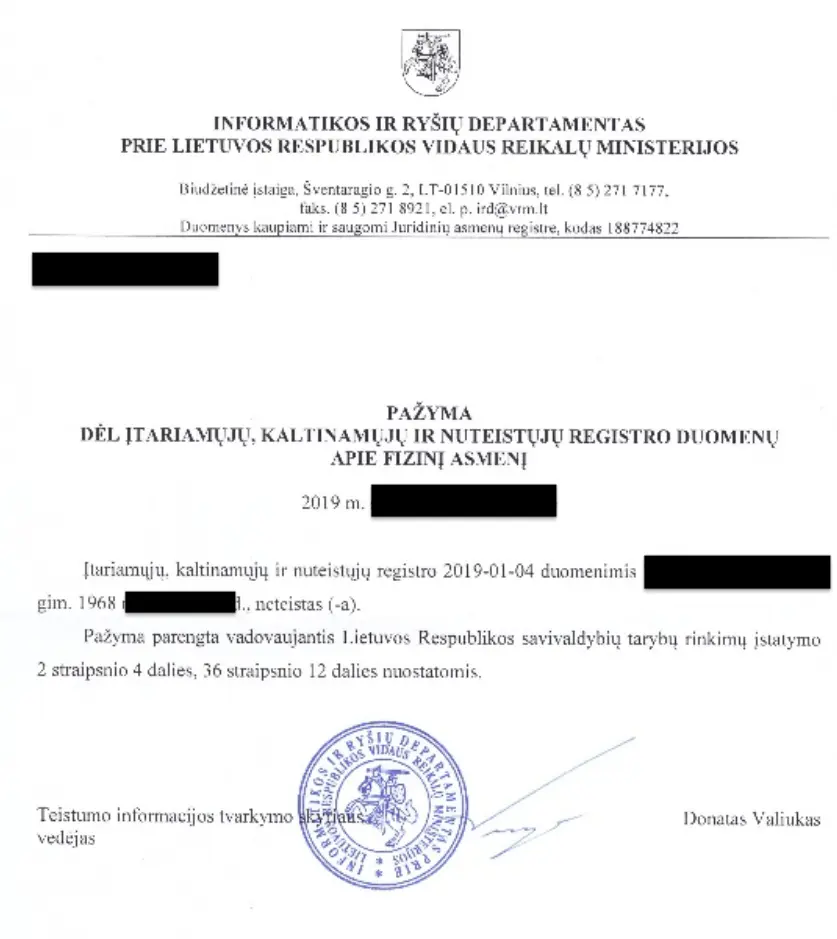
Criminal record certificates in Lithuania can be requested in the following ways:
- In person at the Information and Communications Department of the Ministry of the Interior of Lithuania;
- By post or courier service from the Information and Communications Department of the Ministry of the Interior of Lithuania;
- Electronically (online) via the Electronic Services Portal using a publicly available e-service provided by the e-Government portal.
The Lithuanian authorities strongly recommend not using Internet Explorer when applying for a criminal record certificate.
Electronic Certificate
A certificate issued in electronic form is signed with a digital signature and made available in the user’s personal account via the online public services platform.
Paper Certificate
A paper certificate can be ordered and collected directly at the service desk of the Information and Communications Department of the Ministry of the Interior.
Certificate by power of qttorney
A criminal record certificate may also be requested by an authorized representative. When submitting the request, the representative must present an identity document, a document authorizing them to act on behalf of the applicant (power of attorney), as well as provide copies of both the authorization document and the applicant’s identity document.
To apply for a certificate in person, you need to:
- Visit the service desk at the Information and Communications Department of the Ministry of the Interior;
- Present an identity document or a notarized copy (if required — along with a power of attorney or a document confirming a relationship with a child under 18 years of age);
- Submit a request in the prescribed form.
To apply by post or courier, you need to:
- Send a request in the prescribed form;
- Include a copy of an identity document (the Department may request a notarized copy if necessary), and, where applicable, documents authorizing you to request data for a third party;
- Include proof of payment of the state fee;
- Specify the delivery address.
To apply via government online services, you need to:
- Complete identification on the Electronic Services Portal or the e-Government portal;
- Log in to your personal account using a qualified electronic signature;
- Select the link “Register of Suspects, Accused and Convicted Persons” in the “For Residents” section;
- Select either “Ordering and Issuance of a Certificate from the Register” or “Ordering and Issuance of an Extract from the Register”;
- Complete the online application form;
- Receive the certificate in your personal account.
Criminal Record Certificate through a consulate
To obtain a criminal record certificate through a Lithuanian consulate or the consular section of an embassy abroad, the following documents must be provided:
- An application;
- An identity document;
- Proof of payment of the state fee.
When receiving a criminal record certificate, it is essential to carefully verify all personal details. Any error or typo will render the document invalid.
Processing time for a Criminal Record Certificate in Lithuania
The standard processing time ranges from one to two months, depending on the city, the specifics of the request, the need for legalization, and the delivery address.
How to verify the authenticity of a Criminal Record Certificate
The authenticity of an electronic criminal record certificate can be verified using the document verification service in the “ADOC Document Verification and Confirmation” section.
Apostille on a Criminal Record Certificate from Lithuania
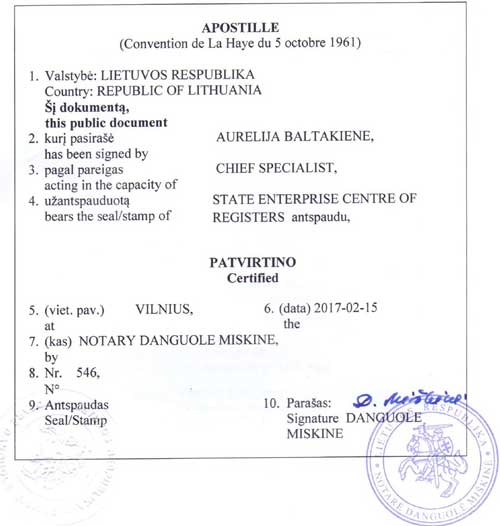
Since 1996, Lithuania has been a party to the Hague Convention of 5 October 1961 abolishing the requirement of legalization for foreign public documents (the “Apostille Convention”).
An apostille is an internationally standardized form certifying the legality of a document for use in countries that recognize this form of legalization. It usually takes the form of a special stamp or certificate. In recent years, the electronic apostille (e-Apostille) has also become common — a digital certification confirming the authenticity of documents issued electronically.
Since 2016, documents in Lithuania have been apostilled by notaries.
An apostille cannot be affixed to criminal record certificates issued by Lithuanian consular institutions, as the apostille procedure does not apply to consular documents. As a result, authorities in many countries refuse to accept such certificates. Before obtaining this type of document, it is advisable to confirm with the relevant authority whether it will be accepted.
What is an apostille?
What is an apostille? Why do I need an apostille? How do I get an apostille? - Our video will explain everything you need to know about the apostille. If you have a document that needs to be certified with an apostille for use abroad, Schmidt and Schmidt will assist you! We provide apostille services in more than 100 countries worldwide.
Consular legalization of a Criminal Record Certificate from Lithuania
If the country where the Lithuanian criminal record certificate will be used is not a party to the 1961 Hague Convention (for example, the UAE), a more complex and costly consular legalization procedure is required.
Consular legalization is a multi-step process used to certify the authenticity of documents for countries that are not parties to the 1961 Hague Convention.
To complete consular legalization of a Lithuanian criminal record certificate, the following steps must be followed:
- Obtain the certificate;
- Legalize the document at the Consular Department of the Ministry of Foreign Affairs of Lithuania;
- Prepare an official translation of the document;
- Legalize the document at the consulate or consular section of the embassy of the destination country.
Due to the number of steps involved, this procedure is time-consuming and relatively expensive. Some countries do not have consulates in Lithuania, and the final stage of legalization may need to be completed in another country where the relevant consulate is located.
What is consular legalization?
In our video we are explaining what consular legalization is and where to apply for it.
Schmidt & Schmidt will assist you in all issues concerning the legalization.
Schmidt & Schmidt offers legalization in more than 80 countries all over the world.
Official translation of a Police Clearance Certificate from Lithuania
The Police Clearance Certificate from Lithuania is issued in Lithuanian. To use it abroad, an official translation must be prepared in accordance with the requirements of the destination country — by a sworn, certified, notary, or court translator in the country where the document will be submitted.
A translation made in Lithuania (except in cases of consular legalization or specific bilateral recognition agreements) will most likely not be accepted abroad.
Document delivery
After obtaining a Police Clearance Certificate, its apostille, or legalization, it is often necessary to send the document to another country. In such cases, not only speed but also the security of delivery is crucial, especially when dealing with original official documents.
Schmidt & Schmidt organizes international document delivery worldwide. We use reliable logistics solutions and modern tracking systems, allowing full monitoring of the shipment at every stage and ensuring timely delivery to the recipient.
Our specialists provide careful and confidential handling of documents and assist with any issues that may arise during international shipping, including carrier requirements and customs procedures.
We can arrange delivery of Police Clearance Certificates, apostilled documents, translations, and other official papers to most countries worldwide — for both private clients and legal entities.
How we can help
We are happy to assist you in obtaining a Police Clearance Certificate from Lithuania, including requesting it, apostilling, and legalizing it for use abroad, as well as providing translation and delivery to any location worldwide.
You can always contact Schmidt & Schmidt. We have extensive experience in requesting and legalizing a wide variety of documents and provide all necessary services in this field, including notarized copies, translations, preparation of required powers of attorney, legalization of documents with government authorities and foreign consulates, and delivery of completed documents to most countries around the world.
For more information about the legalization and apostille process, you can read on our website.