
In today’s globalized commercial landscape, conducting high-value transactions with foreign corporate clients is a massive growth opportunity for Turkish jewelry companies, precious metal refineries, and real estate agencies. However, under Turkey’s strict regulatory framework (such as Law No. 5549 on Prevention of Laundering Proceeds of Crime and the Regulation on Measures Regarding Prevention of Laundering Proceeds of Crime and Financing of Terrorism), it is also a massive compliance minefield.
With MASAK (Mali Suçları Araştırma Kurulu) (Financial Crimes Investigation Board) intensely auditing the precious metals and luxury real estate sectors, accepting a foreign corporate buyer is no longer as simple as signing a contract. Local businesses must legally prove the official existence, corporate structure, and ultimate ownership of every foreign entity—specifically when transactions reach major monetary thresholds like 185,000 TRY or cross into suspicious territory—they do business with. Failing to do so can result in catastrophic compliance fines reaching up to hundreds of thousands of Liras per violation.
At Schmidt & Schmidt, we provide comprehensive, end-to-end services for obtaining foreign trade registry documents (ticari sicil belgeleri), securing international apostilles, handling multi-stage consular legalization, and mapping Ultimate Beneficial Owners (UBO) across more than 140 countries. Our goal is to robustly prepare your foreign B2B transactions for MASAK requirements, helping protect your business during regulatory audits quickly, securely, and without bureaucratic delays.
You can submit your corporate document request via our secure B2B web form. Our compliance experts will provide a free preliminary evaluation regarding the retrieval feasibility, country-specific legal chains, timelines, and costs.
2026 MASAK Compliance Updates and Enforcement Trends
The compliance landscape has significantly tightened for high-value asset markets, driven by a series of progressive digitization and threshold adjustments. Under direct instructions from the Ministry of Treasury and Finance, MASAK has accelerated inter-agency data monitoring, phasing out manual procedures in favor of strict digital accountability.
2025 Updates: Sector-Specific Guidelines and Digitization
- Updated Suspicious Transaction Reporting (ŞİB) Guides: On June 13, 2025, MASAK published updated, sector-specific Suspicious Transaction Reporting guides tailored explicitly for real estate traders/intermediaries (taşınmaz alım satımıyla uğraşanlar) and precious metal/jewelry dealers (kıymetli maden, taş veya mücevher alım satımı yapanlar). These guides define specific red flags for these industries (e.g., uncharacteristic gold hoarding or suspect real estate cash purchases).
- MASAK Online 2.0 Mandate: To streamline compliance, MASAK launched the "MASAK Online 2.0" system. Real estate and precious metal businesses are now required to register and submit all of their Suspicious Transaction Reports (ŞİB) electronically through this portal, phasing out paper-based or manual reporting.
- Source: MASAK Official Announcement (June 2025)
2026 Updates: Strict Cash and Transfer Thresholds
Because jewelry, precious metals, and real estate are classified as high-risk for money laundering due to their cash-intensive nature, the January 1, 2026 MASAK General Communiqué heavily targets these trades. Vague explanations for large transactions are no longer accepted.
- 200,000 TL to 2 Million TL: Traders and intermediaries must record the specific nature of the transaction (e.g., selecting "real estate purchase"). If a generic option like "Other" is used, a minimum 20-character written explanation is strictly required.
- 2 Million TL to 20 Million TL: The transaction requires the mandatory completion of a formal "Cash Transaction Declaration Form" (Nakit İşlem Beyan Formu).
- Over 20 Million TL: Requires the submission of physical documents proving the source of the funds (contracts, invoices, etc.). If providing documentation is genuinely impossible due to the nature of the transaction, the trader must provide a highly detailed explanation of at least 50 characters on the declaration form.
- Source: MASAK Official Portal and the 2025 MASAK Activity Report (Published April 2026) detailing the transition to these stricter controls.
Enforcement and Oversight
While a proposed 2026 mandate requiring bank clients to declare the explicit sub-sources of real estate funds at payment counters was ultimately rolled back to maintain fluid market operations, oversight has shifted entirely to synchronized digital tracking. Authorities now heavily rely on digital tools such as the Electronic Listing Verification System (Elektronik İlan Doğrulama Sistemi) and automated Web-Tapu registry systems to trace asset footprints.
Furthermore, MASAK recently issued official sector-wide compliance notices through the Union of Chambers and Commodity Exchanges of Turkey (TOBB). These warnings explicitly target jewelers and real estate professionals handling foreign investments. In recent public enforcement cases, spot check deficiencies regarding hidden or complex corporate shareholders have led authorities to initiate immediate criminal referrals to Chief Public Prosecutor's Offices (Cumhuriyet Başsavcılıkları), demonstrating that operating without an authenticated international corporate record path poses a critical existential risk to local trading licenses.
Understanding these enforcement trends is only the first step. The following sections explain which foreign corporate documents Turkish businesses should obtain, how they should be authenticated, and how they can be used to support AML and KYC compliance during MASAK inspections.
In This Guide
This guide explains how international trade registry retrieval, apostille, and corporate legalization processes work to support Turkish jewelers and real estate agents in aligning with MASAK KYC mandates.
Why Emailed PDFs from Foreign Clients Fail MASAK Audits
Many foreign clients seamlessly email PDF copies of their Certificate of Incorporation or local corporate profiles. However, when MASAK auditors or the Land Registry (Tapu Müdürlüğü) conduct an inspection, unverified digital printouts are flatly rejected. The primary reasons why simple digital copies fail compliance checks include:
-
1
The PDF Alteration Risk
Digital corporate profiles can easily be digitally altered or photoshopped to hide bankruptcies, active litigation, or sanctioned shareholders. -
2
Lack of Official Verification Background
Turkish jewelers and real estate agents lack direct access, subscription accounts, or language capabilities to cross-reference these PDFs against complex foreign government registries (like the UK Companies House, Delaware Division of Corporations, or Dubai Freezone Authorities). -
3
The "Up-to-Date" (Current Status) Mandate
MASAK requires corporate documents to show the live, current state of the company. A PDF issued two years ago does not prove the company hasn't been dissolved, struck off, or placed on an international sanctions list. -
4
The Wet-Ink and Apostille Requirement
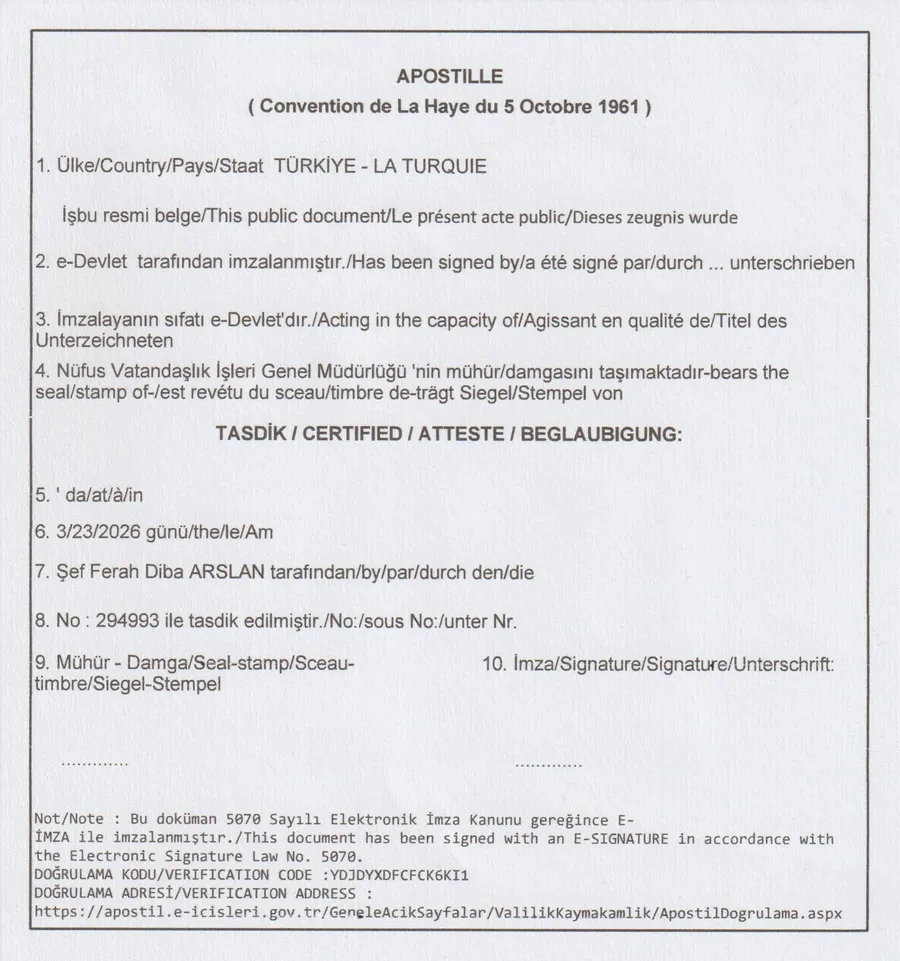
For a foreign corporate document to hold legal weight before Turkish authorities, it must bear an original physical stamp, a verifiable electronic state signature, or a valid Hague Apostille or consular legalization.
The Complexity of the Ultimate Beneficial Owner (UBO) Mapping
Under MASAK’s strict anti-money laundering (AML) protocols, identifying the company name is only 10% of the job. Guided by the Ministry of Treasury and Finance's official Real Beneficial Owner Guide (Gerçek Faydalanıcı Rehberi), jewelers and real estate agents must uncover the Ultimate Beneficial Owner (UBO)—defined under national and international standards as any natural person who ultimately owns or controls more than 25% of the foreign company’s shares or voting rights.
Foreign buyers frequently utilize multi-layered corporate structures. For example, a British Virgin Islands (BVI) offshore shell company might own a Delaware LLC, which in turn acts as the buyer for a luxury villa in Istanbul or a gold bullion shipment in the Grand Bazaar.
We specialize in unraveling these corporate layers. We retrieve the consecutive share registries and certificates of incumbency across multiple jurisdictions to build a clear UBO Map Diagram designed to align with regulatory expectations and support your position during MASAK inspections.
Crucial Details for Power of Attorney (Vekaletname)
While many open-access registries (like the UK or France) allow us to extract corporate documents digitally without client intervention, stricter jurisdictions—especially offshore hubs or corporate registries in the Middle East (such as specific Dubai or Swiss cantonal registries)—require a formal Power of Attorney (Vekaletname) or an authorized corporate resolution to release full shareholder breakdowns.
If a formal retrieval authorization is required, generic powers of attorney will be rejected by foreign registry registrars. We provide your legal team with the exact, word-for-word bilingual clauses required by international corporate registries, such as "authorized to demand, extract, and receive certified true copies of the share registry, director logs, and certificates of good standing from the relevant registrar of companies."
Critical Rules on Corporate Translation, Legalization, and Document Physics
Before discussing the legalization process, it is important to understand what an apostille actually is. An apostille is a certificate issued under the 1961 Hague Convention that authenticates the signature, official seal, and authority of the public official issuing a document. It does not verify the accuracy or legal validity of the document's contents. Where both the issuing country and Türkiye are parties to the Hague Apostille Convention, an apostille generally replaces the traditional consular legalization process. Documents originating from non-Hague countries must instead undergo the applicable consular legalization procedure.
In international corporate compliance, the physical state of the document and the exact chronological sequence of legalization are just as vital as the text itself. Common procedural errors that result in massive MASAK non-compliance liabilities include:
Detailed Guide to Essential Corporate Documents (2026 Updated)
Below are the key corporate documents we retrieve, legalize, and prepare for MASAK KYC compliance folders, categorized by their operational functions.
1. Certificate of Incorporation / Good Standing / certificate of activity (Şirket Kuruluş Belgesi / Faaliyet Belgesi / Sicil Tasdiknamesi)
| What it proves | The legal existence, active status, and registration number of the foreign company. |
| Why MASAK wants it | To verify the entity is not a completely fabricated, non-existent fictitious company designed to mask illegal capital flows. |
| Our value-add | We pull this directly from the country of origin, ensuring it reflects the "Active/In Good Standing" status at the time of your deal. |
2. Articles of Association / Memorandum (Şirket Esas Sözleşmesi / Şirket Kuruluş Sözleşmesi)
| What it proves | The internal regulations, scope of business, and structural rules of the foreign corporation. |
| Why MASAK wants it | To cross-check whether the person signing the real estate deed or wire transfer authorization has the actual corporate authority to bind the company. |
3. Shareholder Registry / Return of Allotment (Pay Defteri / Hissedar Sicili)
| What it proves | The equity distribution, names, and ownership percentages of the corporate shareholders. |
| Why MASAK wants it | This is the primary document used to satisfy the MASAK >25% UBO Rule. Without a verified share registry, your KYC folder is legally incomplete. |
4. Certificate of Incumbency / Director Registry (İmza Sirküleri / Yetki Belgesi / Yönetici Sicili)
| What it proves | The current list of appointed corporate directors, managers, and official legal signatories of the company. |
| Why MASAK wants it | To prevent identity fraud and unauthorized corporate representations during high-value gold or real estate closings. |
Pricing and Service Tiers (Transparent B2B Pricing)
We provide highly competitive, customized quotations tailored to each individual engagement. Corporate retrieval costs vary comprehensively based on the total volume of your order, the specific target country, the technical complexity of local registry retrieval (such as electronic extractions versus intricate physical archive searches), and the exact international legalization pathway required (Hague Apostille or multi-stage Consular Legalization). Final binding quotes are delivered following our free preliminary review, factoring in specific country registry fees, translation volume, and localized consulate charges.
Frequently Asked Questions (FAQ)
Data Security and Business Confidentiality (KVKK & GDPR Compliance)
Corporate documents, share registries, and UBO declarations contain highly sensitive commercial and personal data. The cross-border transfer of these records poses significant compliance and security risks. All our retrieval and verification processes strictly comply with the European Union’s General Data Protection Regulation (GDPR) and Turkey’s Personal Data Protection Law (KVKK). Your corporate data is routed via secure courier networks, digital registry files are stored on end-to-end encrypted servers, and strict data-purging protocols are enacted once your compliance folder is delivered.