


Diplomas, certificates, school transcripts, and other educational documents issued in Kazakhstan require prior legalization in order to be officially recognized and used in most countries around the world.
If you plan to use a Kazakhstani diploma in a country that is a party to the 1961 Hague Convention, it can be legalized for university admission through a simplified procedure known as apostille certification.
When and why is an apostille required?
An apostille is a special certification stamp that confirms the authenticity of an official document. It may be applied to documents issued by government authorities, local administrative bodies, educational institutions, and other entities officially authorized by the state.
Commercial documents cannot be apostilled. Therefore, if you obtained a certificate for completing educational courses provided by a private company without an official educational license, it cannot be certified with an apostille. Only documents issued by accredited educational institutions holding a valid state license are eligible for apostille legalization.
It is also important to understand that apostille certification only verifies the authenticity of the document itself and the signature of the authorized official. It does not automatically grant the right to work in regulated professions such as medicine or law, nor does it replace the formal recognition of higher education credentials (nostrification).
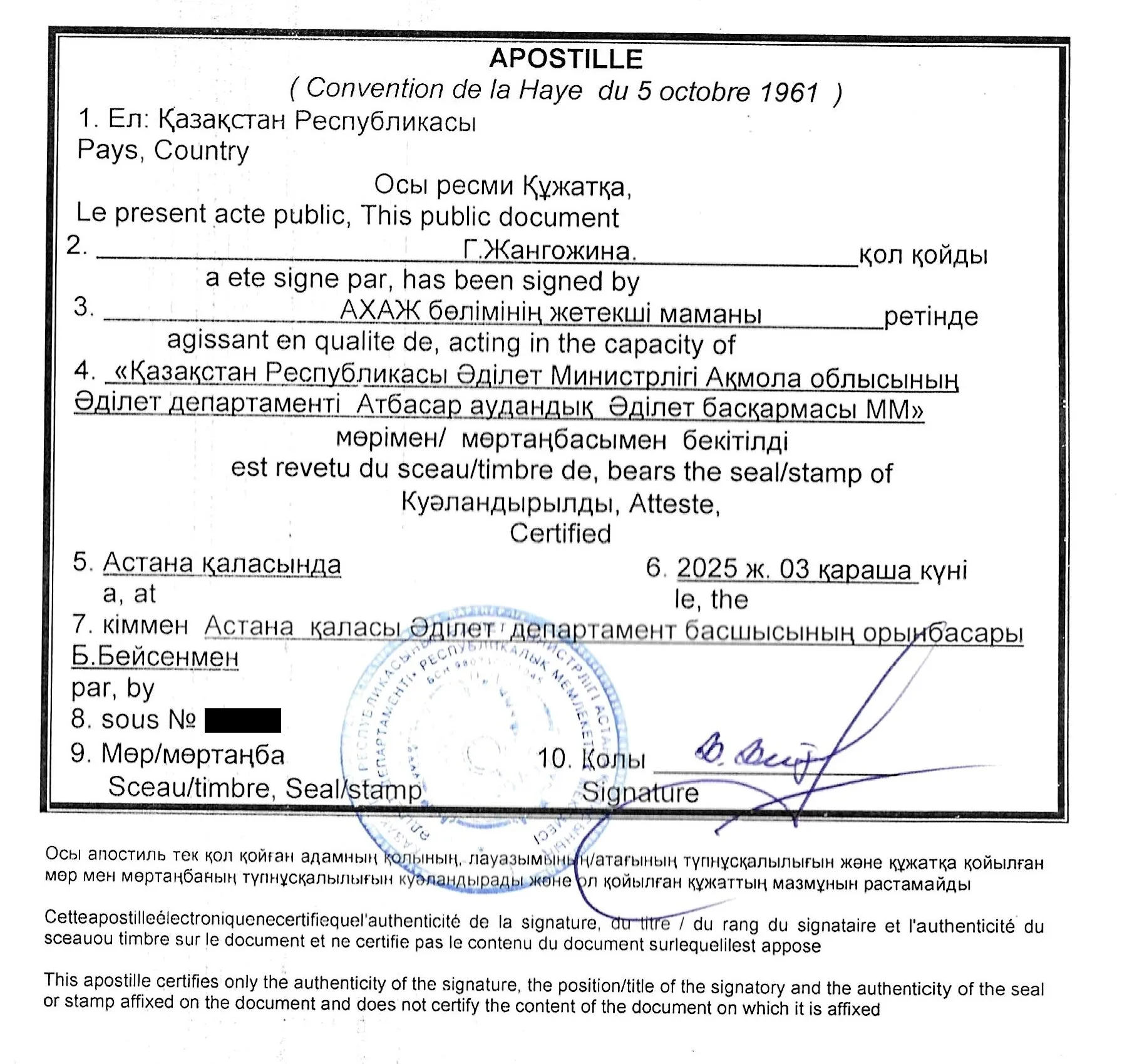
An apostille can only be issued in the country where the document was originally issued. It cannot be obtained through embassies or consulates abroad.
If you plan to use a Kazakhstani diploma in a country that is a party to the 1961 Hague Convention, it can be legalized for university admission through a simplified procedure known as apostille certification.
When is an apostille not required?
Most private employers hiring staff for positions that do not involve access to restricted information usually do not require educational documents to be legalized through apostille certification. In addition, an apostille is not required if Kazakhstan and the receiving country have a special agreement on the mutual recognition of diplomas and academic degrees, which may affect university admission or professional employment opportunities.
Before using a Kazakhstani educational document abroad, it is advisable to confirm with the receiving country whether apostille certification is required.
Educational documents in Kazakhstan
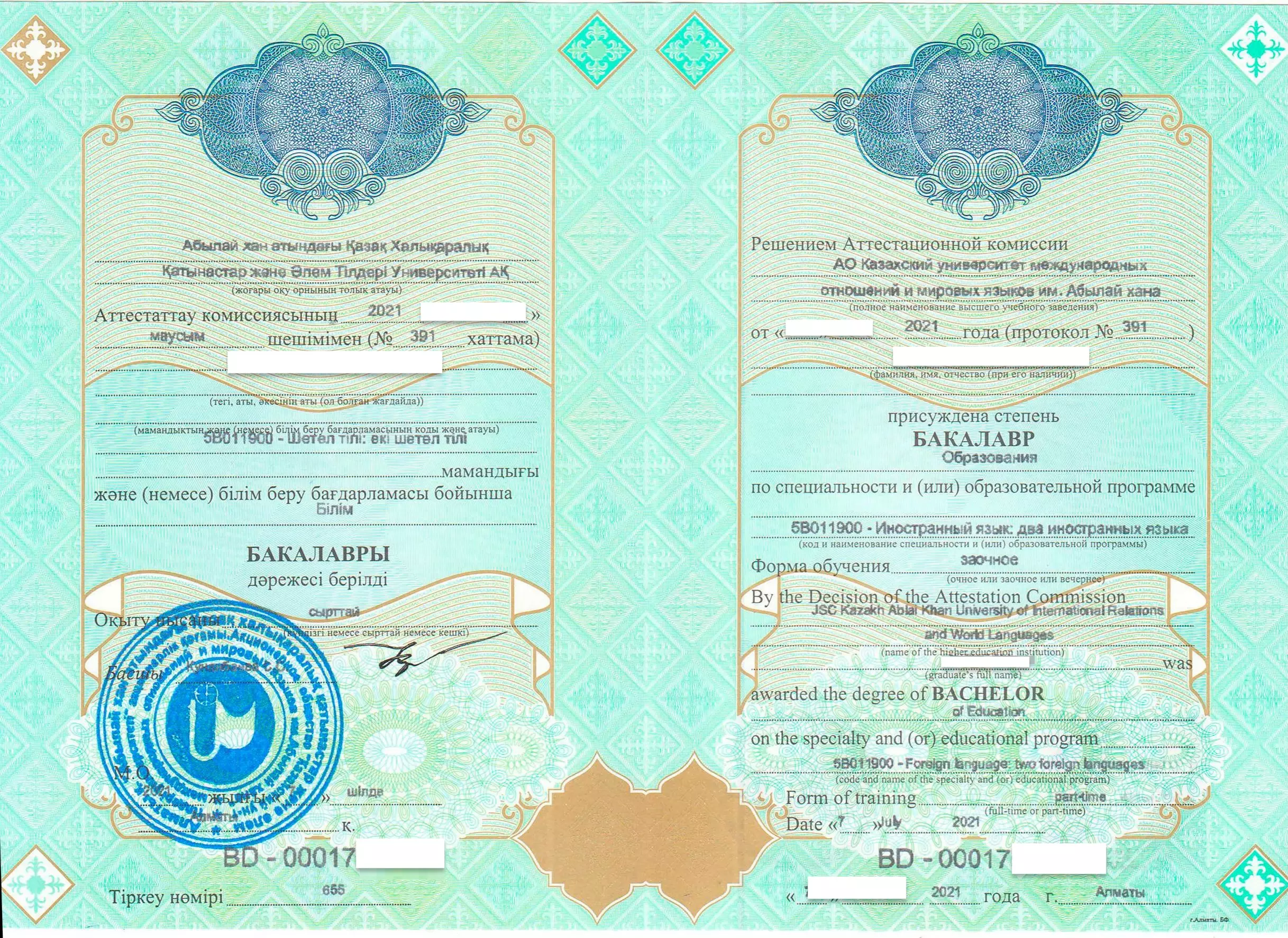
Educational documents in Kazakhstan are issued upon graduation from universities, vocational and technical colleges, schools, training courses, and other educational institutions. Main types of educational documents issued in Kazakhstan:
- Certificate of Basic Secondary Education;
- Certificate with Honors of Basic Secondary Education;
- Certificate of General Secondary Education;
- Certificate with Honors of General Secondary Education;
- “Altyn Belgi” Certificate of General Secondary Education (equivalent to a Gold Medal distinction);
- Diploma of Technical and Vocational Education;
- Diploma with Honors of Technical and Vocational Education;
- Diploma of Post-Secondary Education;
- Diploma with Honors of Post-Secondary Education;
- Certificate of Professional Training;
- Bachelor’s Degree Diploma in Higher Education;
- Bachelor’s Degree Diploma with Honors;
- Higher Education Diploma with Professional Qualification;
- Higher Education Diploma with Honors and Professional Qualification;
- Postgraduate Diploma conferring the degree of Master;
- Postgraduate Diploma conferring the degree of Doctor of Business Administration.
In addition, Kazakhstan has officially approved forms for certificates of postgraduate medical training, academic title certificates, and diplomas awarding academic degrees.
In certain cases, students may also receive official statements or certificates confirming their studies or qualifications.
Procedure for apostilling diplomas and certificates in Kazakhstan
The authority to apostille educational documents in Kazakhstan is divided between the Ministry of Education and the Ministry of Science and Higher Education.
Apostille certification for documents related to primary, secondary, technical, vocational, and postgraduate education is carried out by the territorial departments of the Committee for Quality Assurance in Education under the Ministry of Education of the Republic of Kazakhstan (legal basis: the State Service Rules “Apostille Certification of Official Documents Issued by Primary, Basic Secondary, General Secondary, Technical and Vocational, and Postgraduate Educational Institutions” dated May 18, 2020).
Apostille certification for higher and postgraduate education documents is carried out by the Committee for Quality Assurance in Science and Higher Education under the Ministry of Science and Higher Education of the Republic of Kazakhstan (legal basis: the State Service Rules “Apostille Certification of Official Documents Issued by Higher and/or Postgraduate Educational Institutions” dated December 11, 2023).
Applications for apostille certification are not submitted directly to the authorities, but through the national e-government portal or via the non-profit state corporation “Government for Citizens”.
To obtain an apostille for a diploma, certificate, or other educational document, applicants must visit a Public Service Center (PSC) with the original document, proof of identity, and proof of payment of the state fee. Applications may also be submitted through the portal using an electronic digital signature and a scanned copy of the document. In this case, the applicant must later appear at the PSC at the scheduled appointment time with the original document and identification.
What is an apostille?
What is an apostille? Why do I need an apostille? How do I get an apostille? - Our video will explain everything you need to know about the apostille. If you have a document that needs to be certified with an apostille for use abroad, Schmidt and Schmidt will assist you! We provide apostille services in more than 100 countries worldwide.
Consular legalization of diplomas and certificates from Kazakhstan
If the country where a Kazakhstani educational document will be used is not a party to the 1961 Hague Convention — for example, the UAE — the document must undergo the more complex and costly procedure of consular legalization.
Consular legalization is a multi-step procedure used to verify the authenticity of documents intended for countries that are not members of the 1961 Hague Convention. To complete consular legalization of a diploma or certificate issued in Kazakhstan, the following steps must be followed:
- Obtain the educational document;
- Submit the document to the Consular Service Department of the Ministry of Foreign Affairs of the Republic of Kazakhstan;
- Provide an identity document with a copy (and, if necessary, a copy of the document confirming authority to act on behalf of another person), as well as proof of payment of the state fee;
- Legalize the document through the Consular Service Department of the Ministry of Foreign Affairs;
- Obtain a notarized translation of the document;
- Legalize the document at the consulate or consular section of the embassy of the destination country.
Due to the number of required steps, this procedure is both time-consuming and relatively expensive. In some cases, the destination country may not have a consulate in Kazakhstan, meaning that the final stage of legalization must be completed in another country where the relevant consulate is located.
What is consular legalization?
In our video we are explaining what consular legalization is and where to apply for it.
Schmidt & Schmidt will assist you in all issues concerning the legalization.
Schmidt & Schmidt offers legalization in more than 80 countries all over the world.
Documents delivery from Kazakhstan
Despite the current international situation, it is still possible to send documents from Kazakhstan abroad. However, for certain destinations, international delivery may need to be arranged in several stages.
Translation of educational documents
When using an educational document issued in Kazakhstan in a foreign country, it is necessary to obtain an official translation of the document in accordance with the legal requirements of the destination country. Depending on local regulations, this may be a notarized, sworn, court-certified, or otherwise officially certified translation.
The translation must обязательно undergo a verification procedure. During this process, the completed translation is sent to the graduate for review in order to confirm the correct spelling of personal names, academic subjects, and titles of research papers, as translation inaccuracies may occur.
Depending on the legal requirements of the receiving country, the official translation may also need to be attached to an apostilled notarized copy of the document.
What’s next?
Once you have obtained your legalized diploma, along with a copy accompanied by a notarized official translation, the documents can generally be considered officially valid for use abroad.
In countries that do not have agreements with Kazakhstan on legal assistance and mutual recognition of foreign documents, educational documents must usually undergo a nostrification procedure after apostille certification or consular legalization, as well as official translation.
How can we help?
If you are located outside Kazakhstan, we will be happy to assist you with apostille certification and legalization of documents for international use.
You can always contact Schmidt & Schmidt. We have extensive experience in the legalization of various types of documents and provide a full range of related services, including obtaining notarized copies, translation, preparation of powers of attorney, legalization of documents before government authorities and foreign consulates, as well as international delivery of completed documents to most countries worldwide.
You can read more about the legalization and apostille process on our website.


