
Procurement of documents in China may be required when an original document has been lost, damaged, outdated, unavailable, or when a current official copy is needed for use abroad. Chinese civil status documents, police clearance certificates, educational records, corporate documents, and other official certificates are often requested for immigration, marriage registration, employment, university admission, inheritance, court proceedings, banking, and other legal or administrative purposes.
Schmidt & Schmidt assists with the procurement, preparation, certified translation, apostille certification in China, consular legalization, and international delivery of documents issued in mainland China. Through our own office in China — 上海史密德商务咨询有限公司 — we can coordinate the procedure directly with local authorities, notary offices, educational institutions, and other competent bodies.
If a Chinese document is intended for use abroad, obtaining the document itself is often only the first step. In many cases, the document must also be converted into a Chinese notarial certificate, translated, and authenticated with an apostille or consular legalization, depending on the destination country. A certified translation may also be required by the receiving authority abroad.
In this guide
When Is Document Procurement in China Needed?
Document procurement may be necessary when the original document is no longer available, when a newly issued copy is required, or when the receiving authority does not accept an old document. This is common in international procedures where foreign authorities request recent, verifiable, and properly legalized documents from China.
Chinese documents may need to be obtained or reissued for the following purposes:
- marriage registration abroad;
- family reunification and immigration procedures;
- visa, residence permit, or citizenship applications;
- employment abroad;
- university admission or recognition of qualifications;
- professional licensing and registration;
- inheritance, court proceedings, or notarial procedures;
- opening bank accounts or compliance checks;
- corporate due diligence and business transactions;
- preparation of documents for apostille or consular legalization.
For people who have already left China, the procedure may be difficult because many authorities require local knowledge, Chinese-language communication, proof of identity, household registration information, or an authorized representative. In some cases, a power of attorney may be required.
What Documents Can Be Requested in China?
The possibility of obtaining a document in China depends on the document type, place of issue, applicant’s status, available records, and local administrative practice. Commonly requested Chinese documents include:
Birth documents
Birth-related documents in China may include a medical birth certificate, birth registration records, household registration records and notarial birth certificates. For international use, foreign authorities often request a Chinese notarial birth certificate rather than the original domestic birth document.
If the original document is no longer available but a clear scan or copy has been preserved, it may still be possible to prepare a Chinese notarial certificate based on the available copy and official records. After that, the notarial certificate can be apostilled or legalized for use abroad, depending on the destination country.
Marriage documents
Chinese marriage certificates are issued by the competent civil affairs authority. For use abroad, the marriage is usually confirmed through a Chinese notarial certificate, which may then be translated and authenticated by apostille or consular legalization.
If the original marriage certificate is lost or unavailable, it may be necessary to check whether the marriage registration record can be confirmed by the competent local authority or whether a notarial certificate can be prepared based on existing copies, scans or official records.
Divorce documents
Divorce in China may be confirmed by a divorce certificate issued by the civil affairs authority, or by a court judgment or mediation document. For international use, the receiving authority may require a notarial certificate confirming the divorce.
In court divorce cases, additional proof may be required to show that the judgment or mediation document has entered into legal effect. If the original divorce document is unavailable, the possibility of preparing a notarial certificate depends on the court records, local archive practice and the documents available to the applicant.
Death documents
Death-related documents may be required for inheritance, estate settlement, pension matters, bank procedures, insurance claims or family record updates. Depending on the case, the procedure may involve hospital records, public security records, household registration information, civil registration records or notarial certification.
As with other civil status documents, obtaining a new original death-related document may be difficult without proper authorization and local access to the competent authority. If scans or previous copies are available, it may be possible to assess whether a notarial certificate can be prepared for use abroad.
Police Clearance Certificate from China
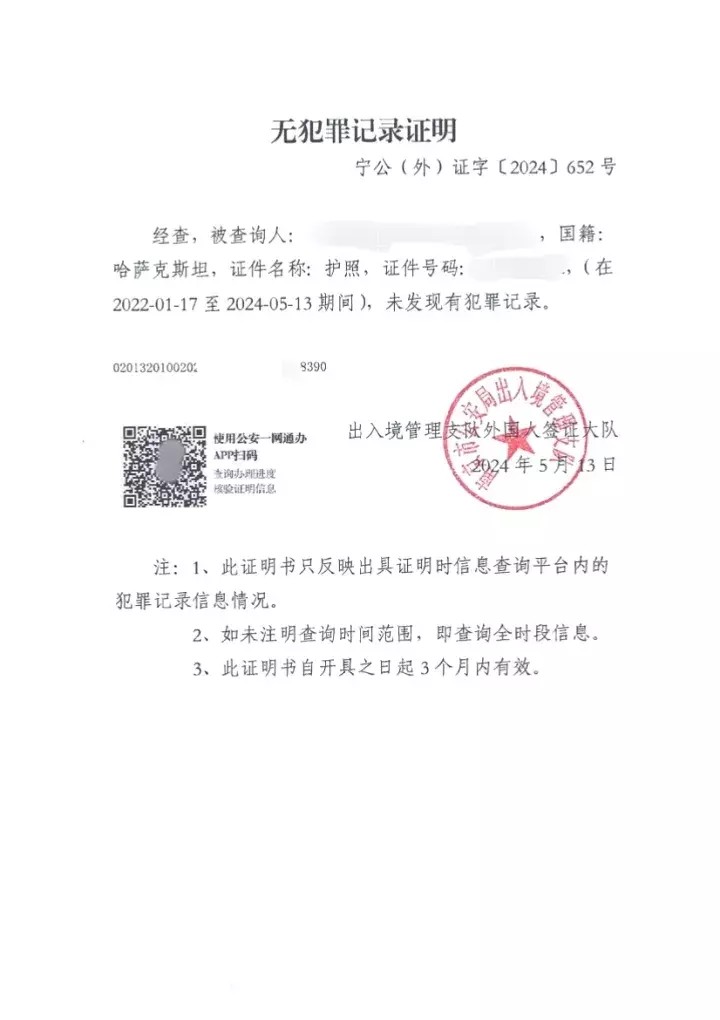
A Chinese police clearance certificate, also known as a certificate of no criminal record, may be required for immigration, employment, residence permits, citizenship applications, study abroad, marriage registration abroad, professional licensing or other official procedures.
In practice, this document can usually be requested only for a person who has continuously resided in China for more than six months. The exact procedure depends on the city of residence, the applicant’s status in China, the period of stay, available immigration records, and local public security requirements.
For foreign nationals, the following information and documents are usually required for preliminary assessment:
- a scan of the passport main page;
- scans of all Chinese visas, residence permits and entry/exit stamps covering the relevant period of stay in China;
- a scan of the residence registration in China, such as the temporary accommodation registration form;
- the name and address of the university, campus, employer or workplace in China;
- information about the city and period of residence in China;
- any previously issued Chinese police clearance certificate, if available.
The procedure is highly individual. In some cases, the competent authority may accept an application submitted through an authorized representative. In other cases, a notarized power of attorney may be required, and if the power of attorney is signed outside China, it may need to be apostilled or legalized before it can be used in China. Some local authorities may also request additional documents or even the applicant’s original passport for verification.
After the police clearance certificate has been issued, it usually has to be converted into a Chinese notarial certificate for use abroad. The notary may verify the contents of the certificate with the public security authority before issuing the notarial act. The notarial certificate can then be apostilled or legalized, depending on the destination country.
The preparation of a police clearance certificate together with the notarial certificate and apostille usually takes up to three weeks, depending on the city, the completeness of the documents, and the workload of the competent authorities.
It is also important to check in advance whether the translation included in the Chinese notarial certificate will be accepted in the destination country. Some receiving authorities may require an additional translation prepared by a local, sworn, accredited or otherwise approved translator.
Detailed information about Chinese police clearance certificates, including eligibility, required documents, notarization, apostille certification, consular legalization, translation requirements and processing time, is available in our guide on how to obtain a police clearance certificate in China.
Educational Documents and Academic Records
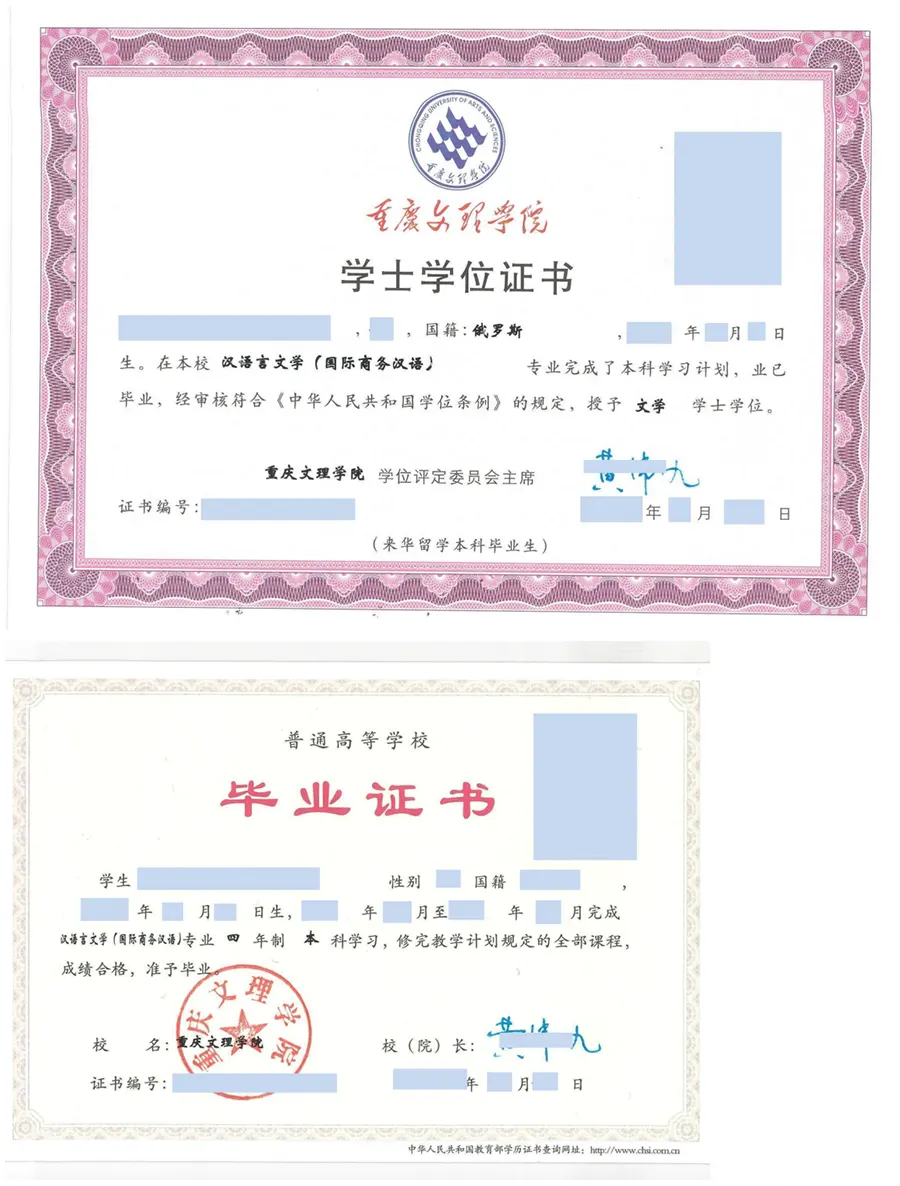
Chinese educational documents may be required abroad for university admission, employment, immigration, professional licensing, academic credential evaluation, and recognition of qualifications. These documents may include diplomas, degree certificates, graduation certificates, academic transcripts, certificates of study, enrollment records, and other academic documents issued by schools, colleges, universities, or educational authorities in China.
Depending on the case, it may be possible to:
- obtain a duplicate, replacement certificate, verification report, or official confirmation from the issuing institution;
- use a clear scan or preserved copy as a basis for preliminary assessment;
- verify the educational record through official Chinese education systems or directly with the issuing institution;
- prepare the document for notarization, apostille, consular legalization, or certified translation.
In some cases, the applicant may still have the original educational document or a clear scan. In other cases, the document may be lost, damaged, outdated, or difficult to access. The possibility of obtaining a replacement, duplicate, verification report, or other official confirmation depends on the issuing institution, the year of issue, the available records, and the requirements of the receiving authority abroad.
Before a Chinese educational document can be notarized, apostilled, or legalized for use abroad, it may need to be verified through official Chinese education systems or by the issuing institution. If the record cannot be found in the official system, the notary may refuse to issue the notarial certificate until the information is corrected or confirmed by the university or competent education authority.
For a detailed explanation of the procedure, including verification through Chinese education databases, preparation of a notarial certificate, apostille certification, consular legalization, translation requirements, and recognition of Chinese diplomas abroad, please see our dedicated guide on apostille and legalization of diplomas and educational documents from China.
Former Chinese Citizens and Household Registration Cancellation
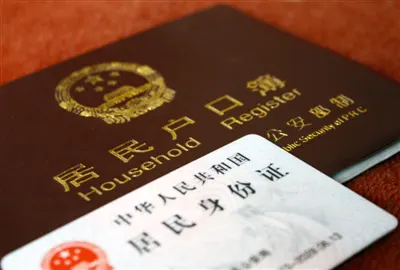
The procedure may be more complex for former Chinese citizens who have acquired another nationality. If the person previously held Chinese citizenship and had a household registration record in China, the authorities may first check whether the original 户口 was formally cancelled.
In practice, the Chinese administrative procedure in such cases can be quite formal and document-based. If the household registration has not been properly closed, the applicant may be asked to provide documents connected with the former Chinese identity, such as the Chinese identity card and household registration booklet.
If these documents are no longer available or cannot be renewed, the practical route is usually to obtain a Certificate of Household Registration Cancellation — 户籍注销证明. Only after this certificate has been issued can it usually become possible to request new Chinese documents or proceed with notarization based on the applicant’s previous records.
The 户籍注销证明 can normally be obtained either through a Chinese consulate abroad or by applying in person at the police station responsible for the place where the original household registration was recorded.
Procedure for Procuring Documents in China
The exact procedure depends on the type of document, place of issue, applicant’s current location, available records, and whether the document must be used in China or abroad.
-
1
Preliminary assessment
The available information is reviewed to determine which document is needed, where it can be obtained, whether a newly issued copy is possible, and whether the document must later be notarized, translated, apostilled, or legalized.
-
2
Identification of the competent authority
The competent authority may be a civil affairs bureau, public security bureau, notary office, university, education authority, court, company registry, or another local institution depending on the document type.
-
3
Preparation of supporting documents
The applicant may need to provide passport copies, Chinese identity documents, household registration information, old document scans, residence records, powers of attorney, or other supporting materials.
-
4
Application and document retrieval
The application is submitted to the competent authority or institution. Depending on the case, the authority may issue a duplicate, a current certificate, an official confirmation, or a document suitable for notarial certification.
-
5
Notarization, translation and authentication
If the document is intended for use abroad, it may need to be converted into a Chinese notarial certificate, translated, and then authenticated by apostille or consular legalization.
-
6
International delivery
Once the document is ready, it can be delivered to the applicant, a foreign authority, a university, employer, legal representative, or another recipient abroad.
Use of Chinese Documents Abroad
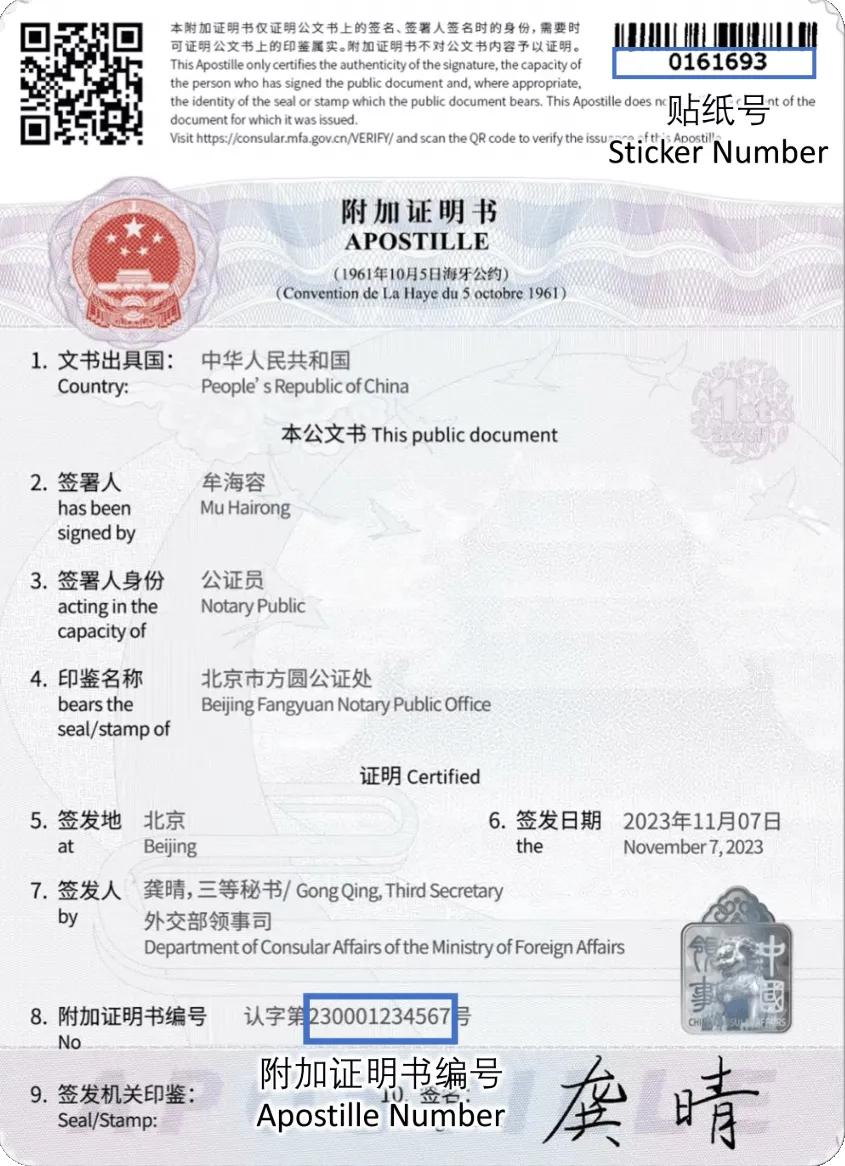
Documents obtained in China often require additional preparation before they can be accepted abroad. In many cases, a domestic Chinese certificate is not enough for foreign use. The document may first need to be notarized by a Chinese notary office and converted into a foreign-related notarial certificate.
If the destination country is a member of the Hague Apostille Convention, the notarial certificate may require an apostille in China. If the destination country is not a Convention member, or if apostille is not accepted for a specific purpose, consular legalization may be required.
A certified translation may also be required. The translation included in a Chinese notarial certificate may be necessary for authentication in China, but it may not always replace a translation required by the receiving authority abroad.
Validity and Timing of Chinese Documents
Many Chinese civil status documents do not have a fixed expiry date under Chinese law. However, the receiving authority abroad may require documents to be recently issued, especially for immigration, marriage registration, residence permits, employment, banking, or court procedures.
Police clearance certificates and certain administrative certificates are usually time-sensitive and may need to be obtained shortly before submission. The required issue date and acceptable validity period should always be checked with the receiving authority before starting the procedure.
If the document also requires notarization, translation, apostille, consular legalization, and international delivery, the overall timeline should be planned carefully so that the document does not become outdated before submission.
How Schmidt & Schmidt Can Assist
Schmidt & Schmidt can assist with the procurement and preparation of documents in China for use abroad. Through our own office in mainland China — 上海史密德商务咨询有限公司, located in Shanghai — we coordinate procedures directly with local authorities, notary offices, universities, public security authorities, and other competent institutions.
We can assist with:
- preliminary assessment of the required Chinese document;
- identification of the competent authority or institution;
- procurement of civil status documents, police clearance certificates, educational documents, and other official records;
- preparation of powers of attorney and authorization documents;
- notarization and preparation of Chinese notarial certificates;
- certified translation of Chinese documents;
- apostille certification in China;
- consular legalization where apostille is not applicable;
- international courier delivery of completed documents;
- consultation on the correct route for a specific destination country.
With our own Shanghai office and international network, we help reduce the risk of delays, incorrect document type, unsuitable notarization, wrong authentication route, translation problems, or rejection by the receiving authority abroad.