
When a marriage that took place in Turkey needs to be proven on an international platform for marriage registration abroad, visas, immigration, or legal proceedings, obtaining a Formula B (International Marriage Certificate) is required. This multilingual civil status document is commonly required for family reunification, residence permits, immigration procedures, inheritance matters, recognition of foreign divorce judgments, name changes, and other legal or administrative purposes.
Schmidt & Schmidt provides comprehensive assistance with obtaining Turkish civil status documents, arranging sworn translations, apostille authentication, consular legalization, and international courier delivery. We coordinate these processes directly with the Civil Registration Offices (Nüfus Müdürlükleri), District and Provincial Governorates, the Ministry of Foreign Affairs, and relevant consulates.
If a Turkish civil status document is intended for use abroad, it must first be obtained in the format required by the receiving authority, whether as a wet-signed original or a digitally signed document with a barcode. In most cases, depending on the international treaties the target country is a party to, the document must be duly authenticated with an apostille or through consular legalization.
When is Formula B required?
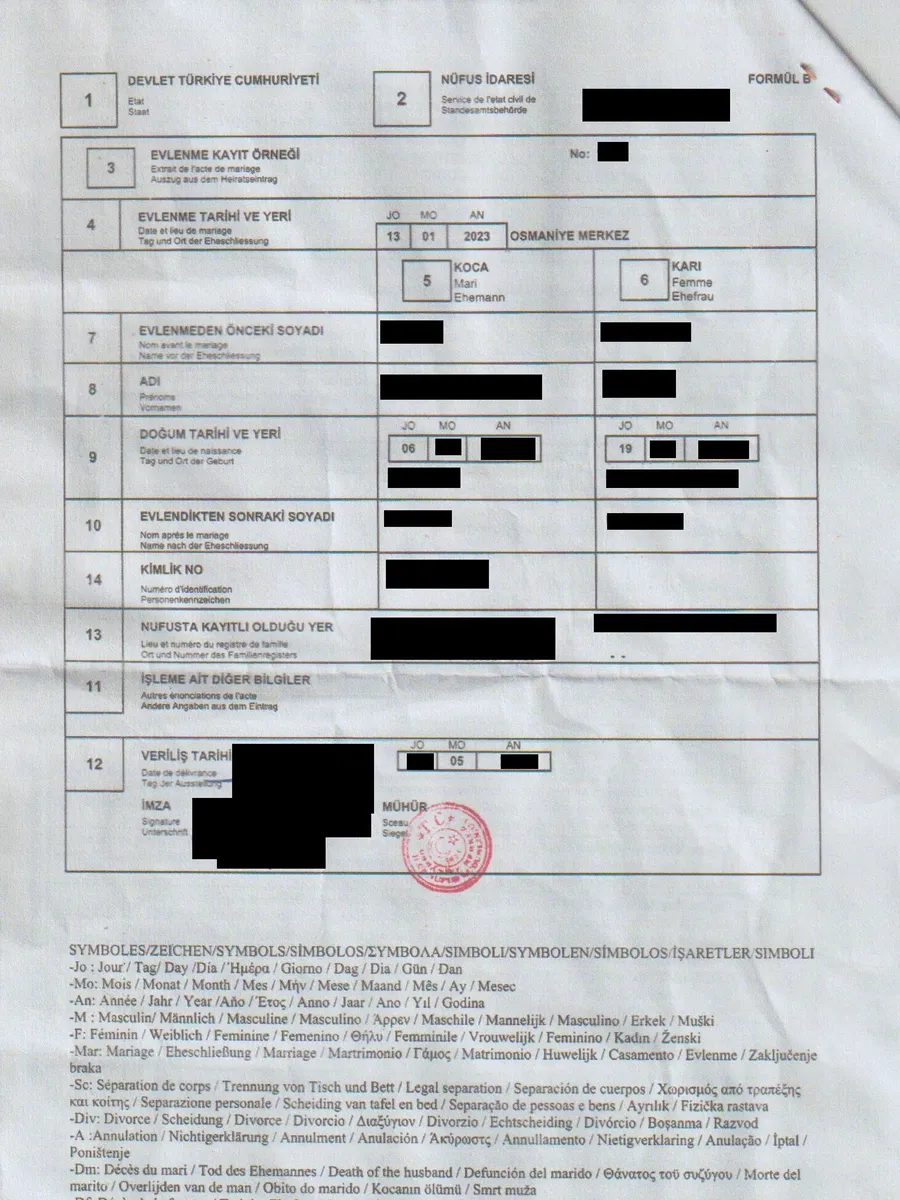
You may need this document when relocating abroad, completing official procedures, or proving your marital status to a foreign authority. It is commonly requested in international procedures where authorities require recent, multilingual, verifiable, and, where applicable, legalized documents issued in Turkey.
You may need to obtain a Formula B certificate for the following purposes:
- Registration of a Turkish marriage abroad
- Family reunification (Spouse Visa) and immigration procedures
- Residence permit, work permit, or citizenship applications
- International divorce or child custody cases
- Inheritance distribution and asset liquidation processes
- Registration of children born abroad and passport procedures
- Corporate compliance checks and opening bank accounts
For individuals living outside Turkey, completing these procedures independently can be a challenging task—especially when the receiving authority requires an original document with a "wet" signature and an apostille. In such cases, the process must be conducted through consulates or by issuing an official notarized Power of Attorney to a lawyer or a trusted representative in Turkey.
Schmidt & Schmidt can help you in both ways. If there is no Turkish embassy in your city or country, we can contact the diplomatic mission responsible for your region, or obtain the documents directly in Turkey. The process of obtaining the original document directly in Turkey takes about 3 working days. We act based on your notarized Power of Attorney, completely freeing you from bureaucratic routines and the need for personal travel.
Scope of Formula B vs. the Turkish family booklet
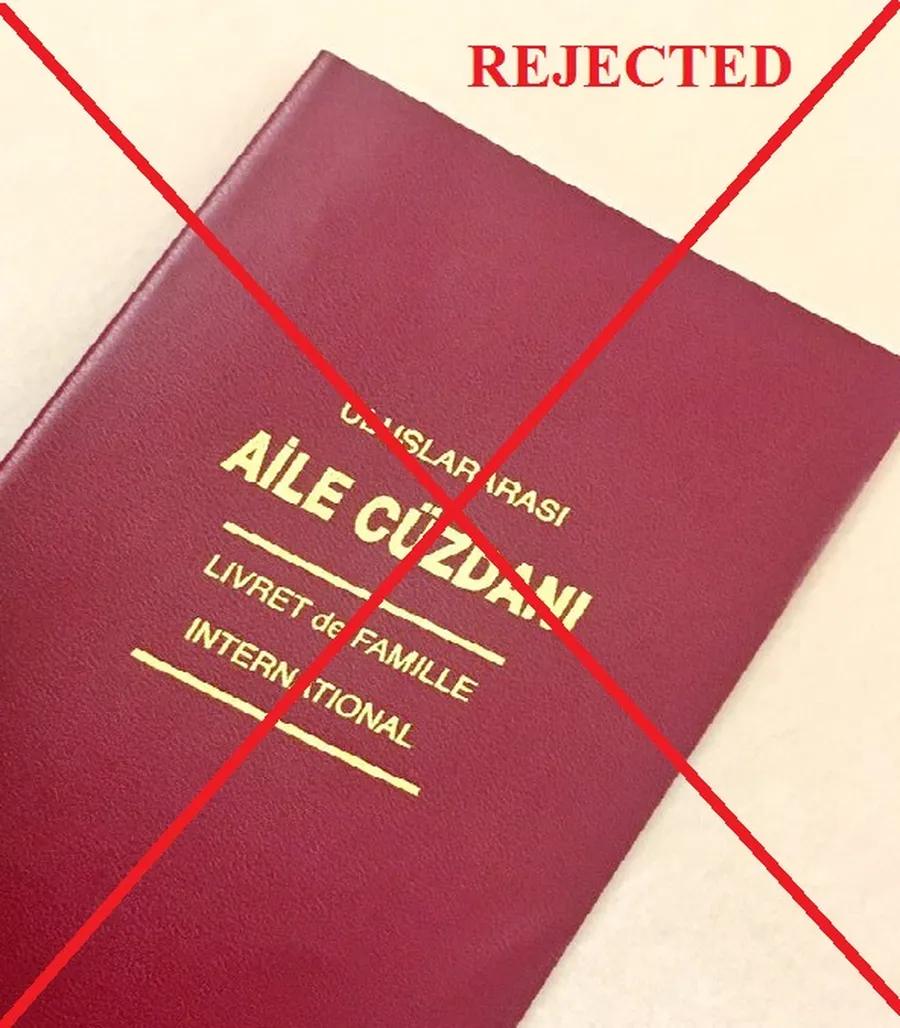
While several documents are issued in Turkey regarding marital status, foreign authorities have strict, standardized acceptance criteria. The most common point of confusion for our clients is the difference between the international Formula B and the domestic Turkish Family Booklet (Aile Cüzdanı).
- Family Booklet (Aile Cüzdanı): The traditional burgundy booklet handed to couples at their wedding ceremony serves a mostly ceremonial and domestic role. Because it lacks international standardization, it cannot be apostilled and will almost certainly be rejected by foreign immigration offices, consulates, and courts.
- Other Domestic Records: Documents like the Certificate of Capacity to Marry or the Detailed Population Extract serve entirely different legal purposes and cannot substitute a Formula B for proving a marriage abroad.
The Bottom Line: For international legal, immigration, or registration purposes, foreign authorities will demand a Formula B. Attempting to submit a translated Family Booklet will likely result in rejected applications, wasted translation fees, and lost time.
Special cases for foreign authorities
Dual Citizenship: If individuals who have acquired citizenship of another country (dual citizens) marry abroad using their foreign identity, the Turkish Central Civil Registration System (MERNİS) does not process this marriage automatically. First, the individual's dual citizenship status must be registered with the Turkish authorities, then the marriage must be recorded, and only after that can a Formula B be generated.
Formula B After Divorce: If you get divorced in Turkey, your marriage record is not deleted. If you obtain a Formula B after a court decree becomes final, the document will still display the details of the marriage. However, in the "Remarks" section, a specific numerical code will indicate that the marriage was dissolved by a court order.
Processing procedure
The exact procedure to follow depends on the applicant's current location, whether a digital document is accepted, and the destination country.
- 1. Preliminary assessment: We evaluate whether the target country accepts barcoded digital documents, whether the document falls under the CIEC agreement or the Hague (Apostille) Convention, and if a translation is necessary.
- 2. Determining the competent authority: For physical documents, the competent authorities are the Provincial/District Civil Registration Offices (Nüfus Müdürlükleri) in Turkey or Turkish Consulates abroad.
- 3. Preparing supporting documents: If the document is to be obtained via a proxy, a specifically worded, notarized Power of Attorney explicitly authorizing the representative to "obtain population registry extracts and international civil status documents" must be provided.
- 4. Application and retrieval: The application is submitted to the competent authority, and the document (wet-signed or digital) is obtained.
- 5. Notary approval, translation, and authentication: If the document will be used abroad and the target country is not a party to the CIEC convention, an apostille or consular legalization is required. If necessary, the sworn translation process is carried out.
- 6. International delivery: The completed original and legalized documents are delivered to the recipient abroad via international courier/cargo.
Short on time and unable to travel to Turkey? Contact us, and our team will procure and legalize your documents without your personal presence.
Why and when is an apostille needed?
An Apostille is a special international stamp that confirms the authenticity of an official document. It can be used to certify documentation issued by state institutions and local government bodies, which includes the Turkish Civil Registration Offices.
The apostille confirms the fact that the document was issued and verifies the authenticity of the authorized official's signature. The apostille stamp can only be applied in the territory of the country where the document was issued. It is impossible to do this through diplomatic or consular institutions abroad. In Turkey, the authority to issue apostilles lies with the Governorates (Valilik) and District Governorates (Kaymakamlık).
When an Apostille is NOT Needed (CIEC Convention No. 16): Formula B is issued in a standard format in accordance with the Vienna Convention No. 16 of the International Commission on Civil Status (CIEC). For documents submitted to member countries of this convention (e.g., Germany, Austria, France, Switzerland, the Netherlands, Belgium), neither an apostille nor a translation is required.
For countries that are signatories to the Hague Convention (e.g., the United States, the United Kingdom, Australia), the document must be authenticated with an Apostille. The apostille stamp is applied directly to the original Formula B document.
What is an apostille?
What is an apostille? Why do I need an apostille? How do I get an apostille? - Our video will explain everything you need to know about the apostille.
If you have a document that needs to be certified with an apostille for use abroad, Schmidt and Schmidt will assist you! We provide apostille services in more than 100 countries worldwide.
Consular legalization of documents in Turkey
If the document is to be used in a country that does not recognize the Hague Convention (for example, the United Arab Emirates, Qatar, China, and other states), a procedure called consular legalization is applied.
Consular legalization is the process of confirming the authenticity of a legal document so that the legal system of a foreign state recognizes it as valid. This is a more complex, lengthy, and expensive procedure compared to an apostille. In Turkey, it requires several preliminary certifications: the public document must be legalized by the Ministry of Foreign Affairs of Turkey, and only after that—authenticated by the embassy or consulate of the destination country.
What is consular legalization?
In our video we are explaining what consular legalization is, why it is needed, when it is applied, and how it differs from the apostille procedure.
Schmidt & Schmidt offers legalization in more than 80 countries all over the world.
Validity and timelines
Foreign authorities (especially immigration offices and foreign departments) typically require the submitted Formula B to have been issued within the last 6 months (or within the last 3 months for certain strict jurisdictions). Applications made with a Formula B that is over a year old will almost certainly be rejected. Because obtaining the document, completing the legalization process, arranging any required translation, and shipping it internationally can take time, the process should be planned carefully to ensure the document remains valid when submitted.
Official translation of documents
When using Formula B in the territory of a foreign state (that is not a part of the CIEC convention), an official translation must be made according to the legislative requirements of that state.
In Turkey, this process is strictly regulated: the translation is performed by an authorized sworn translator (yeminli tercüman), after which the signature is certified by a notary. The document translation must also undergo a verification process. This is a step where the prepared text is sent to the client to verify the correct spelling of the name and surname strictly according to their international passport, as inaccuracies can arise when converting Turkish characters (ç, ğ, ı, ö, ş, ü), leading to the document being rejected.
Forwarding of documents from Turkey
Despite complex international circumstances, the possibility of forwarding documents from Turkey remains reliable. We work with leading international courier services, which allows us to provide insured and secure delivery of the ready originals and legalized documents directly to the recipient abroad.
How can we help?
If you are outside of Turkey, we will be glad to assist you with the procurement, apostille authentication, and legalization of documents for use abroad. We have accumulated extensive experience in the legalization of civil documents and provide all necessary services in this area as a turnkey solution.
Our services include:
- Preliminary assessment of the Formula B requirements and destination country legislation;
- Preparation of the Power of Attorney and authorization documents;
- Procurement of the wet-signed original Formula B from the Civil Registration Offices;
- Sworn translation and notarization of Turkish documents;
- Execution of the Apostille procedure at the Governorates in Turkey;
- Consular legalization for countries where the apostille is invalid;
- Courier delivery of ready documents to most countries in the world.
Thanks to our international network, we minimize risks such as delays, obtaining the wrong type of document, or the ultimate rejection of the document by foreign institutions.
FAQ: Formula B and legalization of documents in Turkey
This depends entirely on the receiving foreign authority. While Turkey issues verifiable digital Formula B documents via the e-Devlet portal, many strict foreign immigration and civil registry offices still explicitly require an original hard copy with a physical "wet signature" and an ink stamp from the Population Directorate. You must verify this with the institution in your destination country before applying.
No. If you reside outside of Turkey, you can either request the document at your nearest Turkish Consulate or issue a notarized Power of Attorney to a representative or lawyer in Turkey. Our team can assist with procuring the document on your behalf if you provide the necessary authorization.
Not always. Because Formula B is created under CIEC Convention No. 16, it is exempt from apostille and translation requirements if it is being submitted to another country that is a signatory to this specific convention (e.g., Germany, Austria, Belgium, France). If you are submitting the document to a non-CIEC but Hague-member country (like the US or UK), an apostille is mandatory.
Obtaining the document and getting it apostilled locally in Turkey usually takes a few working days. However, if your document requires consular legalization (for non-Hague countries), or if you need sworn translations and international shipping, the process can take several weeks.