


Diplomas and diploma supplements issued by the Turkish Republic of Northern Cyprus (TRNC) can face difficulties when used abroad. In most countries, they carry no automatic legal force. In practice, this means that without proper legalization, a holder may struggle to enroll in a postgraduate program at a foreign university or take up employment in a government institution. That said, some direct agreements between TRNC universities and foreign institutions do allow for mutual recognition, so it is always worth checking with the receiving party first.
Whether legalization is needed — and whether it will be accepted — depends heavily on the target country. As a rule, countries with closer ties to Turkey, such as Azerbaijan, Pakistan, and some Central Asian states, tend to be more accommodating. Many EU member states, by contrast, are generally less likely to accept documents from an unrecognized entity, even with an apostille in place. If you are planning to use your diploma in a country where acceptance is uncertain, contacting the relevant Ministry of Education or the institution directly before starting the process can save considerable time and expense.
Crucial first step: Before starting, confirm in writing with the university or employer you are applying to that they will accept a TRNC document — even a legalized one. The TRNC's unrecognized international status means acceptance is never guaranteed.
Schmidt & Schmidt offers comprehensive consular legalization and apostille services for documents issued in the Turkish Republic of Northern Cyprus.
What Is an Apostille — and When Do You Need One?
An apostille is a special certification stamp that confirms the authenticity of an official document. It can be placed on documents issued by state bodies, local authorities, and organizations to which the state has granted special powers.
Key Facts to Keep in Mind:
- Private-sector certificates cannot be apostilled. If your certificate comes from a private company's training course without an official state educational license, it does not qualify. Only documents from accredited institutions with a formal state license are eligible.
- An apostille confirms authenticity, not equivalence. An apostille on a medical diploma, for instance, does not entitle you to practice medicine abroad — it simply confirms the diploma is genuine and correctly issued.
- An apostille must be affixed on the territory of the issuing country. It cannot be processed through diplomatic or consular missions abroad.
- Turkey is the only route for TRNC documents. Because the TRNC is internationally recognized solely by Turkey, documents issued there can only be apostilled for foreign use via Turkey. There is no alternative path, and whether the receiving country ultimately accepts such documents remains at its own discretion.
- An apostille is not always required. Most commercial employers, for positions that do not involve security clearance or regulated professional licenses, do not insist on one. Furthermore, if you plan to study or work in Turkey, no apostille is needed at all — TRNC universities operate under the rules of Turkey's Council of Higher Education (YÖK), meaning a shared educational framework already exists.
Why get an apostille? Having an apostille significantly speeds up recognition elsewhere. Without it, a foreign authority may spend up to 30 working days independently contacting the issuing institution to verify authenticity — and if the institution does not respond, recognition may be refused entirely. With an apostille, that verification step is skipped, and the process can be completed in as little as 10–15 days.
Step-by-Step Apostille Procedure for TRNC Diplomas
The process is multi-stage and must be followed in strict sequence. You will need the original diploma and, where applicable, the original diploma supplement. Since the procedure requires originals, documents must be physically sent to the processing office in Turkey — use only a reliable, trackable courier service. If you are unable to manage the process yourself, a representative acting under a notarized power of attorney can handle the procedure on your behalf.
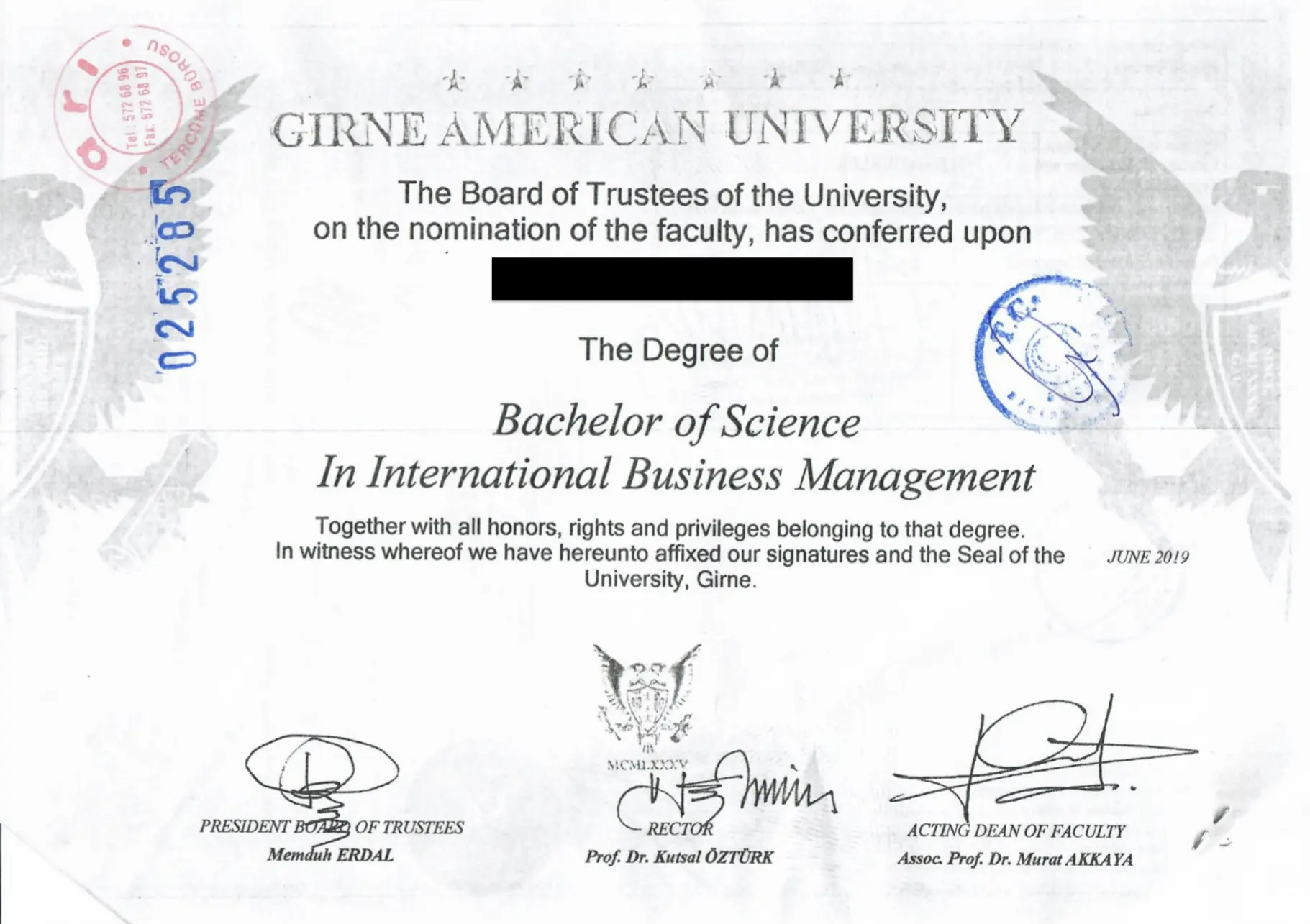
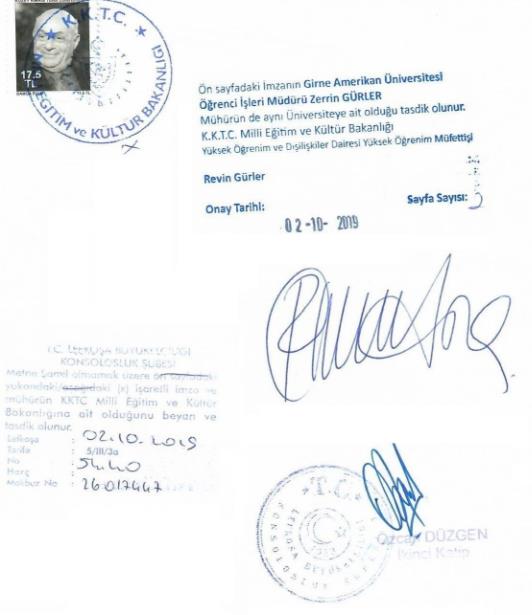
- Step 1 — Certification at the Turkish Embassy in Northern Cyprus. Have your diploma certified at the Turkish Embassy in the TRNC. Many universities already issue diplomas bearing the embassy seal; if yours does not, you must apply to the Embassy directly.
- Step 2 — Notarized copy in Turkey. Obtain a notarized copy of the certified diploma from a notary public in Turkey. Note: The diploma and its supplement (transcript) are treated as two separate documents and must each be apostilled individually — they cannot be combined under a single stamp.
- Step 3 — Translation into Turkish. TRNC universities often issue diplomas in English. If yours is not already in Turkish, a certified Turkish translation is required for processing by Turkish state authorities.
- Step 4 — Apostille on the notarized copy. The apostille is affixed by the provincial governorate (Valilik) of whichever city in Turkey is most convenient for you — you are not tied to a specific location. This typically takes 1–3 working days.
Translation and Recognition in the Target Country
To complete the recognition procedure abroad, a notarized translation of the diploma into the language of the target country is required. This can be certified either by a notary in the receiving country or by the diplomatic mission of the issuing country. The notarized translation is typically attached directly to the notarized and apostilled copy of the diploma.
Pro-Tip: Before finalizing the translation, review it thoroughly to check the accuracy of names, dates, the list of disciplines studied, and academic titles. Document errors are common, and a mistake at this stage can significantly delay recognition. Once the legalized diploma and its notarized translation are ready, they can be submitted for the formal recognition procedure in the target country.
What Can Go Wrong? (Common Pitfalls)
Even when you follow every step correctly, the apostille and recognition process has several real failure points worth knowing about in advance:
- Pre-emptive rejection by the receiving institution: Because the TRNC lacks international recognition beyond Turkey, some foreign universities and government employers flatly refuse TRNC documents regardless of an apostille. Always get written confirmation of acceptance first.
- Unnoticed translation errors: Mistakes in names, course titles, or academic degrees can cause immediate rejection at the recognition stage, forcing you to repeat the entire translation and certification process.
- No response from the institution (if non-apostilled): Without an apostille, foreign authorities must contact the TRNC institution directly. If the university fails to respond to international inquiries, recognition will be refused.
- Apostille on the wrong document version: If you have multiple copies (e.g., a draft, a ceremonial copy, and the official embassy-sealed copy), the apostille must go on the official certified version. An apostille on a ceremonial copy is legally worthless.
- Target country questioning document origin: Some states — particularly certain EU members — argue that a TRNC-origin document rerouted through Turkish notarization does not legitimately qualify for a Turkish apostille. Check the specific country's geopolitical stance beforehand.
- Regulated fields of study: In professions like medicine, law, engineering, and teaching, qualification recognition is governed by strict professional licensing bodies. An apostille only proves authenticity, not the right to practice. Additional exams, local accreditation checks, or supervised practice periods may still be required.
How Schmidt & Schmidt Can Help
If you are currently outside the TRNC or Turkey and need assistance with the apostille and legalization of your academic documents, Schmidt & Schmidt offers a full range of services. We handle notarial certification, professional translation, preparation of powers of attorney, certification at state authorities, and secure courier delivery to most countries worldwide.
Real Examples of Our Work (Case Studies)
Case 1: Bachelor's Degree, American University of Girne — Master's Application in Barcelona
Context: A graduate of the American University of Girne needed their bachelor's degree accepted by a university in Barcelona, Spain, for entry into a postgraduate program.
Solution: The Barcelona institution confirmed it would accept a notarized copy of the diploma provided it bore a Turkish apostille and was accompanied by a notarized translation into Spanish. Schmidt & Schmidt managed the process: the diploma was certified at the Turkish Embassy in the TRNC, a notarized copy was made in Turkey, the apostille was affixed by the Valilik, and a Spanish translation was attached.
Result: The university in Barcelona accepted the documents, and the applicant was successfully admitted to the master's program.
Key Takeaway: The apostille does not always need to be placed on the original diploma. If the receiving institution allows it, apostilling a notarized copy can simplify logistics and keep your original document safe.
Case 2: Third-Year Physics Student, ODTÜ Northern Cyprus Campus — Credit Transfer to Germany
Context: A student who completed three years of a physics bachelor's degree at the Middle East Technical University Northern Cyprus Campus (ODTÜ NCC) was transferring to a university in Germany. The German institution required official, legalized academic records to assess credit transfers.
Solution: The required documents included the official transcript, student enrollment certificate (öğrenci belgesi), and course syllabi. Schmidt & Schmidt coordinated the re-issuance of these documents through the university registrar, obtained the mandatory Turkish Embassy certification in the TRNC, and successfully processed the individual apostilles through the competent authorities in Turkey.
Result: The German university accepted the legalized records, processed the credit transfer, and the student successfully continued their degree in Germany.
Key Takeaway: The apostille procedure applies to academic records at any stage of study, not just final degrees. Transcripts and enrollment certificates must often be apostilled individually.
FAQ: Apostille and Legalization of TRNC Diplomas
Yes. We handle the entire cross-border process on your behalf. You will only need to send your original documents to our processing office via secure courier, or authorize a representative via a notarized power of attorney, which we can help prepare.
The Turkish state authorities (Valilik) typically process the apostille within 1 to 3 working days once they receive the documents. However, the entire multi-stage process—including embassy certification, notarization, translation, and international courier shipping—generally takes between 10 to 15 working days.
Yes. Turkish authorities treat the diploma and the diploma supplement as two separate official documents. They cannot be combined under a single apostille stamp, meaning both must go through the notarization and apostille process individually.
Because the TRNC is only recognized by Turkey, acceptance ultimately rests at the sole discretion of the receiving institution or foreign ministry. While our apostille process drastically increases your chances of success, we highly recommend getting written confirmation of acceptance from your target institution before beginning the procedure.
You must provide the original physical diploma and diploma supplement. Turkish state authorities and the embassy will not certify or apostille scanned copies, printouts, or digital PDFs. Because the process requires physical handling across multiple government offices, you will need to ship your original documents to our office via a secure, trackable courier service.
No, only documents from universities formally accredited and licensed by the TRNC Ministry of National Education and operating under the framework of Turkey’s Council of Higher Education (YÖK) can be processed. Diplomas or certificates from unaccredited private training academies or short-term courses do not qualify for state legalization or a Turkish apostille. If you are unsure about your institution's status, our team can verify eligibility before you ship your documents.
If you do not have your original documents, Schmidt & Schmidt can handle the reissuance process for you. We coordinate directly with the registrar's office at your university in Northern Cyprus to obtain fresh, official copies of your diploma, transcript, or student enrollment certificates. Once the new originals are successfully issued, we will immediately begin the multi-step embassy certification and Turkish apostille procedure on your behalf.
What is an apostille?
What is an apostille? Why do I need an apostille? How do I get an apostille? - Our video will explain everything you need to know about the apostille. If you have a document that needs to be certified with an apostille for use abroad, Schmidt and Schmidt will assist you! We provide apostille services in more than 100 countries worldwide.
What is consular legalization?
In our video we are explaining what consular legalization is and where to apply for it.
Schmidt & Schmidt will assist you in all issues concerning the legalization.
Schmidt & Schmidt offers legalization in more than 80 countries all over the world.


