Schmidt & Schmidt provides apostille and consular legalization services for documents issued in Hong Kong. We assist with document checks, apostille applications, notarization where required, and courier delivery abroad. If a new copy of a document is required, we can advise on the available ordering procedure and, where possible, assist with local formalities in Hong Kong.
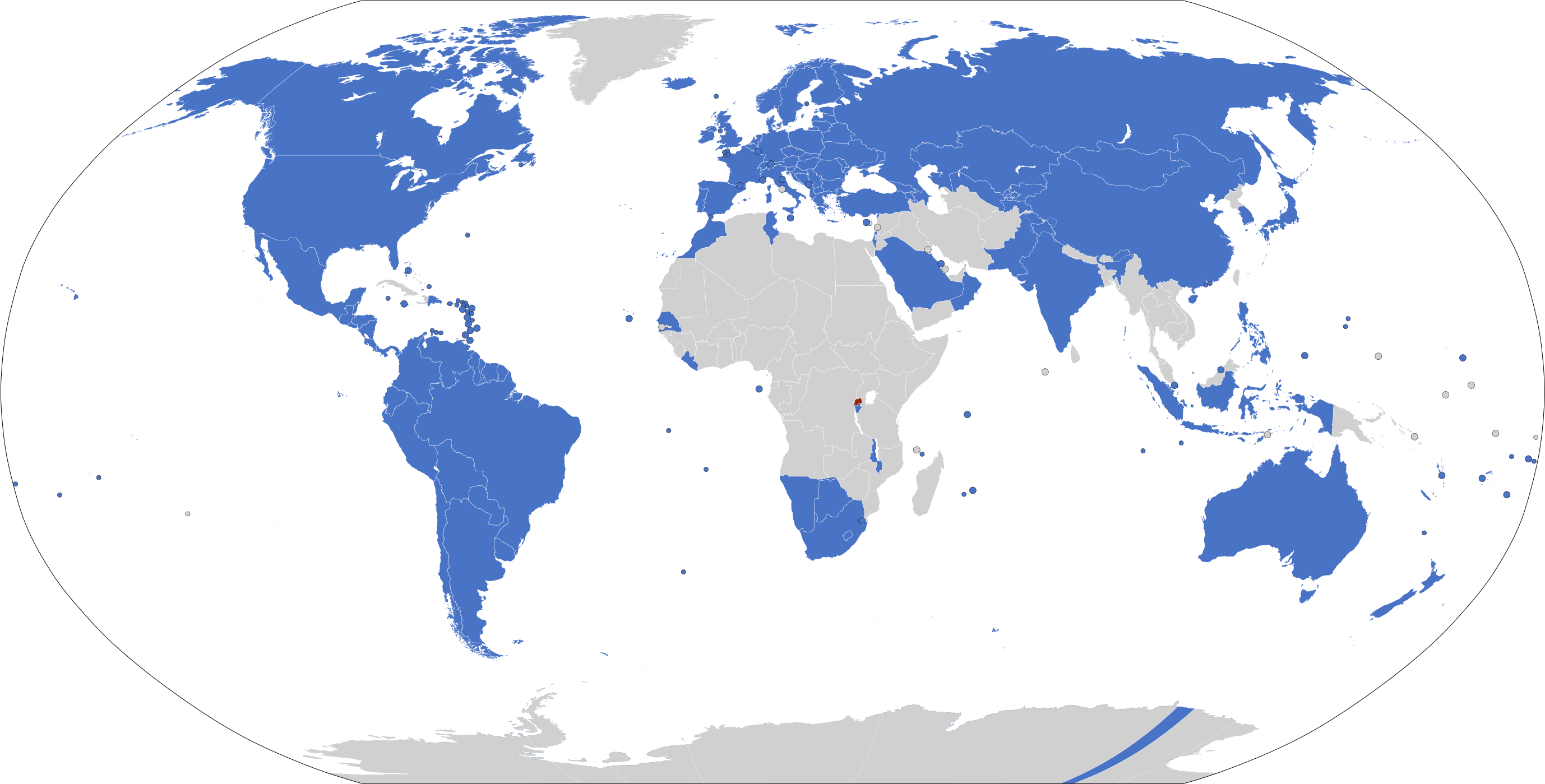
The Apostille Convention has been in force for Hong Kong SAR since 25 April 1965 and continued to apply after the transfer of sovereignty to China. Therefore, Hong Kong public documents can be certified with an apostille for use in other Contracting Parties to the Hague Apostille Convention.
Please note: Apostilles for documents issued in Hong Kong, Macao and Mainland China are issued under separate procedures and by different competent authorities. A Hong Kong apostille can only be issued for documents originating from Hong Kong. Documents issued in Mainland China must be apostilled in Mainland China, while documents issued in Macao must be processed through the competent authorities in Macao.
An apostille is an official certificate that confirms the authenticity of the signature, seal or stamp on a public document. It does not certify the content of the document itself, but confirms that the document was issued or certified by a competent authority.
If the destination country accepts apostilles, no further consular legalization is normally required. If the destination country does not apply the Apostille Convention, the document may need to undergo consular legalization instead.
Competent apostille authority in Hong Kong
In Hong Kong, apostilles are issued through the Apostille Service Office of the High Court Registry. The competent authorities designated under the Apostille Convention include the Administrative Secretary, the Registrar of the High Court, the Senior Deputy Registrar of the High Court and the Deputy Registrar of the High Court.
Before issuing an apostille, the authority checks whether the signature, seal or stamp on the document corresponds to its official records. If the document is accepted, an apostille certificate is attached to confirm the authenticity of the signature, seal or stamp.
For some documents, especially private documents such as powers of attorney, declarations or certified copies, notarization or certification by a competent Hong Kong professional may be required before the apostille can be issued.
Which Hong Kong documents can be apostilled?
A wide range of Hong Kong documents can be certified with an apostille, provided that they bear a verifiable official signature, seal or stamp, or have first been properly notarized or certified in Hong Kong. The most common categories include civil status documents, corporate and commercial documents, educational documents, court documents and notarial documents.
The key question is not only the type of document, but whether the signature, seal or stamp on the document can be verified by the competent authority in Hong Kong. Some public documents may be submitted for apostille directly, while private documents usually need to be notarized or certified before an apostille can be issued.
Please note: Ordinary photocopies, unsigned private documents, original identity cards or passports as physical ID documents are usually not apostilled as standalone documents. However, certified or notarized copies may be accepted in certain cases, depending on the document type and the requirements of the receiving authority.
Need to obtain a new copy before apostille?

In some cases, the document that needs to be apostilled has not yet been obtained, has been lost, or a more recent official copy is required. This may apply to civil status certificates, company documents, register extracts, court documents, educational records or other documents issued in Hong Kong.
Many Hong Kong documents can be ordered by the applicant directly through the relevant government portal, registry or issuing institution. For example, applications for searches and certified copies of Hong Kong birth, death and marriage records can be submitted through the official GovHK online service: Apply online for search of birth, death or marriage records or certified copies.
Important: If you order a new document yourself and would like us to arrange the apostille afterwards, please contact us before submitting the online application. When choosing the delivery or collection method, it may be necessary to indicate the address and recipient details of our representative in Hong Kong. If the document is sent to another address or reserved for collection by the applicant only, an additional authorisation or power of attorney may be required for us to receive or collect the document.
If you are not sure which document format is required for apostille, Schmidt & Schmidt can advise on the available ordering procedure and check whether the document is suitable for apostille certification. Where legally and practically possible, we can also assist with local formalities in Hong Kong, apostille certification and international courier delivery.
How to obtain an apostille in Hong Kong
The apostille procedure in Hong Kong depends on the type of document, the authority that issued it and the purpose for which the document will be used abroad. Before submitting a document for apostille, it is important to check whether the document can be accepted directly or whether it first needs notarization, certification or another preliminary step.
Step 1. Check the document
The first step is to determine whether the document is a Hong Kong public document, a certified copy, a notarial document or a private document. Documents issued by Hong Kong government authorities, courts or registries may often be submitted directly, provided that the signature, seal or stamp can be verified by the competent authority.
Private documents, such as powers of attorney, declarations, commercial documents, contracts or copies of identity documents, usually need to be notarized or certified in Hong Kong before an apostille can be issued.
Step 2. Prepare the document for submission
If the document is not ready for apostille in its current form, additional preparation may be required. This may include obtaining a new official copy, arranging notarization, preparing a certified copy, or checking whether a translation is required by the receiving authority abroad.
The exact preparation depends on the document type and on the requirements of the country or institution where the document will be submitted.
Step 3. Submit the document to the competent authority
Apostilles in Hong Kong are issued through the Apostille Service Office of the High Court Registry. The document is submitted for examination, and the authority checks whether the signature, seal or stamp on the document corresponds to its official records.
If the document is accepted, the prescribed court fee is paid and the application is processed by the competent authority.
Step 4. Receive the apostilled document
Once the apostille has been issued, the apostille certificate is attached to the document. The apostille confirms the authenticity of the signature, seal or stamp on the Hong Kong document and allows it to be used in countries that accept apostilles under the Hague Apostille Convention.
After completion, the document can be collected in Hong Kong or sent abroad by courier. If the destination country does not accept apostilles, consular legalization may be required instead.
Please note: The apostille confirms the authenticity of the signature, seal or stamp on the document. It does not certify the content of the document itself and does not guarantee that the receiving authority abroad will accept the document for a specific procedure. Requirements should always be checked in advance.
Apostille of Hong Kong educational documents
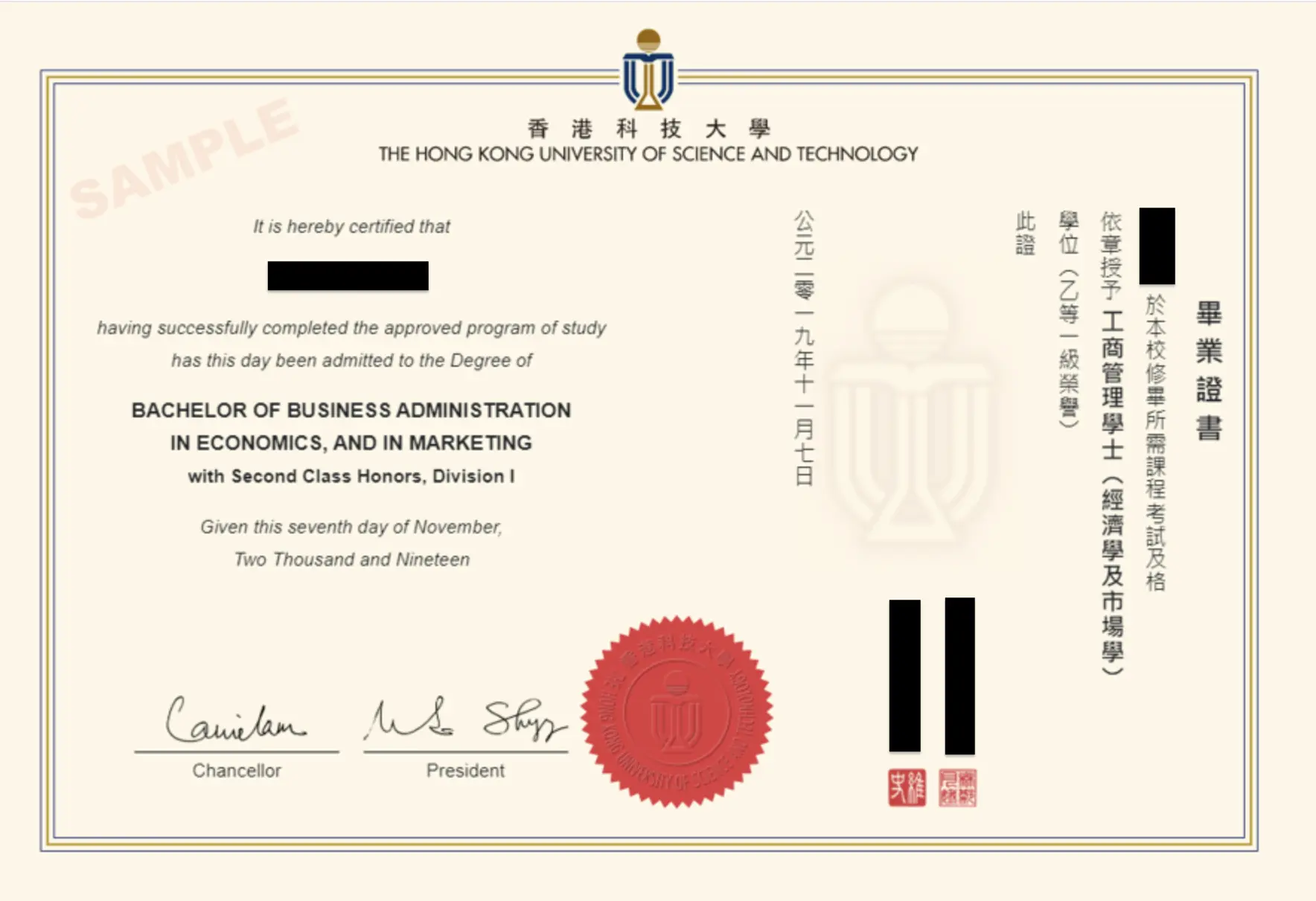
Educational documents issued in Hong Kong may require an apostille for use abroad, especially for university admission, academic credential evaluation, work visa applications, professional licensing, employment procedures or further studies.
This may apply to degree certificates, graduation certificates, academic transcripts, school records, certificates of enrolment, certificates of completion and other documents issued by schools, universities or educational institutions in Hong Kong.
The exact procedure depends on the format of the document and on whether the signature, seal or certification on the document can be verified by the competent authority in Hong Kong. Some educational documents may be submitted for apostille directly, while others may first require certification by the issuing institution, notarization or preparation of a certified copy.
Before submitting an educational document for apostille, it is advisable to check the requirements of the receiving authority abroad. In some cases, the receiving institution may also require a translation, a sealed transcript, direct verification from the university or a document issued within a specific period.
Consular legalization of Hong Kong documents for use abroad
Consular legalization may be required when a Hong Kong document is intended for use in a country that does not accept apostilles under the Hague Apostille Convention, or when the receiving authority specifically requests consular legalization.
In this case, the document may need to pass through additional authentication steps before it is submitted to the diplomatic mission of the destination country. The exact procedure depends on the type of document, the country where it will be used and the requirements of the relevant embassy or consulate.
Consular legalization may also involve additional requirements, such as notarization, certified copies, translations, application forms or supporting documents. For this reason, the requirements should be checked with the receiving authority or diplomatic mission before the procedure is started.
Please note: Apostille and consular legalization are not interchangeable procedures. The correct procedure depends mainly on the country where the Hong Kong document will be used.
Apostille vs consular legalization
Both apostille and consular legalization are used to authenticate documents for use abroad. However, they apply in different situations and follow different procedures.
| Apostille | Consular legalization | |
|---|---|---|
| When it applies | Used when the destination country accepts apostilles under the Hague Apostille Convention. | Used when the destination country does not accept apostilles or specifically requires consular legalization. |
| Authority involved | Issued by the competent apostille authority in Hong Kong. | Usually involves additional authentication steps and the diplomatic mission of the destination country. |
| Procedure | Usually simpler and faster, provided that the document is eligible for apostille. | Usually more complex, as requirements vary depending on the embassy or consulate. |
| Use abroad | No further consular legalization is normally required in countries accepting apostilles. | The document is legalized for use in the specific country whose embassy or consulate completed the legalization. |
| Additional requirements | May require notarization or certification first, depending on the document type. | May require notarization, translation, application forms, supporting documents or prior authentication. |
Related services
FAQ: Apostille and consular legalization of Hong Kong documents
No. Hong Kong, Macao and Mainland China have separate apostille procedures and different competent authorities. The correct place of apostille depends on where the document was issued, not on the applicant’s nationality or place of residence.
No. A document issued in Mainland China must be processed through the competent apostille authority in Mainland China. Hong Kong apostilles are issued for documents originating from Hong Kong only.
No. Documents issued in Macao must be apostilled through the competent authorities in Macao. Hong Kong, Macao and Mainland China should be treated as separate jurisdictions for apostille purposes.
Consular legalization may be required when the destination country does not accept apostilles under the Hague Apostille Convention, or when the receiving authority specifically requests consular legalization. The exact procedure depends on the destination country, the document type and the requirements of the relevant embassy or consulate.
No. An apostille confirms the authenticity of the signature, seal or stamp on a public document. It does not certify the content of the document itself and does not confirm whether the information in the document is correct or sufficient for a particular procedure.
No. An apostille confirms the authenticity of the signature, seal or stamp, but it does not guarantee acceptance by the receiving authority abroad. The receiving authority may have additional requirements regarding document format, validity period, translation, certification or supporting documents.
Private documents are usually not apostilled as standalone documents. However, they may become eligible for apostille after notarization or certification by a competent professional in Hong Kong. This may apply to powers of attorney, declarations, affidavits, commercial documents, contracts, invoices and certified copies.
In many cases, the original document or an officially certified copy is required. Ordinary photocopies are usually not accepted unless they have been properly certified or notarized. The exact requirement depends on the document type and the authority that issued or certified it.
This depends on the requirements of the receiving authority abroad. In some cases, the original Hong Kong document is apostilled first and translated in the destination country. In other cases, a certified translation prepared in Hong Kong may also need to be notarized or certified before apostille. We recommend checking the required format before starting the procedure.
Yes, educational documents issued in Hong Kong may be apostilled if the signature, seal or certification on the document can be verified or if the document is first properly certified. This may apply to degree certificates, graduation certificates, academic transcripts, school records, certificates of enrolment and other documents issued by recognized educational institutions.
No. An apostille confirms the authenticity of the signature, seal or stamp on the educational document or its certification. It does not evaluate the academic level of the qualification and does not replace credential evaluation where such evaluation is required.
In many cases, applicants can order searches and certified copies of Hong Kong birth, death or marriage records through the official GovHK online service: Apply online for search of birth, death or marriage records or certified copies.
If the document will then be sent to us for apostille, please contact us before submitting the online application. It may be necessary to indicate the address and recipient details of our representative in Hong Kong when choosing the delivery or collection method.
If the document is sent to another address or reserved for collection by the applicant only, additional authorization may be required for us to receive or collect it. In some cases, this may require sending an original authorization or power of attorney to Hong Kong, which can make the procedure longer and more complicated.
In many cases, submission or collection by a representative is possible. However, depending on the document type, the collection method and the requirements of the issuing authority, authorization or additional supporting documents may be required.
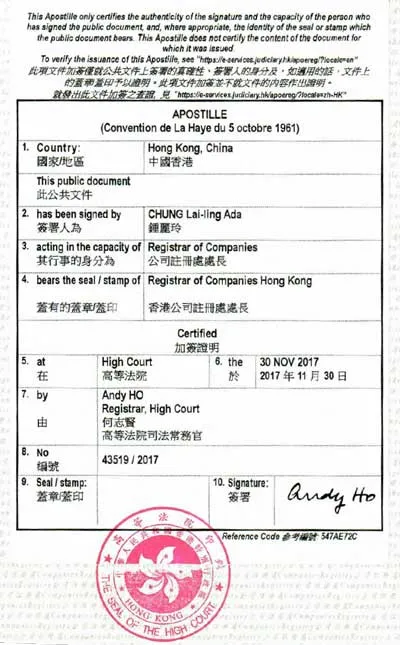
A Hong Kong apostille is attached to the document as an official apostille certificate. It contains the heading “Apostille” and refers to the Hague Convention of 5 October 1961. The exact appearance may depend on whether the apostille is issued in paper form or through an electronic apostille procedure.
Hong Kong has introduced electronic apostille services for certain digitally signed documents. However, not every document can be processed electronically. The availability of e-Apostille depends on the type of document, the form of signature and the applicable requirements of the Apostille Service Office.
The Apostille Convention of 5 October 1961 has been in force for Hong Kong SAR since 25 April 1965. This means that Hong Kong public documents can be certified with an apostille for use in other Contracting Parties to the Convention.
Other international conventions may also apply to specific legal matters, including the Convention of 15 November 1965 on the Service Abroad of Judicial and Extrajudicial Documents in Civil or Commercial Matters and the Convention of 1 June 1970 on the Recognition of Divorces and Legal Separations. However, these conventions do not replace the apostille procedure and are relevant only in specific legal contexts.