Schmidt & Schmidt provides apostille and consular legalization services in Turkey for public documents issued in Turkey and intended for use abroad. We manage the complete authentication workflow, including document procurement, notarization, certified translation, apostille certification, consular legalisation through embassies in Turkey, and international courier delivery.
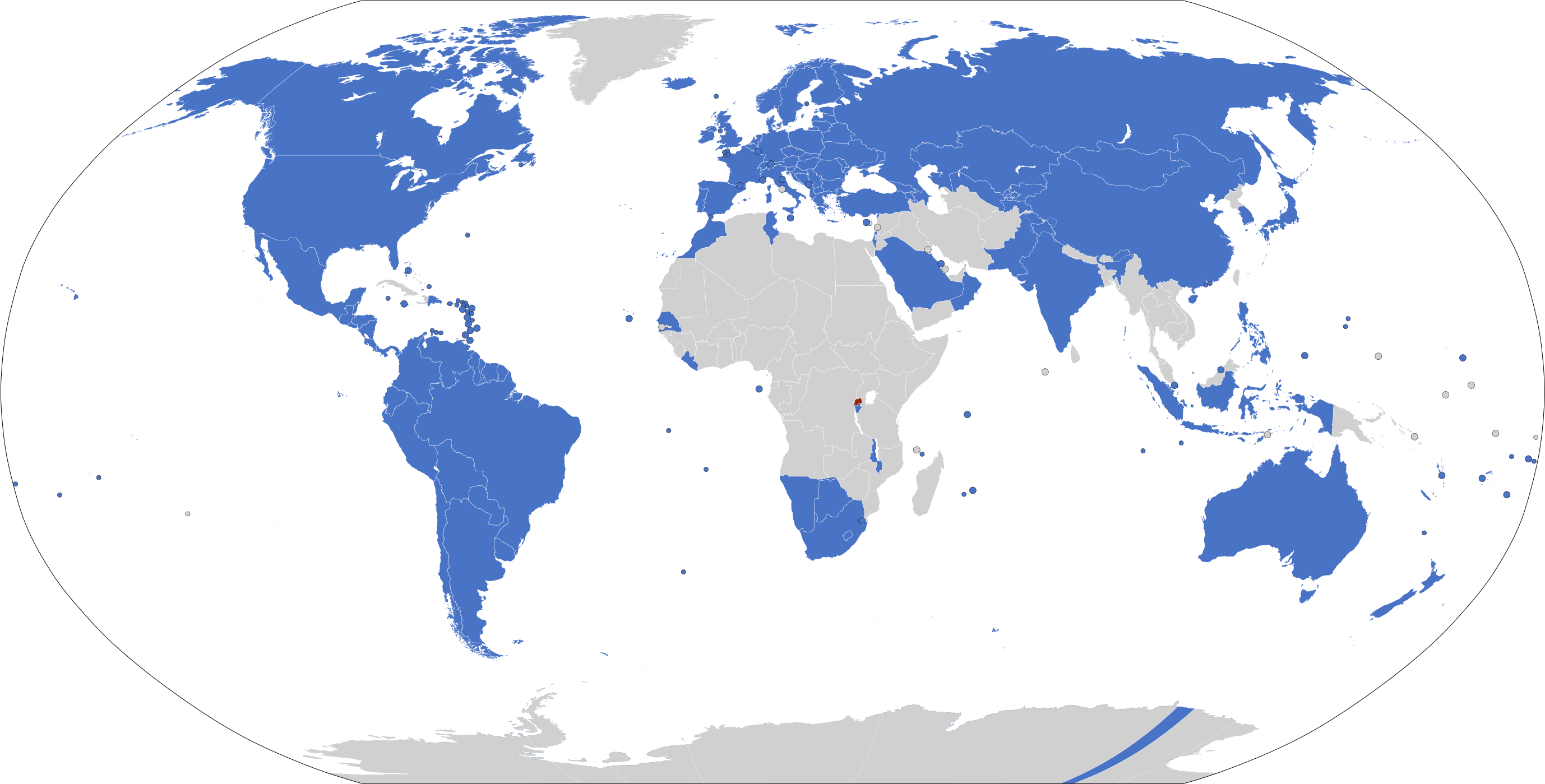
Turkey joined the Hague Convention Abolishing the Requirement of Legalisation for Foreign Public Documents in 1985. Documents issued in Turkey can therefore be authenticated for use in over 120 member states by means of a standardized certificate known as an Apostille, without the need for multi-tier consular legalization.
In brief: Apostille and Legalization Requirements in Turkey
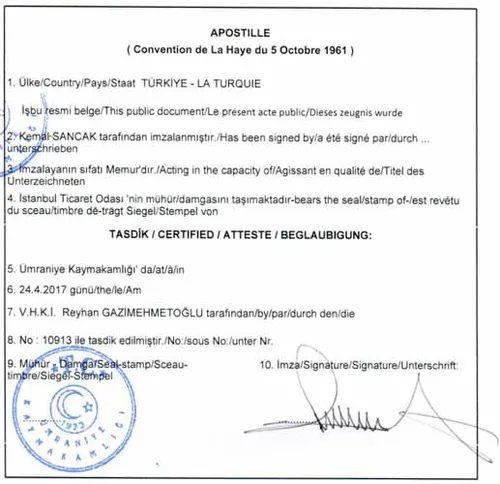
- What is a Turkish Apostille? A square stamp (at least 9×9 cm) with the mandatory heading "Apostille" and the French reference (Convention de La Haye du 5 octobre 1961) certifying the authenticity of the signature, seal, and capacity of the issuing official.
- Competent Authorities: Administrative documents (civil status, notary acts) are apostilled by Governor’s Offices (Valilik) or District Governor’s Offices (Kaymakamlık). Judicial documents (court decisions) are handled by the Presidency of the Judicial Commission (Adli Yargı Adalet Komisyonu Başkanlığı). Electronic apostilles are processed via the PTT e-Apostille system.
- Jurisdiction Rule: For in-person applications, the competent authority depends on the place of issue or certification, not the applicant's residence. Documents from different cities require separate applications in their respective districts.
- Private Documents: Contracts, commercial agreements, and private powers of attorney cannot be apostilled directly. They must first undergo Turkish notarization, converting them into public notarial acts.
- e-Apostille System: Turkey issues electronic apostilles via the state postal service (PTT) for criminal record certificates, court decisions, population register extracts, and multilingual civil status certificates (Formula A, B, C).
- Non-Hague Countries: For countries that are not party to the Hague Convention, full consular legalization is required (Notary → Ministry of Foreign Affairs in Ankara → Embassy of the destination country).
- CIEC Exemptions: Multilingual civil status extracts (Formula A, B, C) issued under the 1976 Vienna CIEC Convention and certificates of capacity to marry under the 1980 Munich CIEC Convention are exempt from all legalization formalities in contracting states.
- Educational Documents: University diplomas, ÖSYM certificates, and transcripts require preliminary verification (e.g., YÖK/Ministry of National Education) before notarization and apostillation.
- Sequence of Translation: The correct workflow is Original Document → Apostille on Original → Sworn Translation → Notarization of Translation / Second Apostille (if required by the destination country).
What is an Apostille and when is it required?
An Apostille (or "Hague Apostille") is a standardized certificate that authenticates the origin of a public document (e.g., birth, marriage, or death certificates, court judgments, commercial register extracts from Turkey, or notarial certifications). It certifies the authenticity of the signature and seal of the issuing official, as well as the legal capacity in which the official acted.
Turkey joined the Hague Convention of October 5, 1961, on September 29, 1985 (the treaty entered into force on September 29, 1985). Consequently, public documents issued in Turkey and affixed with a Hague Apostille are legally recognized in all other member states without requiring additional verification by foreign embassies or consulates.
The Apostille in Turkey is a square stamp in the Turkish language with the mandatory French heading "Apostille (Convention de La Haye du 5 octobre 1961)". The sides of the Apostille stamp must measure at least 9 centimeters in length. It is affixed directly onto the reverse side of the original document or placed on an attached extension sheet (allonge) securely bound to the document with official seals.
An apostille is necessary whenever a Turkish document must be presented to official authorities, educational institutions, courts, or banks in another country for visa applications, immigration, marriage registration, university enrollment, employment, corporate branch setup, or litigation. For countries that are not signatories to the Hague Convention, standard consular legalization is mandatory instead.
Need an apostille or legalization for a Turkish document?
Send us a scan of your document and tell us the country where it will be used.
Competent apostille authorities in Turkey
Jurisdiction for issuing an apostille in Turkey is divided among different state bodies depending on the legal nature of the document:
- For Administrative Documents: Including civil status certificates, population register extracts, diplomas, notarial certifications, powers of attorney, and commercial register documents.
- At the provincial level: The Governor's Office (Valilik) in each of Turkey's 81 provincial capitals.
- At the district level: The District Governor's Office (Kaymakamlık) in municipal districts.
- For Judicial and Court Documents: Including divorce decrees, court judgments, indictment files, and judicial records.
- Handled by the Presidency of the Judicial Commission (Adli Yargı Adalet Komisyonu Başkanlığı) located at Assize Courts (Ağır Ceza Mahkemesi) in major court centers.
- For Central Ministry & e-Apostille Documents:
- Central court and Ministry of Justice documents are processed electronically through the Ministry of Justice and the Ministry of Interior via the state postal service's PTT e-Apostille system.
The issuing authority verifies the signature, title, and seal on the document against its official central registry. If the signature matches the registered specimen, the Apostille is officially affixed and signed by the appointed official.
Types of documents eligible for apostille
The Hague Convention applies exclusively to public documents issued by an authority or an official connected with the courts or administration of the state. Private documents cannot be apostilled directly.
| Can be apostillized directly | Cannot be apostillized directly |
|---|---|
|
|
Two-Step Apostille Process for Private Documents
Private agreements, commercial contracts, corporate financial statements, and private powers of attorney cannot receive a Hague apostille directly. To legalise these documents for international use in Turkey, a standard two-step procedure is followed:
- The private document is presented to a Turkish notary public who certifies the signatures, execution, or official copy. This converts it into a public notarial act.
- The notarial act is then submitted to the local Kaymakamlık or Valilik overseeing the notary for the final apostille certification.
Document requirements and apostille procedure in Turkey
To qualify for an apostille in Turkey, a document must satisfy strict formal standards:
- Original or Certified Copy: The document must be an original public document or an official certified copy issued by the competent registry. Ordinary uncertified photocopies are rejected automatically.
- Physical Condition: The document must be undamaged, with clear, fully legible seals, stamps, and handwritten signatures. It must not contain unauthorized handwritten notes, corrections, or stickers.
- Legible Official Seal: The signature and seal of the issuing official or notary must be on file in the verification database of the Kaymakamlık, Valilik, or Judicial Commission.
Standard Step-by-Step Procedure
- Procurement: Obtaining the official original public document or certified registry copy from the issuing authority in Turkey.
- Pre-verification (if applicable): Obtaining necessary preliminary approvals (e.g., YÖK endorsement for higher education diplomas, Trade Registry verification for corporate records).
- Notarization (if applicable): Certifying private documents, translations, or copies through a Turkish notary public.
- Signature Verification & Apostillation: Presenting the document to the competent Kaymakamlık, Valilik, or Judicial Commission for signature verification against the central database and affixing the physical Apostille stamp.
- Translation & Submission: Executing a sworn translation into the language of the receiving country and submitting it to the destination authority.
Completing the entire process, including preliminary checks and courier handling, generally takes between 5 and 14 business days depending on the cities involved.
The e-Apostille system in Turkey
Turkey operates an electronic apostille system (e-Apostille) accessible via www.eapostil.gov.tr, executed through the state postal service (PTT) in coordination with the Ministry of Justice and the Ministry of Interior.
The e-Apostille system allows electronic documents signed with a secure Qualified Electronic Signature (QES) to be apostilled online. The generated e-Apostille contains a verifiable QR-code and digital signature, enabling foreign institutions to verify its authenticity online.
Eligible e-Apostille Document Categories:
- Criminal Record Certificates (Adli Sicil Belgesi)
- Court Decisions and Judicial Judgments
- Population Register Extracts (Nüfus Kayıt Örneği)
- Multilingual Civil Status Certificates (Formula A, Formula B, Formula C)
Important Acceptance Note: While an e-Apostille possesses the same legal standing as a paper apostille under the Hague e-APP program, certain foreign embassies, municipal registries, and financial institutions still insist on physical paper apostilles with wet-ink signatures and embossed seals. Always confirm with the receiving authority whether an electronic apostille is accepted before choosing this option.
Processing times and factors affecting delays
Apostille processing times in Turkey are non-standardized. Each Governor's Office, District Office, and Judicial Commission manages its daily queue independently based on local caseloads:
- Small District Authorities: In less populated districts, an in-person apostille application can often be completed within a few hours or on the same day.
- Metropolitan Authorities (Istanbul, Ankara, Izmir): High-volume offices in major cities typically require 3 to 7 business days for processing.
- Peak Periods & Archive Checks: During peak seasons or when older archive records require manual verification, processing can take up to 2 weeks or longer.
There is no official government "expedited fee" service for physical apostilles at Turkish offices. Submitting applications well in advance of visa or corporate deadlines is strongly recommended.
Exemptions from authentication (CIEC Conventions & Treaties)
Under specific international conventions and bilateral legal assistance treaties, certain Turkish public documents are completely exempt from apostille certification and consular legalization:
1. Multilingual Civil Status Certificates (CIEC Vienna Convention 1976)
Multilingual extracts from civil status registers issued on official international forms pursuant to the Vienna Convention of the International Commission on Civil Status (CIEC) are recognized in contracting states without any apostille or translation requirement:
- Formula A (Birth Certificate / Doğum Kayıt Örneği)
- Formula B (Marriage Certificate / Evlenme Kayıt Örneği)
- Formula C (Death Certificate / Ölüm Kayıt Örneği)
Contracting States: Austria, Belgium, Bosnia-Herzegovina, Bulgaria, Estonia, France, Germany, Cape Verde, Croatia, Lithuania, Luxembourg, North Macedonia, Moldova, Montenegro, Netherlands, Poland, Portugal, Romania, Serbia, Slovenia, Spain, Switzerland, and Turkey.
2. Certificate of Capacity to Marry (CIEC Munich Convention 1980)
Multilingual Certificates of Capacity to Marry (Evlenme Ehliyet Belgesi) issued under the Munich CIEC Convention are also exempt from all authentication formalities in: Austria, Germany, Greece, Italy, Luxembourg, Moldova, Netherlands, Portugal, Switzerland, Spain, and Turkey.
3. Bilateral Legal Assistance Treaties
Turkey has entered into special bilateral agreements exempting certain judicial and personal status documents from legalization with specific nations, including Luxembourg, Spain, and Switzerland. However, these exemptions apply strictly to specific public document categories; higher education diplomas and commercial register files usually remain subject to mandatory apostille certification.
Legalization of Turkish educational documents
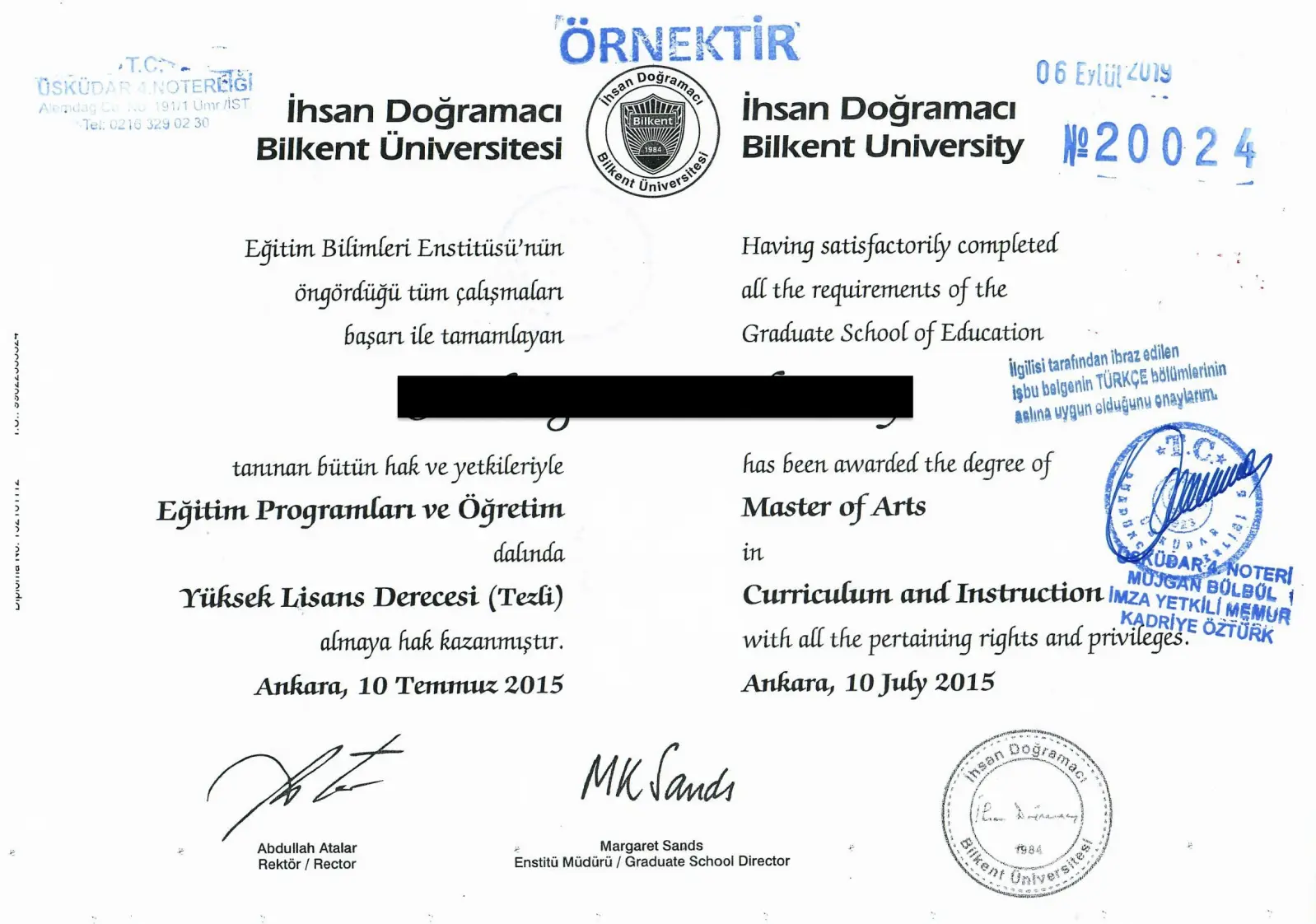
Turkish educational documents — such as high school diplomas, university bachelor's/master's degrees, ÖSYM exam result certificates, transcripts of records (Transkript), and student certificates (Öğrenci Belgesi) — require apostille authentication for study, employment, or professional recognition abroad.
Workflow for Apostilling Turkish Diplomas:
- Pre-verification / YÖK Endorsement: Higher education diplomas issued by Turkish universities must be verified via the e-Devlet portal or endorsed by the Council of Higher Education (Yükseköğretim Kurulu — YÖK) in Ankara to confirm university accreditation and degree authenticity.
- Sworn Translation: The verified original diploma and transcript are translated into the target language by an official sworn translator in Turkey.
- Notarization: The sworn translation is certified by a Turkish notary public connected with the translator.
- Apostille Issuance: The notarized educational file is presented to the competent Governor's Office (Valilik) or District Governor's Office (Kaymakamlık) overseeing the notary for the final Apostille stamp.
Legalization of Turkish Police Clearance Certificates
A Turkish Police Clearance Certificate (Adli Sicil Belgesi) is frequently required for foreign residence permits, work visas, citizenship applications, and corporate compliance.
- Domestic Certificates: Standard paper police clearance records issued by local Turkish courthouses or downloaded via e-Devlet with a official verification barcode can be apostilled by the local Kaymakamlık or via the PTT e-Apostille system.
- Consular-Issued Certificates Warning: Police clearance extracts issued by Turkish consulates or embassies located abroad cannot be apostilled by foreign authorities and are frequently rejected by foreign immigration departments. A domestic paper certificate issued in Turkey is almost always required.
- Non-Hague Destinations: If the destination country is not a Hague member, the certificate must undergo full multi-step consular legalization through the Ministry of Foreign Affairs in Ankara and the destination embassy.
Apostille for commercial and corporate documents
Corporate documents of Turkish entities are required abroad for opening offshore bank accounts, establishing subsidiaries, participating in international tenders, or conducting cross-border litigation.
The following Turkish corporate documents are eligible for apostille certification:
- Trade Register Records: Extracts from the Turkish Trade Register (Ticaret Sicil Gazetesi / Sicil Tasdiknamesi), Activity Certificates (Faaliyet Belgesi), and Certificates of Good Standing.
- Real Estate Records: Land Register Extracts (Tapu Kaydı) and valuation reports.
- Corporate Governance Files: Articles of Association (Ana Sözleşme), Board Resolutions, Signatory Circulars (İmza Sirküleri), and Shareholder Registers.
- Financial & Tax Documents: Tax Registration Certificates (Vergi Levhası), audited financial statements, and audit reports certified by a notary.
Corporate documents issued in Turkey must be apostilled in Turkey. Documents of foreign companies operating in Turkey must be apostilled in their original country of incorporation.
Consular legalization for non-Hague countries
If a Turkish document is intended for use in a nation that has not ratified the Hague Apostille Convention (e.g., UAE, Qatar, Vietnam, Kuwait, Canada), apostillation is inapplicable. The document must undergo full Consular Legalization.
The Consular Legalization Chain for Turkish Documents:
- Issuance & Verification: Obtaining the official public document or notarized copy. Commercial corporate documents must be pre-certified by the relevant Chamber of Commerce (Ticaret Odası) or the Union of Chambers and Commodity Exchanges of Turkey (TOBB).
- Notarization: Certification by an authorized Turkish notary public.
- Ministry Approval: Pre-authentication of the notary’s signature and seal by the Ministry of Foreign Affairs (Dışişleri Bakanlığı) Authentication Unit in Ankara.
- Consular Endorsement: Final legalization stamp affixed by the Embassy or Consular Section of the destination country located in Turkey (Ankara or Istanbul).
Apostille vs. Consular Legalization: Key differences
| Feature | Hague Apostille | Consular Legalization |
|---|---|---|
| Applicability | Valid only between member states of the 1961 Hague Apostille Convention. | Required for non-Hague nations or where a member state objected to accession. |
| Procedure Length | Simplified 1-step or 2-step process at local Turkish Governor's offices. | Complex multi-tier process involving Notary, Ministries, and Embassy. |
| MFA Ankara Verification | Not required (handled locally by Kaymakamlık/Valilik). | Mandatory pre-authentication stage at the MFA in Ankara. |
| Embassy Fee & Stamp | No contact with the destination country's consulate needed. | Mandatory final stamp by the destination country's embassy. |
| Commercial Documents | Notarization + Kaymakamlık apostille. | Chamber of Commerce (TOBB) → MFA Ankara → Destination Embassy. |
Apostille services across all 81 Turkish provinces
Schmidt & Schmidt provides full apostille, consular legalization, and document procurement coverage across all 81 provinces (iller) of the Republic of Turkey, including major economic hubs and administrative centers:
Procurement of original Turkish documents
If your original Turkish document is lost, damaged, outdated, or if a foreign authority demands a recently issued civil status certificate (issued within the last 6 months), a new official duplicate must be procured in Turkey prior to apostillation.
Our consultants assist clients living abroad with remote document procurement in Turkey. We can re-issue fresh civil registry certificates (Nüfus Kayıt Örneği, Formula A/B/C), corporate trade register extracts, and court decrees directly from Turkish authorities and handle the entire apostille and dispatch process seamlessly.
Certified translations and correct processing sequence
Apostillation and translation are two separate legal procedures. An apostille certifies the authenticity of the Turkish public document, while a sworn translation makes its contents legally intelligible to foreign authorities.
Correct Order of Processing:
The Apostille stamp contains critical information (issuing official, date, certificate number, seal) that must be translated into the target language. Translating before apostillation results in an incomplete translation that will be rejected by foreign registries or embassies. Learn more about common mistakes in document translation for use abroad.
How to obtain a Turkish apostille while living abroad
If you reside outside Turkey, you cannot obtain a Turkish apostille from foreign institutions in your country of residence; the apostille must be issued by the authorized bodies within Turkey.
Options for Applicants Living Abroad:
- Dispatch Original to Turkey: Courier your original Turkish document to our office in Turkey. We handle local notarization, Valilik/Kaymakamlık apostille, and express courier dispatch back to your international address.
- Remote Procurement & Apostille: If you do not have the original document, we can procure a fresh official duplicate in Turkey on your behalf and complete the apostille process without requiring you to travel.
- Power of Attorney: For specific court or property files, a notarized power of attorney (Vekaletname) executed at a Turkish Consulate abroad may be utilized to authorize our representatives.
What is an Apostille?
In this video, we explain what an apostille is, why it is required, how the authentication process works, and the history of the Hague Apostille Convention.
If you need to apostille or legalise official documents issued in Turkey or abroad, Schmidt & Schmidt provides professional assistance across more than 120 countries worldwide.
How to order apostille and legalization services in Turkey
We provide complete end-to-end management of the apostille and legalization process for Turkish documents — from preliminary scan review to courier delivery of the authenticated originals.
Typical mistakes when applying for an apostille in Turkey
-
1
Submitting uncertified photocopies
Apostilles in Turkey are issued exclusively on original public documents or official certified copies. Submitting uncertified photocopies or printouts leads to immediate rejection by the Kaymakamlık or court.
-
2
Applying at the wrong regional authority
Presenting a document to a local Kaymakamlık outside the district where the document or notary certification was issued results in rejection. Local jurisdiction rules are strictly enforced.
-
3
Apostilling private contracts without prior notarization
Private corporate contracts or commercial agreements cannot be apostilled directly. They must first be certified by a Turkish notary public to acquire public act status before apostillation.
-
4
Translating the document before obtaining the apostille
If translation occurs before apostillation, the text and seal of the apostille itself remain untranslated. Foreign receiving authorities frequently reject translations that omit the apostille metadata.
-
5
Relying on consulate-issued police clearance certificates
Police clearance certificates (Adli Sicil Belgesi) issued by Turkish embassies or consulates abroad cannot be apostilled by foreign authorities and are rejected by many immigration departments. A domestic Turkish document is required.
-
6
Failing to check for uncorrected document errors
Spelling mistakes in names or dates must be corrected in the Turkish civil registry before apostillation. Obtaining an apostille on an erroneous document invalidates the procedure and requires repeating the process after correction.
-
7
Confusing Apostille with Consular Legalization
Requesting an apostille for a non-Hague destination country (e.g., UAE, Qatar) results in an unusable document. Non-Hague destinations require full consular legalization via the MFA in Ankara and destination embassy.
-
8
Overlooking YÖK endorsement for university diplomas
Submitting Turkish university diplomas directly for apostillation without preliminary e-Devlet or YÖK degree verification often leads to delays or refusal by provincial governor offices.
Why choose Schmidt & Schmidt for Turkish document legalization?
When you need official documents authenticated in Turkey, Schmidt & Schmidt provides reliable professional support backed by extensive legal expertise and an established local presence in Turkey:
- Comprehensive Legalization Support: Full management of Apostille and Consular Legalization procedures across all 81 Turkish provinces.
- Direct Presence in Ankara & Istanbul: Physical handling of submissions at the Ministry of Foreign Affairs (MFA) in Ankara, YÖK, TOBB, Judicial Commissions, and foreign embassies.
- Remote Document Procurement: Fast re-issuance of fresh civil status records, trade register extracts, and official transcripts without requiring your presence in Turkey.
- Sworn & Notarized Translations: High-quality translations by registered court interpreters with notarization and apostillation.
- Multilingual Customer Service: Consultations available in 7 languages (English, German, Russian, French, Chinese, Turkish, Portuguese).
- Pre-submission Verification: Free preliminary check of document scans to identify potential defects before incurring government or notary fees.
- Global Express Courier Delivery: Safe, tracked international shipping via premier courier services (courier delivery options).
With Schmidt & Schmidt, you can be confident that your Turkish public documents will be authenticated in full compliance with international legal standards and accepted by official authorities worldwide.