Schmidt & Schmidt offers the legalization of your documents from the Azores by apostille.
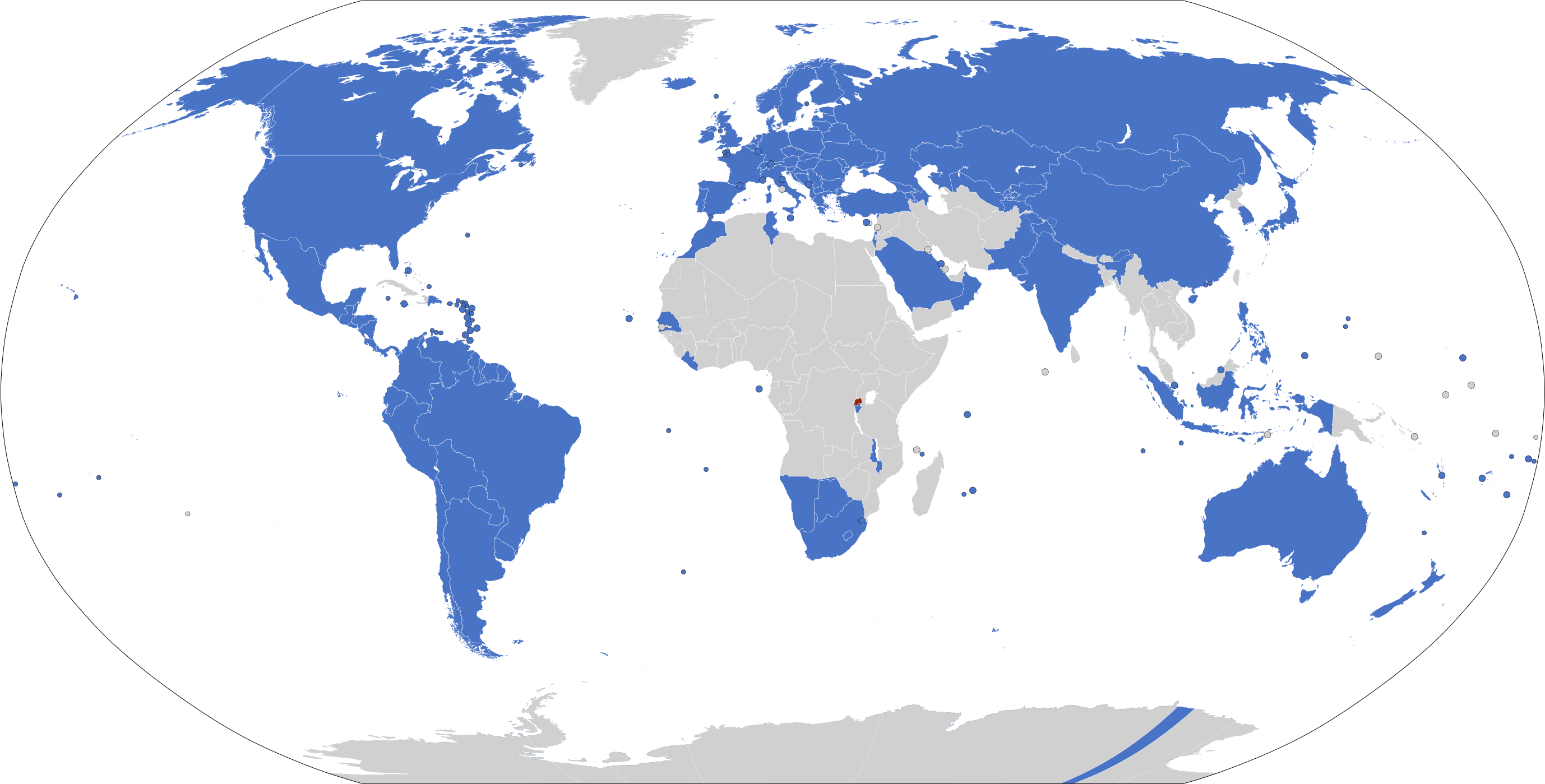
The Azores are a grouping of portuguese islands in the Atlantic. Portugal has joined the Hague Convention Abolishing the Requirement of Legalization for Foreign Public Documents in 1969. Therefore, no diplomatic authentication or consular legalization of documents from the Azores is required for the legal communication with other member states of the Convention. The documents only need to be attested by an apostille certificate with an "apostille" stamp on it by the issuing state's authorities in order to be valid in the state of destination.
The apostille, or the “Hague apostille” is a certificate that authenticates the origin of a public document (e.g., a birth, marriage or death certificate, a judgment, an extract of a register or a notarial attestation). It confirms the authenticity of the signature and the authority of an official who signed the public document.
The apostille is a stamp of rectangular shape. It should be filled in in the official language of the issuing authority. The heading "Apostille (Convention de la Haye du 5 octobre 1961)" written in French is a necessary requirement for the apostille's validity.
Responsible for issuing the apostille is the Department of Public Prosecution.
The following documents can be authenticated by apostille:
- Certificates of civil status (certificates of birth, death, marriage and divorce)
- Education documents (school reports, certificates, diplomas)
- Excerpts from the commercial register
- Court decisions
- Notarially certified copies of documents
- Notarially certified translations
- Further notarial documents (authorizations, last will, declarations)
- Commercial documents legalized by a state registration body (articles of incorporation, registration certificates, tax registrations etc.)
Requirements for the documents:
The apostille can be exclusively issued for the original document. Therefore, the latter must be presented in good condition, with all stamps and signatures clear and readable. Furthermore, it must not contain alien markings or labels.
Consular legalization of Azorean documents for use abroad
Consular legalization is the process of authenticating or certifying a legal document so a foreign country's legal system will recognize it as with full legal effect that is carried out by the diplomatic or consular mission of the country in which the document is to be used.
Consular legalization is more complex, time-consuming and costly than the Consular legalization is more complex, time-consuming and costly than the simpler apostille procedure. Whereas apostille is usually issued within one step, consular legalization requires several pre-certifications before a public document can be certified at the embassy or consulate of the destination country.
It is a common requirement that the document has to be translated into the official language of the destination country before submission to the embassy. It is up to the diplomatic mission to decide about the authentication procedure.
The main differences between an apostille and consular legalization of documents
The common feature between apostille and consular legalization is that they authenticate an official document for presentation to institutions in another country. However, they have many differences.
| Apostille | Consular legalization | |
|---|---|---|
| Legal effect | Can be used in all countries that are party to the Hague Convention on the Simplified Legalization of Documents. | Use between States one or both of which is not a member of the Hague Convention, or where one of the contracting States has protested the accession of the other. |
| Difficulty | Moderate. To obtain an apostille, contact the competent apostille authority of the state of origin of the document. | High. For consular legalization, various inland authorities and a diplomatic mission of the state of destination must be involved. |
| Pre-certification | Usually not required. | Is obligatory. |
| Attestation at the state of destination embassy in the state of origin of the document | No need to contact the Consulate of the country of destination. | Is the final step of legalization. |
Additional services
In addition to the legalization of your documents, we can provide you with high-quality translations.
Should you require company information for the court, it needs to be legalized as well. We are therefore offering extracts from the commercial register of the Azores including apostillation and translation.
On average, it takes 14 days to process the documents.
Courier services are charged and invoiced separately according to the courier service’s rates.
You can pay for our services by PayPal, bank transfer or credit card.