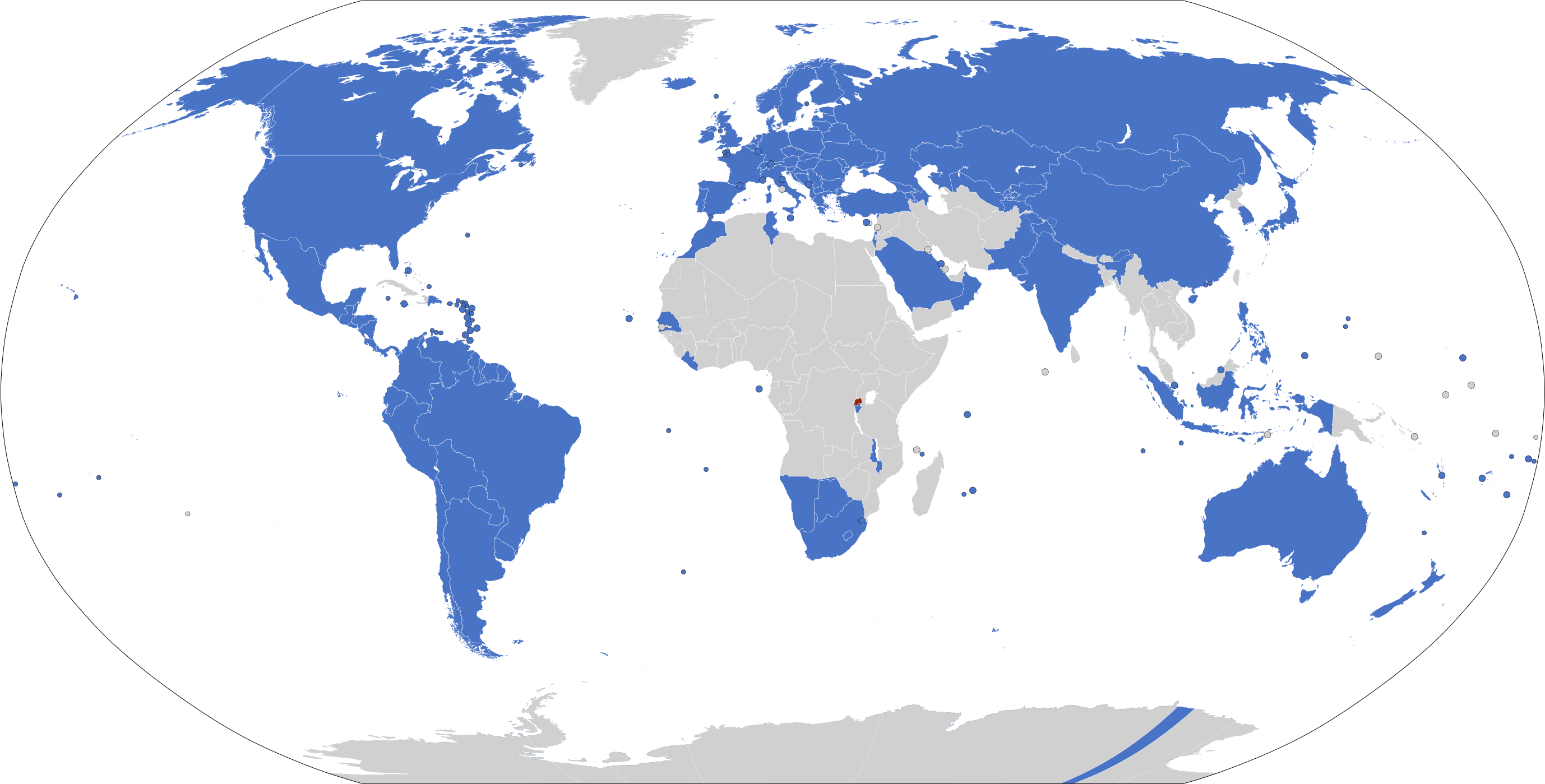
Schmidt & Schmidt provides comprehensive legalization and apostille services for documents issued in China. We assist private individuals and companies with the preparation of Chinese documents for use abroad, including notarial certification, translation, apostille, consular legalization where required, and international courier delivery.
Chinese documents such as birth certificates, marriage certificates, diplomas, academic transcripts, police clearance certificates, business licenses, company documents and powers of attorney often need to be formally certified before they can be submitted to foreign authorities, universities, courts, banks, immigration offices or business partners.
China acceded to the Convention Abolishing the Requirement of Legalisation for Foreign Public Documents on 8 March 2023, and the Convention entered into force for China on 7 November 2023. Since then, Chinese public documents intended for use in another contracting state generally no longer require consular legalization. Instead, they are certified by an apostille.
An apostille is a certificate that confirms the authenticity of the signature, seal and authority of the official who signed or certified a public document. It does not certify the content of the document itself, but confirms its formal origin for international use.
In China, an apostille is issued as an additional certificate attached to the document package. It usually contains text in Chinese, English and French, an apostille number, a verification QR code and a special seal. As a rule, the apostille must be issued in the country where the document was originally prepared or notarized.
In China, an apostille is usually not affixed directly to the original document. For many common documents, such as birth certificates, diplomas, police clearance certificates or company registration documents,a notarial certificate is first prepared on the basis of the original document or its scan. The apostille is then attached to this notarial document, often together with a translation bound into the same package.
Consular legalization may still be required if the document is intended for use in a country that is not a party to the Hague Apostille Convention. The correct procedure therefore depends on the destination country, the type and language of the document, the presence of signatures and seals, and the requirements of the receiving authority abroad.
In this guide
This guide explains how documents issued in China can be prepared for use abroad through apostille certification or consular legalization, including notarization, translation, competent authorities, document retrieval, and common practical issues.
What does a Chinese apostille look like?
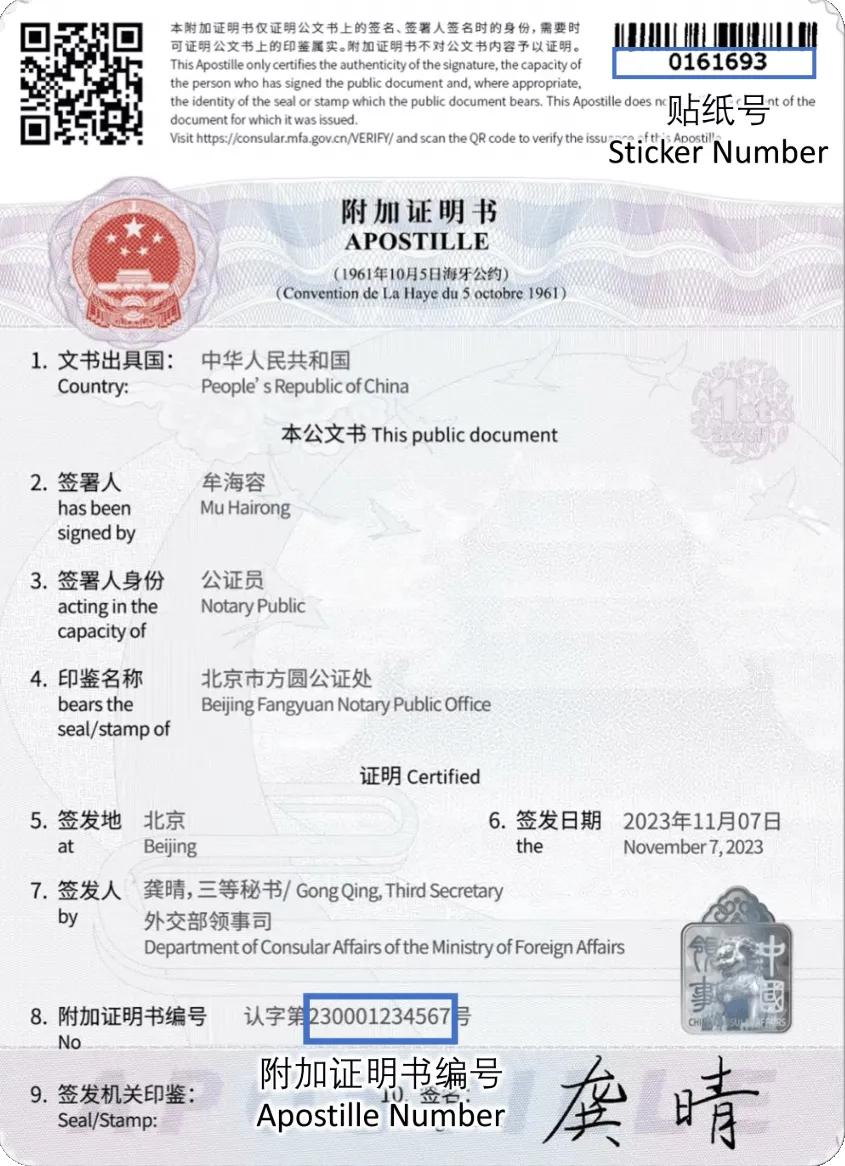
A Chinese apostille is issued as an additional certificate attached to the notarial or official document package. It confirms the authenticity of the signature, seal and authority of the official who signed or certified the document. It does not certify the content of the document itself.
A Chinese apostille normally contains the following details:
- the title “Apostille” and reference to the 1961 Hague Convention;
- the country of issuance, namely the People’s Republic of China;
- the name and capacity of the person who signed the public document or notarial certificate;
- the name of the authority or organization whose seal or stamp appears on the document;
- the place and date of apostille issuance;
- the name of the competent authority issuing the apostille;
- the apostille number;
- the seal and signature of the authorized apostille officer.
In mainland China, apostilles are issued by the Ministry of Foreign Affairs of the People’s Republic of China and by authorized local Foreign Affairs Offices within their respective administrative areas.
Which Chinese documents can be apostilled?
A wide range of Chinese documents can be prepared for apostille certification, provided that they can be converted into the proper notarial or official certificate format required for international use.
The most common categories include civil status documents, educational documents, police clearance certificates, and corporate or commercial documents.
The key question is not only whether the document exists, but whether it is suitable for notarisation or official certification in China.
Private documents should normally bear valid signatures and seals, while documents issued by public authorities, schools, registration bodies or other institutions should have a formal official format.
In most cases, the source document used for preparing a Chinese notarial certificate should also be in Chinese.
Need to obtain the document before apostille?
In some cases, the document that needs to be apostilled has not yet been obtained. This may apply to police clearance certificates, trade register extracts, company registration documents, certificates of marital capacity, duplicate civil status documents and other records issued by Chinese authorities or institutions.
Schmidt & Schmidt can assist not only with apostille certification, but also with the preliminary document retrieval stage where this is legally and practically possible. Depending on the document type, we may help obtain or arrange its issuance in China, prepare the necessary notarial certificate, arrange translation, apply for the apostille and organise international delivery.
For further information about specific document types, please see our guides on obtaining commercial register extracts and company documents from China and obtaining and legalizing a Certificate of Marital Capacity in China.
Procedure for apostilling documents in China
Step 1: Notarization
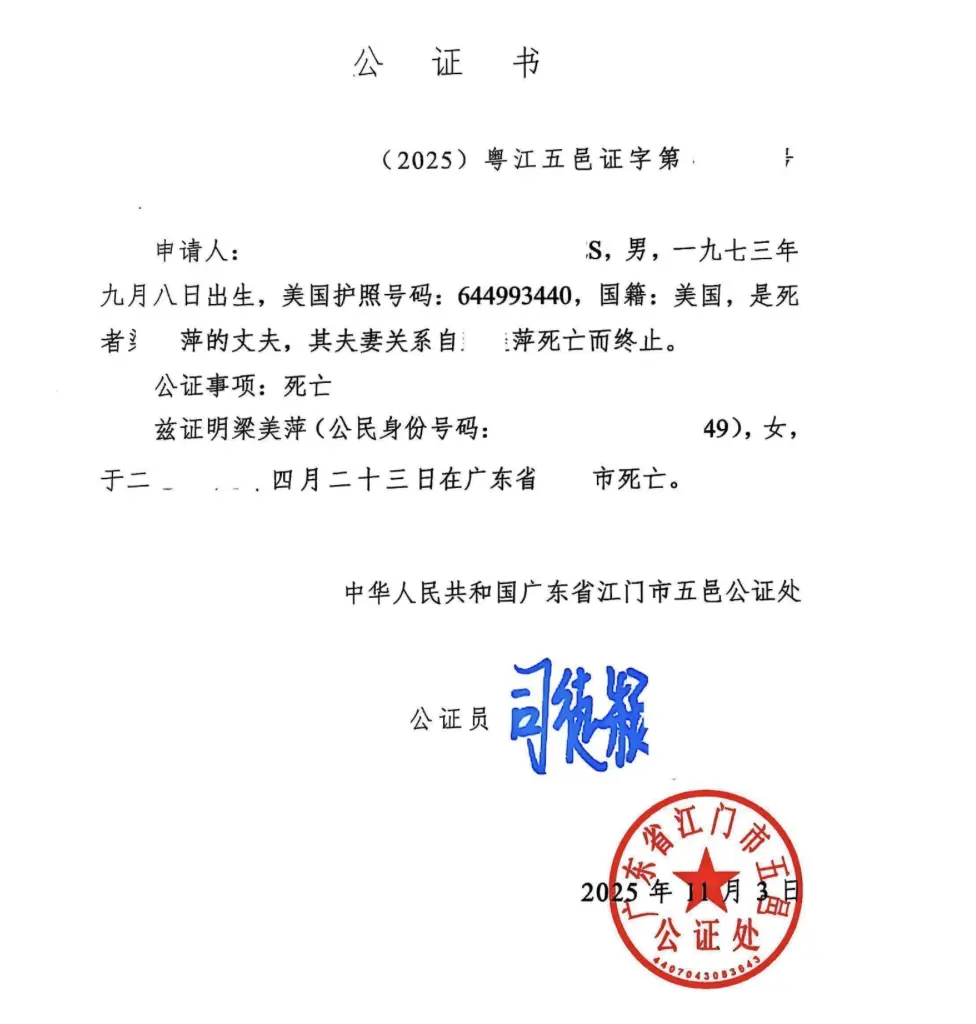
In China, an apostille is never affixed to original documents — only to notarized copies. There are two types of notarization (single and double), depending on the destination country, so inform the notary of this in advance.
Chinese notaries can only notarize documents issued in Chinese. If the original is in a foreign language (e.g., certificates from international schools or universities), it cannot be notarized — only the Chinese version is accepted.
A translation into the required foreign language is included in the notarial certificate as a mandatory part, so you will receive a single certificate with both the notarized document and translation, to which one apostille will be affixed.
Important: This translation may not be accepted abroad. Always check requirements with the receiving authority in advance, as an additional certified translation in the destination country is often required. Some Chinese documents are only valid for 3 months, so failure to clarify requirements early may result in the entire process needing to be repeated at significant cost.
Notarization typically takes around 5 business days, depending on translation volume.
Notarization of certificates, contracts, invoices, and other commercial documents
The legalization procedure for commercial documents is carried out not through a notary, but through the China Council for the Promotion of International Trade (CCPIT). Each province has its own CCPIT office, and applications must be submitted at the place where the document was issued or where the company to which it was issued is registered. The document must be issued in Chinese; contracts and other commercial documents must bear the company seal and the signature of the company’s legal representative.
To legalize such documents, a business license and the ID card of the founder (legal representative) of the Chinese company will be required. After that, the procedure is similar to notarization through a notary.
Step 2: Apostille issuance by the Ministry of Foreign Affairs
No prior appointment is required to obtain an apostille from the Ministry of Foreign Affairs. To have an apostille affixed, it is sufficient to visit the Foreign Affairs Office of the region where the notarial certificate was issued and submit the document through the electronic queue system.
The standard apostille processing time at the MFA of the PRC is 5 work days; however, if an express service is requested, it can be reduced to 3 work days (excluding delivery time).
When submitting documents for apostille, the applicant must confirm their identity. If the documents are submitted by an organization, the person submitting them is required to provide the original power of attorney and a copy of the valid passport of the document owner.
China’s electronic apostille
As of June 18, 2025, China has launched a pilot electronic apostille system (e-Apostille). The first document that can be apostilled in digital form is the electronic “Certificate of Origin” issued by the China Council for the Promotion of International Trade. Holders of such certificates should submit them to the Legalization Service of the Ministry of Foreign Affairs of the PRC.
In the future, the procedure will be gradually extended to other types of PRC documentation. At present, the system is available only to Chinese citizens who possess a local ID card.
Legalization of Chinese educational documents for use abroad
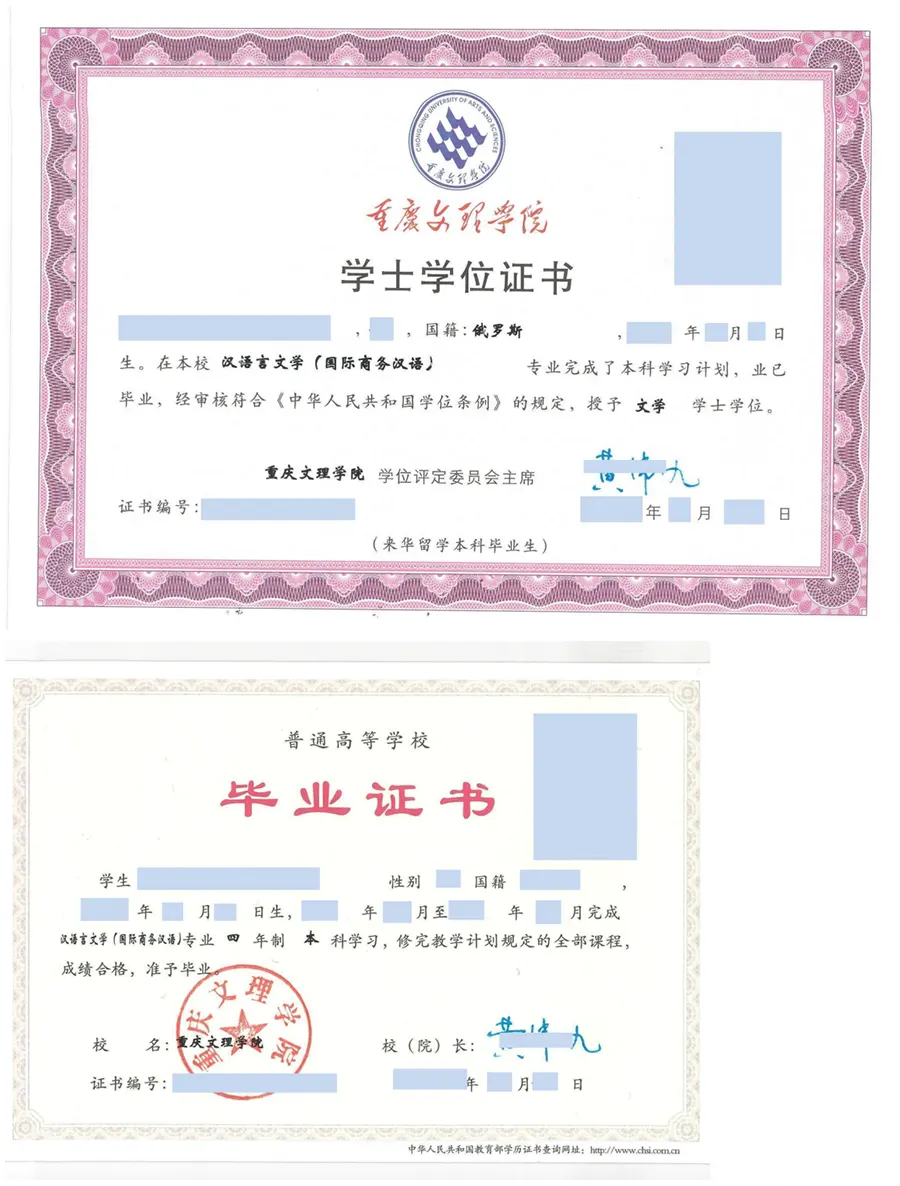
Chinese educational documents may be required abroad for university admission, employment, immigration, professional licensing, academic credential evaluation and recognition of qualifications. These documents may include diplomas, degree certificates, graduation certificates, academic transcripts, school reports, certificates of study and enrollment records.
In China, an apostille is usually not affixed directly to the original diploma or transcript. In most cases, the educational document is first verified through the official Chinese education system or by the issuing institution, after which a Chinese notarial certificate is prepared. The apostille is then affixed to this notarial certificate.
The notarial certificate normally includes a translation required for the apostille procedure in China. However, this translation may not always be accepted by the receiving authority abroad. Some universities, employers, immigration authorities or licensing bodies may require an additional certified, sworn or locally approved translation.
Requirements may differ depending on the destination country and the institution receiving the documents. For more information about verification, notarization, apostille certification, consular legalization, translation requirements and recognition abroad, please see our guide to apostille and legalization of educational documents and diplomas from China.
Legalization of a Chinese Police Clearance Certificate for use abroad
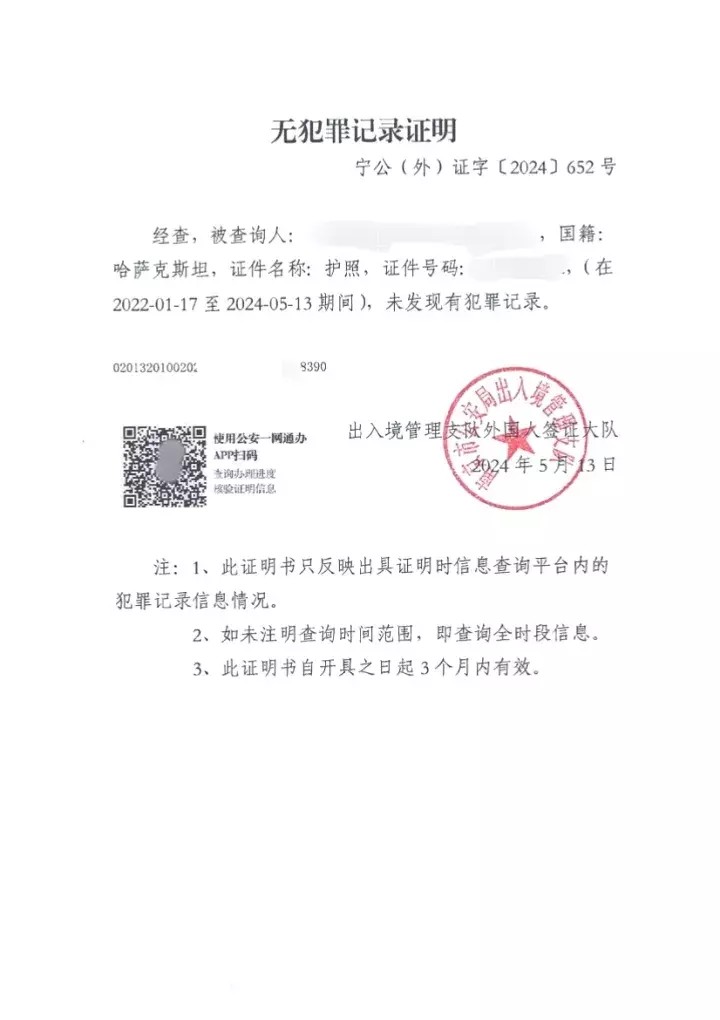
A Chinese Police Clearance Certificate, also known as a Certificate of No Criminal Record, may be required abroad for immigration, employment, residence permits, citizenship applications, study, marriage registration, professional licensing and other official procedures.
Before it can be used abroad, the certificate normally has to be prepared as a Chinese notarial certificate and then authenticated by apostille or consular legalization, depending on the destination country.
The general procedure includes:
- Notarization: the certificate is notarized by a Chinese notary office and normally combined with a translation in the notarial certificate package. The destination country should be specified at this stage, as the requirements may vary.
- Apostille: if the destination country is a party to the Hague Apostille Convention, the notarial certificate is submitted to the Ministry of Foreign Affairs of China or an authorized local Foreign Affairs Office for apostille certification.
- Consular legalization: if the destination country is not a party to the Hague Apostille Convention, the document must normally be authenticated by the competent Chinese authority and then legalized by the consulate of the destination country in China.
The procedure may take approximately 10–14 days or longer, depending on the city, the applicant’s residence history, the completeness of the documents, notarial requirements and the destination country.
Note: Some foreign authorities may require an additional certified, sworn or locally approved translation. Since police clearance certificates are generally time-sensitive, careful advance planning is essential.
What can go wrong when applying for an apostille in China on your own?
At first glance, the apostille procedure in China may seem straightforward: prepare the document, submit it to the competent authority and wait for the result. In practice, however, many problems arise before the apostille is even issued — during document preparation, notarisation, translation or submission.
-
1
Wrong type of notarisation
The notary or certification body must know that the document is intended for use abroad and in which country it will be submitted. If the wrong type of notarial certificate is prepared, the document may not be accepted for apostille or by the receiving authority abroad.
-
2
Document not suitable for certification
Some documents cannot be used as a basis for a Chinese notarial certificate or commercial certificate. Problems may arise if the document is not in Chinese, lacks a proper signature or seal, or was not issued in an official format.
-
3
Translation may not be accepted abroad
A translation is often included in the Chinese notarial certificate package. However, this translation may not always replace a certified or sworn translation required by the receiving authority in the destination country.
-
4
Wrong place of submission
The apostille route usually depends on where the notarial certificate or commercial certificate was issued. Submitting the document through the wrong regional procedure may lead to delays or rejection.
-
5
Validity period problems
Some Chinese documents, such as police clearance certificates or certain official certificates, may be accepted only within a limited period. If the procedure is started incorrectly or too late, the document may expire before it can be used abroad.
-
6
Requirements of the destination country are overlooked
Even if the apostille is issued correctly in China, the receiving authority abroad may have its own requirements regarding the language, document format, date of issue, notarisation type or additional certified translation.
Each of these mistakes can result in rejected documents, wasted fees and weeks of delay.
A specialist who knows the Chinese apostille process will identify the correct document type,
notarisation form and submission route from the start — so your documents are accepted the first time.
Former Chinese citizens who have changed their citizenship
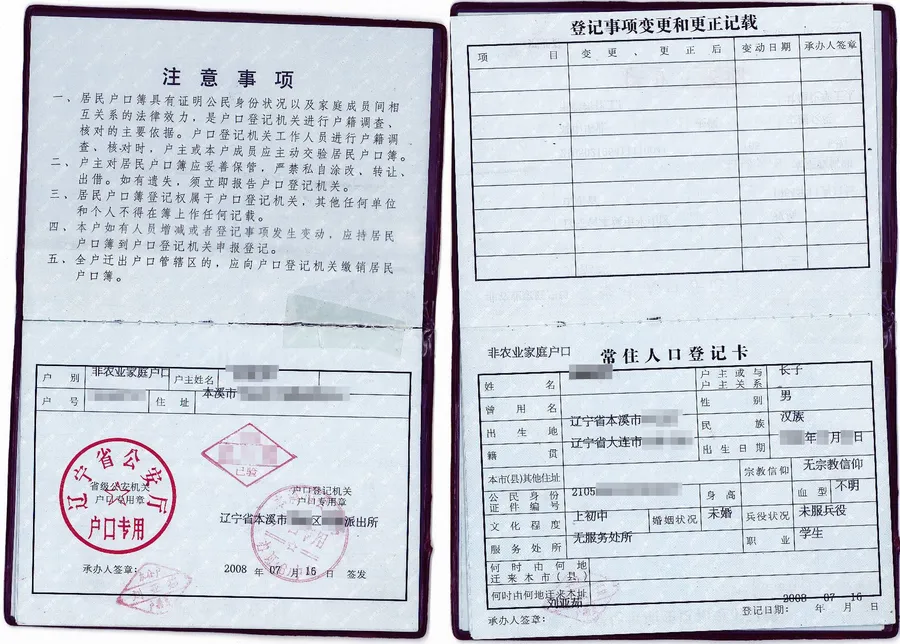
For former Chinese citizens who have acquired another nationality, the procedure may be less flexible than for foreign applicants who have never held Chinese citizenship. If the person still has an active or not formally closed household registration record in China, the authorities may require documents connected with the former Chinese identity, such as the Chinese ID card and household registration booklet.
If these documents are no longer available or cannot be renewed, the only practical route is usually to first obtain a Certificate of Household Registration Cancellation (户籍注销证明). Only after this certificate has been issued can the applicant usually proceed with requesting new Chinese documents and arranging notarization and apostille.
The Certificate of Household Registration Cancellation (户籍注销证明) can normally be obtained either through a Chinese consulate abroad or by applying in person at the police station responsible for the place where the original hukouben (户口本)was registered.
Foreign Affairs Offices by Province
The following list provides a compact overview of authorized local Foreign Affairs Offices in mainland China.For apostille procedures, the competent office usually depends on the place where the document or notarial certificate is issued.
Office: Anhui Foreign Affairs Office
Address: Hefei, Ma'anshan Road 509, Provincial Government Service Centre, Building C, 1st Floor, Hall 1, Window 6
Office: Ministry of Foreign Affairs Apostille Service Window
Address: Beijing, Chaoyang District, Chaoyangmen Outer Street 18, Full Link Plaza, Tower B, 11th Floor
Office: Chongqing Foreign Affairs Office
Address: Chongqing, Yubei District, Honghu East Road 57
Office: Fujian Foreign Affairs Office
Address: Fuzhou, Hualin Road 97, Fujian Foreign Affairs Office Building, Service Hall, 2nd Floor
Office: Gansu Foreign Affairs Office
Address: Lanzhou, Nanchang Road 805
Office: Guangdong Foreign Affairs Office
Address: Guangzhou, Haizhu District, Chigang, Youlin 1st Road 2
Office: Guangxi Foreign Affairs Office
Address: Nanning, Qingxiu District, Yibin Road 6, Government Service Centre, 2nd Floor, Window 5
Office: Guizhou Foreign Affairs Office
Address: Guiyang, Guanshanhu District, Guanshan West Road 172
Office: Hainan Foreign Affairs Office
Address: Haikou, Wuzhishan South Road 3, Provincial Government Service Centre, 2nd Floor
Office: Hebei Foreign Affairs Office
Address: Shijiazhuang, Shifan Street 75, Provincial Government Offices, Minxin Plaza, Building B, Room 103
Office: Heilongjiang Foreign Affairs Office
Address: Harbin, Nangang District, Gogol Street 300
Office: Henan Foreign Affairs Office
Address: Zhengzhou, Jinshui Road 15
Office: Hubei Foreign Affairs Office
Address: Wuhan, Wuchang District, Bayi Road 3
Office: Hunan Foreign Affairs Office
Address: Changsha, Shaoshan North Road 12, Xianghui Building, 3rd Floor
Office: Inner Mongolia Foreign Affairs Office
Address: Hohhot, Xinhua Avenue 63, Building 8, West Annex, Room 104
Office: Jiangsu Foreign Affairs Office
Address: Nanjing, Hanzhongmen Avenue 145, 2nd Floor, Zone F
Office: Jiangxi Foreign Affairs Office
Address: Nanchang, Honggutan District, North Longpan Street 993, Provincial Government Service Centre, 4th Floor
Office: Jilin Foreign Affairs Office
Address: Changchun, Renmin Avenue 9999, Provincial Government Service Centre, 1st Floor
Office: Liaoning Foreign Affairs Office
Address: Shenyang, Huanggu District, Huanghe South Avenue 96-6
Office: Ningxia Foreign Affairs Office
Address: Yinchuan, Fenghuang North Street 106
Office: Qinghai Foreign Affairs Office
Address: Xining, Jiefang Road 14
Office: Shaanxi Foreign Affairs Office
Address: Xi'an, Beilin District, Huancheng East Road, South Section 1, Productivity Building, 3rd Floor, North Hall
Office: Shandong Foreign Affairs Office
Address: Jinan, Lixia District, Qianfoshan West Road 28-1, Shandong Foreign Affairs Service Hall
Office: Shanghai Foreign Affairs Office
Address: Shanghai, Jing'an District, Huashan Road 228, Guidu Office Building, 1st Floor, Room 104
Office: Shanxi Foreign Affairs Office
Address: Taiyuan, Yingze Avenue 366, Document Processing Hall, 2nd Floor
Office: Sichuan Foreign Affairs Office
Address: Chengdu, 1st Ring Road, East 3rd Section 100
Office: Tianjin Foreign Affairs Office
Address: Tianjin, Hexi District, Youyi North Road, Guangyin Building, 2nd Floor
Office: Tibet Foreign Affairs Office
Address: Lhasa, Linkuo North Road 11
Office: Xinjiang Foreign Affairs Office
Address: Urumqi, Tianshan District, East Ring Road 226
Office: Yunnan Foreign Affairs Office
Address: Kunming, Daguan Road 230
Office: Zhejiang Foreign Affairs Office
Address: Hangzhou, Shifan Road 1
Consular legalization of Chinese documents for use abroad
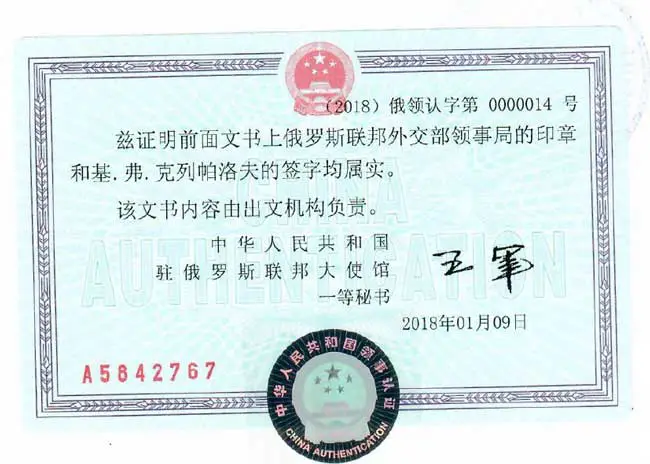
For countries that are not parties to the Hague Convention (e.g., the UAE), consular legalization — also known as "embassy attestation" — applies instead of an apostille. For a complete list of countries that accept and use apostilles, click here.
Consular legalization is the process of authenticating or certifying a legal document so a foreign country's legal system will recognize it as with full legal effect that is carried out by the diplomatic or consular mission of the country in which the document is to be used.
Consular legalization is more complex, time-consuming and costly than the simpler apostille procedure. A document must:
- be translated by an authorized translator into the language of the country where the document will be used;
- have the translation notarized by a notary in China;
- be certified by the office of the Ministry of Foreign Affairs of China;
- be legalized by the consulate of the destination country in China.
Only after completing these procedures will the legalization of the document be considered complete, and the document may be used in the destination country.
It is important to remember that a document will have legal force only in the territory of the country whose consular stamp appears on it and cannot be used in other countries.
The validity period of consular legalization is generally not limited; however, restrictions may apply to the validity period of the documents themselves.
The main differences between an apostille and consular legalization of documents
The common feature between apostille and consular legalization is that they authenticate an official document for presentation to institutions in another country. However, they have many differences.
| Apostille | Consular legalization | |
|---|---|---|
| Legal effect | Can be used in all countries that are party to the Hague Convention on the Simplified Legalization of Documents. | Use between States one or both of which is not a member of the Hague Convention, or where one of the contracting States has protested the accession of the other. |
| Difficulty | Moderate. To obtain an apostille, contact the competent apostille authority of the state of origin of the document. | High. For consular legalization, various inland authorities and a diplomatic mission of the state of destination must be involved. |
| Pre-certification | Usually not required. | Is obligatory. |
| Attestation at the state of destination embassy in the state of origin of the document | No need to contact the Consulate of the country of destination. | Is the final step of legalization. |
Procurement of documents from China
If the important documents are lost or damaged, or current copies of the documents are needed, the re-issue of the documents is required. It is not unusual for people outside China to encounter difficulties with obtaining new documents when abroad. Our consultants will help you procure new documents from China remotely, and we can arrange for your documents to be sent by courier anywhere in the world.
Certified translation of documents from China
In China, there is no separate service for notarized translation — a translation acquires legal force only as part of a notarial certificate (公证书). Translations performed by ordinary or “certified” translators in China are not recognized abroad if they are not included in a notarial certificate.
Therefore, if the destination country specifically requires a translation, it is recommended to have the translation done directly in the country where the document will be used, in accordance with local requirements.
Does the translation have to be apostillized?
Any foreign document issued in one country and used in another country must be legalized for use abroad. Therefore, the authenticity of a certified translation from China needs to be certified by an apostille. Consequently, many authorities may not accept certified translations from China if the translation has not been properly authenticated in China for use abroad. To avoid this confusion, translations should better be made in the state of destination of the document.