Schmidt & Schmidt offers the legalization of documents from Madeira by apostille.
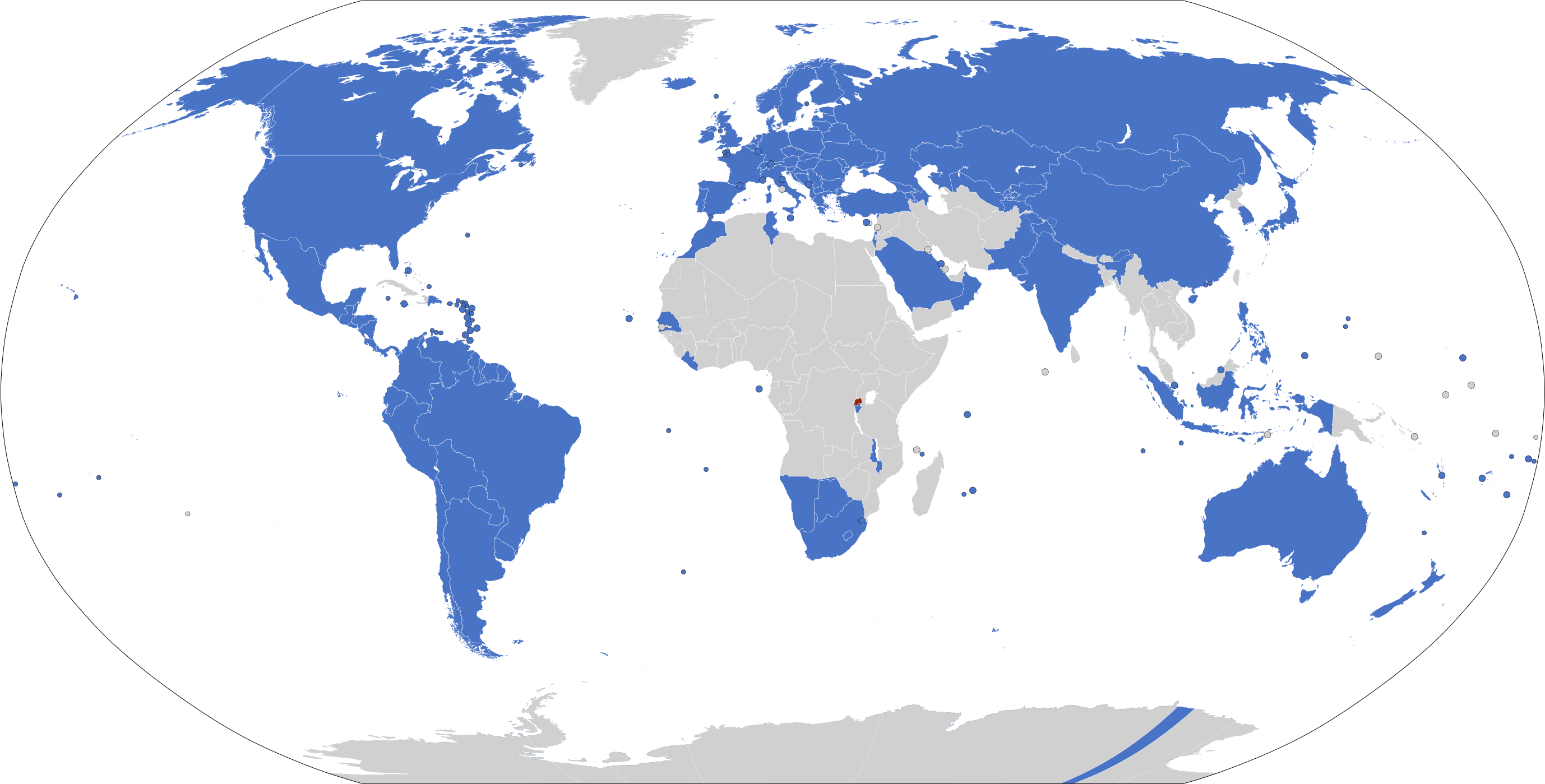
The autonomous region of Madeira is legally a part of Portugal and as such, the Hague Convention Abolishing the Requirement of Legalization for Foreign Public Documents came into effect in 1969. Therefore, no diplomatic authentication or legalization of documents from Madeira is required for the legal communication with another member state of the convention. The documents only need to be stamped with an apostille by the issuing state's authorities in order to be valid in the state of destination.
The apostille, or the “Hague apostille” is a certificate that authenticates the origin of a public document (e.g., a birth, marriage or death certificate, a judgment, an extract of a register or a notarial attestation). It confirms the authenticity of the signature and the authority of an official who signed the public document.
Responsible for issuing the apostille is the Department of Public Prosecution of Funchal. In order to be eligible for apostilling, public certificates must be issued by portuguese government bodies in Portuguese.
An apostille is a stamp of rectangular shape. The heading "Apostille (Convention de La Haye du 5 octobre 1961)" must be in French. The stamp indicates the signature verified by the apostille, the date and the identification number of the apostille itself.
The following documents can be authenticated by apostille:
| Can be apostillized | Cannot be apostillized |
|---|---|
|
|
Specific aspects and document requirements for the apostille in Madeira
Madeira is among the countries that recognize and issue apostilles in accordance with the Hague Convention of 5 October 1961. The apostille serves as a confirmation of the official status of a document.
The apostille process can vary depending on the sender and recipient country, but typically to obtain an apostille for a document in Madeira, you must go through the following steps:
- The document must be an original or a certified copy issued by the competent authority.
- The document should contain all relevant and accurate information.
- The document must be in the official language of the issuing country or translated into the official language of the country where the apostille is sought
- The apostille must be affixed by the designated competent authority in accordance with regulations.
This process can be time-consuming, especially if it includes multiple documents and different countries. To ensure a smooth and accurate apostille process, it is recommended to seek guidance from specialists familiar with the requirements and procedures. Their expertise can help avoid delays and errors in obtaining documents apostille.
Document requirements that might apply:
- The document must be an original or a certified copy issued by the competent authority.
- The document should contain all relevant and accurate information.
- The document must be in the official language of the issuing country or translated into the official language of the country where the apostille is sought
- The apostille must be affixed by the designated competent authority in accordance with regulations.
The apostille is issued in a uniform format. In Madeira, it has the form of a printed sticker with a handwritten signature of an official, an official seal, and a hologram.
In cases where apostilles are not recognized, holders of foreign documents will need to legalize them instead. However, If the country of destination of the document recognizes and issues apostilles, then legalization is unnecessary.
Consular legalization of Madeiran documents for use abroad
Consular legalization is the process of authenticating or certifying a legal document so a foreign country's legal system will recognize it as with full legal effect that is carried out by the diplomatic or consular mission of the country in which the document is to be used.
This procedure is required when the destination country does not recognize or accept the apostille certification. One needs to submit the original document, along with any required copies or supporting materials, to the respective consular office. The consular officials will review the document, verify its authenticity, and affix their seal or stamp to certify its validity.
The consular legalization process may require additional steps like obtaining translations of the document into the language of the destination country or providing additional supporting documentation as requested by the consular office.
It is up to the diplomatic mission to decide about the authentication procedure. The specific requirements and procedures for consular legalization may vary depending on the regulations of the destination country.
Requirements for the documents:
An apostille can be issued exclusively on an original document. Therefore, the latter must be in an apparent good condition, all stamps and signatures have to be clear and readable. Furthermore, it must not contain alien marking and labels.
Additional services
In addition to the legalization of your documents, we can provide you with high quality translations.
If you want to bring company information before the court, it needs to be legalised as well. We are therefore offering extracts from the commercial register of Madeira including apostille and translation.
Usually, processing the documents takes us 14 days.