Schmidt & Schmidt provides up-to-date commercial register extracts from Spain. Upon request, the commercial register extract from Spain can be apostilled and translated.
The commercial register — Registros Mercantiles — in Spain has a long history. Its predecessors include a ship and flag registry — the Ordenanzas de Bilbao (1737), the Commercial Code Código de Comercio of 1885, the formal establishment of the Commercial Register in 1885, and subsequent regulations from 1919 and December 14, 1956, as amended by the decree of July 21, 1973. Today, the register operates on the basis of the Act of 1998.
The Commercial Register is an official public institution established in all provincial capitals. The registry is maintained under the supervision of the Directorate General for Registries and Notariats of the Ministry of Justice. The system is decentralized and consists of Territorial Registries (Registros Mercantiles Territoriales) located in each provincial capital, and the Central Commercial Register (Registro Mercantil Central) in Madrid. Entries are processed by authorized registrars following a detailed verification of the data, which guarantees a high reliability of the information. The registry contains information on more than 3 million companies.
Commercial register extracts can be used for:
- Obtaining information about your business partners in Spain and verifying their reliability (Due Diligence)
- Preparing foreign trade agreements and cross-border transactions
- Filing lawsuits and conducting international legal proceedings
- Registering joint ventures or executing real estate acquisitions
- Verifying potential employers or contractors
- Fulfilling immigration and visa application procedures (e.g., work visas)
The following registries exist in Spain:
- Commercial Register („Registros Mercantiles“)
- Property and Land Registry („Registros de la Propiedad de Bienes Inmuebles“)
- Movable Property Registry („Registros de la Propiedad de Bienes Muebles“)
- Registry of General Contractual Conditions („Registro de Condiciones Generales de la Contratación“)
- Registry of Cooperatives („Registro de Cooperativas“)
- Registry of Foundations („Registro de Fundaciones“)
The following entities must be registered in the Commercial Register:
- Sole traders / individual entrepreneurs (Empresario Individual)
- Commercial partnerships and corporations
- Civil law partnerships and legal entities
- Credit and insurance institutions
- Pension funds and investment funds
- Branch offices and representative offices
- Foreign companies and their operating branches located in Spain
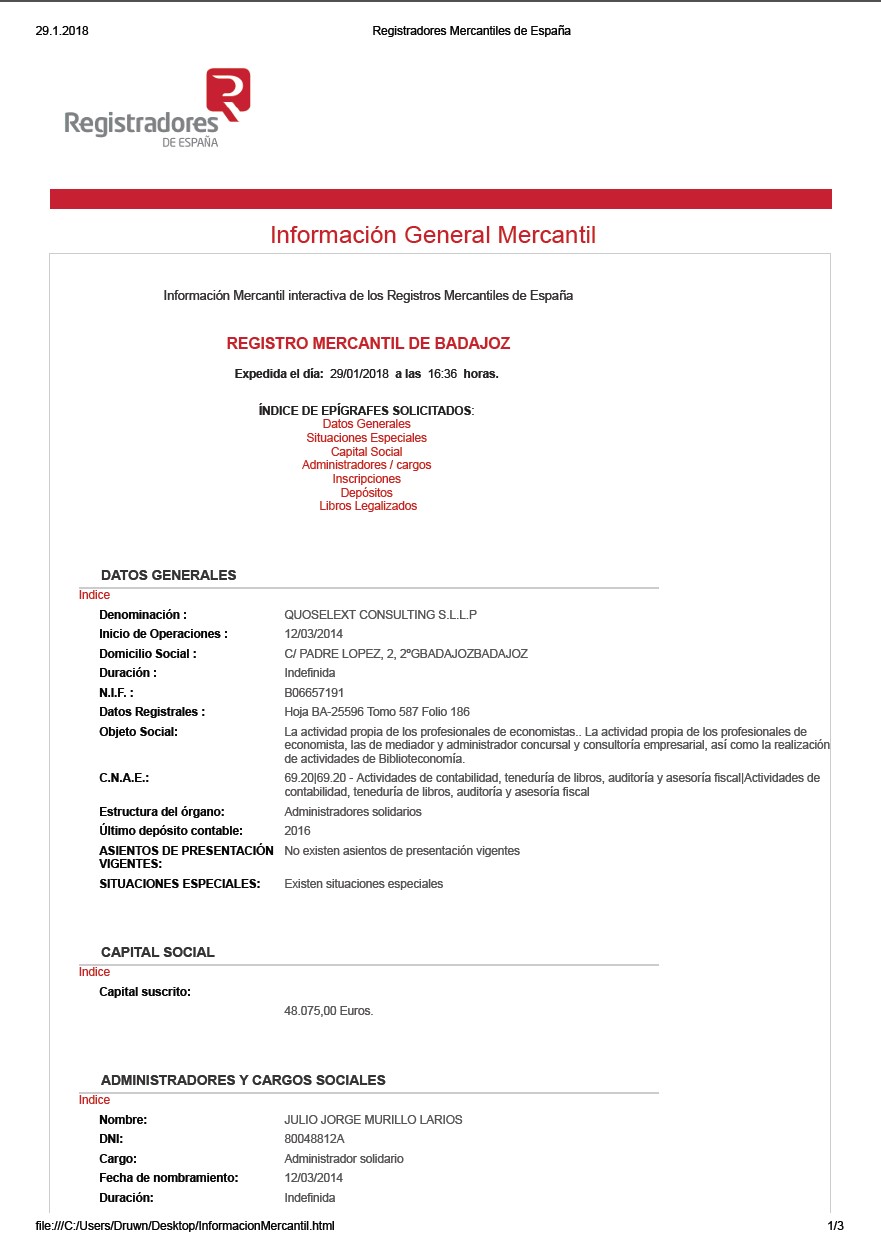
Commercial register extracts from Spain are available in two main formats:
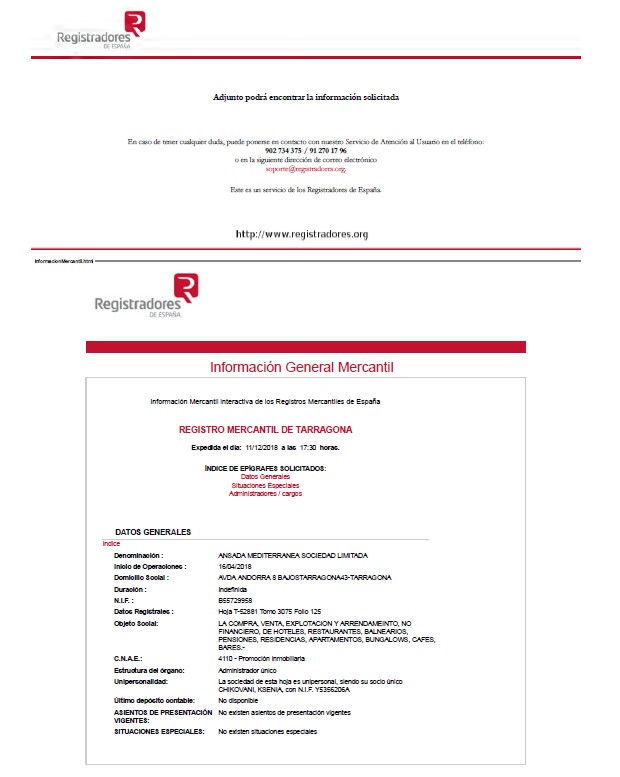
- The electronic extract (Nota informativa mercantil) is available in digital format and serves purely informative purposes. It carries no formal legal weight as an official document.
- The certified extract (Certificación) is a certified copy of a document filed with the registry, signed and sealed by the registrar. It is issued as a physical hard copy and holds full legal force. This format is mandatory for international document traffic and subsequent apostillation.
A standard extract contains the following information:
- Company name and legal form
- Corporate identification number
- Registered office and contact information
- Business scope (Core activity / corporate purpose)
- Share capital
- Details of management and authorized representatives
- Details of branch offices
- Data from annual financial statements
- Records concerning insolvency, bankruptcy, or liquidation
* Certain information may not be publicly accessible for specific entity types or may require an additional fee.
Inquiries are typically processed from 30 minutes.
| Service | Price incl. 19% VAT | Price excl. VAT |
|---|---|---|
| Price for an electronic commercial register extract from Spain | from 47.60 € | from 40.00 € |
| Price for a commercial register extract from Spain with an apostille (excluding international shipping) | from 357.00 € | from 300.00 € |
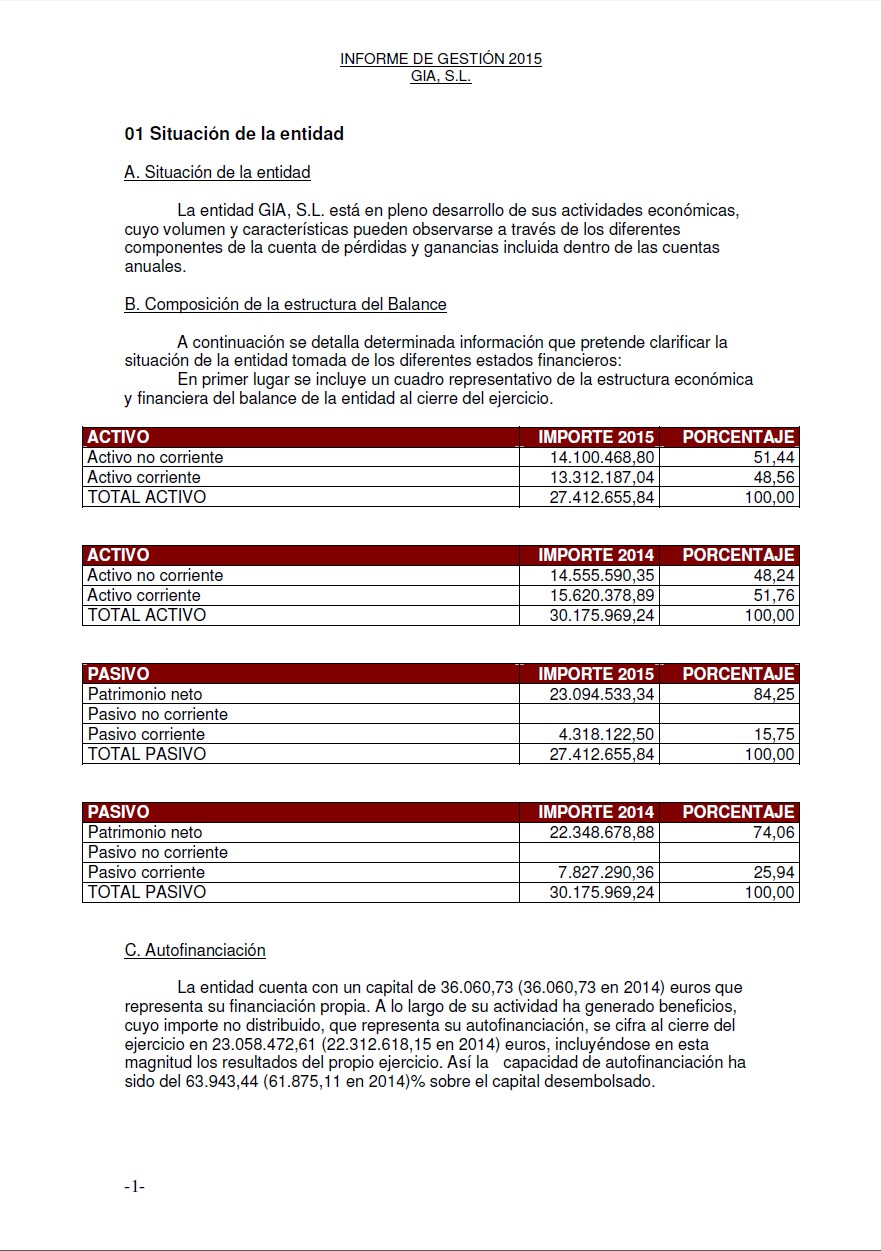
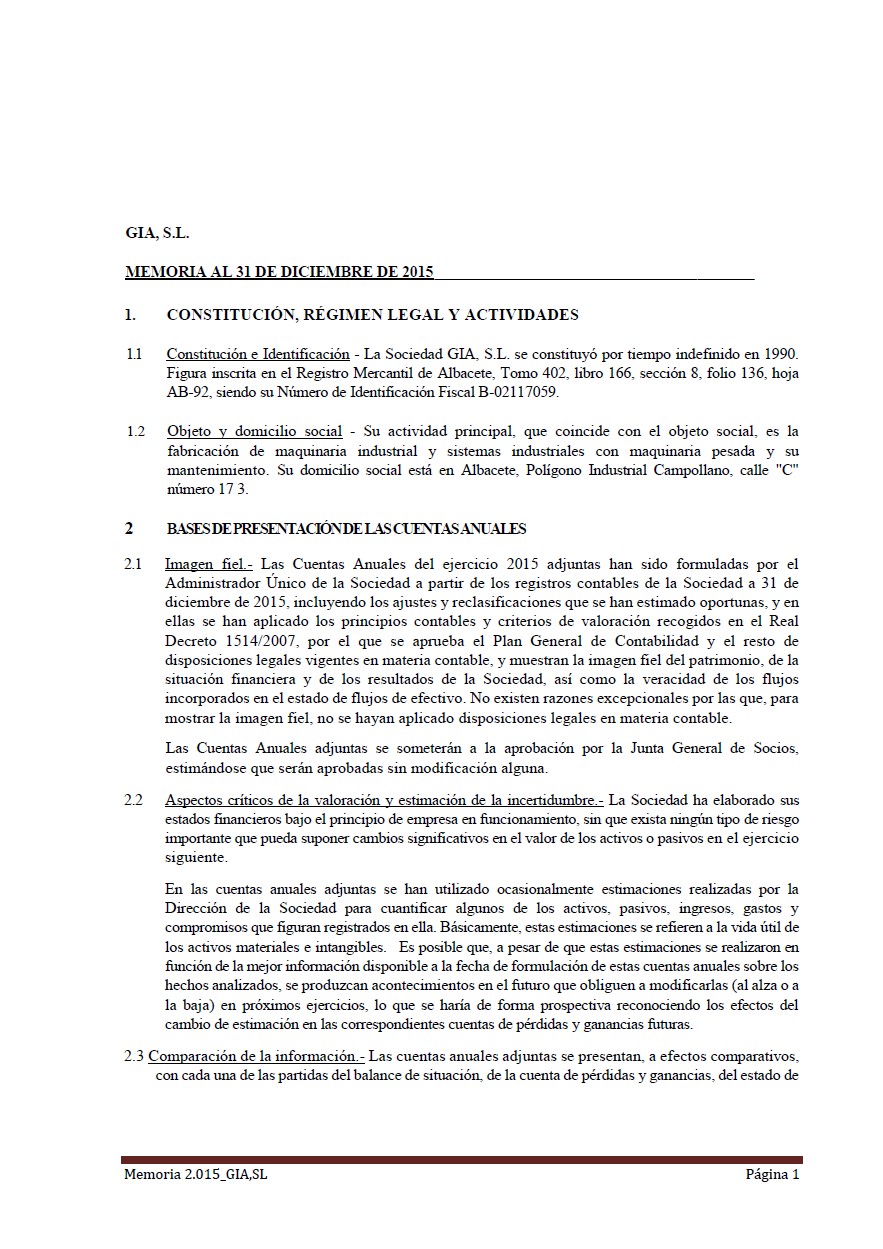
An annual financial statement (Cuentas Anuales) consists of a balance sheet, a profit and loss statement, an auditor's report, and a management report. Based on this information, it is possible to gain a comprehensive overview of the financial standing and economic situation of a company. The document is provided in Spanish.
Inquiries are typically processed from 30 minutes.
| Service | Price incl. 19% VAT | Price excl. VAT |
|---|---|---|
| Price for an electronic commercial register extract from Spain | from 47.60 € | from 40.00 € |
| Price for a commercial register extract from Spain with an apostille (excluding international shipping) | from 357.00 € | from 300.00 € |
Searching for companies in which a specific natural person is involved is possible in the Spanish Commercial Register based on the following criteria:
- Full name (due to name similarities, this may not always yield an unequivocal result)
- Foreign tax identification number / Tax ID (NIE)
A registry search strictly using regular passport data is not supported by the system.
| Service | Price incl. 19% VAT | Price excl. VAT |
|---|---|---|
| Price for an electronic commercial register extract from Spain | from 47.60 € | from 40.00 € |
| Price for a commercial register extract from Spain with an apostille (excluding international shipping) | from 357.00 € | from 300.00 € |
Furthermore, the following records and corporate acts are maintained by the Commercial Register of Spain:
- Reports and official disclosures
- Articles of association, incorporation deeds, and similar corporate documents
| Service | Price incl. 19% VAT | Price excl. VAT |
|---|---|---|
| Price for an electronic commercial register extract from Spain | from 47.60 € | from 40.00 € |
| Price for a commercial register extract from Spain with an apostille (excluding international shipping) | from 357.00 € | from 300.00 € |
Search Criteria and Tax Identifiers
A registry search and retrieval of an extract are possible based on the following criteria:
- Full legal company name
- Partial name combined with the registered address
- Company's tax identification number (CIF/NIF)
There are three primary types of identification and tax numbers used in Spain:
- DNI (Documento Nacional de Identidad) – National identity card and tax number for Spanish citizens.
- NIE (Número de Identidad de Extranjero) – Identification and tax number for foreign nationals.
- NIF (Número de Identificación Fiscal) – Tax identification number for legal entities (companies).
The DNI consists of 8 digits followed by a control letter. The NIE begins with a letter that defines the residency status, followed by 7 digits and a control letter. In the case of the NIF, the first letter defines the type of corporate entity, followed by 8 digits.
Types of Companies in Spain
Corporations (Entities with distinct legal personality):
- Sociedad anónima (SA) – Public limited company / joint-stock company
- Sociedad de responsabilidad limitada (SRL / SL) – Limited liability company
- Sociedad Limitada Nueva Empresa (SLNE) – Simplified LLC format designed for new business startups
- Sociedad Limitada Unipersonal (SLU) – Single-member limited liability company
- Sociedad comanditaria por acciones (Soc. Com. p.a.) - Partnership limited by shares
Partnerships and other structures (Entities without separate legal personality):
- Empresario Individual – Sole proprietorship / individual entrepreneur
- Sociedad Civil (SC) – Civil law partnership / general partnership
- Sociedad colectiva (Soc.Col.) – Registered general partnership
- Sociedad comanditaria simple (Soc.Com.) – Limited partnership
The Spanish Beneficial Ownership Register (RBE)
In accordance with Regulation 319/2018, Spanish corporate entities are required to disclose their ultimate beneficial owners (individuals who directly or indirectly hold more than 25% of the share capital or voting rights, or otherwise exercise control over management). Only publicly traded listed companies are exempt from this reporting obligation.
Important Notice: Following the European Court of Justice (ECJ) ruling of November 22, 2022, Spain has restricted open public access to the Beneficial Ownership Register (RBE). Third-party applicants must now demonstrate a "legitimate interest" in writing; each request is verified individually and is subject to rejection. Unrestricted access is maintained exclusively for competent public authorities (law enforcement, tax offices), as well as notaries, legal counsel, and banking institutions within the scope of AML/KYC compliance checks.
Documents of Dissolved Companies and Entities in "Cierre Registral" Status
Information on Spanish companies that have been struck off or removed from the active registry remains preserved within the historical archive of the Registro Mercantil. In these cases, a formal certificate featuring the remark "Cancelación de asientos" (Cancellation of entries) or "Extinción" (Extinction of the entity) is issued.
The Registry Lock Status (Cierre Registral): A registry lock occurs (known as Cierre Registral or "Hoja cerrada" — closed register sheet) if a company fails to file its annual financial statements (Cuentas Anuales) or update its beneficial ownership data for more than one year. In this state, the registrar will refuse to record any new corporate resolutions, and acquiring an updated official certificate (Certificación) for an apostille becomes blocked until compliance defaults are fully remedied.
Apostille from Spain
If you intend to present Spanish public documents to foreign judicial bodies or state authorities, these records must be officially authenticated. Spain has been a contracting state to the multilateral Hague Apostille Convention since 1978. This means that diplomatic legalization via an embassy is not required for legal transactions between member states. Documents merely require the attachment of an "Apostille" by the designated domestic authorities. The apostille confirms the authenticity of the signature and seal, but not the accuracy of the contents. Following a certified translation, these documents attain full legal force internationally.
Electronic extracts (Nota informativa mercantil) cannot be directly apostilled; an official paper certificate (Certificación) must be obtained. If the company's register is locked (Cierre Registral), the issuance of a certified document suitable for apostillation is generally not possible. Furthermore, apostille authentication is frequently rejected if companies are in default with their mandatory annual financial reporting, as their administrative status is officially deemed non-compliant.
Comparison of Extract Types
| Feature | Electronic Extract | Extract with Apostille |
|---|---|---|
| Format | PDF file | Hard-copy paper original with Hague Apostille |
| Delivery time | From 30 minutes | 2–3 weeks (Registry certification + apostille) |
| Legal validity | Non-binding informational reference | Official public document for state authorities and courts |
| Legalization | No | Yes (Apostille) |
| Application | Counterparty checks, drafting contracts | Court proceedings, corporate bank account openings, notary appointments |
| Cost | from 40 € | from 300 € |
Validity Period of a Spanish Register Extract
The duration of validity depends entirely on the requirements of the receiving institution. Within Spain, a commercial register extract is generally considered current for a period of 3 months. For international application, it is recommended to use digital files that are no older than one week. For apostilled records, most global entities accept documents up to 3 to 6 months old from the date the apostille stamp was appended.
Sworn and Certified Translations
Schmidt & Schmidt provides professional translation services carried out by sworn and court-certified translators. We can organize certified translations produced either by Spanish-based sworn translators (Traductor Jurado) or by court-authorized translators in the respective target country. Costs are calculated individually based on the volume of the specific text.
Shipping and Logistics
Upon acquiring the extract and completing its apostillation, we arrange worldwide courier shipping for original physical documents from Spain. We partner with reliable global courier networks offering complete shipment tracking to guarantee a secure and timely delivery.
All registry inquiries and data processing tasks are performed in strict compliance with Spanish commercial legislation, domestic statutory requirements, and the General Data Protection Regulation (GDPR).
Requests processed through the digital platform are answered within one working day. Courier expenses for physical logistics are billed separately according to the rates of the delivery service provider.
Preliminary checks to determine whether a specific company is listed in the Spanish commercial register can be requested on our website free of charge.